
Key computer and laptop lifespan statistics
- Japanese households of two or more people kept the PC they replaced for 7.7 years on average to March 2026.
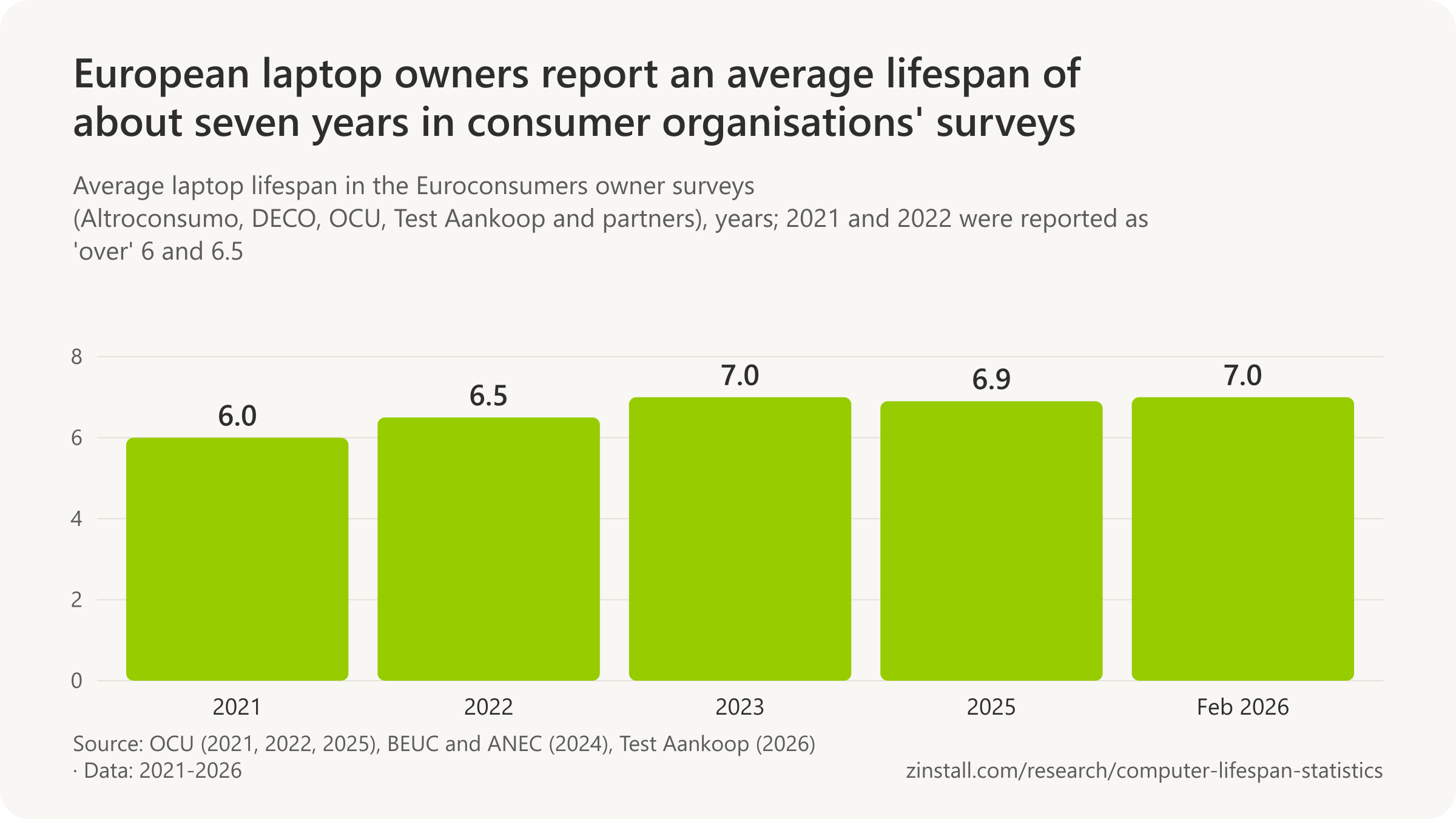
- European laptop owners put a laptop's average lifespan at 7 years, in a 2026 survey of 31,054 consumers.
- Japanese households kept a PC 3.6 years longer before replacing it in 2026 than in 2002: 7.7 years against 4.1.
- Chromebooks get 10 years of automatic updates from their platform's release, under a policy announced in September 2023.
- Intel Macs from 2012 to 2020 got 5.8 years of macOS upgrades on average, four to eight depending on the model (2026).
- US organisations that buy PC refresh services replaced their PCs every 3.9 years on average (2024).
- About 33% of the PCs in use were four years old or older in May 2026, by a PC maker's estimate.
- The world generated 62 billion kg of e-waste in 2022, 7.8 kg per person (2024).
Sources: Cabinet Office of Japan, Economic and Social Research Institute (2026a, 2026b); Test Aankoop / Test Achats, with consumer organisations in seven other countries; Google; Apple; IDC; Dell Technologies; UNITAR and ITU
How long does a laptop last, and when does a computer need replacing? The usual answer, three to five years, has no study behind it. This page collects what has been measured: how long households and owners keep their computers, how long makers keep them updated, what tax rules and businesses assume, how many PCs are sold and still in use, what wears out first and what happens to old computers, each with its measure, its date and its source. Macs and Chromebooks are included alongside Windows PCs.
How long do laptops and computers last?
Japanese households of two or more people kept the PC they replaced for 7.7 years on average to March 2026 (Cabinet Office of Japan, 2026).

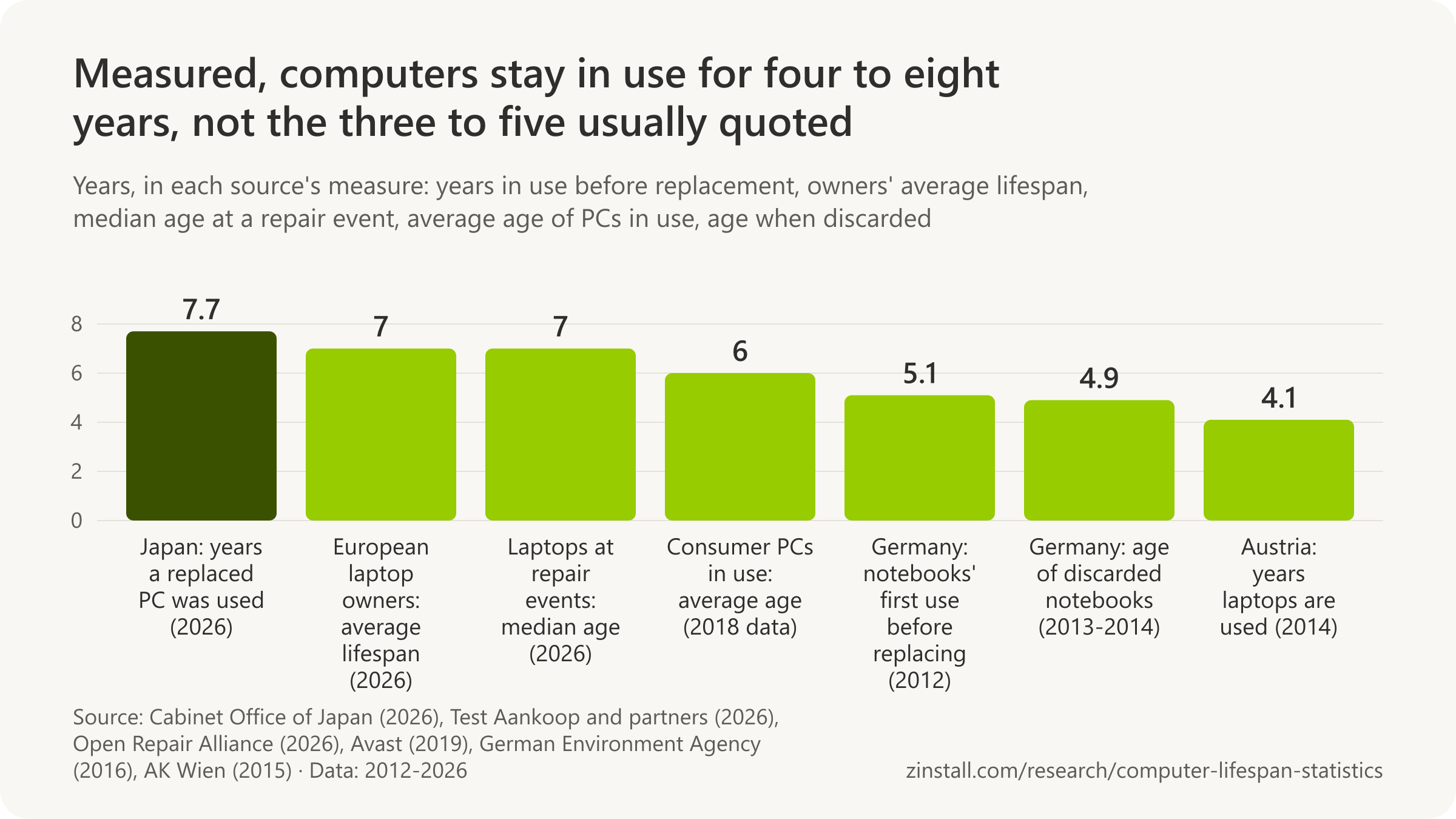
- European laptop owners put a laptop's average lifespan at 7 years, in a 2026 survey of 31,054 consumers (Test Aankoop, 2026).
- 95% or more of the US laptops and desktops bought since 2019 were still in use in early 2025, in a consumer magazine's member survey.
- The average consumer PC in a security vendor's 2018 data was 6 years old, up from five and a half in 2017.
- More than 60% of consumers who replaced a laptop or other mobile PC in 2022 had used it for under five years.
- Austrians said a laptop should work 7.0 years, against the 4.1 years they normally kept one, in a 2014 survey.
| Source, measure and date | Figure |
|---|---|
| Japan, all households: years a replaced PC was used, 2026 | 7.6 years |
| Japan, single-person households: the same, 2026 | 7.3 years |
| European owner survey: laptops' average lifespan, 2025 | 6 years 11 months |
| European owner survey: laptops' average lifespan, 2021 | over 6 years |
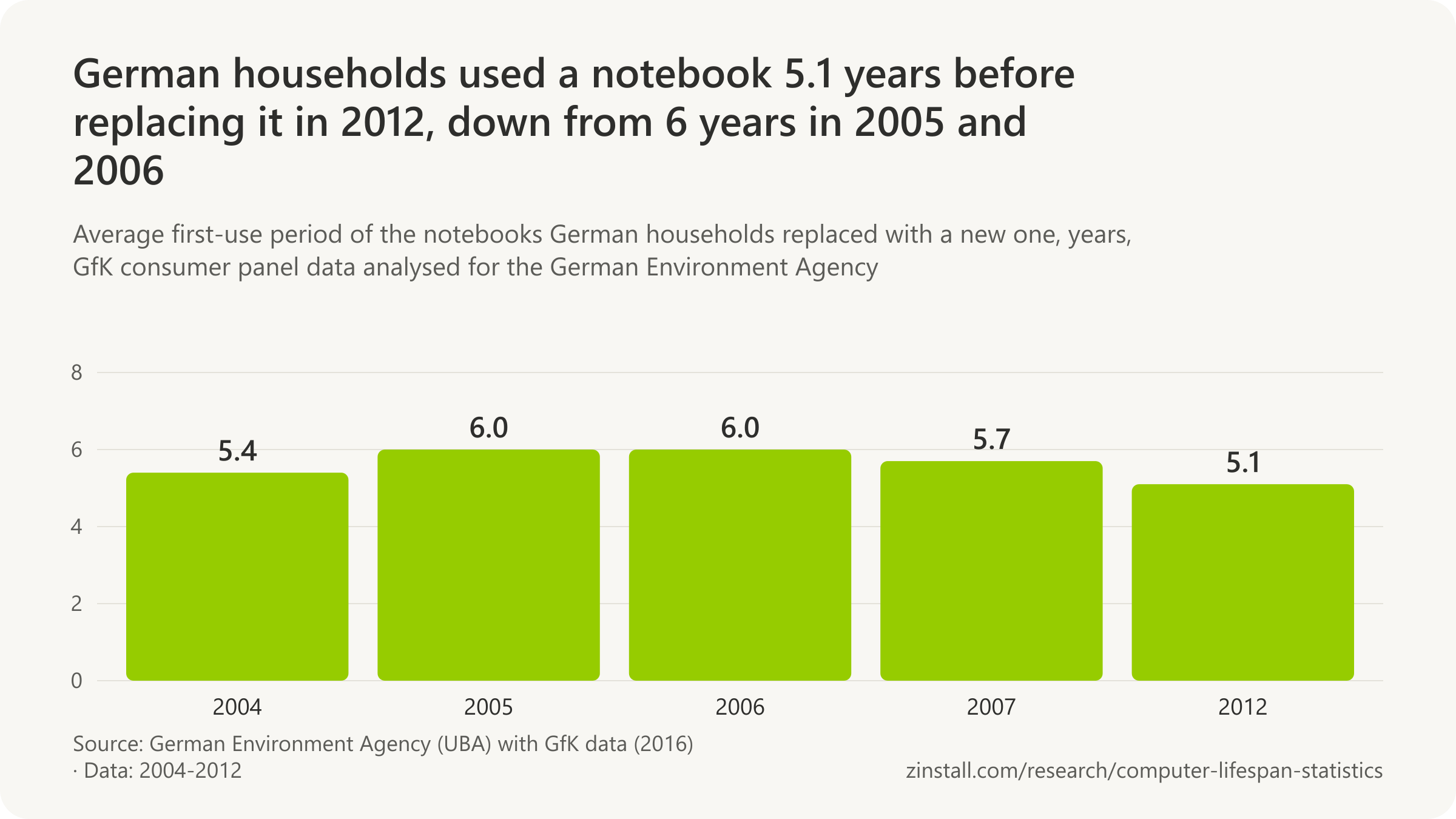
| Germany: notebooks' first use before replacing, 2012 | 5.1 years |
| Germany: age of discarded notebooks, 2013-2014 | 4.9 years |
| Austria: years a laptop is normally used, 2014 | 4.1 years |
| PCs more than eight years old, security vendor's 2017 data | nearly 28% |
| Laptops brought to repair events: median age, data to 2026 | 7 years |
| Apple devices of every kind: derived average lifespan, 2018 | 4 years 3 months |
Sources: Cabinet Office of Japan, Economic and Social Research Institute (2026a, 2026b, 2026c); Test Aankoop / Test Achats, with consumer organisations in seven other countries; Consumer Reports; Avast (2019, 2017); NielsenIQ; Kammer für Arbeiter und Angestellte für Wien; OCU, Euroconsumers group (2025, 2021); Umweltbundesamt; Open Repair Alliance; Asymco
Related guides: Everything to a new Windows 11 PC · Clone or transfer · Old PC to new PC
More statistics (11)
Ask how long a computer lasts and most answers give a range with no measurement behind it. The figures that were measured come from household surveys, consumer organisations' owner surveys, a security vendor's count of the PCs it protects and the laptops people bring to repair events, and in most of them a computer stays in use well past five years. None of them separates a computer that died from one that was replaced while it still worked.
Owner and household surveys

- 95% or more of laptop and desktop computers bought since the start of 2019 and owned for no more than five years were still in use in early 2025, per a Consumer Reports survey of 100,606 members (Consumer Reports, 2025).
- 20% of Consumer Reports members who owned a Microsoft laptop had owned it for at least four years, versus 13% for any other laptop brand, in CR's 2025 member survey (Consumer Reports, 2025).
- 15% of Consumer Reports members who owned a Windows-compatible laptop or desktop brand had owned it for at least four years, against 12% for brands not typically Windows-compatible (Consumer Reports, 2025).
- More than 60% of consumers who replaced a laptop or other mobile PC in 2022 did so after less than five years of use, against about 25 months for smartphones, NielsenIQ (formerly GfK) wrote in October 2023 (NielsenIQ, 2023).
- 7.0 years is how long Austrians said a laptop or notebook should work properly under normal use, against the 4.1 years they normally used one, in a quota-sampled online survey for the Vienna Chamber of Labour (AK Wien, 2015).
The age of PCs in use
- Slightly more than 5 years was the median age of the PCs in Avast's Q3 2017 PC Trends data from 155 million users, the security vendor said (Avast, 2017).
- Nearly 28% of the PCs in Avast's Q3 2017 PC Trends data were more than eight years old, and only 10% had been bought in 2015 or later, the security vendor said of 155 million users (Avast, 2017).
What life-cycle studies assume
- 4 years is the typical notebook lifetime assumed in life-cycle assessment studies, with others assuming 4 to 6 years, and desktop studies assume 4 to 8 years, a review for Germany's Environment Agency found; assumptions, not measurements (Umweltbundesamt, 2016).
- 4.5 years was the expected notebook lifetime the European Environmental Bureau used in its 2019 Coolproducts study, a modelling input taken from a German Environment Agency study, alongside 'typical' lifetimes of 4 to 5 years (EEB, 2019).
Numbers in circulation
- 'Consumers expect laptops to function for 7 years or more, the typical lifetime of a laptop today is a mere 4 to 5 years,' the environmental NGO ECOS wrote in February 2020, citing an Austrian survey that measured a desired 7.0 years and an actual 4.1 years (ECOS, 2020).
- 'Estimated by ADEME at 6 years for a laptop, 4 for a smartphone' is how a January 2023 synthesis for the French government on free software and device durability restated ADEME's life-cycle figure (OW2, 2023).
Sources: Consumer Reports; NielsenIQ; Kammer für Arbeiter und Angestellte für Wien; Avast; Umweltbundesamt; European Environmental Bureau; ECOS; OW2, synthesis; OCU, Euroconsumers group (2021, 2022, 2025); BEUC and ANEC; Test Aankoop / Test Achats, with consumer organisations in seven other countries
How long do people keep their computers?
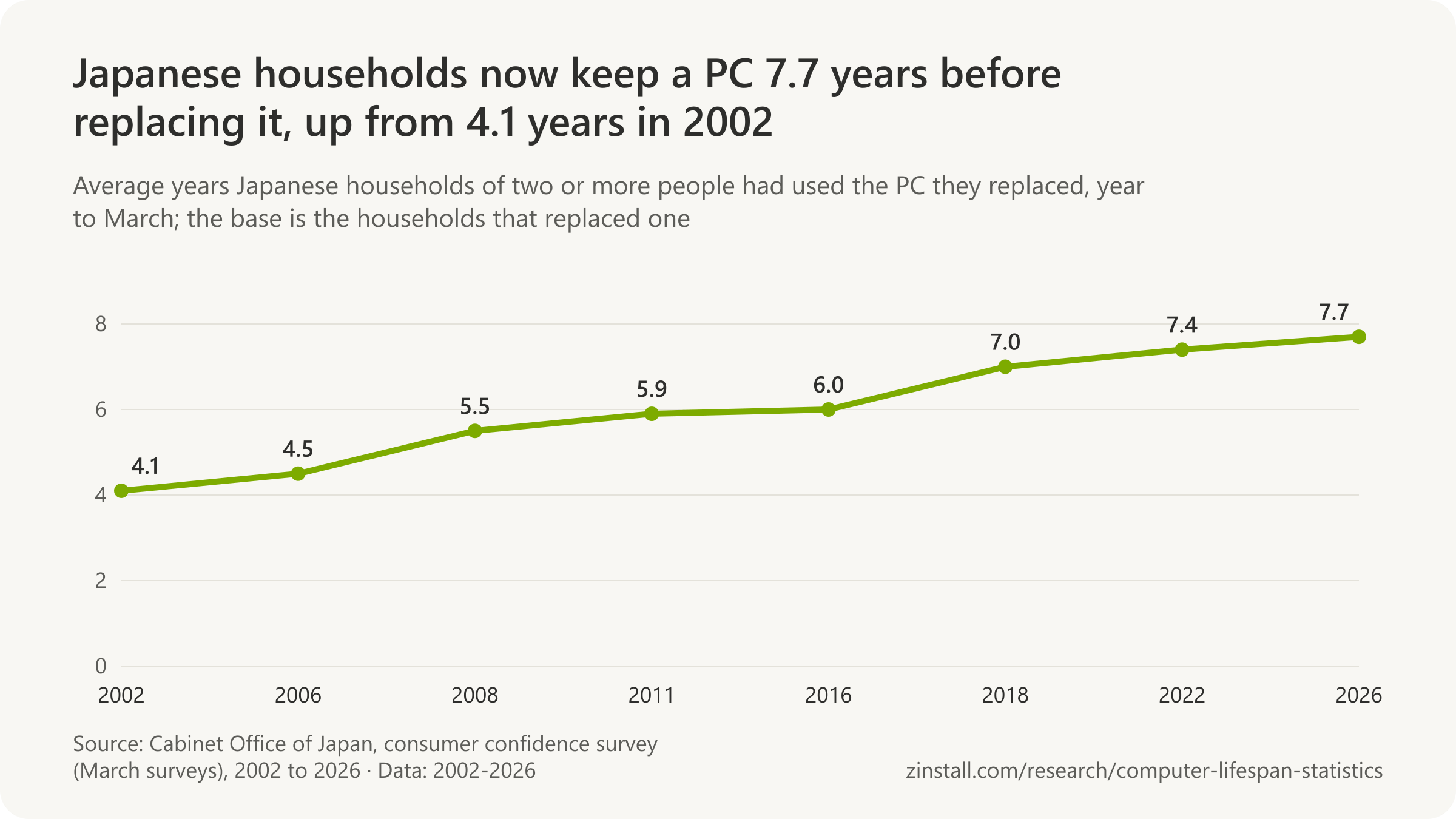
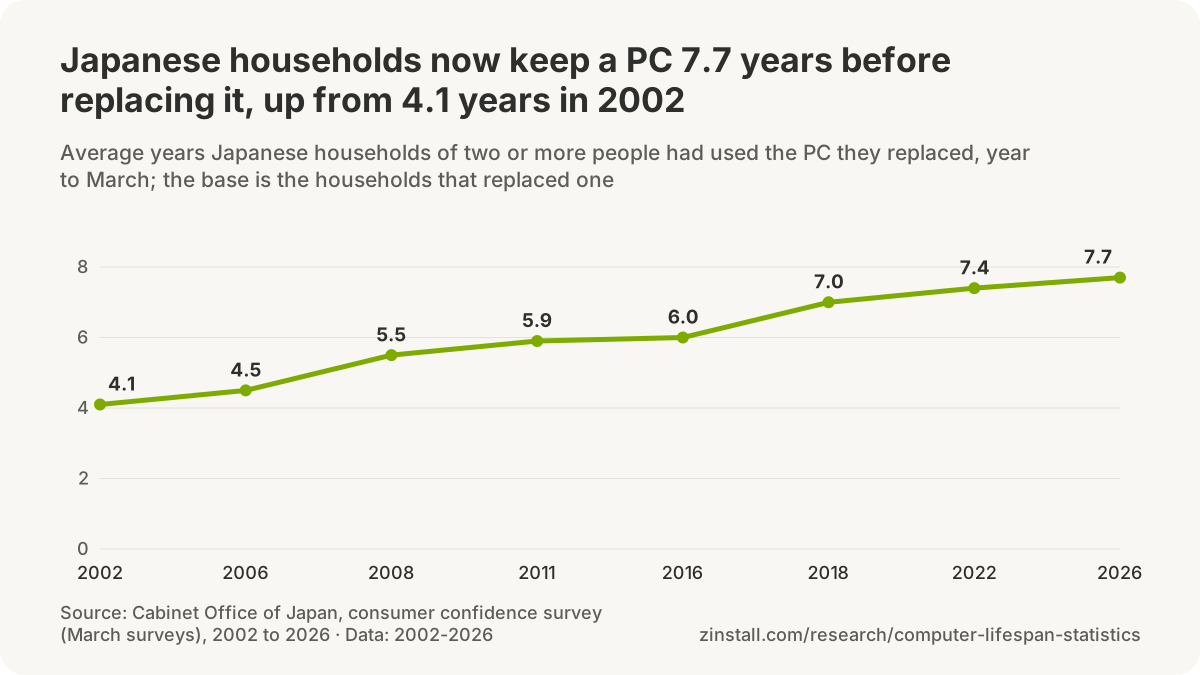
Japanese households kept a PC 3.6 years longer before replacing it in 2026 than in 2002: 7.7 years against 4.1 (Cabinet Office of Japan, 2026).

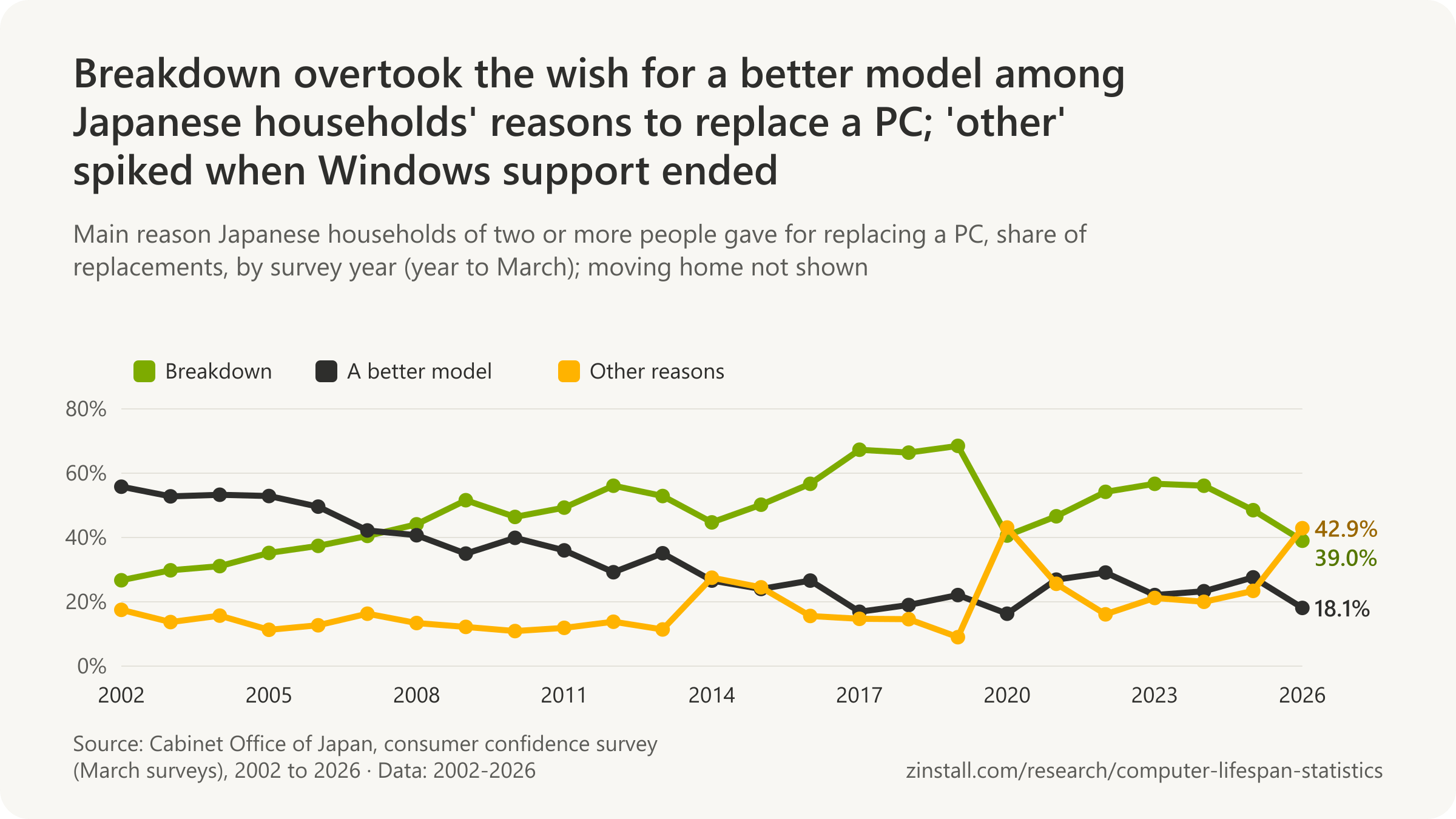
- A breakdown was the main reason for 39.0% of Japanese households' PC replacements in the year to March 2026.
- 'Other reasons' rose to 43.1% of Japanese PC replacements in the year Windows 7 support ended, and to 42.9% when Windows 10's did.
- Over 25% of the notebooks German households replaced in 2012 and 2013 were replaced because they were broken.
- 14.0% of UK adults using Windows 10 said they would replace their computer as its support ended in 2025.
| Source, measure and date | Figure |
|---|---|
| Japan: replaced because it broke, 2019 (the peak) | 68.5% |
| Japan, all households: replaced because it broke, 2026 | 36.9% |
| Japan: years in use at the first quarterly measurement, June 2001 | 4.4 years |
| Japan: years a replaced mobile phone was used, 2026 | 4.6 years |
| Japan: years a replaced TV was used, 2026 | 10.8 years |
| Germany: notebooks' first use before replacing, 2005 | 6 years |
| Germany: years of use of notebooks replaced as faulty, 2012 | 6.2 years |
Sources: Cabinet Office of Japan, Economic and Social Research Institute (2026a, 2026b, 2026c, 2012); Umweltbundesamt; Which?
Related guides: Will I lose programs if I upgrade? · Files from an old computer
More statistics (12)
Japan's Cabinet Office has asked households every year since 2002 how long they used the PC they replaced and why they replaced it, the longest such series anywhere. The years have grown almost every year, and a breakdown has overtaken the wish for a better model among the reasons given. In the years Windows 7 and Windows 10 support ended, far more households gave other reasons. German panel data and UK surveys point the same way.
Japan: years in use before replacing

- 7.3 years was the average time Japanese single-person households had used the personal computer they replaced between April 2025 and March 2026, in the Cabinet Office's consumer confidence survey (Cabinet Office of Japan, 2026).
- 7.6 years was the average time Japanese households of all sizes had used the personal computer they replaced between April 2025 and March 2026, in the Cabinet Office's consumer confidence survey (Cabinet Office of Japan, 2026).
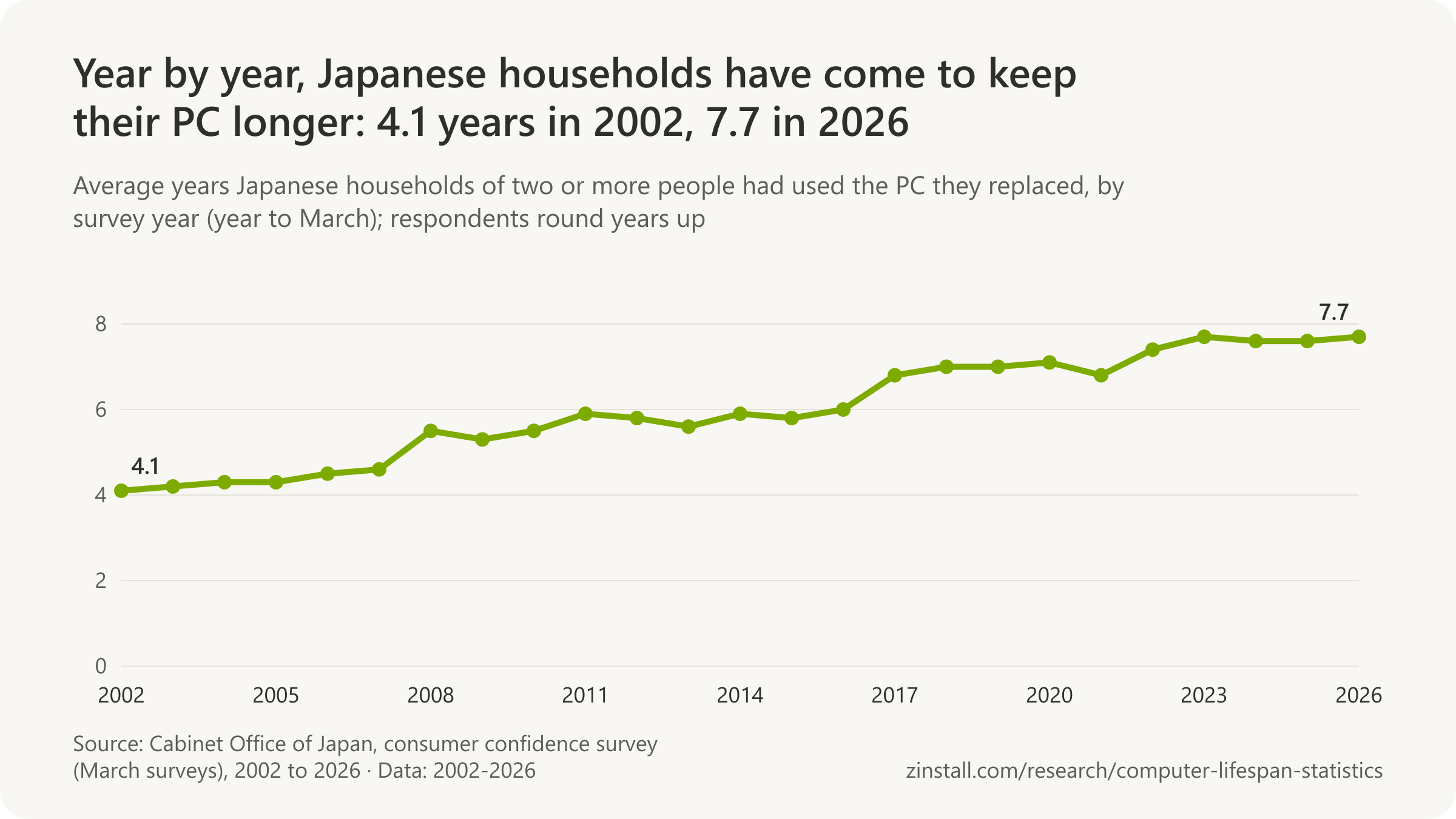
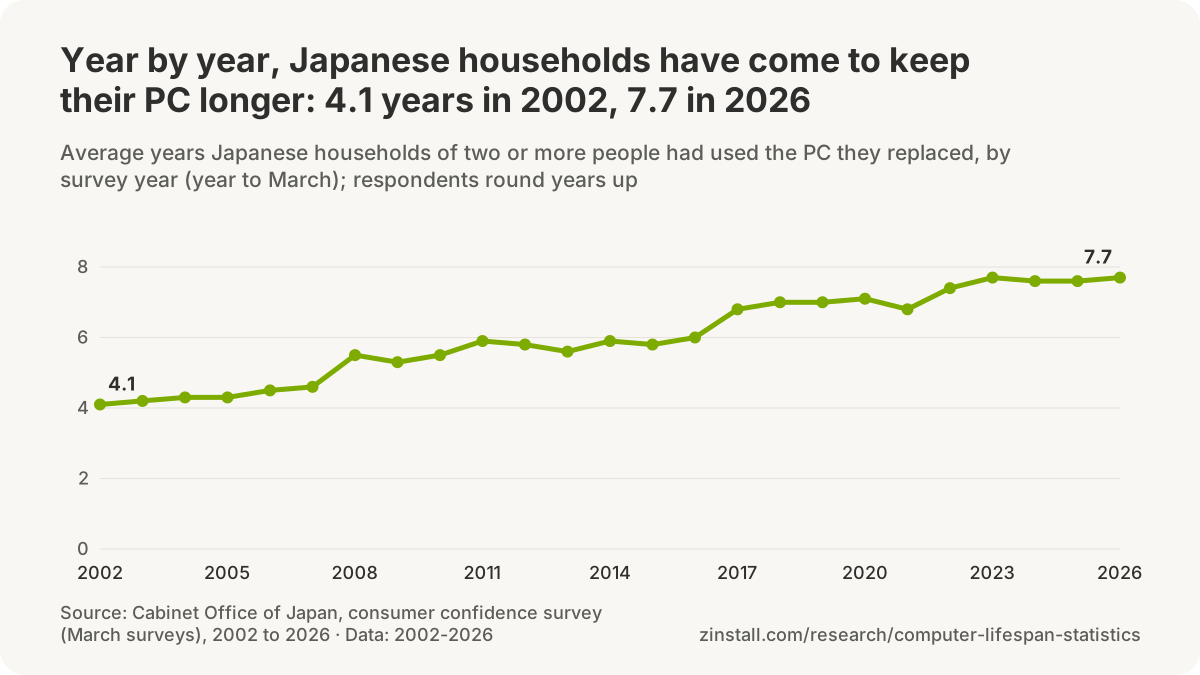
- 3.6 years longer: Japanese households of two or more people had used the PC they replaced for 7.7 years on average in the year to March 2026, against 4.1 years in early 2002, in the Cabinet Office's consumer confidence survey (Cabinet Office of Japan, 2026).
- 43.1% of Japanese PC replacements in the year to March 2020, which included the end of Windows 7 support, and 42.9% in the year to March 2026, which included the end of Windows 10 support, were for reasons other than breakdown, upgrade or moving home, against 9.0% in the year to March 2019 (Cabinet Office of Japan, 2026).
- 18.1% of Japanese households of two or more people that replaced a PC in the year to March 2026 did so to move to a better model, against 55.8% in early 2002, while breakdown rose from 26.7% to 39.0% (Cabinet Office of Japan, 2026).
- 4.4 years was the average time Japanese households had used the personal computer they replaced in the first quarterly measurement, the June 2001 consumer confidence survey, when 66.0% replaced to move to a better model and 24.0% because of breakdown (Cabinet Office of Japan, 2001).
Why households replace a PC

- 36.9% of Japanese households of all sizes that replaced a personal computer between April 2025 and March 2026 gave breakdown as the main reason, 18.9% a better model and 43.8% another reason, in the Cabinet Office's consumer confidence survey (Cabinet Office of Japan, 2026).
- Over 25% of the notebooks German households replaced in 2012/2013 were replaced because they were broken, a clear rise on 2004 and 2007, in GfK data analysed for Germany's Environment Agency (Umweltbundesamt, 2016).
Japan's PCs against phones and TVs
- 4.6 years was the average time Japanese households of two or more people had used the mobile phone they replaced between April 2025 and March 2026, the shortest of the 11 durables surveyed, against 7.7 years for a personal computer (Cabinet Office of Japan, 2026).
- 10.8 years was the average time Japanese households of two or more people had used the television they replaced between April 2025 and March 2026, 3.1 years more than a personal computer (7.7 years), in the Cabinet Office's consumer confidence survey (Cabinet Office of Japan, 2026).
Germany and the UK

- 6.2 years was the average first-use period of notebooks German households replaced in 2012 because they were faulty or unreliable, up from 4.8 years in 2004, in GfK data analysed for Germany's Environment Agency (Umweltbundesamt, 2016).
- 14.0% of UK adults using Windows 10 said they would replace their computer as support ended in October 2025 (Which?, 2025).
Sources: Cabinet Office of Japan, Economic and Social Research Institute (2012, 2026); Umweltbundesamt; Which?
How long do Macs, Chromebooks and Surface laptops get updates?
Chromebooks get 10 years of automatic updates from their platform's release, under a policy announced in September 2023 (Google, 2023).

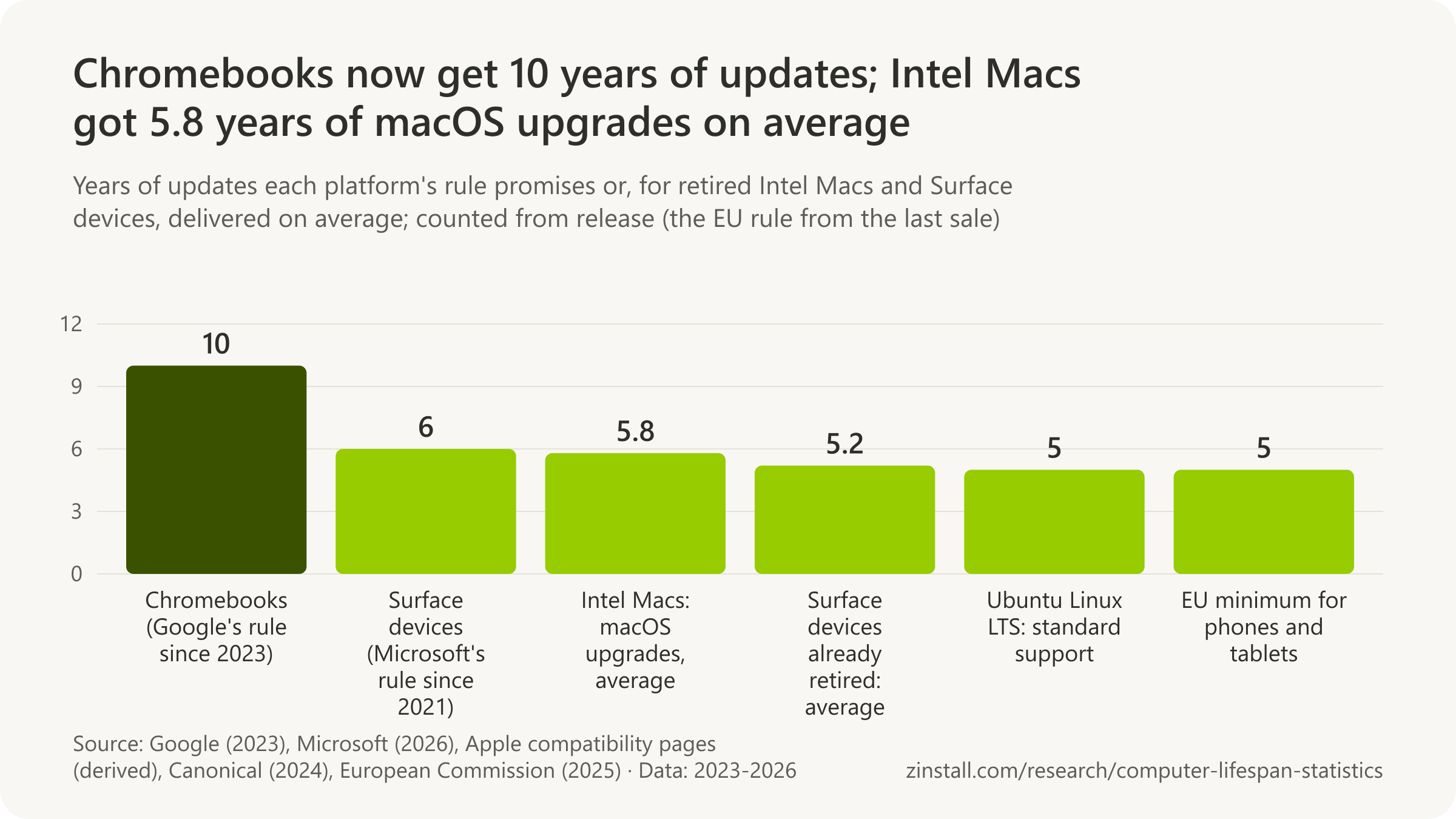
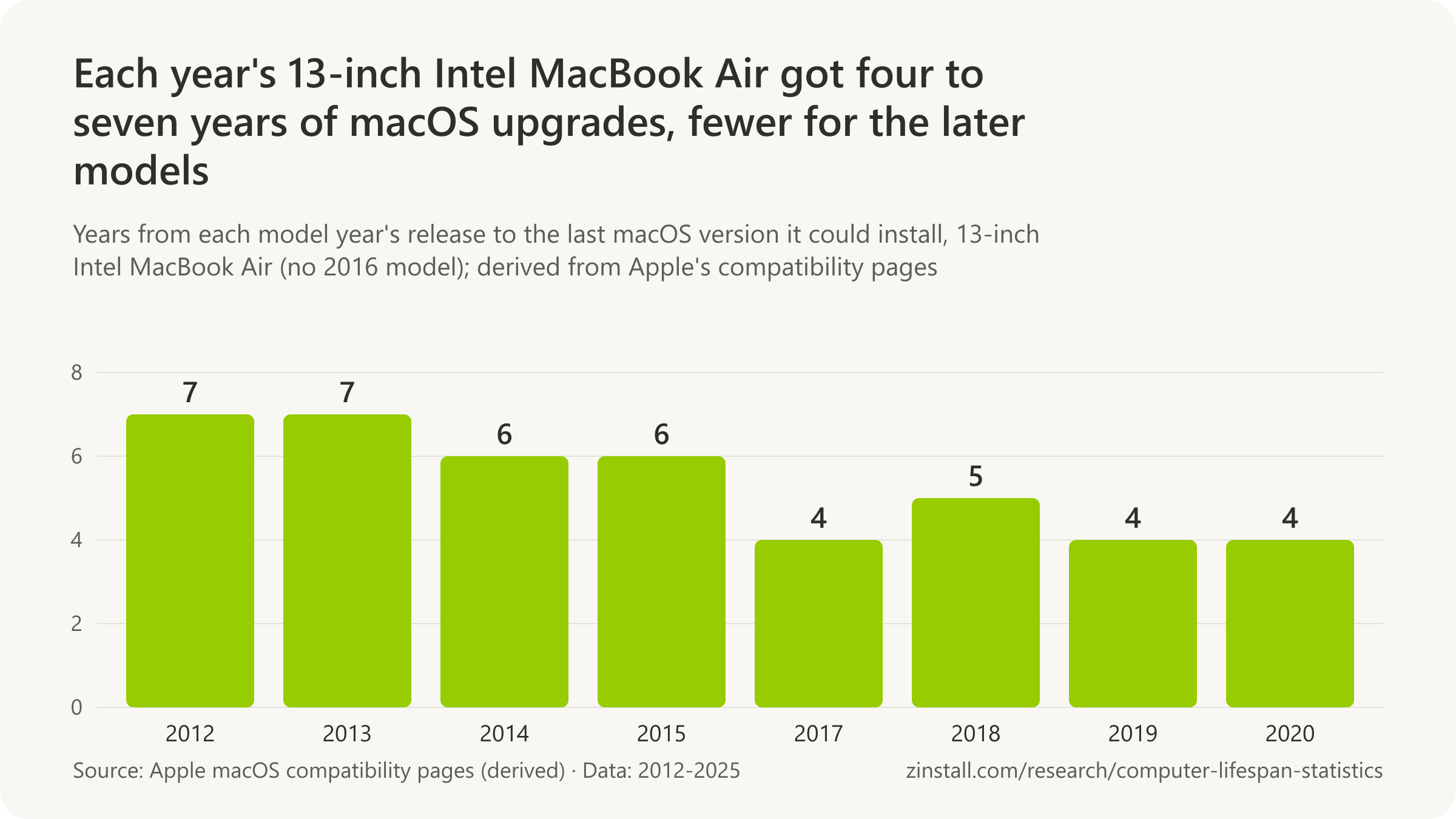
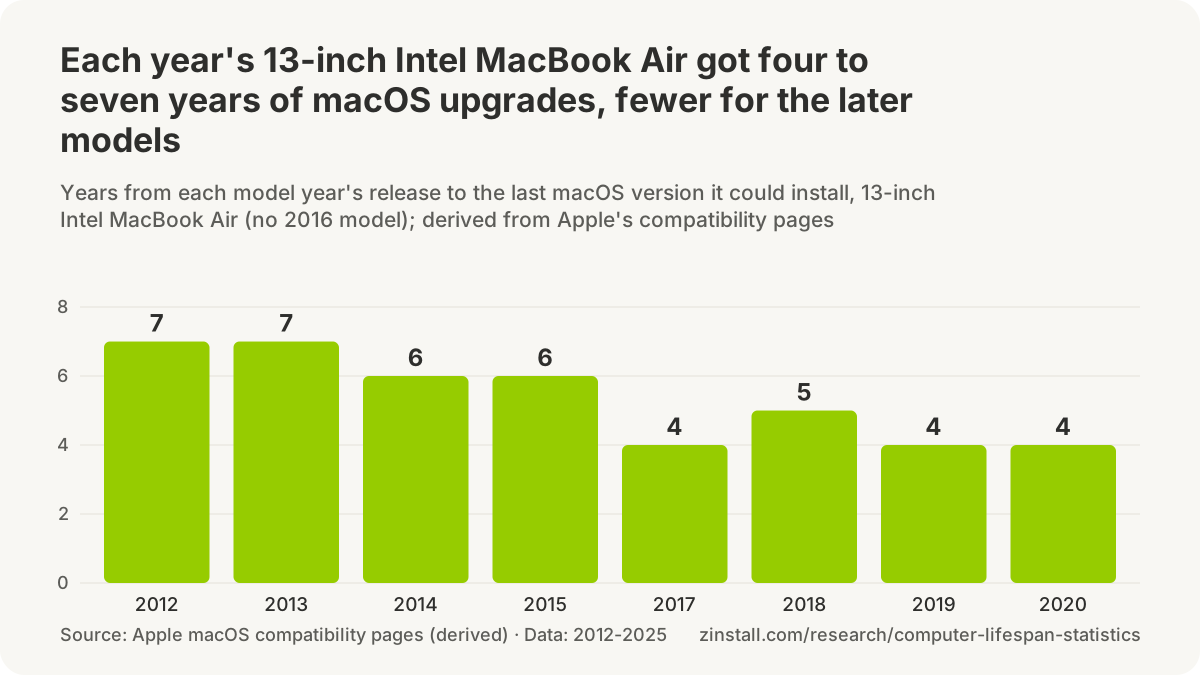
- Intel Macs from 2012 to 2020 got 5.8 years of macOS upgrades on average, four to eight depending on the model (derived from Apple, 2026).
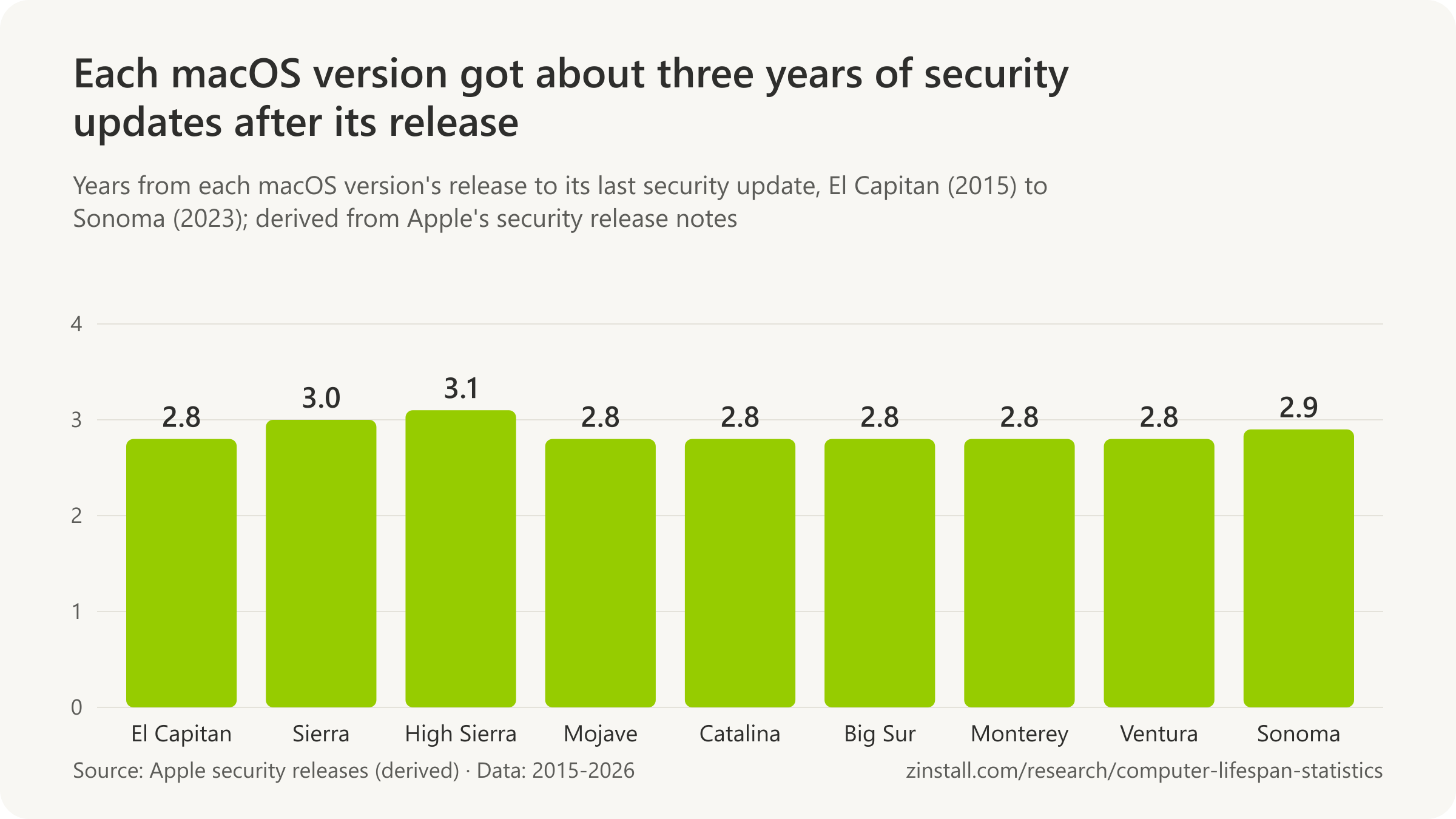
- Each macOS version got about 2.9 years of security updates after its release.
- Surface devices released since 2021 get at least six years of driver and firmware updates.
- The 26 Surface devices whose updates have ended got 5.2 years of them on average.
- A Mac becomes obsolete 7 years after it was last sold, and hardware service for it ends.
| Platform or rule | Period |
|---|---|
| Chromebooks at launch (2011): years of updates | 3 years |
| Chromebook models past their update end date, November 2026 | 128 of 821 |
| Apple: parts and service after the last sale, at least | 5 years |
| Apple: battery-only repairs on Mac laptops, up to | 10 years |
| Apple in France: service and parts for Mac laptops | 7 years |
| MacBook Air (mid 2012): years of security updates | about 10 years |
| MacBook Air (2017): years of security updates | about 7 years |
| Surface devices released before 2021: updates, at least | 4 years |
| France: spare parts for laptops after the last unit, at least | 5 years |
| Ubuntu Linux LTS: standard security maintenance | 5 years |
Sources: Google (2026, 2023, 2020); Apple (2026a, 2026b, 2026c, 2026d); Microsoft; Ministère de la Transition écologique; Canonical; European Commission
Related guides: Programs and files to Windows 11 · Windows Easy Transfer on Windows 11
More statistics (55)
A computer keeps working after its maker stops updating it, but without security updates it becomes risky to use online, so update periods set a practical limit. Google now promises Chromebooks a decade and Microsoft six years for new Surface devices; Apple promises no period for macOS, and its Intel Macs got about six years of upgrades on average, then about three more of security updates. Repair and parts windows are set separately, and only France and the EU have written minimums into law.
Across platforms
Chromebooks

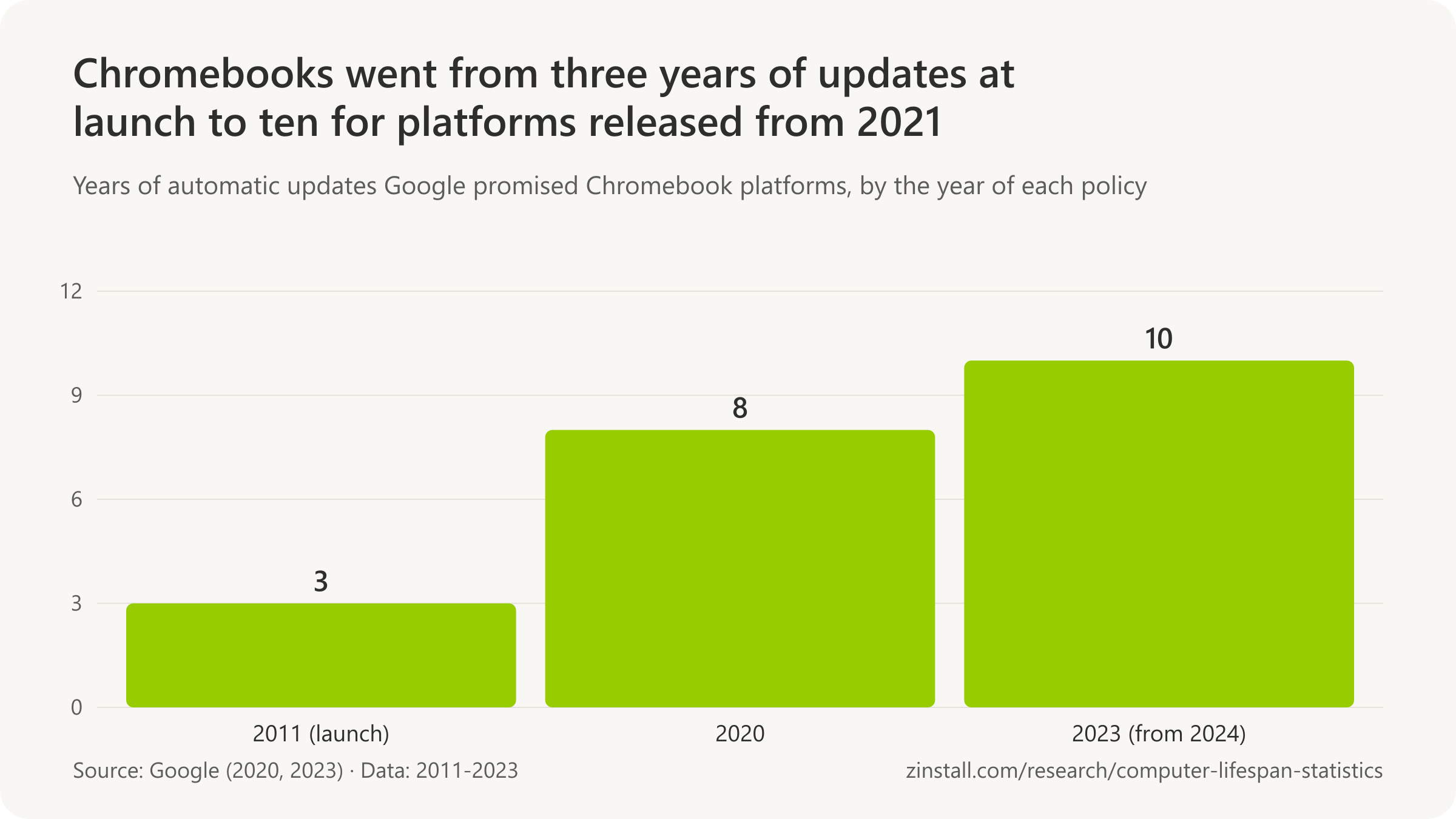
- Chromebooks released before 2021 get ten years of updates only if users or IT admins opt in after the device's last regular automatic update, while those released from 2021 get them automatically, Google said in September 2023 (Google, 2023).
- 128 of the 821 ChromeOS devices on Google's Auto Update list had passed their automatic-update end date by November 2026, the oldest being the Cr-48 test laptop (December 2015) and the latest dates reaching June 2036 (derived from Google, 2026).
- No ChromeOS model on Google's list has an automatic-update end date in 2024 or 2025, against 13 in 2023 and 63 in 2027, the gap left by Google's 2023 ten-year extension of the platforms then due to expire (derived from Google, 2026).
Macs

- 6 years and counting: the MacBook Air (M1, 2020) can still install macOS 27, the version Apple released in September 2026, by Apple's compatibility list (derived from Apple, 2026).
- 7 years of macOS upgrades went to the MacBook Pro (13-inch, Mid 2012), whose last supported version was macOS Catalina 10.15 of 2019, by Apple's compatibility lists (derived from Apple, 2026).
- 7 years of macOS upgrades went to the MacBook Pro (Retina, 13-inch, Late 2013), whose last supported version was macOS Big Sur 11 of 2020, by Apple's compatibility lists (derived from Apple, 2026).
- 6 years of macOS upgrades went to the MacBook Pro (Retina, 13-inch, Mid 2014), whose last supported version was macOS Big Sur 11 of 2020, by Apple's compatibility lists (derived from Apple, 2026).
- 6 years of macOS upgrades went to the MacBook Pro (Retina, 13-inch, Early 2015), whose last supported version was macOS Monterey 12 of 2021, by Apple's compatibility lists (derived from Apple, 2026).
- 5 years of macOS upgrades went to the MacBook Pro (13-inch, 2016, Two Thunderbolt 3 ports), whose last supported version was macOS Monterey 12 of 2021, by Apple's compatibility lists (derived from Apple, 2026).
- 5 years of macOS upgrades went to the MacBook Pro (13-inch, 2017, Two Thunderbolt 3 ports), whose last supported version was macOS Ventura 13 of 2022, by Apple's compatibility lists (derived from Apple, 2026).
- 6 years of macOS upgrades went to the MacBook Pro (13-inch, 2018, Four Thunderbolt 3 ports), whose last supported version was macOS Sequoia 15 of 2024, by Apple's compatibility lists (derived from Apple, 2026).
- 5 years of macOS upgrades went to the MacBook Pro (13-inch, 2019, Two Thunderbolt 3 ports), whose last supported version was macOS Sequoia 15 of 2024, by Apple's compatibility lists (derived from Apple, 2026).
- 4 years of macOS upgrades went to the MacBook Pro (13-inch, 2020, Two Thunderbolt 3 ports), whose last supported version was macOS Sequoia 15 of 2024, by Apple's compatibility lists (derived from Apple, 2026).
- 5 years of macOS upgrades went to the MacBook Pro (13-inch, 2020, Four Thunderbolt 3 ports), whose last supported version was macOS Tahoe 26 of 2025, by Apple's compatibility lists (derived from Apple, 2026).
- 6 years and counting: the MacBook Pro (13-inch, M1, 2020) can still install macOS 27, the version Apple released in September 2026, by Apple's compatibility list (derived from Apple, 2026).
- 6 years of macOS upgrades went to the MacBook Pro (16-inch, 2019), whose last supported version was macOS Tahoe 26 of 2025, by Apple's compatibility lists (derived from Apple, 2026).
- 7 years of macOS upgrades went to the iMac (27-inch, Late 2012), whose last supported version was macOS Catalina 10.15 of 2019, by Apple's compatibility lists (derived from Apple, 2026).
- 6 years of macOS upgrades went to the iMac (21.5-inch, Late 2013), whose last supported version was macOS Catalina 10.15 of 2019, by Apple's compatibility lists (derived from Apple, 2026).
- 6 years of macOS upgrades went to the iMac (Retina 5K, 27-inch, Late 2014), whose last supported version was macOS Big Sur 11 of 2020, by Apple's compatibility lists (derived from Apple, 2026).
- 6 years of macOS upgrades went to the iMac (Retina 5K, 27-inch, Late 2015), whose last supported version was macOS Monterey 12 of 2021, by Apple's compatibility lists (derived from Apple, 2026).
- 5 years of macOS upgrades went to the iMac (Retina 5K, 27-inch, 2017), whose last supported version was macOS Ventura 13 of 2022, by Apple's compatibility lists (derived from Apple, 2026).
- 5 years of macOS upgrades went to the iMac (Retina 5K, 27-inch, 2019), whose last supported version was macOS Sequoia 15 of 2024, by Apple's compatibility lists (derived from Apple, 2026).
- 5 years of macOS upgrades went to the iMac (Retina 5K, 27-inch, 2020), whose last supported version was macOS Tahoe 26 of 2025, by Apple's compatibility lists (derived from Apple, 2026).
- 5 years and counting: the iMac (24-inch, M1, 2021) can still install macOS 27, the version Apple released in September 2026, by Apple's compatibility list (derived from Apple, 2026).
- 7 years of macOS upgrades went to the Mac mini (Late 2012), whose last supported version was macOS Catalina 10.15 of 2019, by Apple's compatibility lists (derived from Apple, 2026).
- 7 years of macOS upgrades went to the Mac mini (Late 2014), whose last supported version was macOS Monterey 12 of 2021, by Apple's compatibility lists (derived from Apple, 2026).
- 6 years of macOS upgrades went to the Mac mini (2018), whose last supported version was macOS Sequoia 15 of 2024, by Apple's compatibility lists (derived from Apple, 2026).
- 6 years and counting: the Mac mini (M1, 2020) can still install macOS 27, the version Apple released in September 2026, by Apple's compatibility list (derived from Apple, 2026).
- macOS Tahoe, released in September 2025, is the final macOS release for Intel Macs, Apple told developers at WWDC in June 2025, completing the move to Apple silicon it began in 2020 (Apple, 2025).
- 3 years of security updates will continue for Intel Macs that run macOS Tahoe, such as the 16-inch MacBook Pro of 2019, an Apple spokesperson told The Verge in June 2025 (The Verge, 2025).
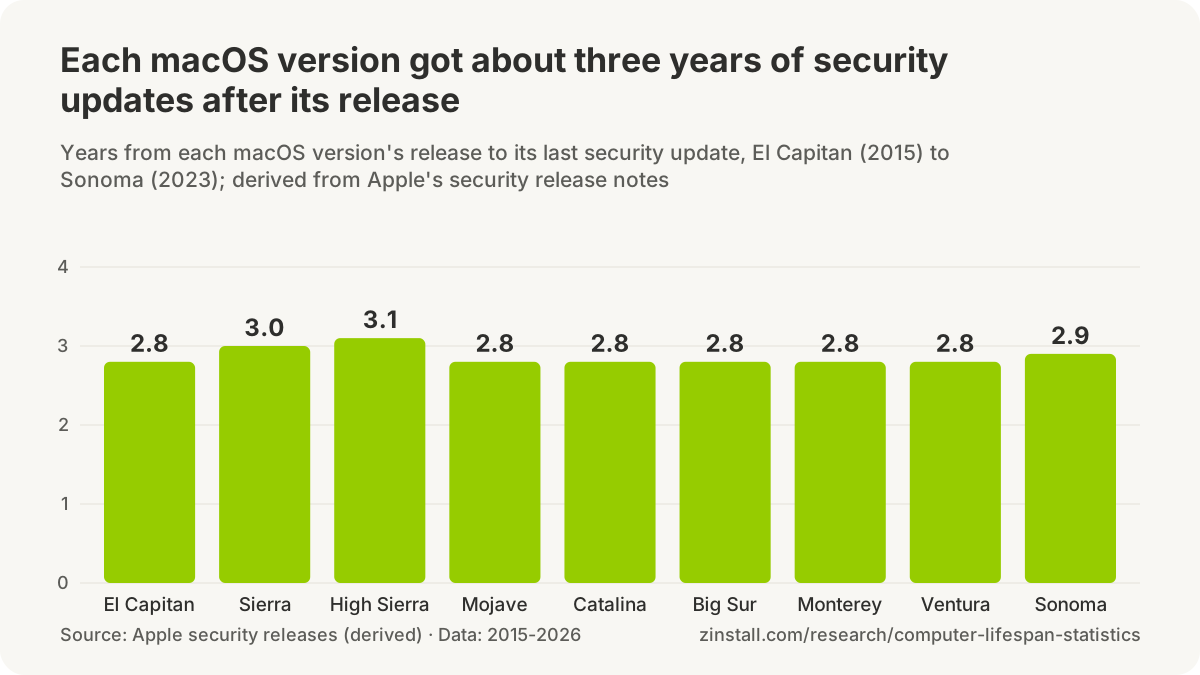
- 2.9 years on average passed between a macOS version's release and its last security update for the nine versions from El Capitan (2015) to Sonoma (2023), with every version between 2.8 and 3.1 years (derived from Apple security releases, 2026).
- About 10 years of security updates went to the mid-2012 13-inch MacBook Air: its last macOS, Catalina, received its final security update on 20 July 2022 (derived from Apple, 2022).
- About 7 years of security updates went to the 13-inch MacBook Air of 2017: its last macOS, Monterey, received its final security update on 29 July 2024 (derived from Apple, 2024).

- 5 years from when Apple last sold a product is the minimum period Apple says owners can get service and parts for a Mac, iPhone or iPad, under its vintage and obsolete products policy (Apple, 2026).
- 7 years after Apple stops selling a product it becomes obsolete and Apple discontinues all hardware service; between 5 and 7 years it is vintage, repaired subject to parts availability (Apple, 2026).
- Up to 10 years after Apple last sold a Mac laptop, the owner may still be able to get a battery-only repair, subject to parts availability, an extension of Apple's seven-year service window (Apple, 2026).
- 7 years of service and parts from when Apple last supplied the model in France is what owners of a Mac laptop or iPhone bought in France after 31 December 2020 can obtain, a longer floor than Apple's worldwide five (Apple, 2026).
- California and Turkey were the only places where Apple still serviced vintage Macs in 2016, California 'as required by statute', while elsewhere vintage products counted as obsolete (Apple, 2016).
- Not all known security issues are fixed in older versions of macOS, Apple's deployment guide says, because of architecture dependencies and system changes in the current version (Apple, 2026).
- Three macOS versions received the security update Apple released on 9 November 2026: macOS 27.2.1, macOS Tahoe 26.7.3 and macOS Sequoia 15.8.3, the current version and the two before it (Apple, 2026).
- Only Macs with Apple silicon can upgrade to macOS 27, released in September 2026, Apple's compatibility page says, so Intel Macs stop at macOS Tahoe 26 (Apple, 2026).
Surface

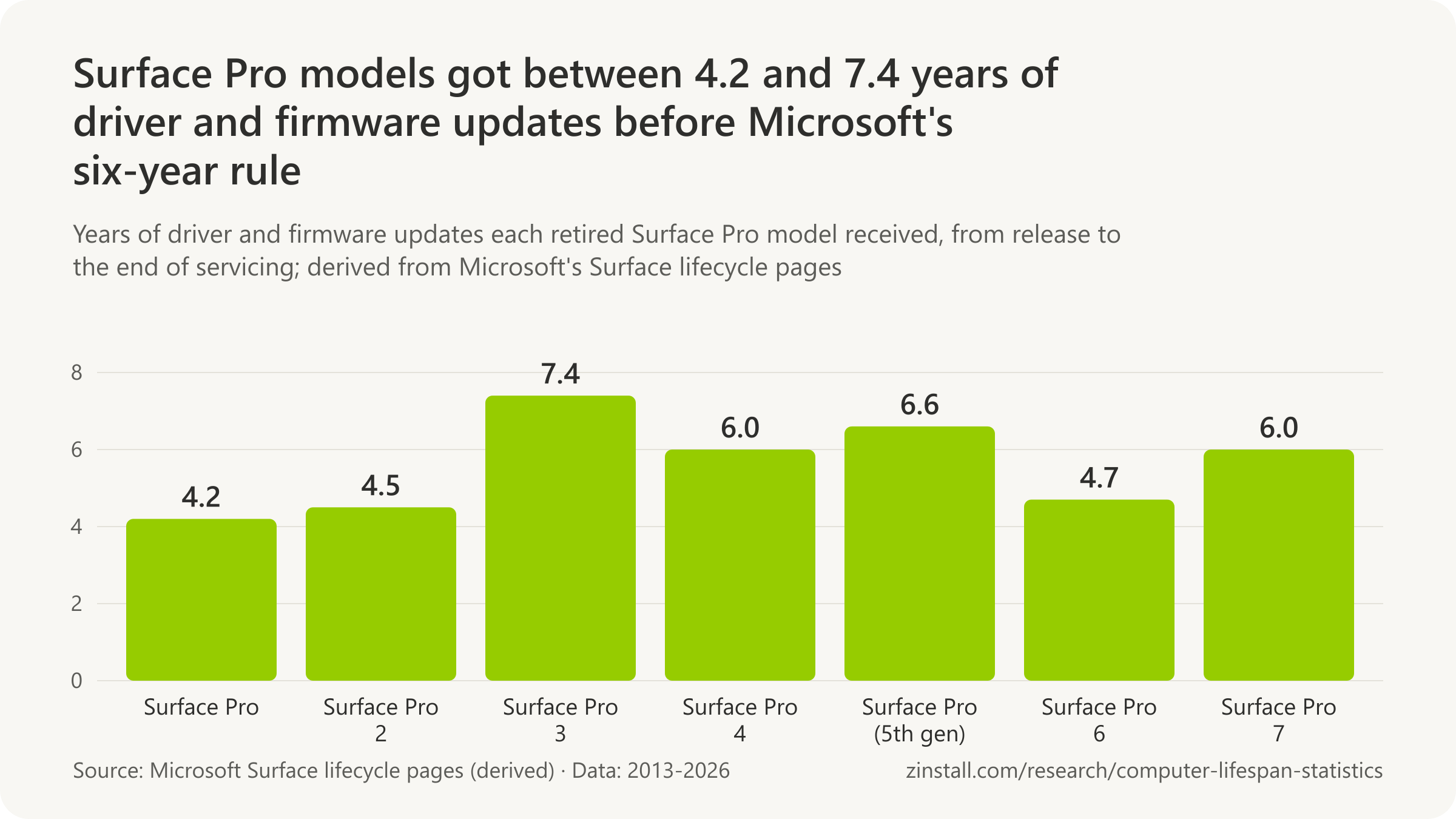
- At least four years of driver and firmware updates from first release was Microsoft's rule for Surface devices released before 1 January 2021 (Microsoft, 2026).
- Windows versions released in the prior 30 months are the only ones Surface devices get driver and firmware updates for during their servicing period, Microsoft's Surface lifecycle rule says (Microsoft, 2026).
- 4.0 years of driver and firmware updates is what Microsoft gave the Surface Go, from its release on 2 August 2018 to the end of servicing on 2 August 2022 (Microsoft, 2026).
- 4.4 years of driver and firmware updates is what Microsoft gave the Surface Laptop (1st gen), from its release on 14 June 2017 to the end of servicing on 13 November 2021 (Microsoft, 2026).
- 4.8 years of driver and firmware updates is what Microsoft gave the Surface Laptop 3, from its release on 22 October 2019 to the end of servicing on 30 July 2024 (Microsoft, 2026).
- 4.5 years of driver and firmware updates is what Microsoft gave the Surface RT, from its release on 26 October 2012 to the end of servicing on 11 April 2017 (Microsoft, 2026).
- 15 January 2027 is the end of driver and firmware updates for the Surface Pro 7+, the first Surface released under the six-year rule, on 15 January 2021 (Microsoft, 2026).
- 16 October 2032 is the end of driver and firmware updates for the Surface Laptop Ultra, released on 16 October 2026, the latest end date in Microsoft's Surface lifecycle table (Microsoft, 2026).
Linux
Spare parts, repairs and the law
- 7 years after a model is no longer sold in the EU is how long makers must keep supplying key spare parts for smartphones and tablets placed on the EU market from 20 June 2025, a rule that does not yet cover laptops (European Commission, 2025).
- 10 years of spare parts and operating system updates after the last unit is placed on the market is what consumer groups BEUC and ANEC asked the EU to require for computers in October 2024, longer than in the Commission's draft (BEUC and ANEC, 2024).
- 5 years after the last unit of a model is placed on the market is the minimum period French law requires spare parts for laptops and smartphones to stay available, under the anti-waste law (AGEC) and its decree of 31 December 2021 (French Ministry of Ecological Transition, 2026).
- 15 years of availability of original spare parts was what France's Citizens' Convention on Climate proposed, against the five-year minimum the law adopted for laptops (French Ministry of Ecological Transition, 2026).
- Less than five years old from the original invoice was Dell's limit for paid out-of-warranty hardware repair of its desktops, laptops and tablets in its 2014 service terms, with some younger models excluded when parts ran out (Dell, 2014).
- 2 years from delivery is the minimum legal guarantee on goods bought from a seller in the EU, computers included, and some countries give longer; a shop's or maker's commercial warranty comes on top of it and cannot reduce it (European Commission, 2026).
Sources: Google (2020, 2023, 2026); Apple (2016-2026); The Verge; Microsoft; European Commission (2025, 2026); BEUC and ANEC; Ministère de la Transition écologique; Dell
How long is Windows supported, and which PCs can't run Windows 11?
The oldest Intel processors Windows 11 accepts were 8.1 years old when Windows 10's support ended in October 2025 (derived from Microsoft, 2025).

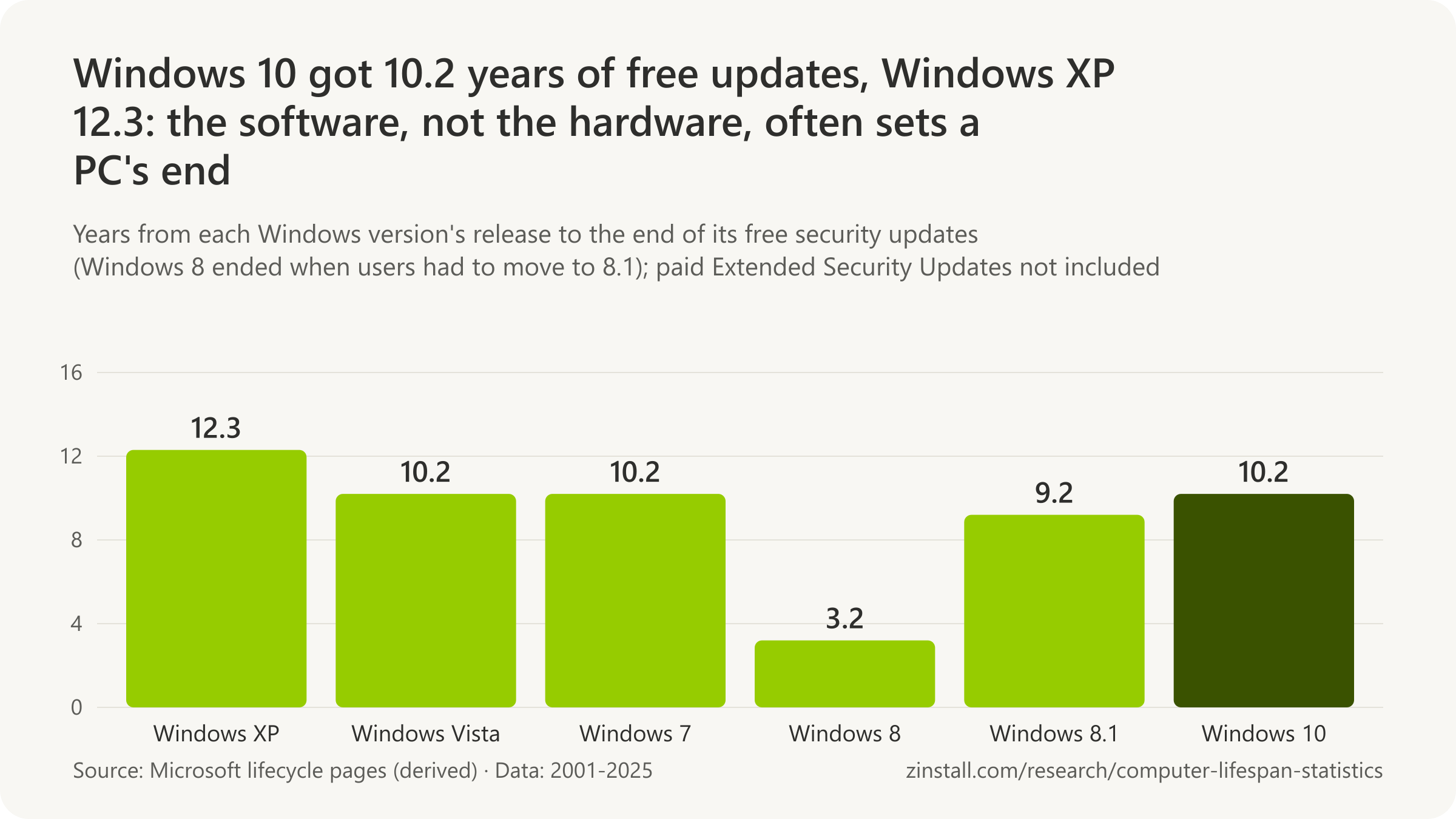
- Windows 10 got about 10.2 years of free security updates, from July 2015 to October 2025.
- Paying for every year of extended security updates stretches a Windows 10 PC's updates to 13.2 years.
- Windows XP had the longest free support of any Windows version: 12.3 years.
- Graphics cards of the GeForce GTX 10 series got 9 years of game-ready drivers before security-only updates.
- 17.5% of Steam users' graphics cards in October 2026 came from families launched in 2019 or earlier.
| Software or hardware | Period or date |
|---|---|
| Oldest Intel generation Windows 11 supports: launched | 21 August 2017 |
| Oldest AMD desktop generation Windows 11 supports: on sale | 19 April 2018 |
| Windows 11: minimum hardware | TPM 2.0, 4 GB, 64 GB |
| Windows 10 extended updates for home users: price | $30 |
| Windows 10 extended updates for businesses, year 1: price per device | $61 |
| Windows 7: years of free updates | 10.2 years |
| Windows 8: years before users had to move to 8.1 | 3.2 years |
| Chrome on Windows 7 and 8.1: last version | Chrome 109 |
| Nvidia Maxwell graphics (GTX 750 to 900): years of game-ready drivers | 11 years |
| Nvidia Kepler laptop graphics: game-ready drivers ended | April 2019 |
Sources: Microsoft (2014-2026); Nvidia (2025, 2021); Valve; Intel; AMD; Google
Related guides: Windows 10 to Windows 11 · An XP or Vista PC to Windows 11
More statistics (47)
Many PCs are retired by software rather than wear. Most Windows versions have had about a decade of free security updates, and Windows 11 refuses processors made before 2017 and 2018, so working PCs lost their upgrade path when Windows 10's support ended. Browsers, graphics drivers and alternatives such as ChromeOS Flex follow their own timetables, and gamers keep graphics cards long after their makers stop optimising for them.
Windows versions
- Windows 10 was released on 29 July 2015, the start date Microsoft's lifecycle listing gives for Windows 10 Home and Pro (Microsoft, 2015).
- Windows 10 Home and Pro (version 22H2, the final version) reached end of support on 14 October 2025, after which no further security updates are issued without ESU (Microsoft, 2025).
- Windows 11 Home and Pro has a lifecycle start date of 4 October 2021 (version 21H2); the public release was announced for 5 October 2021 (Microsoft, 2021).
- Windows 7, released on 22 October 2009, reached the end of extended support on 14 January 2020, after mainstream support ended on 13 January 2015 (Microsoft, 2023).
- Windows 7 Extended Security Updates ran for three paid years after end of support, from 14 January 2020 to 10 January 2023 (Microsoft, 2023).
- Windows 8, released on 30 October 2012, lost support on 12 January 2016, when customers had to move to Windows 8.1 to stay supported (Microsoft, 2016).
- Windows 8.1, released on 13 November 2013, reached the end of extended support on 10 January 2023 with no ESU offered (Microsoft, 2023).
- Windows XP reached the end of extended support on 8 April 2014, after mainstream support ended on 14 April 2009; its lifecycle start date is 31 December 2001 (Microsoft, 2014).
- Windows Vista, released on 25 January 2007, reached the end of extended support on 11 April 2017, after mainstream support ended on 10 April 2012 (Microsoft, 2017).
- Windows 10 ESU runs for a maximum of three years after the 14 October 2025 end of support: Year 1 to 13 October 2026, Year 2 to 12 October 2027 and Year 3 to 10 October 2028 (Microsoft, 2025).
- Windows 10 IoT Enterprise LTSC 2021 reaches the end of extended support on 13 January 2032, the latest date in the Windows 10 family (Microsoft, 2026).
- Windows 11 version 25H2 for Home and Pro editions was released on 30 September 2025 and reaches end of servicing on 12 October 2027, a 24-month servicing window (Microsoft, 2026).
- 13.2 years of security updates were available for Windows 7 to businesses that paid for all three years of Extended Security Updates, from its release on 22 October 2009 to 10 January 2023 (Microsoft lifecycle dates, 2023).
- 13.2 years of security updates are possible for a Windows 10 PC whose owner pays for all three years of commercial Extended Security Updates, from the 29 July 2015 release to 10 October 2028 (Microsoft lifecycle dates, 2025).
- 12.2 years of security updates are possible for a home Windows 10 PC enrolled in consumer Extended Security Updates, from the 29 July 2015 release to the 12 October 2027 end of the consumer program (Microsoft, 2026).
- A minimum of five years of mainstream support, plus extended support for some products, is what Microsoft's Fixed Lifecycle Policy promises at launch, the rule that governed Windows XP to Windows 8.1 (Microsoft, 2023).
- Microsoft Edge version 109, released in January 2023, was the last version of Microsoft's browser to support Windows 7 and Windows 8.1, with Windows 10 or later required from version 110 in February 2023 (Microsoft, 2023).
- Windows 11 version 26H2, released in September 2026, is the last version Microsoft will support on devices with Snapdragon 850 processors (Microsoft, 2026).
- Windows 11 version 24H2 was the last supported version of Windows 11 SE, the edition for low-cost school laptops, Microsoft's lifecycle page says (Microsoft, 2026).
- The paid consumer ESU option is a one-time purchase of $30 USD (or local currency equivalent) plus applicable tax per licence, covering up to 10 devices (Microsoft, 2026).
- Consumer ESU coverage for Windows 10 now runs through 12 October 2027, and already-enrolled devices continue automatically; enrolment stays open until the program ends on 12 October 2027 (Microsoft, 2026).
- Commercial Windows 10 ESU costs $61 USD per device for Year 1 with the traditional 5-by-5 activation key, the same as the Windows 7 ESU Year 1 price (Microsoft, 2024).
- Applying Microsoft's doubling rule to the $61 USD Year 1 price gives $122 USD per device for Year 2 (14 October 2026 to 12 October 2027) and $244 USD for Year 3, $427 USD over three years (derived from Microsoft, 2024).
- Education customers, including K-12 and higher education, pay $1 per licence for Year 1 of Windows 10 ESU, $2 for Year 2 and $4 for Year 3 (Microsoft, 2024).
Windows 11's hardware floor
- Intel 8th-generation, AMD Zen 2 and Qualcomm 7 and 8 series processors were named by Microsoft on 28 June 2021 as the CPU floor meeting Windows 11's security and reliability principles (Microsoft, 2021).
- Intel Core X-series, Xeon W-series and the Core i7-7820HQ (select devices) were the only 7th-generation additions to Windows 11's supported CPU list after Microsoft's testing, with AMD Zen 1 excluded (Microsoft, 2021).
- Windows 11's supported Intel processor list 'represent[s] the processor models which meet the minimum floor for the supported processor generations', starting at Celeron and Pentium parts of the 8th-generation era, per Microsoft Learn (updated 30 October 2025) (Microsoft, 2025).
- TPM 2.0, UEFI Secure Boot-capable firmware, 4 GB of memory, 64 GB of storage and a 1 GHz two-core compatible 64-bit processor are Windows 11's minimum hardware requirements, unchanged on Microsoft Learn as of July 2026 (Microsoft, 2026).
- Installing Windows 11 on hardware below the minimum requirements 'isn't recommended' and such devices 'aren't guaranteed to receive updates, including but not limited to security updates', Microsoft's support article states (Microsoft, 2024).
- 21 August 2017 is when Intel launched the first 8th Gen Core processors, the oldest Intel generation on Windows 11's supported list, with the first devices due from September 2017 and the first desktop chips that autumn (Intel, 2017).
- 19 April 2018 is when AMD made its 2nd Generation Ryzen desktop processors (the 'Zen+' Ryzen 7 2700X, 2700 and Ryzen 5 2600X, 2600) available worldwide, the oldest AMD desktop chips on Windows 11's supported list (AMD, 2018).
- Ryzen 5 2600 and Ryzen 7 2700X, AMD's 2018 'Zen+' desktop chips, are on Microsoft's Windows 11 supported AMD processor list, although Microsoft's June 2021 announcement named AMD Zen 2 as the floor (Microsoft, 2023).
- 8.1 years separated the launch of Intel's 8th Gen Core processors, the oldest Intel generation Windows 11 supports, from Windows 10's end of support on 14 October 2025, the line below which Intel PCs got no free upgrade to Windows 11 (derived from Intel and Microsoft, 2025).
Browsers and ChromeOS Flex
- Hundreds of millions of Windows 10 devices were set to lose support because they were ineligible for Windows 11, Google said in February 2024 when it positioned ChromeOS Flex as a way to keep those PCs in use (Google, 2024).
- A ChromeOS Flex USB install kit sold through Back Market for about $3 or 3 euros was Google's April 2026 offer to owners of Windows 10 PCs left unsupported in October 2025 (Google, 2026).
- 683 of the 732 PC and Mac models on Google's ChromeOS Flex list were certified in September 2026, with 47 decertified after their end of support in 2025, each model carrying an end-of-support year from 2025 to 2033 (Google, 2026).
- Intel or AMD processors from 2012 and earlier are 'not recommended or supported' for ChromeOS Flex, which needs a 64-bit x86 PC with 4 GB of memory and 16 GB of storage, Google's requirements say (Google, 2026).
- Chrome 109, released on 10 January 2023, was the last version of Google's browser for Windows 7 and Windows 8.1, while Chrome still had no end date set for Windows 10 in November 2026 (Google, 2026).
- macOS 13 Ventura or later is required to run Chrome on a Mac in November 2026, so Macs whose last macOS is Monterey or older, such as the 2015 MacBook Air and 2016 13-inch MacBook Pro, cannot run current Chrome (Google, 2026).
Graphics drivers

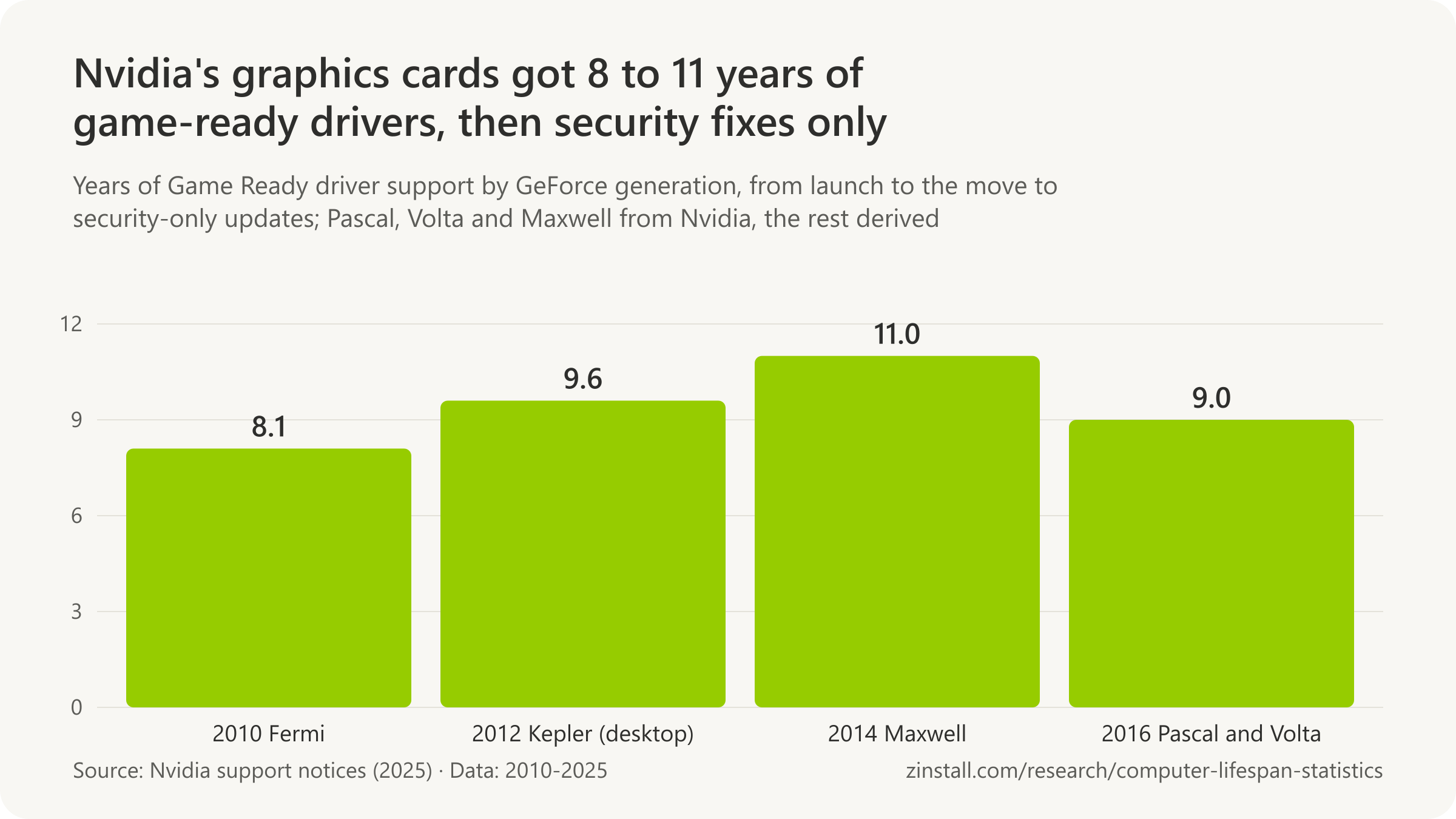
- April 2019 ended Game Ready driver upgrades for laptops with Nvidia Kepler graphics, seven years after Kepler's 2012 launch and two and a half years before the desktop Kepler cards, with security updates to April 2020 (Nvidia, 2021).
- March 2012 is when Nvidia launched its first Kepler graphics processors, the GeForce GTX 680 for desktops and GeForce 600M chips for laptops, succeeding the Fermi architecture first introduced in March 2010 (Nvidia, 2012).
- Radeon HD 7000 to R9 Fury graphics (AMD's first three Graphics Core Next generations, sold from 2012) were moved to a legacy support model with AMD's 21.6.1 driver of June 2021, about 9.5 years after the Radeon HD 7970 launched (AMD, 2021).
- 22 December 2011 is when AMD launched the Radeon HD 7970, the first card on its Graphics Core Next architecture, on sale from 9 January 2012 (AMD, 2011).
- 27 July 2022 is when Intel moved the built-in graphics of its 6th to 10th Gen processors to legacy support, after which they get only critical fixes and security updates, released quarterly or as needed (Intel, 2022).
- 1 September 2015 is when Intel introduced its 6th Generation Core processors (Skylake), the oldest generation whose built-in graphics moved to legacy driver support in July 2022 (Intel, 2015).
Gaming PCs
- 17.5% of the graphics cards on Steam users' PCs in October 2026 came from Nvidia and AMD families launched in 2019 or earlier (GTX 900, 10 and 16, RTX 20, RX 400, 500 and 5000), a proxy for how long gamers keep hardware (Valve, 2026).
- 2.44% of Steam users' PCs ran Nvidia's GeForce GTX 1650, a 2019 graphics card, in October 2026, the ninth most common card in Valve's survey and the most common one from before 2020 (Valve, 2026).
Sources: Microsoft (2014-2026); Intel (2015, 2017, 2022); AMD (2011, 2018, 2021); Google (2024, 2026); Nvidia (2012, 2021, 2025); Valve
What is the useful life of a computer for depreciation?
US tax rules treat computers as 5-year property for depreciation (IRS, 2025).

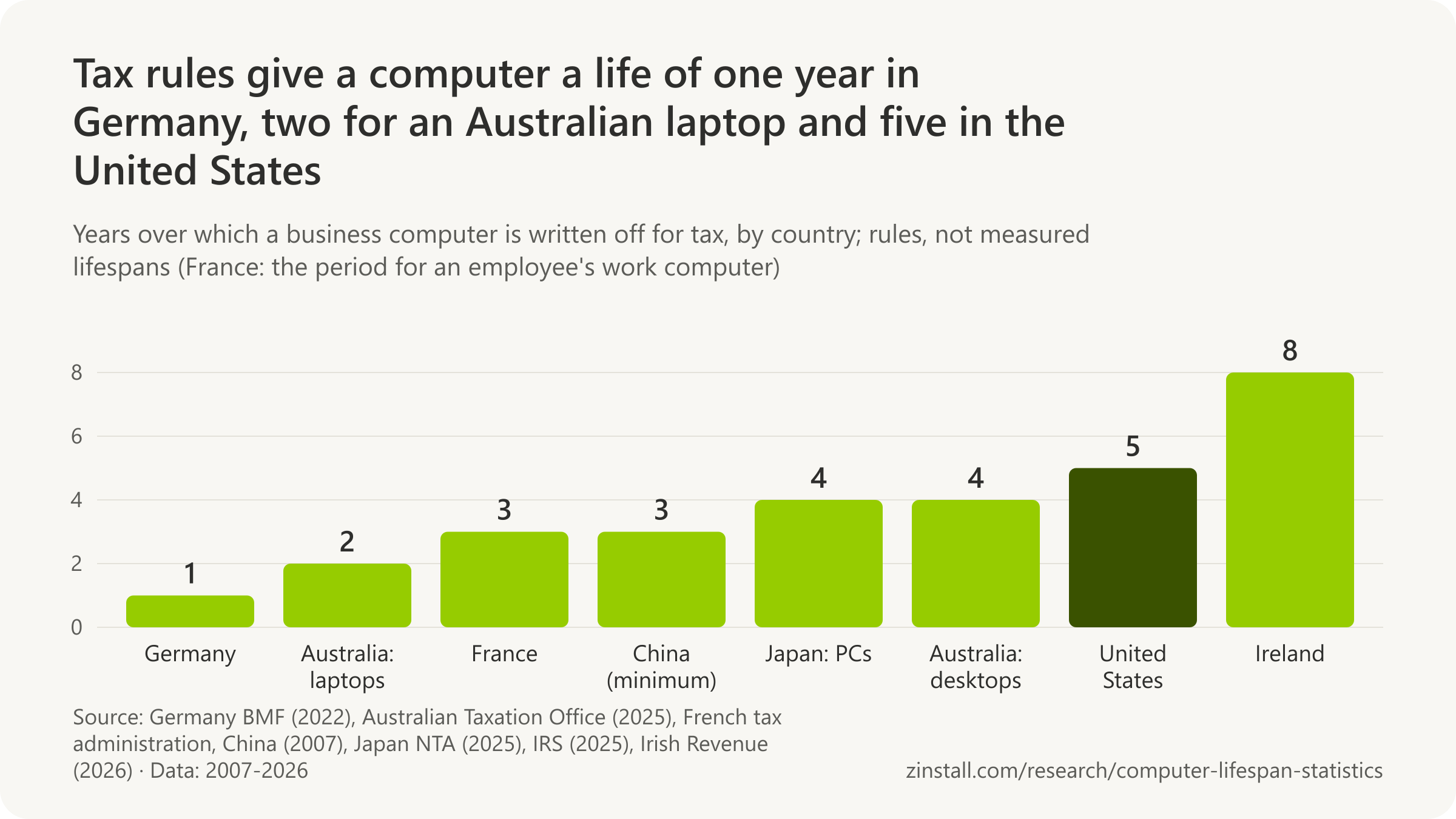
- Japan sets a 4-year useful life for a personal computer, against 5 years for servers.
- Australia sets an effective life of 2 years for laptops and tablets, half the 4 years for desktops.
- Germany lets businesses write off computer hardware over 1 year.
- Ireland generally spreads the cost of business machinery, computers included, over 8 years.
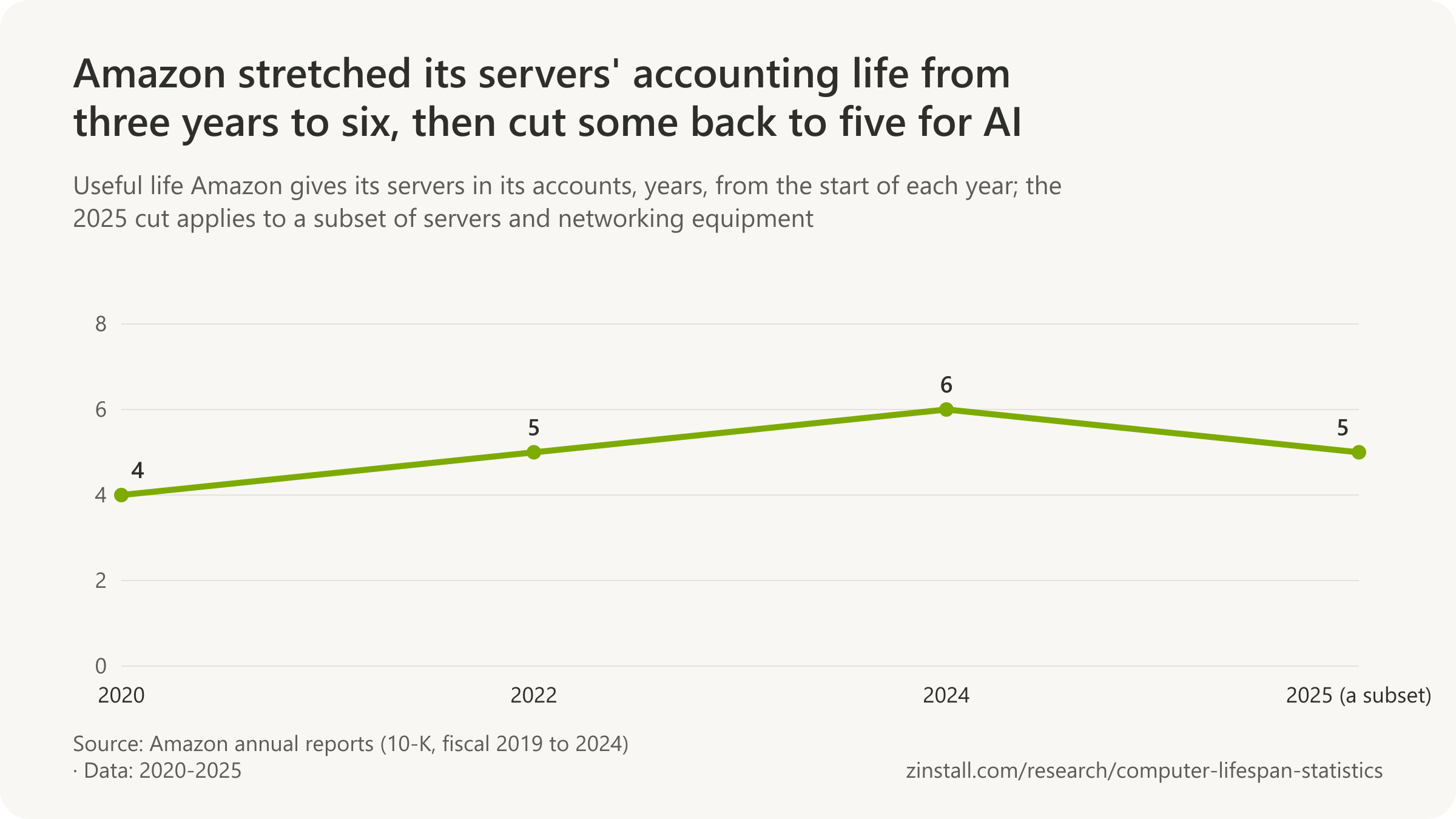
- Amazon cut the accounting life of part of its servers back from six years to 5 years in 2025.
| Country and rule | Life or rate |
|---|---|
| Canada: yearly write-off rate, declining balance | 55% a year |
| UK: share deductible in the first year | 100% in year one |
| Singapore: share written off in one year | 100% in year one |
| US: first-year deduction for property bought after 19 January 2025 | 100% in year one |
| South Korea: standard useful life | 5 years (4 to 6) |
| Netherlands: shortest depreciation period for a laptop | 5 years (minimum) |
| India: useful life of desktops and laptops in company accounts | 3 years |
| Spain: shortest depreciation period | 4 to 8 years |
| Italy: yearly depreciation rate | 20% a year (5 years) |
| UK national accounts: assumed service life of computer hardware | 5 years |
Sources: Internal Revenue Service; National Tax Agency of Japan; Australian Taxation Office; Bundesministerium der Finanzen; Office of the Revenue Commissioners; Amazon; Canada Revenue Agency; HM Revenue and Customs; Inland Revenue Authority of Singapore; Ministry of Economy and Finance of Korea; Netherlands Enterprise Agency, Business.gov.nl; Government of India; Agencia Estatal Boletín Oficial del Estado; Ministero delle Finanze; Office for National Statistics; Direction générale des Finances publiques; State Council of the People's Republic of China
Related guides: A new HP computer · A new Dell laptop
More statistics (24)
Tax authorities set how fast a business may write off a computer, and their answers range from a single year to eight. These are accounting rules, not lifespans, and several countries let a business deduct a computer's whole cost at once. The big cloud companies set their own servers' lives in their accounts, and stretched them from three years to six before Amazon cut some back in 2025.
Tax rules by country

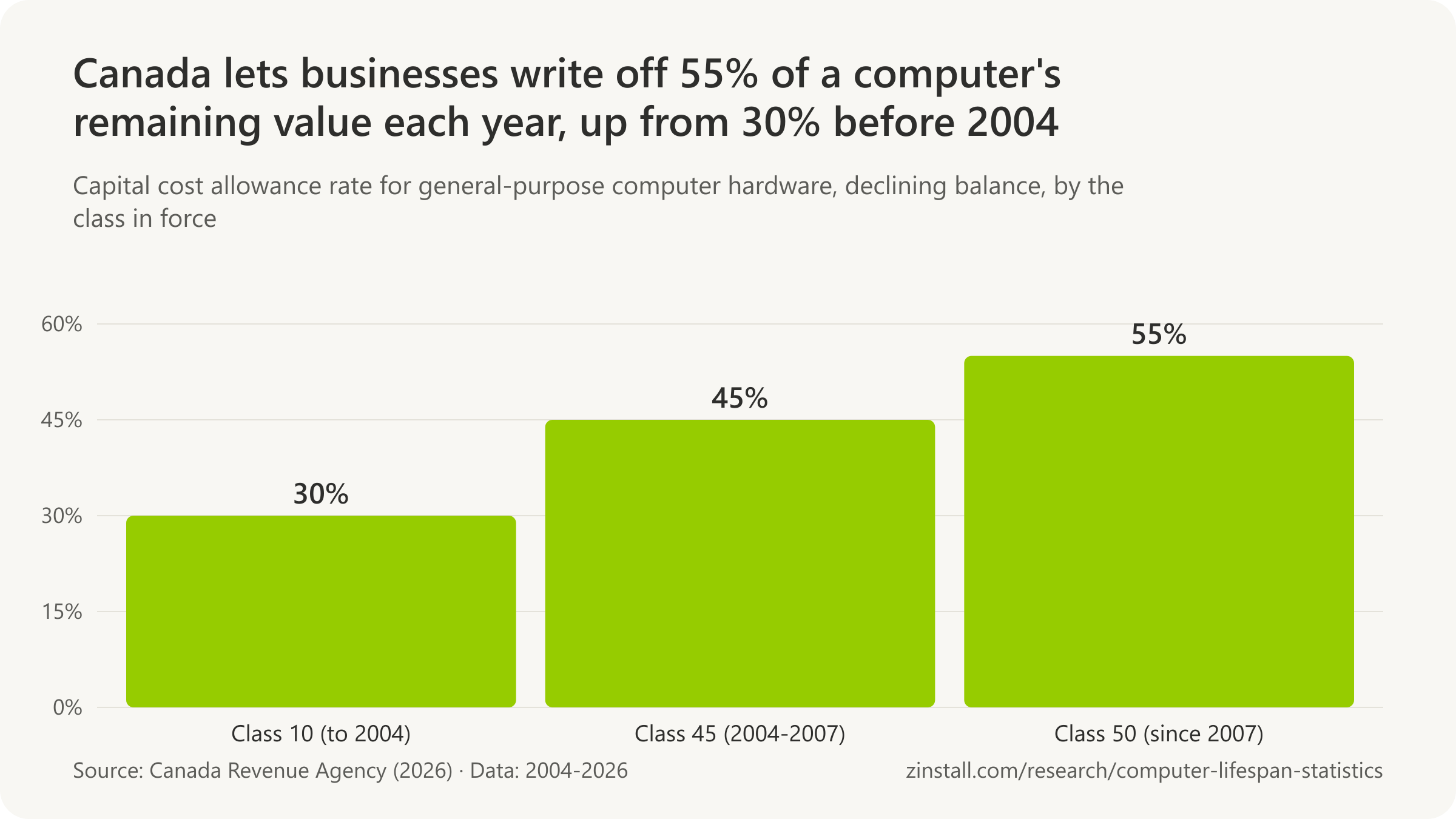
- 100% of the cost of qualifying business property, which includes 5-year property such as computers, must be deducted in the first year in the US for property acquired and placed in service after 19 January 2025 unless the business elects out, after the One Big Beautiful Bill Act reinstated the full special depreciation allowance (IRS, 2026).
- 100% of the cost of a business computer can be deducted from UK profits in the year it is bought under the Annual Investment Allowance, which covers most plant and machinery up to £1 million a year (GOV.UK, 2024).
- 3 years is the useful life India's Companies Act 2013 sets in Schedule II for end-user computing devices such as desktops and laptops, against 6 years for servers and networks (Government of India, 2013).
- 5 years, with a range of 4 to 6 years a company may choose from, is the standard useful life Korea's corporate tax rules set for tools, fixtures and office equipment, the class business computers are depreciated in, in Annex 5 of the Corporate Tax Act Enforcement Rule (Government of South Korea, 2019).
- 5 years is the shortest period over which a Dutch business can depreciate a laptop or other business asset costing €450 or more, because tax depreciation is capped at 20% of the purchase cost a year (Netherlands Enterprise Agency, 2026).
- 4 years is the shortest straight-line tax depreciation period Spain allows for information-processing equipment, whose maximum rate is 25% a year and maximum period 8 years, under the 2014 Corporate Income Tax Law (Government of Spain, 2014).
- 20% a year is the tax depreciation coefficient Italy sets for electronic office machines including computers, a write-off over at least 5 years, under the Finance Ministry decree of 31 December 1988 (Italian Ministry of Finance, 1988).
- 100% of the cost of a computer can be written off in one year by a Singapore business, under Section 19A(2) of the Income Tax Act 1947 (Inland Revenue Authority of Singapore, 2026).
- 400,000 yen is the price below which a Japanese small or midsize company can deduct a PC or other depreciable asset in full in the year it is put to use, raised from 300,000 yen for assets acquired from 1 April 2026, up to 3 million yen of such assets a year, until March 2029 (National Tax Agency of Japan, 2026).
National accounts
- 5 years is the average service life the UK's Office for National Statistics assumes for computer hardware in its capital stock estimates, unchanged when it revised most other asset lives for Blue Book 2019 (Office for National Statistics, 2019).
- 3 to 5 years is the range most UK companies questioned by NIESR use for computers' asset lives in their accounts, shorter than the five-year mean NIESR judged a reasonable approximation of their useful economic life, in its January 2017 review for the Office for National Statistics (NIESR, 2017).
Servers in the cloud companies' accounts

- 4 years became the estimated useful life of Microsoft's own server equipment from fiscal year 2021, up from three, with network equipment lengthened from two to four years, a change Microsoft estimated would add $2.7 billion to fiscal 2021 operating income (Microsoft, 2020).
- 2 to 6 years is the estimated useful life range Microsoft gives its servers and network equipment in its fiscal 2026 annual report (Microsoft, 2026).
- 4 years became the estimated useful life of Alphabet's servers from January 2021, up from three, with certain network equipment lengthened from three to five years, a change Alphabet expected to raise 2021 operating results by about $2.1 billion (Alphabet, 2021).
- 6 years is still the general depreciation period for Alphabet's servers and network equipment in its 2025 annual report (Alphabet, 2026).
- $1.4 billion of extra depreciation in 2025 came from Amazon cutting the useful life of a subset of its servers and networking equipment from six to five years, lowering 2025 net income by $1.0 billion; Amazon cited the faster pace of technology development in artificial intelligence and machine learning (Amazon, 2026).
- 4 years became the estimated average useful life of selected cohorts of Meta's servers and network assets by 2021, up from three, a change that cut 2021 depreciation by $620 million; Meta cited longer refresh cycles in its data centres (Meta, 2022).
- 4 to 5 years became the estimated useful life of Meta's servers and network assets after extensions in the second and fourth quarters of 2022, which cut 2022 depreciation by $860 million (Meta, 2023).
- $2.92 billion less depreciation in 2025 came from Meta extending most of its servers and network assets to a 5.5-year useful life, adding $2.59 billion to its 2025 net income (Meta, 2026).
- 5 years became the estimated useful life of Oracle's servers from fiscal 2023 (which began in June 2022), up from four, lowering fiscal 2023 operating expenses by $434 million (Oracle, 2025).
- 6 years became the estimated useful life of Oracle's servers and networking equipment from fiscal 2025 (which began in June 2024), up from five, lowering fiscal 2025 operating expenses by $733 million and raising net income by $573 million (Oracle, 2025).
- 6 years became the estimated useful life of Microsoft's own server and network equipment from fiscal year 2023, up from four, a change Microsoft estimated would add $3.7 billion to fiscal 2023 operating income (Microsoft, 2022).
- 6 years became the estimated useful life of Alphabet's servers and certain network equipment from January 2023, cutting 2023 depreciation by about $3.4 billion (Alphabet, 2023).
- 5.5 years became the estimated useful life of certain Meta servers and network assets from fiscal 2025, a change Meta expected to cut 2025 depreciation by about $2.9 billion (Meta, 2025).
Sources: Internal Revenue Service; HM Revenue and Customs; Government of India; Ministry of Economy and Finance of Korea; Netherlands Enterprise Agency, Business.gov.nl; Agencia Estatal Boletín Oficial del Estado; Ministero delle Finanze; Inland Revenue Authority of Singapore; National Tax Agency of Japan; Office for National Statistics; National Institute of Economic and Social Research; Microsoft (2020, 2022, 2026); Alphabet (2021, 2023, 2026); Amazon (2020-2026); Meta Platforms (2022-2026); Oracle; Canada Revenue Agency
How often do businesses replace computers?
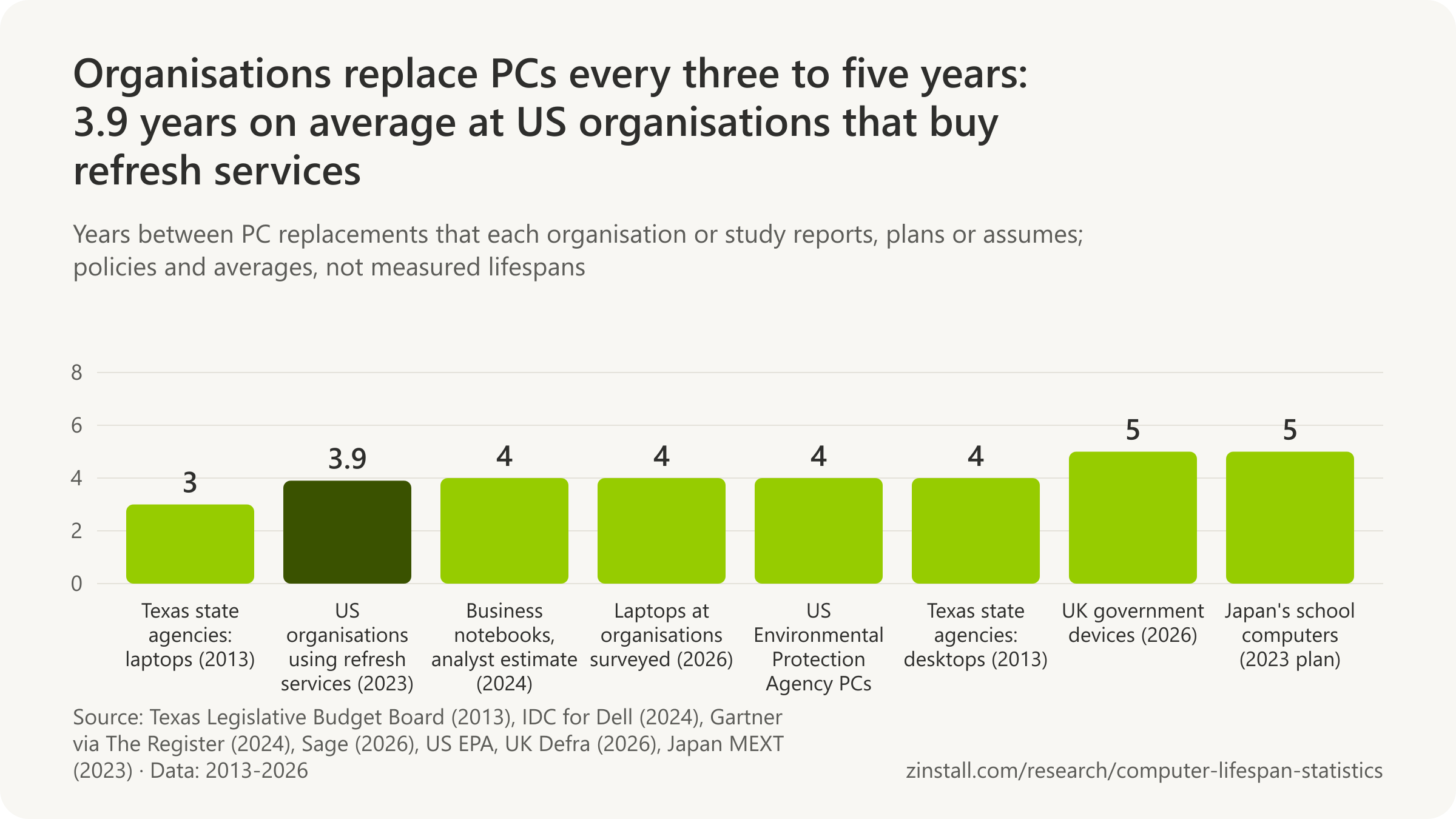
US organisations that buy PC refresh services replaced their PCs every 3.9 years on average (IDC, 2024).

- 70% of organisations used desktops for five years or more before replacing them, against 48% for laptops.
- 84% of IT decision makers said hardware failure drives them to replace company devices.
- A business notebook lasts 4 years on average by an analyst firm's estimate, and consumers keep theirs longer.
- US federal agencies were told in 2015 to replace laptops and desktops every 4 or 5 years.
- PC lifetimes were expected to lengthen by 15% for businesses and 20% for consumers by the end of 2026, as prices rose.
| Organisation, measure and date | Cycle |
|---|---|
| Laptop refresh cycle at organisations surveyed, 2026 | 4.0 years |
| Organisations refreshing PCs every three years or faster, 2023 | 57% (3 years or better), 39% (4 to 5+ years) |
| Enterprise laptop models three to four years old, 2024 | 63% |
| Companies replacing devices because a policy says so | 29% |
| Texas state agencies: recommended cycle for desktops and laptops | 4 years (desktops), 3 years (laptops) |
| Alabama: refresh interval for portable devices | 2 to 4 years (portables), 3 to 5 years (desktops) |
| US Environmental Protection Agency: mandatory PC life cycle | 4 years |
| UK government: device lifetime it usually assumes | 5 years |
| Japan: period for replacing school computers | About 5 years |
| Cost-optimal refresh cycle in a 2009 study for Intel | 3 years |
Sources: IDC; Spiceworks; The Register; Executive Office of the President, Office of Management and Budget; Gartner, Inc.; Sage Sustainable Electronics; Enterprise Strategy Group, showcase commissioned by Dell Technologies; Atos; Legislative Budget Board, State of Texas; State of Alabama Office of Information Technology; US Environmental Protection Agency, Office of Mission Support; Department; Ministry of Education, Culture, Sports, Science and Technology; Wipro Consulting Services
Related guides: A new Lenovo laptop · A new PC on a new domain
More statistics (24)
Most organisations aim to replace PCs every three to five years, and governments and school systems write similar cycles into policy. Surveys of IT departments find desktops kept longer than laptops, and most replacements still triggered by a failure rather than a schedule. The three-year cycle that vendors still recommend goes back to studies Intel commissioned in 2009.
Refresh cycles in surveys and estimates
- 63% of the 50 most common laptop models in medium and large organisations' fleets were three to four years old, 12% one to two years, 24% five to six and 1% seven to eleven, in Atos's 2024 analysis of Nexthink device data (Atos, 2024).
- Around three to four years old was the age of the device stock in medium and large organisations, Atos said in 2024 from an analysis of 28.5 million workplace devices with Nexthink, Tier1 and Circular Computing (Atos, 2024).
- Organisations buying Macs were investing in six-year assets and those buying Windows PCs in three-year assets, Omnissa said in March 2026 from 2025 telemetry of millions of enterprise endpoints it manages (Omnissa, 2026).
- 3 years is the notebook refresh cycle Dell's chief financial officer Yvonne McGill said she wanted to 'plant the seed' for in March 2024, while conceding cycles were 'elongated' after eight quarters of shrinking PC shipments (Dell via The Register, 2024).
- PC lifetimes were expected to lengthen by 15% for business buyers and 20% for consumers by the end of 2026 as rising costs delayed upgrades (Gartner forecast, 2026).
- 6 months, or 10%, is how much large organisations would lengthen their PC lifetimes in 2015 compared with 2014 as a strong dollar pushed PC prices up, Gartner forecast, which puts the business PC lifetime it assumed at about five years (Gartner via eWeek, 2015).
- 57% of organisations still refreshed their PCs every three years or more often in 2023, while 39% had stretched refreshes to four or five years or longer, according to Enterprise Strategy Group research cited in a showcase commissioned by Dell (Enterprise Strategy Group, 2025).
- 55% of organisations scaled back spending in 2023 by holding on to their PCs longer, according to Enterprise Strategy Group research cited in a showcase commissioned by Dell (Enterprise Strategy Group, 2025).
Desktops, laptops and tablets
- 70% of organisations use their desktop computers for five years or more before replacing or decommissioning them, and 24% for seven years or more, in Spiceworks' July 2018 survey of 1,372 IT professionals in North America and Europe (Spiceworks, 2018).
- 48% of organisations use their laptops for five years or more and only 8% for seven years or more, against 70% and 24% for desktops, in Spiceworks' July 2018 survey of 1,372 IT professionals in North America and Europe (Spiceworks, 2018).
- 45% of education organisations use their desktops for seven years or more, against a 24% average, and 27% their laptops, against 8%, in Spiceworks' July 2018 survey of 1,372 IT professionals in North America and Europe (Spiceworks, 2018).
- 84% of IT decision makers say hardware failure drives them to replace company-owned devices, ahead of performance degradation (72%) and physical damage (59%), in Spiceworks' July 2018 survey of 1,372 IT professionals in North America and Europe (Spiceworks, 2018).
- 29% of companies typically replace equipment because of a replacement policy and 26% because a warranty expired, in Spiceworks' July 2018 survey of 1,372 IT professionals in North America and Europe (Spiceworks, 2018).
- 52% of organisations use their tablets for three to four years before replacing or decommissioning them, and 20% for two years or less, in Spiceworks' July 2018 survey of 1,372 IT professionals in North America and Europe (Spiceworks, 2018).
- 68% of organisations said desktops were the primary computing device for most of their employees, against 29% for laptops and 1% for tablets, in Spiceworks' July 2018 survey of 1,372 IT professionals in North America and Europe (Spiceworks, 2018).
- 11% of organisations mainly buy refurbished laptops, against 44% that buy new higher-end and 45% new budget laptops, in Spiceworks' July 2018 survey of 1,372 IT professionals in North America and Europe (Spiceworks, 2018).
Government and school policies

- 4.6 years for desktops and 3.7 years for laptops was the industry-standard replacement cycle attributed to Gartner in a Texas Legislative Budget Board brief of January 2013, against a 4.4-year and 4.3-year average across other states (Texas Legislative Budget Board, 2013).
- 2 to 4 years for portable devices, 3 to 5 years for desktop PCs and 5 to 10 years for servers are the refresh intervals Alabama's Office of Information Technology recommends to state agencies in its Computer Device Refresh policy of August 2018 (State of Alabama OIT, 2018).
- 4 or 5 years is the uniform laptop and desktop refresh cycle the White House Office of Management and Budget told US federal agencies to adopt in October 2015, replacing 25% of inventory a year over four years or 20% a year over five (OMB, 2015).
- 902,667 laptops against 275,556 desktop PCs made up the UK government's end-user computer estate in 2024 to 2025, more than three laptops for every desktop (UK government, 2026).
Where 'replace every three years' comes from

- 36 months is the PC-as-a-service subscription term modelled in a Forrester study commissioned by Dell and Verizon, for a composite organisation of 4,000 devices that Dell says saw a 30% return on investment over three years (Dell, 2026).
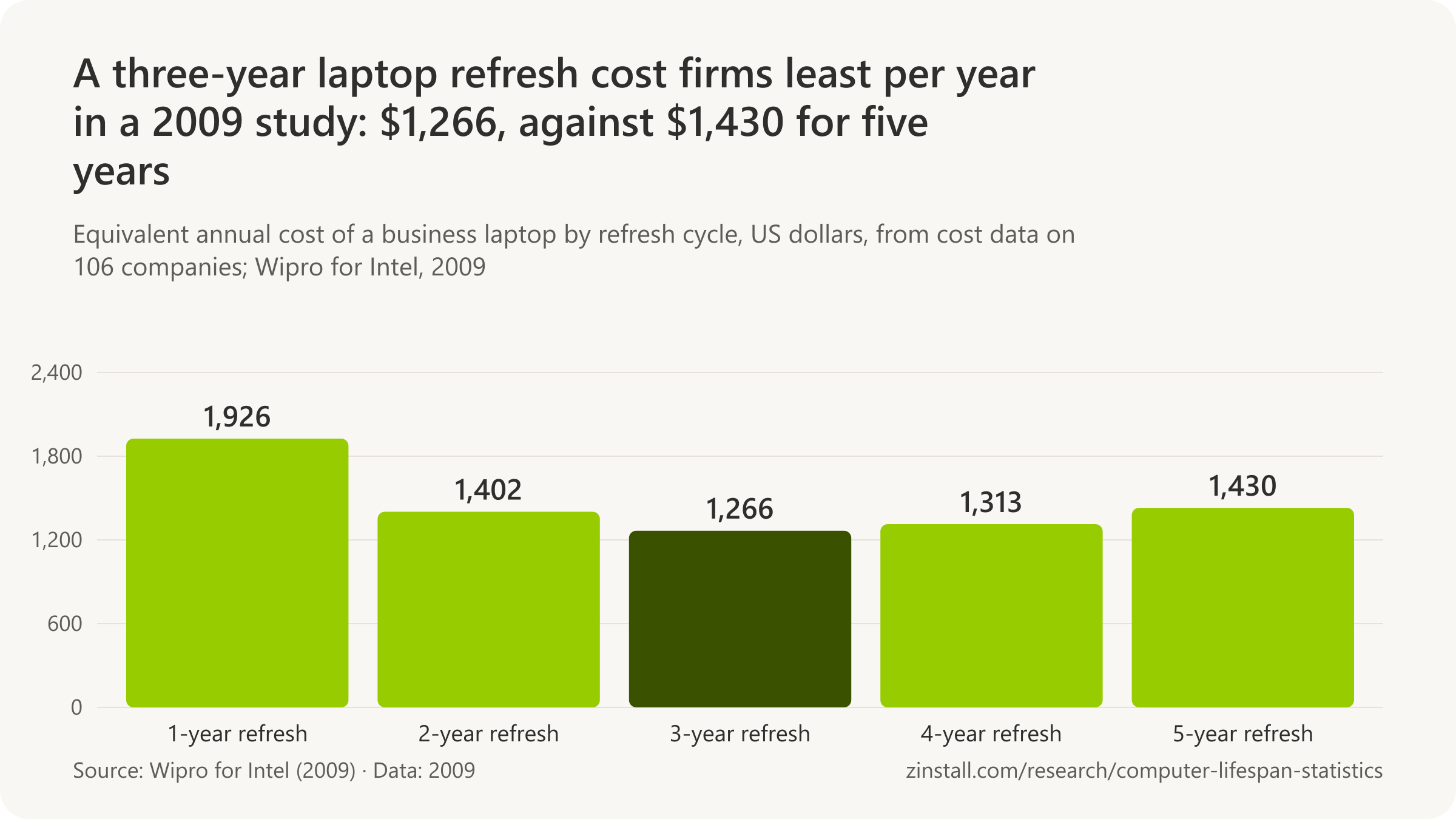
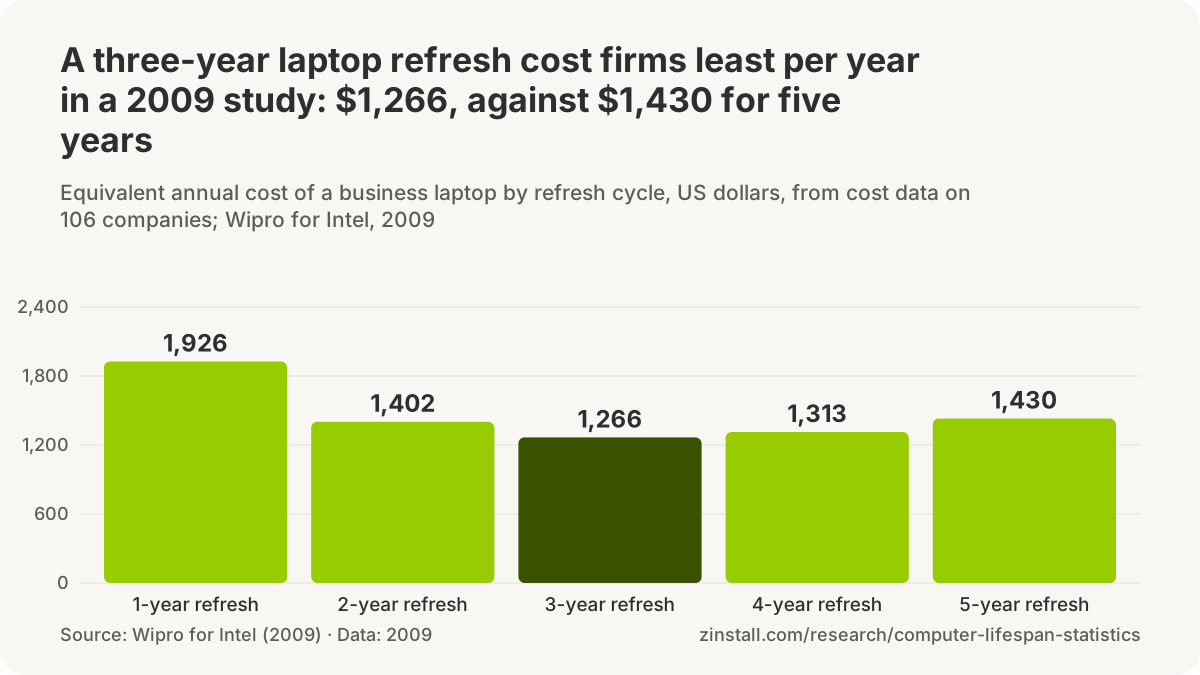
- Every 3 years is the optimal PC refresh frequency Intel's IT department concluded from research it first ran in 2009, finding that PCs older than three years significantly raise support costs and security risk, as Intel IT restated in a November 2016 white paper (Intel, 2016).
- 2 to 4 years is the laptop refresh cycle Intel's IT department ran for its own employees, the range it said still keeps total cost of ownership lowest, in a November 2016 white paper (Intel, 2016).
- 3 to 4 years is the PC refresh cycle Intel's IT department recommends when devices are meeting a department's day-to-day needs, in Intel's May 2025 guidance on public-sector PC procurement (Intel, 2025).
Sources: Atos; Omnissa; The Register; Gartner, Inc.; eWeek; Enterprise Strategy Group, showcase commissioned by Dell Technologies; Spiceworks; Legislative Budget Board, State of Texas; State of Alabama Office of Information Technology; Executive Office of the President, Office of Management and Budget; Department; Dell Technologies; Intel Corporation (2016, 2025); Office of Superintendent of Public Instruction, Washington State; Wipro Consulting Services
How much does an old computer cost a business?
Keeping a PC more than four years old cost a small business US$2,736 per device, in a survey for Microsoft and Intel (Techaisle, 2018).

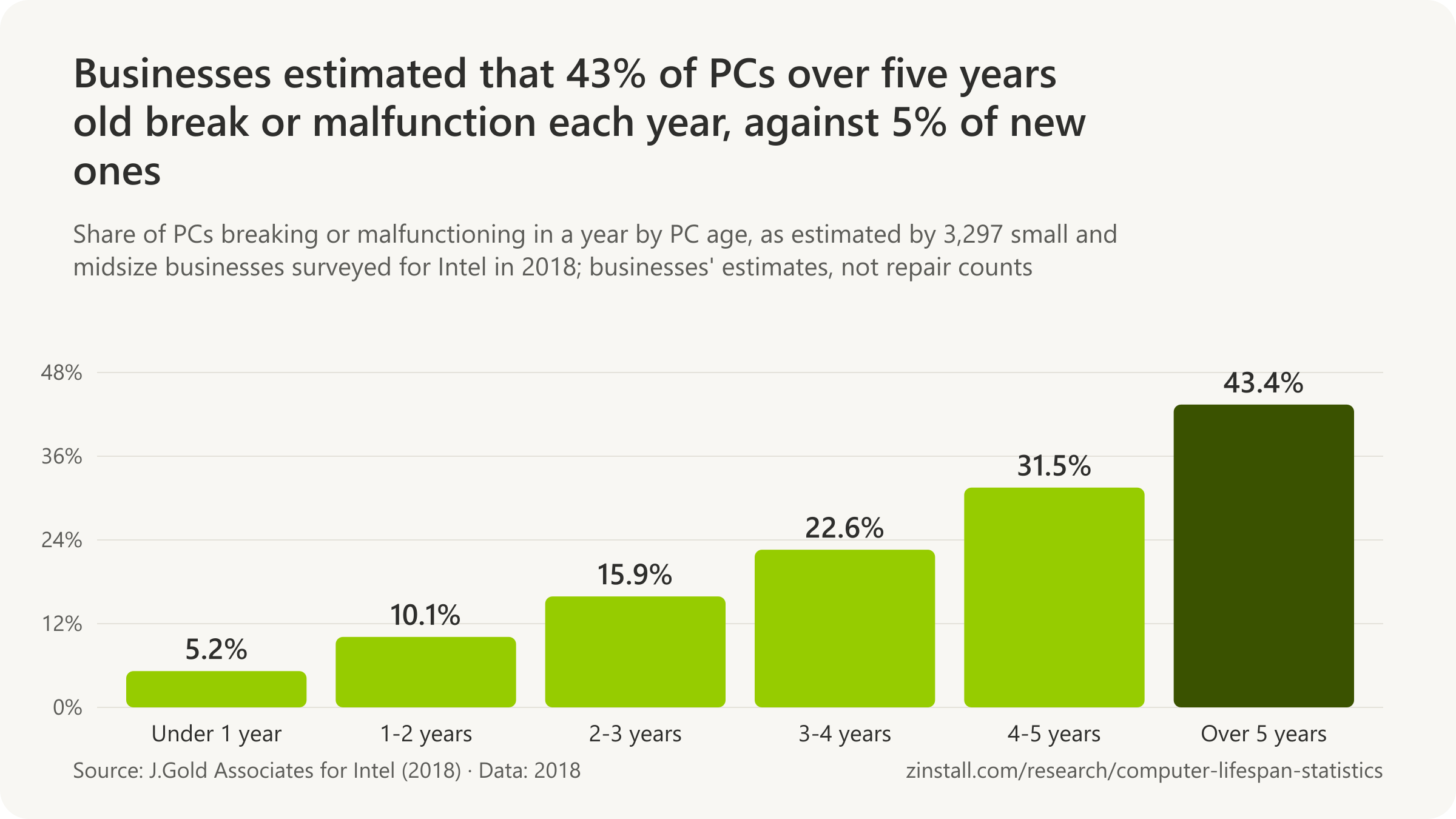
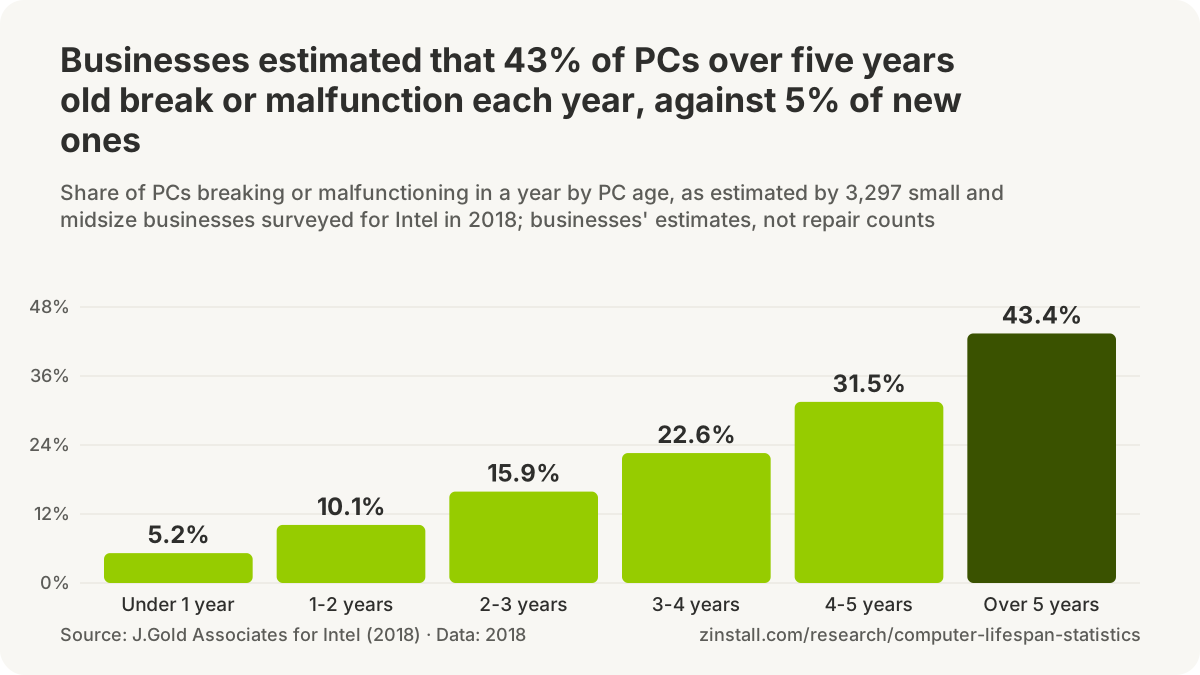
- 43.42% of PCs over five years old break or malfunction each year by businesses' estimates, against 5.16% of new ones.
- A PC more than four years old was 2.7 times as likely to need repairs, small businesses reported.
- A Windows 10 PC four or more years old cost US$1,525 a year to own and run, 3.3 times a newer one.
- Error rates of enterprise devices rose by 100% from their fifth year, in an analysis of fleet data.
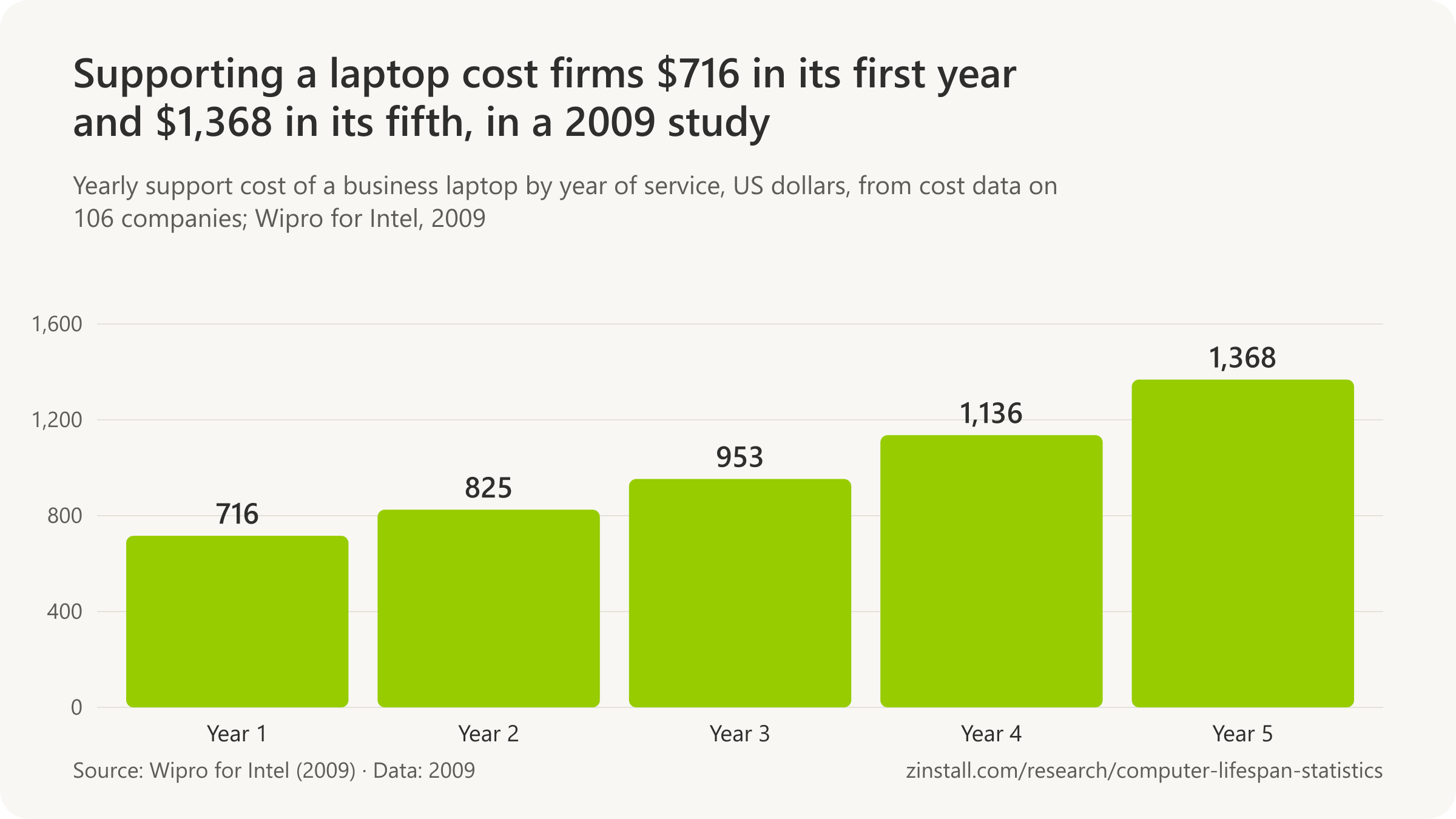
- A four-year-old PC had 53% more security incidents than one in its first year, in a 2009 study for Intel.
| Measure and year | Figure |
|---|---|
| Repair spend per PC four years or older, 2013 | $427 per PC |
| Total yearly maintenance per older PC, 2013 | $561 per PC |
| Extra hours lost a year on an older PC, 2013 | 21 hours |
| Hours lost a year to an older PC's downtime, 2018 | 112 hours |
| Australia: yearly cost of keeping an older PC, 2018 | AU$5,012 per PC |
| New Zealand: older PCs' chance of needing repairs against newer ones, 2019 | 3.1x |
| Productive hours lost a year per older Windows 10 PC, 2020 | 70 hours |
| Failure cost per user a year, PCs over five years old, 2018 | $662 a year |
| Productivity lost on PCs over five years old, 2018 | 29.5% |
| Small businesses with PCs older than four years, 2018 | 7 in 10 |
Sources: Microsoft and Intel; J.Gold Associates; Techaisle (2020, 2018, 2014); Atos; Wipro Consulting Services; Intel; Microsoft Australia and Intel; Techaisle and Microsoft
Related guides: Programs and files to a new computer · Free ways to transfer programs
More statistics (30)
Surveys commissioned by Microsoft and Intel since 2013 asked small businesses what their older PCs cost them, and each found PCs past four years costing more in repairs, downtime and lost time than newer ones. These are respondents' own estimates in surveys paid for by companies that sell new PCs and software, and the figures differ by study. An analysis of enterprise fleets found error rates doubling from a device's fifth year.
Failure rates and costs by PC age

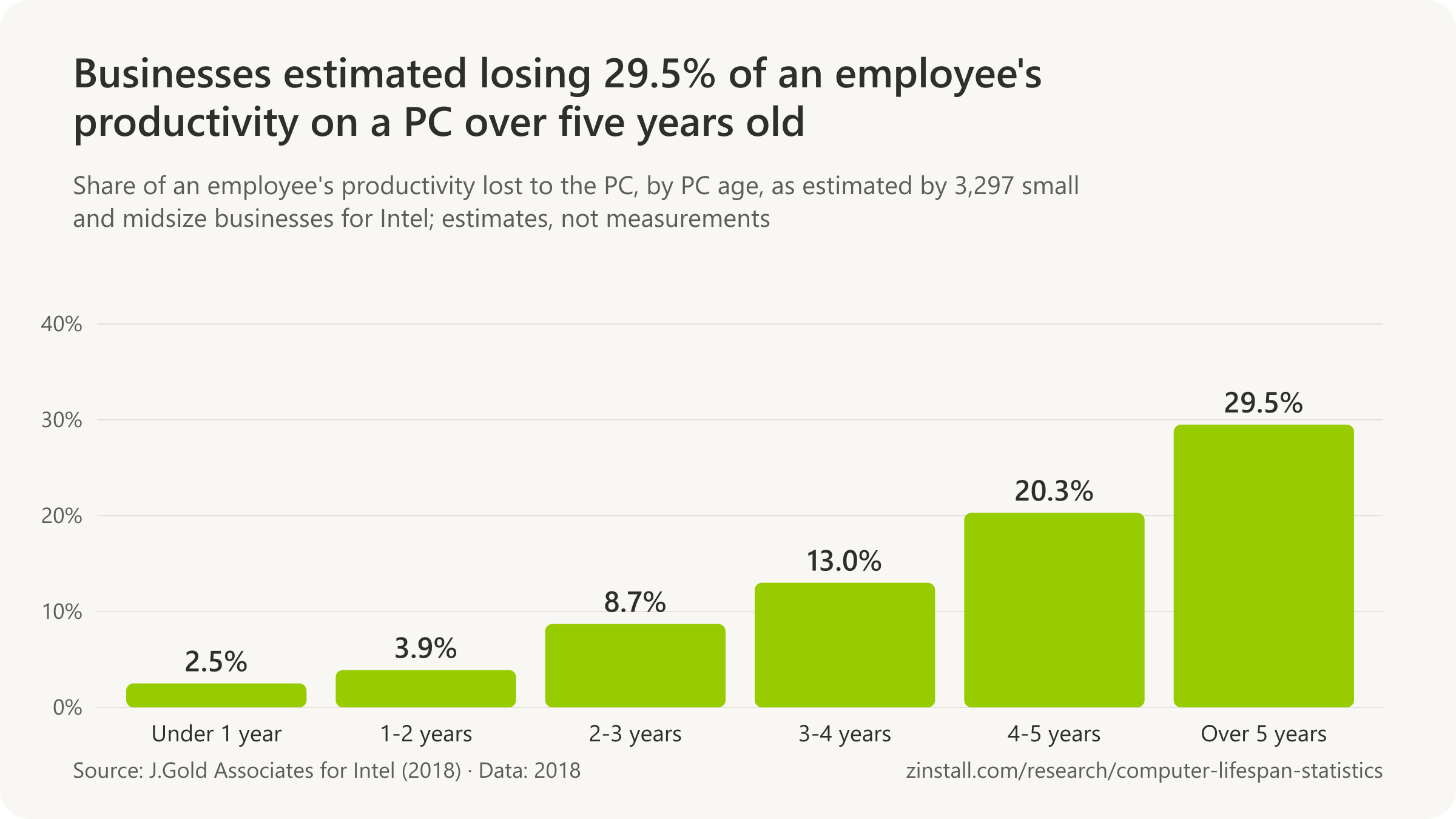

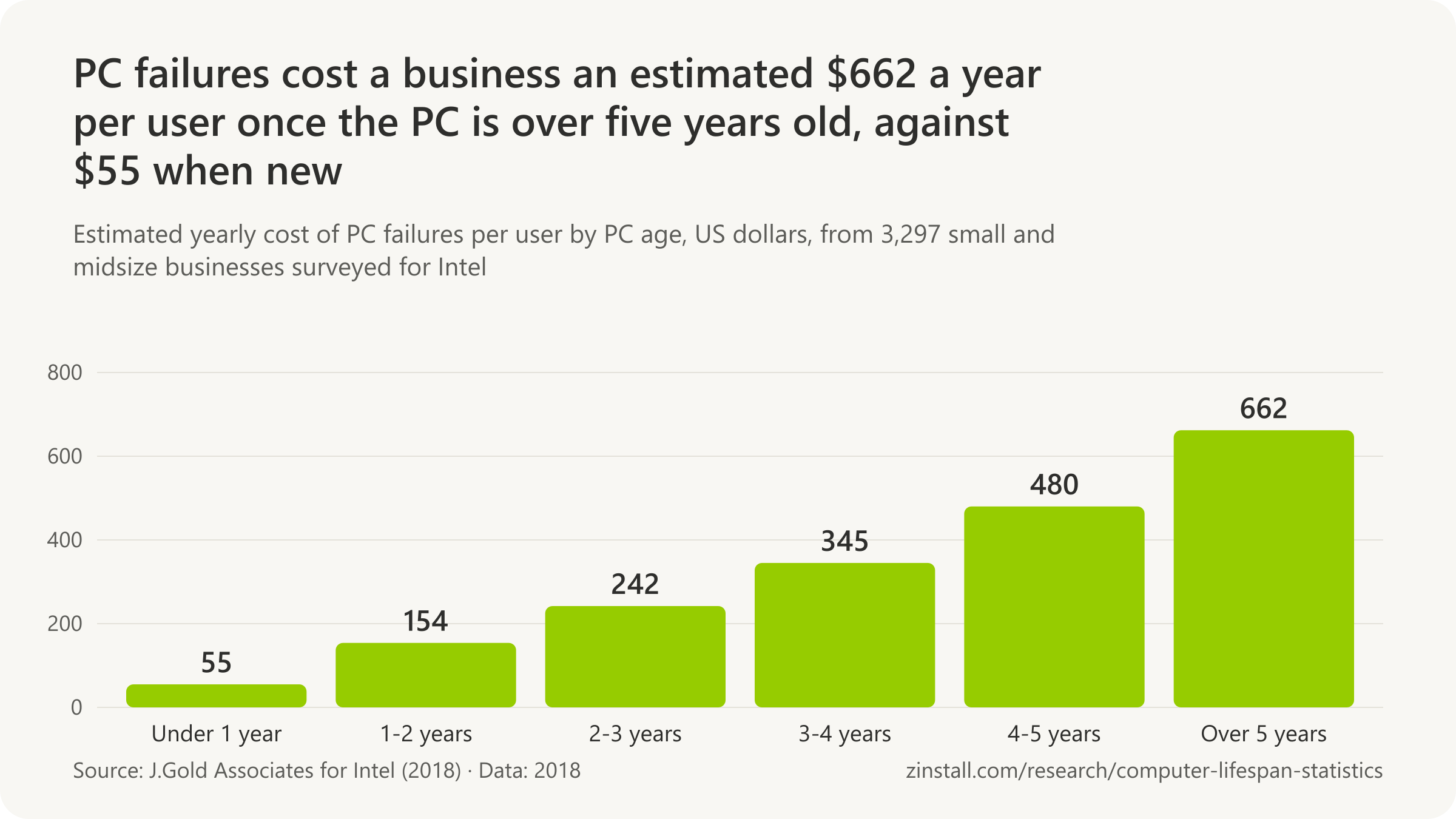
- 2 to 3 years is how often small and midsize businesses should update or replace their PCs, J.Gold Associates concluded from its 2018 survey of 3,297 businesses in 16 countries, a study licensed to Intel (J.Gold Associates, 2018).
Small businesses' older PCs
- $2,657 a year is how much using old PCs can cost a small or midsize business, in a Microsoft-commissioned Techaisle survey of 2,000 IT and business decision makers in Asia Pacific in September 2019 (Techaisle, 2020).
- Over half of small and midsize businesses in Asia Pacific have no PC refresh policy or do not follow it, and over a third use PCs four or more years old, in a Microsoft-commissioned Techaisle survey of 2,000 decision makers in September 2019 (Techaisle, 2020).
- 36% of 736 small businesses surveyed in six countries owned PCs more than four years old, in Intel's 2013 Small Business PC Refresh Study by Techaisle (Intel, 2013).
- 21 more hours per year were lost by employees using a PC four years or older, from repairs, maintenance and security issues, among 736 small businesses surveyed for Intel by Techaisle in 2013 (Intel, 2013).
- $427 was the average spend to repair a PC four years or older, 1.3 times the repair cost of a newer PC, among 736 small businesses surveyed for Intel by Techaisle in 2013 (Intel, 2013).
- 42 working hours were lost when an older PC needed repair, among 736 small businesses surveyed for Intel by Techaisle in 2013 (Intel, 2013).
- 47% of 736 small businesses surveyed were unaware that Microsoft was ending support for Windows XP, in Intel's 2013 PC Refresh Study by Techaisle (Intel, 2013).
- $561 per older PC was the total annual maintenance cost ($427 repair plus $134 upgrades) among 736 small businesses surveyed by Techaisle for Intel in 2013 (Techaisle, 2014).
- 47% of 736 small businesses surveyed cited lack of budget as a key reason for not replacing older PCs despite frequent issues, in Techaisle's 2013 study for Intel (Techaisle, 2014).
- US$2,736 per device was the cost of keeping a PC more than four years old, enough to buy two or more new PCs, among 2,156 Asia Pacific SMBs surveyed by Techaisle for Microsoft and Intel in 2018 (Microsoft, 2018).
- 2.7 times more likely to undergo repairs was a PC older than four years, among 2,156 Asia Pacific SMBs surveyed by Techaisle for Microsoft and Intel in 2018 (Microsoft, 2018).
- 7 in 10 SMBs had PCs older than four years, among 2,156 Asia Pacific SMBs surveyed by Techaisle for Microsoft and Intel in 2018 (Microsoft, 2018).
- 85% of larger SMBs (over 500 employees) had PCs older than four years, against 60% of SMBs with under 100 employees, among 2,156 Asia Pacific SMBs surveyed by Techaisle in 2018 (Microsoft, 2018).
- 42% of PCs used in SMBs were still on older versions of Windows, among 2,156 Asia Pacific SMBs surveyed by Techaisle for Microsoft and Intel in 2018 (Microsoft, 2018).
- Legacy applications not working on a newer operating system, and lack of budget, were the key barriers to migrating to a newer device, among 2,156 Asia Pacific SMBs surveyed by Techaisle for Microsoft and Intel in 2018 (Microsoft, 2018).
- 41% of 2,156 Asia Pacific SMBs surveyed cited fear of application compatibility, and 27% lack of budget, as the key reason for not replacing older PCs, in Techaisle's 2018 study for Microsoft and Intel (Techaisle, 2018).
- 112 hours per year were lost to downtime of a PC four years or older, 3.1 times the figure for newer PCs, among 2,156 Asia Pacific SMBs surveyed by Techaisle for Microsoft and Intel in 2018 (Techaisle, 2018).
- 24% of older PCs were likely to be replaced even though 85% of SMBs with older PCs planned replacement, among 2,156 Asia Pacific SMBs surveyed by Techaisle for Microsoft and Intel in 2018 (Techaisle, 2018).
- 59% of 2,156 Asia Pacific SMBs surveyed had moved away from a PC replacement policy or were keeping PCs longer than in previous years, in Techaisle's 2018 study for Microsoft and Intel (Techaisle, 2018).
- AU$5,012 per device was the cost of keeping a PC more than four years old, and such PCs were 3.3 times more likely to need repairs, among 415 Australian SMBs surveyed by Techaisle for Microsoft and Intel in 2018 (Microsoft Australia, 2018).
- 42% of New Zealand SMBs surveyed had no PC refresh policy and were not pursuing one, citing perceived app incompatibility and cost, in Techaisle's 2019 study for Microsoft (Techaisle and Microsoft via eCommerceNews NZ, 2019).
- 3.1 times higher was the chance of an old PC needing repairs, at an economic cost of at least NZ$4,000 (US$2,657) per PC per year and 157 hours of lost productivity, in Techaisle's 2019 study for Microsoft (Techaisle and Microsoft via eCommerceNews NZ, 2019).
- US$1,525 per year was the total cost of owning and maintaining a Windows 10 PC four or more years old, 3.3 times that of a newer Windows 10 PC, among 2,085 SMBs surveyed by Techaisle for Microsoft in 2020 (Techaisle, 2020).
- 70 hours of productive time per PC per year were lost on Windows 10 PCs four or more years old, among 2,085 SMBs surveyed by Techaisle for Microsoft in 2020 (Techaisle, 2020).
- 40% of 2,085 SMBs surveyed had no PC refresh policy or were not following it, and 32% of their Windows 10 PCs were four or more years old, in Techaisle's 2020 study for Microsoft (Techaisle, 2020).
- 4.5 times the frequency of problems was experienced on Windows 10 PCs four or more years old compared with newer ones, among 2,085 SMBs surveyed by Techaisle for Microsoft in 2020 (Techaisle, 2020).
- US$1,193 per older Windows 10 PC per year was lost in productivity, 3.8 times the figure for newer Windows 10 PCs, among 2,085 SMBs surveyed by Techaisle for Microsoft in 2020 (Techaisle, 2020).
Enterprise fleets
- Error rates of enterprise devices increase by 100% from year five, and performance drops 22% between years four and five, Atos found in 2024 from Nexthink device analytics and IT service data in medium and large organisations (Atos, 2024).
The 2009 studies

Numbers in circulation
- $1,525 is what a PC failure cost a company once the machine was out of warranty, against $1,070 for a failure under warranty, in J.Gold Associates' 2009 study 'Keeping Notebooks Past Their Prime', as the firm restated it in 2018 (J.Gold Associates, 2018).
Sources: J.Gold Associates; Techaisle (2014, 2018, 2020); Intel; Microsoft and Intel; Microsoft Australia and Intel; Techaisle and Microsoft; Atos; Wipro Consulting Services
How long does a laptop battery last?
Every Mac notebook battery since 2009 is rated for 1,000 charge cycles, designed to keep up to 80% of its capacity (Apple, 2026).

- One maker's laptop batteries keep 80% of their capacity after 300 cycles and 65% after 1,000.
- Typical users notice a laptop battery's runtime falling after 18 to 24 months, by one maker's estimate.
- One maker covers most of its laptop batteries for 1 year, even when the laptop itself has a three- to five-year warranty.
- Laptop-type lithium-ion cells lost capacity much faster in storage above about 60% charge, in a laboratory study.
- From 18 February 2027, batteries in laptops sold in the EU must be replaceable by their users.
| Maker, rule or measure | Figure |
|---|---|
| Apple's first Intel notebooks (2006-2009): rated cycles | 300 cycles |
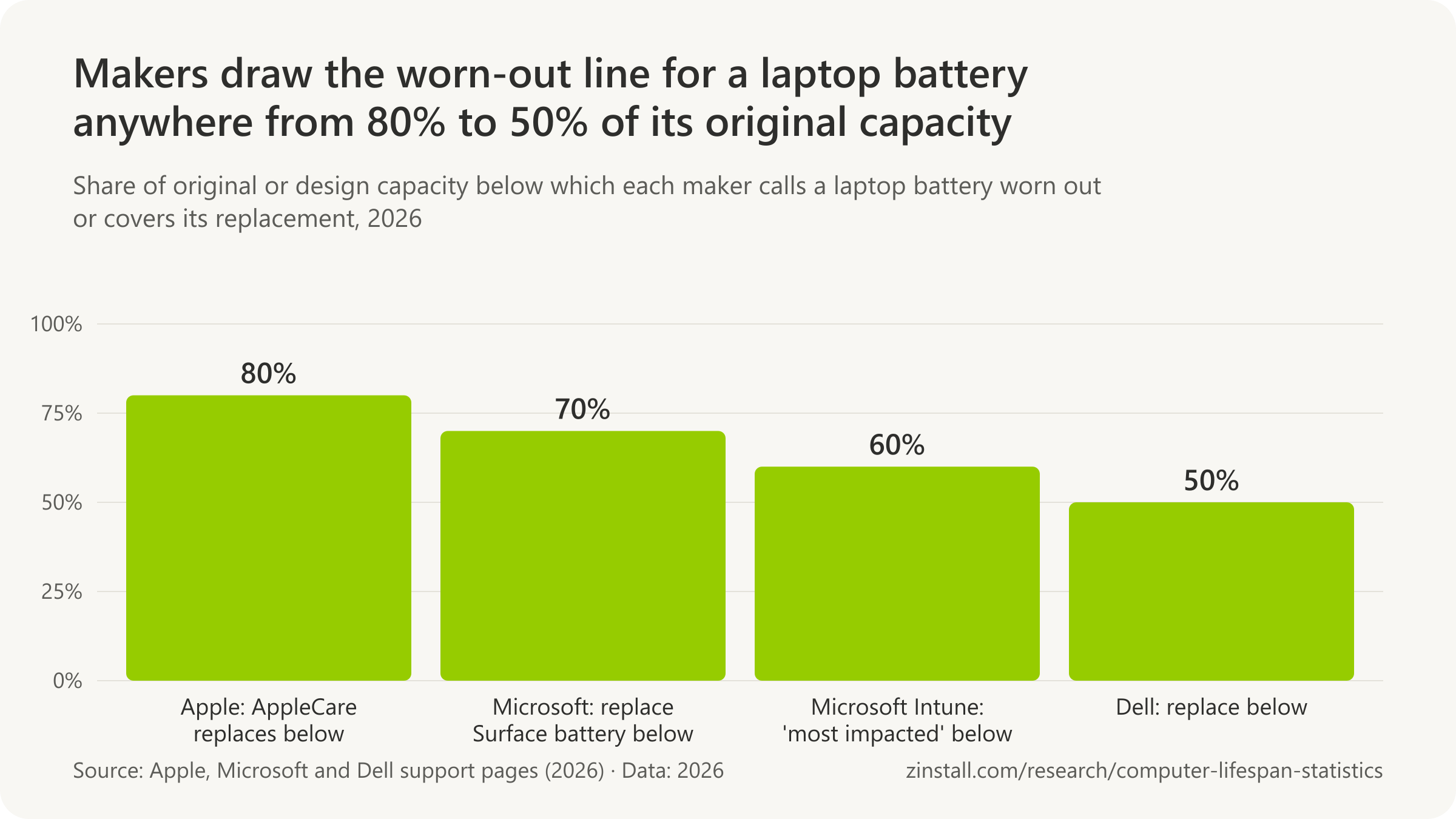
| Microsoft: worn-out line for a Surface battery | below 70% |
| Dell: worn-out line for a laptop battery | below 50% |
| Apple: battery replacement out of warranty, US, 2026 | $149 to $249 |
| Microsoft Surface: battery replacement out of warranty, US | $330 |
| Apple's battery replacement price, 2022 to 2026 | +23% to +25% |
| TCO Certified notebooks: battery capacity required | 90% after 300 cycles |
| EU rule for phones and tablets: cycles at 80% capacity, at least | 800 cycles |
| Lenovo conservation mode: charge level held | 55% to 60% |
| Apple: temperature above which capacity can be lost for good | 35°C (95°F) |
Sources: Apple (2026a, 2026b, 2026c, 2026d); HP Inc.; Dell Technologies (2026a, 2026b); Journal of The Electrochemical Society, Technical University of Munich; European Parliament and Council of the European Union; Microsoft (2026a, 2026b, 2026c); TCO Development; European Commission; Lenovo
Related guides: A laptop with a broken screen · A broken or dead computer
More statistics (56)
Laptop makers rate batteries by the charge cycles they should survive and the capacity they keep, but each maker draws the worn-out line in a different place, and battery warranties are usually shorter than the laptop's own. Heat and long hours at full charge age a battery fastest, which is why every maker now offers a charge limit. From 2027 the EU will require batteries that users can replace themselves.
Ratings and the worn-out line

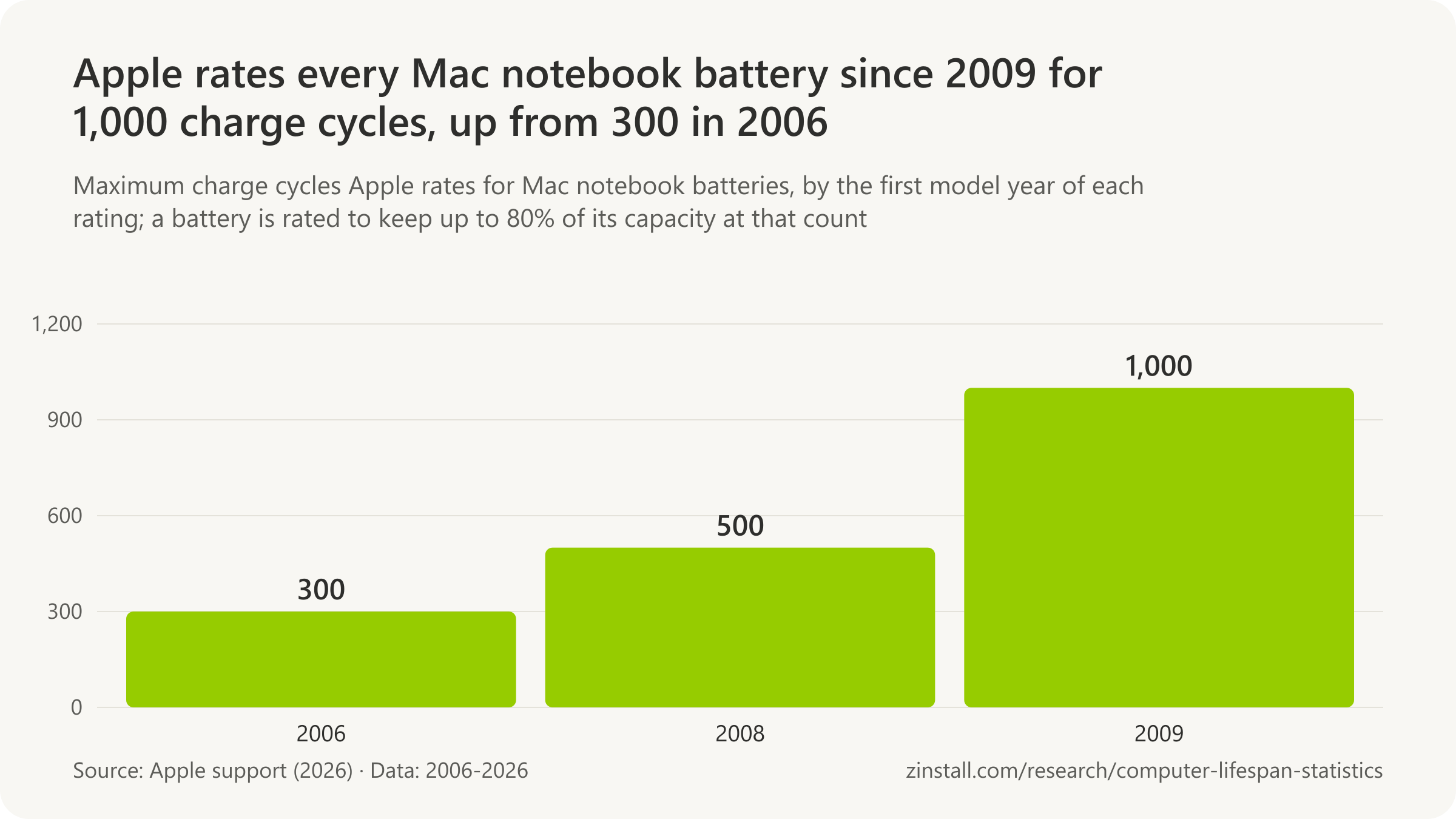
- 80% of its original charge capacity is what a Mac notebook battery is designed to retain when it reaches its rated maximum cycle count, the point at which Apple considers the battery consumed (Apple, 2026).
- 80% is the charge level past which Optimized Battery Charging, on Mac notebooks since macOS Big Sur 11 (2020), delays charging when it predicts the Mac will stay plugged in, to reduce the time the battery spends fully charged (Apple, 2026).
- 35°C (95°F) is the ambient temperature above which Apple says a device's battery capacity can be permanently damaged, with charging in the heat damaging it further; MacBooks work best at 10° to 35°C (Apple, 2026).
- About 50% charge, in a place cooler than 32°C (90°F) and topped up to 50% every six months, is how Apple says to store a device long term, because storing it full can cost capacity and storing it empty can leave it unable to hold a charge (Apple, 2026).
- 80% is the cap Microsoft's Battery Smart Charging puts on a Surface battery when it detects the device has been plugged in for long periods or used at high temperatures, lifting when the battery drops below 20% (Microsoft, 2026).
- 50% is the charge cap of Surface Battery Limit Mode, which Microsoft offers for devices kept plugged in for long periods because constant charging can age batteries prematurely (Microsoft, 2026).
- Batteries kept at a high state of charge lose capacity faster, Microsoft tells Surface owners, advising them to let the battery drain below 50% several times a week rather than leave the device on AC power for long periods (Microsoft, 2026).
- 55% to 60% is the charge level at which Lenovo's conservation mode on IdeaPad laptops stops charging, so the battery never reaches 100%, in order to preserve its life (Lenovo, 2026).
- No adopted EU ecodesign rule yet sets a minimum battery cycle life for laptops: the Commission's review of the 2013 computers regulation (617/2013), whose 2024 draft proposed 800 cycles at 80% capacity, was still in progress in November 2026 (European Commission, 2026).
- About 80% of rated capacity after 300 cycles, or roughly one year of daily use, is what HP told notebook buyers in 2004 to expect from a lithium-ion battery under moderate use (HP, 2004).
- 12 months was HP's warranty on notebook lithium-ion batteries in 2004, set on the expectation that a battery delivers 80% of its initial capacity after 300 cycles; high power loads could reach that point within the warranty (HP, 2004).
- 50% of initial capacity after one year was HP's 2004 projection for a notebook battery kept in a docking station above 35°C running high-power applications, against more than 80% for a mobile user cycling it daily at 25°C with light applications (HP, 2004).
- About 80% is where HP's Battery Health Manager stops charging in its 'Maximize my battery health' setting, which HP recommends for laptops more than a year old or used plugged in all the time; its battery-duration setting charges to 100% and resumes at 95% (HP Japan, 2022).
- 80% is where ChromeOS Adaptive Charging holds a Chromebook's battery until about two hours before it expects to be unplugged, because maintaining a full charge harms a lithium-ion battery's long-term capacity, Google's ChromeOS documentation says (Google, 2026).
- 1,000 cycles or more with 80% capacity retained earns full points for notebook batteries in the EU's green public procurement criteria for computers, with lower scores at 800 and 500 cycles above a 300-cycle baseline (European Commission JRC, 2016).
- Within the first two years of ownership is when a typical 300-to-500-cycle lithium-ion notebook battery will in most cases lose noticeable capacity, against the one-year battery guarantee makers generally offer, the EU's Joint Research Centre wrote in 2016 (European Commission JRC, 2016).
- About 50% longer battery cycle life is the potential the EU's Joint Research Centre attributed in 2016 to notebook software that limits charging to about 80% of capacity (Apple, Asus and Toshiba then shipped it), at the cost of shorter runtime per charge (European Commission JRC, 2016).
- Up to 80% more expensive than standard 300-to-500-cycle batteries is what the 800- and 1,000-cycle batteries in business notebooks from Acer, Dell, Asus, HP and Toshiba cost, notebook and battery makers told the EU's Joint Research Centre in 2016 (European Commission JRC, 2016).
- 60% of capacity after 300 cycles in the IEC 61960 accelerated endurance test is the level Dell declared for all its notebook and tablet batteries under the EU's 2014 ecodesign information rules, as reported by the EU's Joint Research Centre (European Commission JRC, 2016).
- 60% is the charge cap of Asus's Maximum Lifespan Mode, recommended for laptops always on AC power, and 80% that of its Balanced Mode, because users usually keep the adapter connected and the battery sits at 98% to 100% for long periods, which Asus says reduces battery life (Asus, 2026).
- About 60% state of charge is where capacity loss during storage jumps for the nickel-based (NCA and NMC) 18650 cells used in laptops, in a 9-to-10-month calendar-ageing study at 25°C, 40°C and 50°C across 16 charge levels, which advises keeping stored cells below that range (Keil et al., 2016).
- 44% to 130% longer expected battery life came from capping the charge at 50% rather than charging higher, in a three-year cycling test of graphite/NMC-LMO lithium-ion cells modelled for electric-car use at Chalmers University of Technology (Wikner and Thiringer, 2018).
- 50% of 57 lithium-ion cells recovered from discarded electronic devices such as laptops still held more than 70% of their rated capacity, and 63% held at least half, when tested at the University of Oxford in 2014 (Birkl et al., 2014).
- 10,000 insertion and extraction cycles is the minimum durability rating the USB Type-C specification sets for the connector family that charges most new laptops, tested at about 500 cycles an hour without physical damage (USB-IF, 2026).
- 20,000 open-and-close cycles for the hinge, 10 million keystrokes for the keyboard and 5,000 plug cycles for the ports are the durability tests Asus says every Asus laptop goes through (Asus, 2026).
- 30,000 opens and closes is what Lenovo designs the ThinkPad hinge to survive, more than 16 a day over five years, the company showed at CES in January 2011 (Tom's Hardware, 2011).
- 300 cycles for a standard battery and 1,000 for a long-life battery is how HP defines the batteries in its business notebooks, which in 2017 carried warranties from one year for a removable standard battery to three years for a long-life one (HP, 2017).
- 80% of capacity after 300 cycles and 65% after 1,000 cycles (IEC 61960-3 test) are the retention rates HP confirms for its laptop batteries that carry TCO 9.0 or 10.0 certification or the matching EPEAT option (HP, 2026).
- 90% of rated capacity after 300 cycles is the battery minimum in TCO Certified generation 10 for notebooks, released in December 2024, which also requires a battery the user can replace with common tools and pre-installed software that caps charging at 80% or less (TCO Development, 2024).
- 80% state of health after 300 charge cycles is the battery level Sweden's National Agency for Public Procurement sets as its core criterion for laptops bought by public bodies (Upphandlingsmyndigheten, 2023).
- 800 charge cycles with 80% capacity left is the minimum battery endurance the EU has required of smartphones and slate tablets with mobile operating systems since 20 June 2025, along with a user-selectable 80% charge stop; no adopted rule yet covers laptops (European Commission, 2023).
- 1 July 2014 is the date from which EU ecodesign rules have required notebook makers to publish the minimum number of loading cycles their batteries can withstand, an information duty with no minimum attached (European Commission, 2013).
- Below 70% of original capacity is when a Surface owner with a Microsoft Complete or similar protection plan bought from 1 April 2026 can file one battery degradation claim, the first time Microsoft's plans cover battery wear rather than only defects (Microsoft, 2026).
- 800 charge cycles at 80% remaining capacity is the minimum laptop battery endurance in the draft EU ecodesign rules for computers presented to the Consultation Forum on 1 October 2024, by the account of consumer groups BEUC and ANEC (BEUC and ANEC, 2024).
Warranties and replacement prices
- $149 to $249 is what Apple charges in the United States to replace a Mac laptop battery out of warranty: $149 for the MacBook Neo, $159 to $199 for MacBook Air models and $229 to $249 for MacBook Pro models (Apple, 2026).
- $330 is Microsoft's US out-of-warranty battery replacement fee for the current Surface Laptop and Surface Pro models, within a range of $280 (Surface Laptop Go 3) to $600 (Surface Laptop Studio) across the Surface line (Microsoft, 2026).
- 1 year is the standard warranty on most Dell laptop batteries, even when the laptop itself carries a three-, four- or five-year warranty; three years of battery cover come only with Long Cycle Life batteries or extended battery coverage (Dell, 2026).
- 1 year is Lenovo's base battery warranty, which owners can extend to three years with a Sealed Battery Warranty that pays for one replacement if the battery fails to meet minimum performance standards (Lenovo, 2026).
- Up to $200 is what a laptop battery replacement can cost, Lenovo told buyers in its 2021 Sealed Battery Warranty flyer (Lenovo, 2021).
- 12 months is the warranty on an Asus notebook's battery pack in Australia and New Zealand, while the adapter, mouse and stylus carry the same warranty as the system (Asus, 2024).
- Batteries that wear down from normal use are not covered by Apple's one-year limited warranty on Macs, which covers manufacturing issues only; capacity loss is covered by AppleCare below 80% (Apple, 2026).
- $129 for a MacBook Air and $199 for a MacBook Pro or 12-inch MacBook was Apple's US out-of-warranty battery service price in June 2022 (Apple, 2022).
- 23% to 25% higher is what Apple charged in the US to replace a Mac laptop battery out of warranty in November 2026 than in June 2022: $159 against $129 for a 13-inch MacBook Air of the same generations, and $249 against $199 for most MacBook Pro models (derived from Apple, 2022 and 2026).
- Notebook batteries are excluded from Acer's limited warranty in Europe, the Middle East and Africa as consumable parts that need periodic replacement in normal use, leaving buyers to their statutory rights (Acer, 2022).
What wears a battery out
- 80% to 100% is the range of the Charge Limit that Mac notebooks with Apple silicon can set from macOS Tahoe 26.4 (2026), capping what the Mac treats as a full charge (Apple, 2026).
- 18 to 24 months is when typical users will likely notice their Dell laptop battery's runtime falling, and power users within 18 months, Dell's battery guidance says (Dell, 2026).
- Using a laptop while it is plugged in does not harm the battery, Dell's battery FAQ said in 2025, the opposite emphasis to Microsoft's advice that batteries kept at a high charge lose capacity faster (Dell, 2025).
- 57% of the usage samples from 13 college students' laptops were on AC power, and 26% of all samples were plugged in with the battery already at 100%, in a one-month monitoring study published in 2012 (Jones, Wei and Hung, 2012).
- 85% of the time, laptop users left their machines plugged in long after the battery was full, and nearly half of the 13 laptops tracked behaved as desktop replacements living mostly on AC power, in a four-month 2006 study at the University of Massachusetts (Tilkidjieva et al., 2006).
EU rules
- 18 February 2027 is the date from which the EU Batteries Regulation requires portable batteries in products sold in the EU, laptops included, to be readily removable and replaceable by the end-user with commercially available tools (European Union, 2023).
- 5 years after the last unit of a model is placed on the market is how long makers must keep its portable battery available as a spare part at a reasonable price, under the EU Batteries Regulation from 18 February 2027 (European Union, 2023).
- 8 product categories may keep batteries replaceable only by professionals under the EU's July 2026 amendment to the Batteries Regulation (up from 2: washable appliances and medical imaging), and laptops are not among them (European Commission, 2026).
- Devices whose main function is not data collection, or that keep data in non-volatile memory, cannot use the data-integrity exemption from the EU's user-replaceable battery rule, the Commission's July 2026 guidelines say, which leaves laptops without that route (European Commission, 2026).
Other parts that wear
What owners do
- 71% of UK laptop owners whose battery life fell sharply kept using the laptop as normal, while 23% had it fixed or replaced by the maker, in a Which? survey of 10,978 laptop owners in March 2022 (Which?, 2022).
Numbers in circulation
- Up to 50% loss of usable battery capacity in the first year is how BAPCo's 2021 paper on notebook battery degradation, written by an Intel engineer, restates HP's 2004 projection for hot, docked, high-load use (BAPCo, 2021).
- 2 to 5 years and about 300 to 500 charge cycles is how long a laptop battery lasts 'it is said', according to a 2026 Lenovo Japan article that cites no source (Lenovo Japan, 2026).
Sources: Apple (2022, 2026); Microsoft (2026); Lenovo (2018, 2021, 2026); European Commission (2013, 2023, 2026); Hewlett-Packard; HP Japan; Google; European Commission Joint Research Centre; ASUSTeK Computer (2024, 2026); Journal of The Electrochemical Society, Technical University of Munich; Applied Sciences, Chalmers University of Technology; University of Oxford, Department of Engineering Science; USB 3.0 Promoter Group / USB Implementers Forum; Tom's Hardware; HP Inc. (2017, 2026); TCO Development; Upphandlingsmyndigheten; BEUC and ANEC; Dell Technologies (2025, 2026); Acer; Energy Efficiency, open access; University of Massachusetts Amherst, Department of Computer Science; European Parliament and Council of the European Union (2023); Which?; BAPCo; Lenovo Japan
How many PCs are in use, and how old are they?
About 33% of the PCs in use were four years old or older in May 2026, by a PC maker's estimate (Dell, 2026).

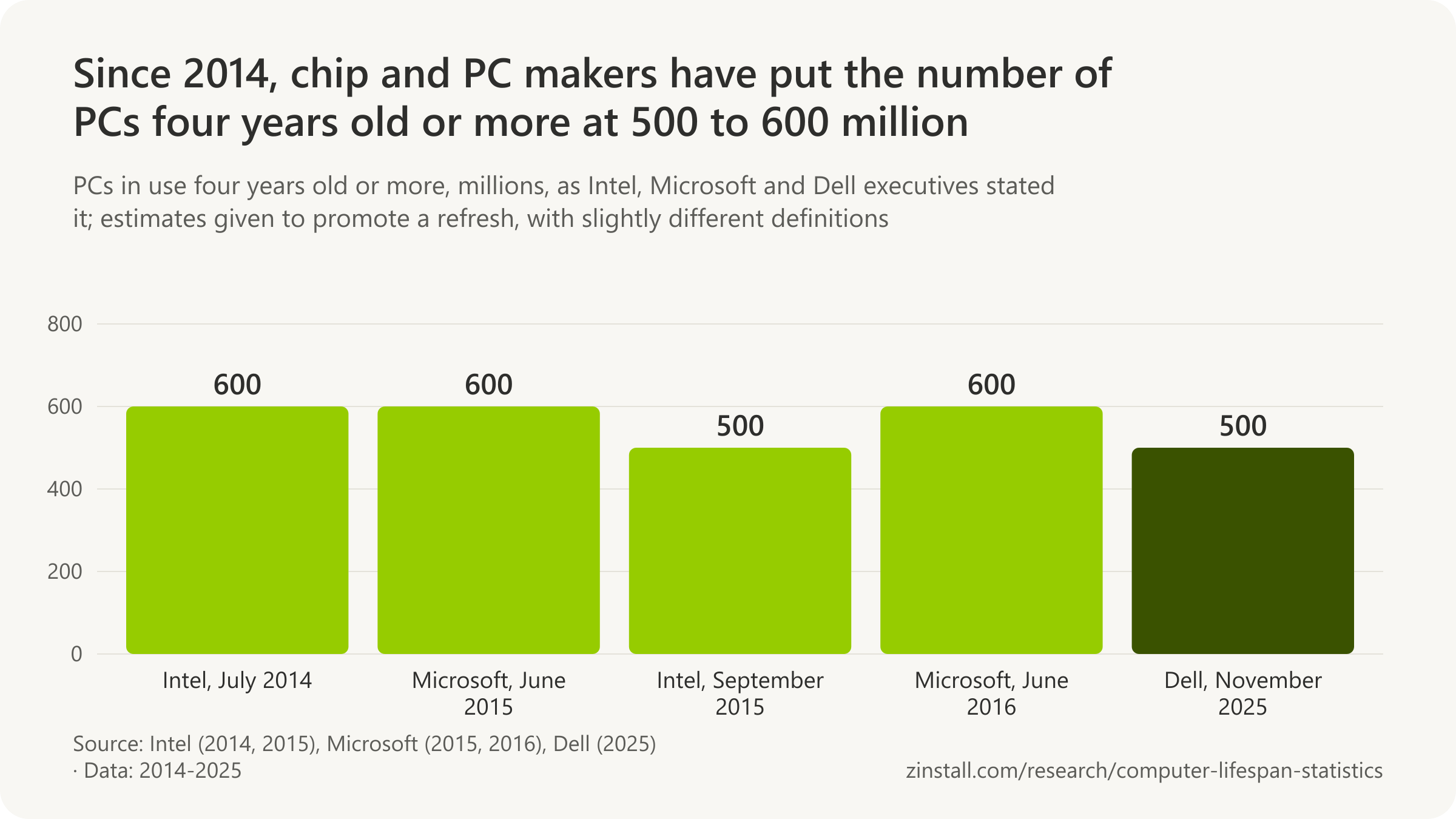
- 500 million of about 1.5 billion PCs in use were four years old or older and could not run Windows 11, by a maker's count.
- Windows runs on over 1.4 billion monthly active devices.
- 2 billion PCs in use by early 2014 was a 2008 forecast that no later count has shown.
- 80.5% of US households had a desktop or laptop computer in 2024.
- 41.8% of German households had a desktop PC in 2023, down from 62.1% in 2008.
| Measure, source and date | Figure |
|---|---|
| PCs at least four years old, as Intel put it in 2014 | 600 million |
| Computers four to five years old or older, Intel, 2015 | over 500 million |
| PCs over five years old, as Apple put it in 2016 | 600 million |
| Windows devices in use, 2016 | more than 1 billion |
| Windows 11 users, January 2026 | 1 billion |
| Active Macs, 2018 (Apple's latest count) | 100 million |
| PCs in use worldwide, 2008 | 1 billion |
| Households with a computer worldwide, 2019 | 49.7% |
| Japanese households with a PC, 2025 | 64.4% |
| South Korean households with a computer, 2024 | 77.2% |
Sources: Dell Technologies (2026, 2025); Microsoft Corporation (2026, 2025, 2016); Gartner, Inc.; U.S. Census Bureau; Statistisches Bundesamt; Intel (2015, 2014); Apple; TechCrunch; International Telecommunication Union; Ministry of Internal Affairs and Communications of Japan; Ministry of Science and ICT and NIA; Microsoft (2016, 2015)
Related guides: Windows 8.1 to Windows 11 · Windows 7 to Windows 11
More statistics (40)
Nobody counts the world's PCs directly. Microsoft reports active Windows devices, Apple its active devices, and PC and chip makers estimate how many PCs are old, usually when arguing that it is time to replace them. Forecasts that the installed base would double did not come true, and household surveys show the share of homes with a computer flat or falling in rich countries as phones take over.
PCs four years old or more
- Over 600 million PCs in use were more than five years old, Apple's marketing chief said in March 2016 when presenting the 9.7-inch iPad Pro as a PC replacement, without giving a source (Apple, 2016).
- About five to six years was the PC replacement cycle in 2016, up from an average of four, Intel's CEO said at an investor conference in June 2016 (Intel, 2016).
- The PC refresh remains 'a meaningful opportunity, given the large installed base of devices that are over four and five years old', Dell's COO said on 26 February 2026, three months after his 500 million figures (Dell, 2026).
- 33% (roughly one third) of the PC installed base consisted of devices four years or older in May 2026, Dell's COO said, describing the remaining refresh runway (Dell, 2026).
- 'More cost-sensitive customers are extending their upgrade cycles,' increasing the number of older devices in the installed base, Dell's COO said on 1 September 2026 as memory prices pushed PC prices up (Dell, 2026).
- 1.5 billion units is the size of the PC installed base Dell COO Jeff Clarke gave from memory on the company's 25 November 2025 earnings call (Dell, 2025).
How many PCs are in use

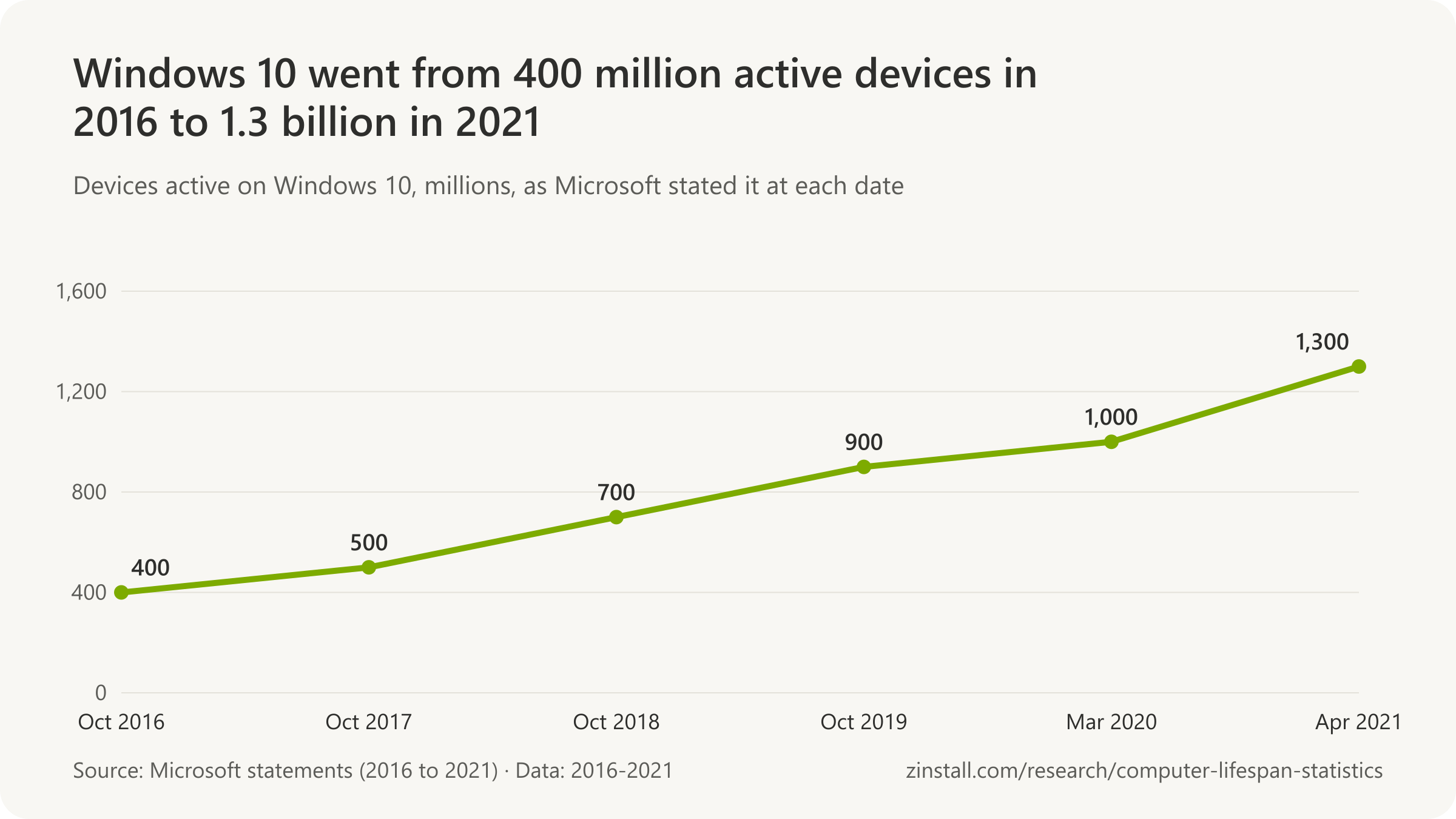
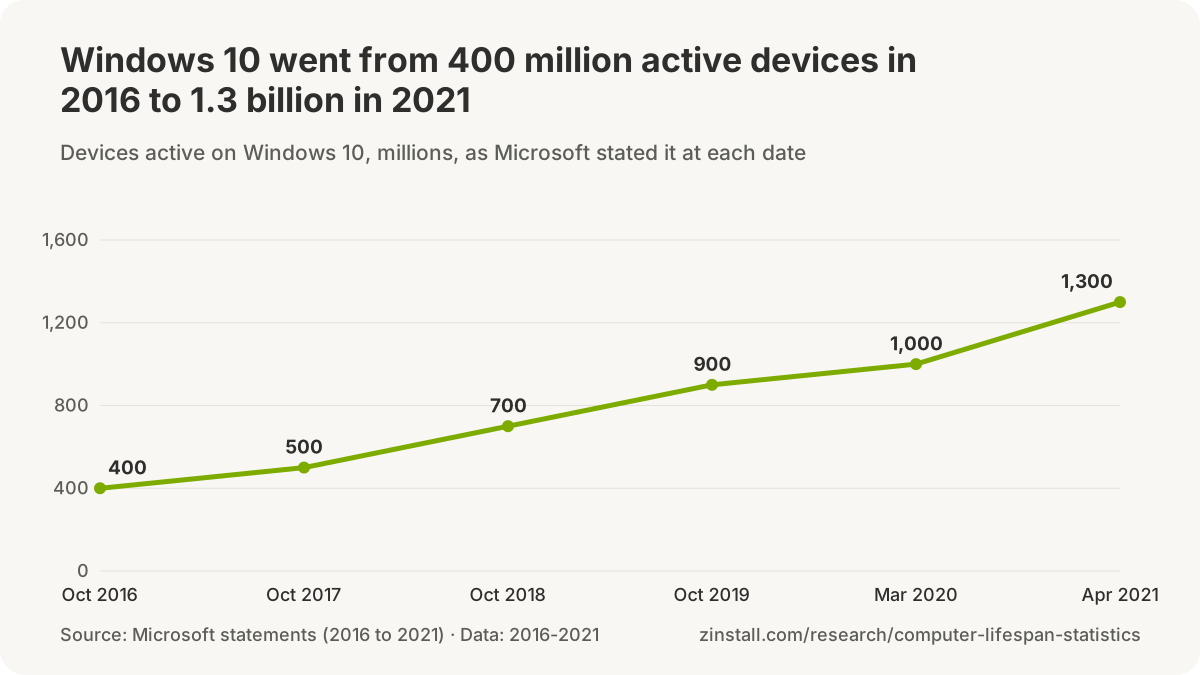
- More than 1 billion Windows devices made up Microsoft's installed base in October 2016, more than 400 million of them already on Windows 10 (Microsoft, 2016).
- More than 1 billion devices were active on Windows 10 in October 2020, Microsoft said in its 2020 annual report, about 63 months after the July 2015 launch (Microsoft, 2020).
- Over 1.4 billion monthly active devices run Windows, Microsoft said in its June 2025 post urging Windows 10 users to move before end of support, the same figure it gave in 2022 (Microsoft, 2025).
- Over a billion monthly active Windows devices was the figure Microsoft first published on 24 June 2025, a wording it changed to 'over 1.4 billion' within ten days after press reports read it as a 400 million drop (Microsoft, 2025).
- The number of devices running Windows 11 more than doubled in Microsoft's fiscal year to June 2023, its 2023 annual report said, without giving the count (Microsoft, 2023).
- 1 billion Windows 11 users was the milestone Microsoft's CEO announced in January 2026, up more than 45% year on year, three months after Windows 10's end of support (Microsoft, 2026).
- 1 billion PCs were in use worldwide by June 2008, Gartner estimated, with the installed base growing just under 12% a year (Gartner, 2008).
- 2 billion PCs in use by early 2014 was Gartner's June 2008 forecast, a level no later count has shown: Dell put the installed base at roughly 1.5 billion in November 2025 (Gartner, 2008).
- More than 1 billion PCs would be in use worldwide by the end of 2008, Forrester forecast in June 2007, 27 years after the first billion started accumulating (Forrester, 2007).
- More than 2 billion PCs in use by 2015 was Forrester's June 2007 forecast, a compound growth rate above 12% a year from 2003 (Forrester, 2007).
- More than 2.5 billion active Apple devices made up Apple's installed base in January 2026, the company said; Safari is the default browser on its iPhones, iPads and Macs, but Apple publishes no Safari user count (Apple, 2026).
- 100 million active Macs made up the Mac installed base in October 2018, Apple CEO Tim Cook said at the company's Brooklyn event, the most recent Mac count Apple has given (TechCrunch, 2018).
- 1.4 billion monthly active devices ran Windows 10 or Windows 11 in Microsoft's fiscal 2022 annual report shareholder letter, the figure most outlets cite for the Windows installed base (Microsoft, 2022).
Households with a computer

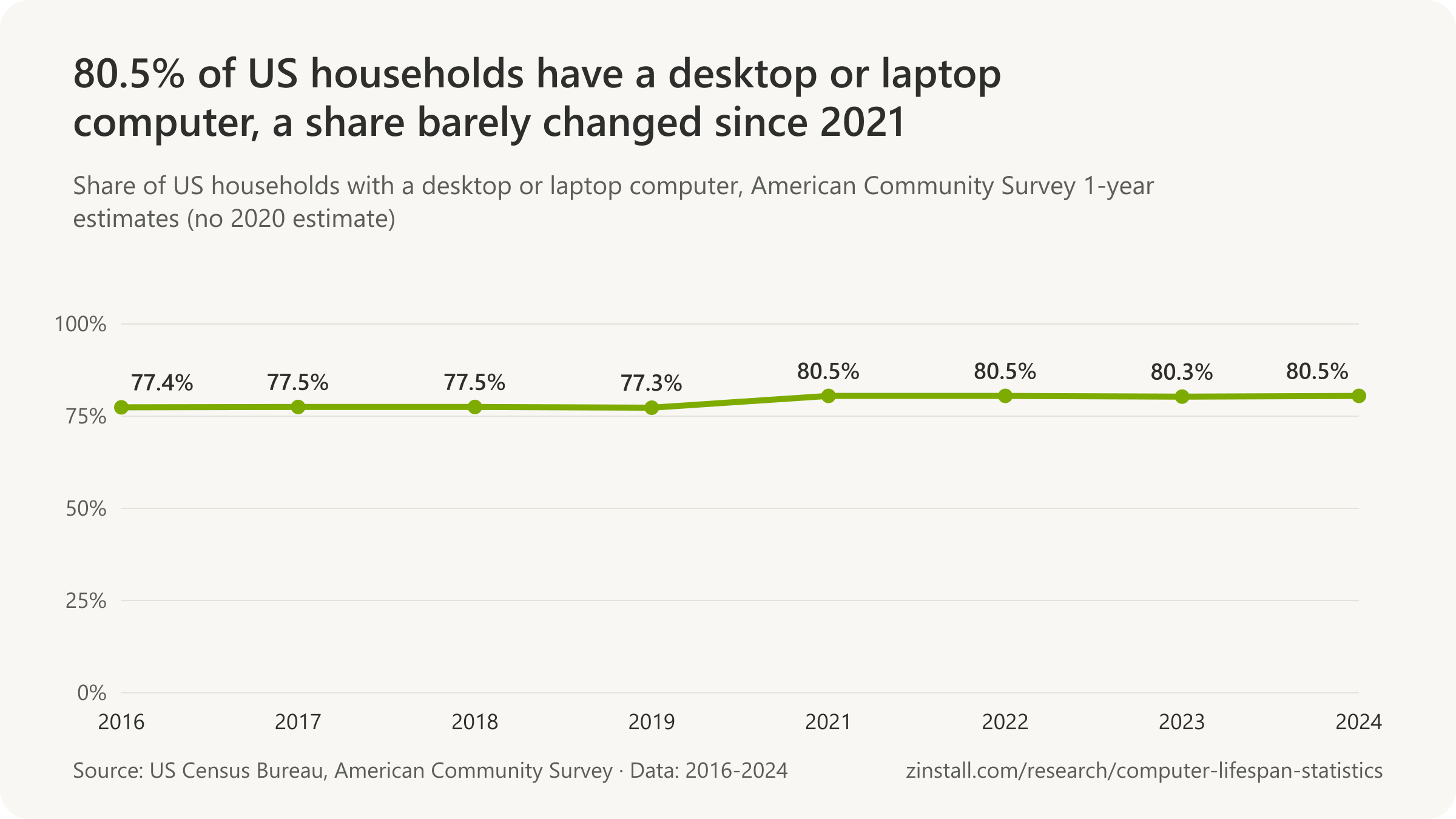
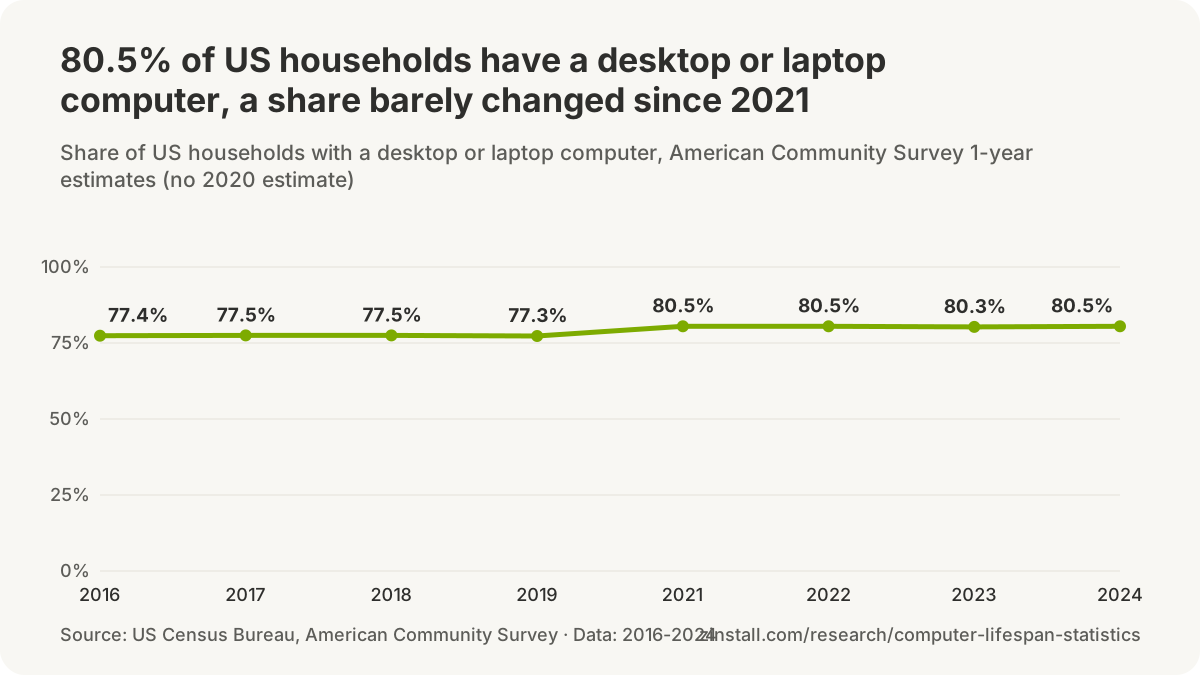

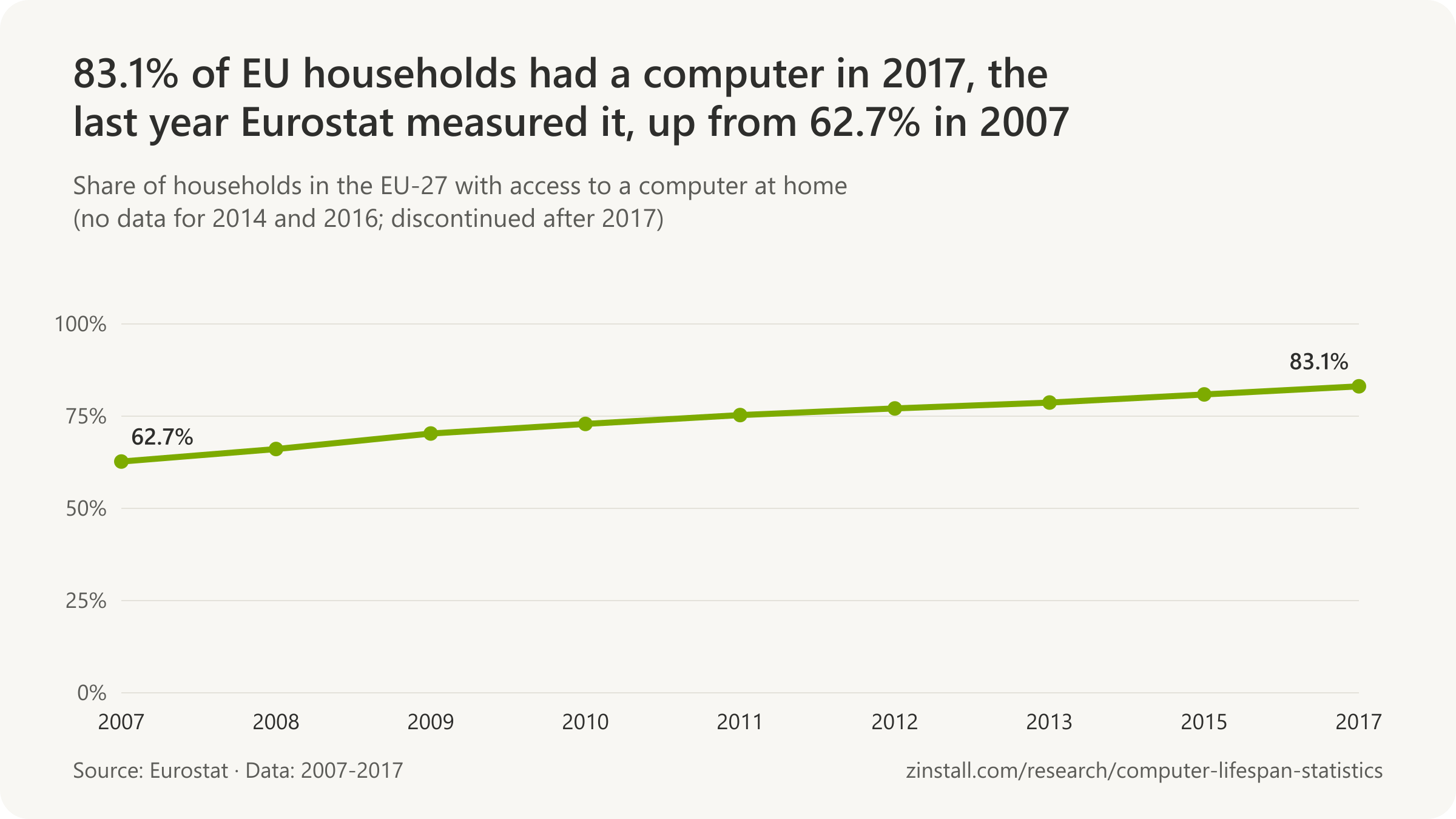
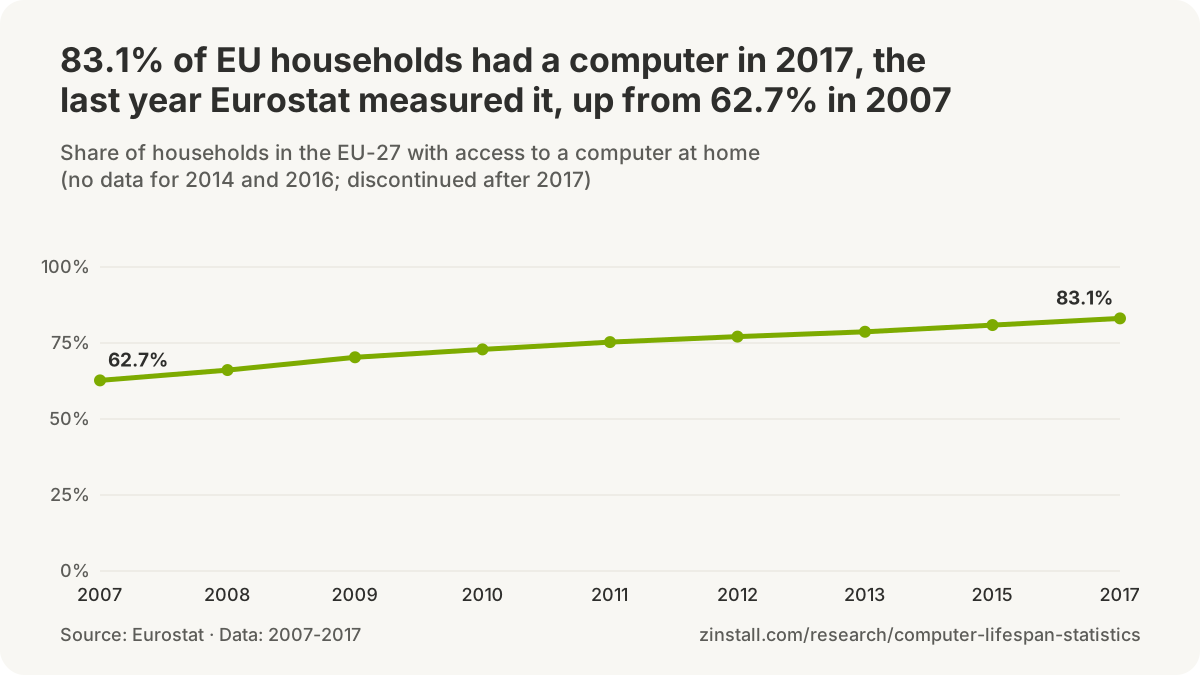

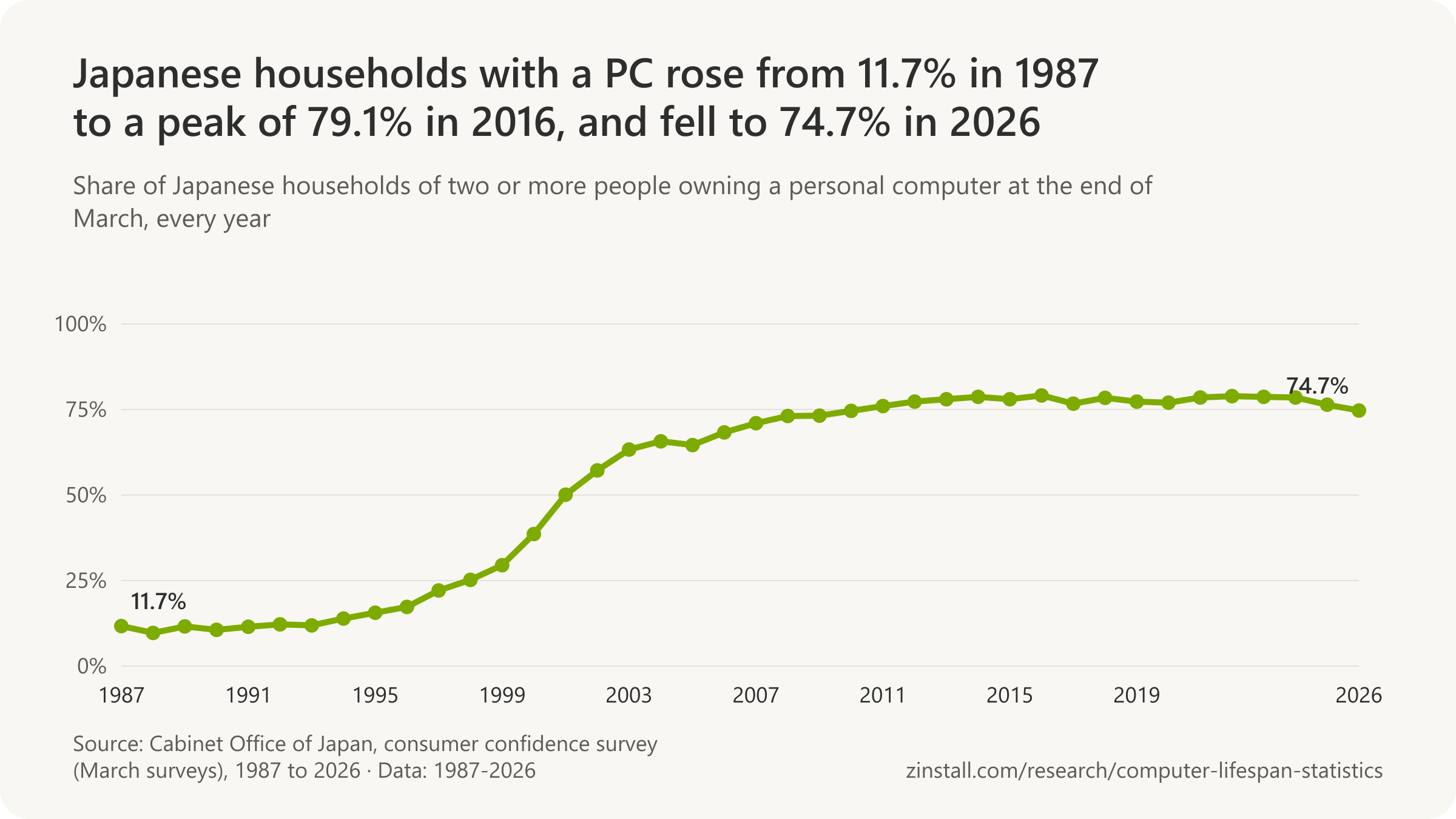
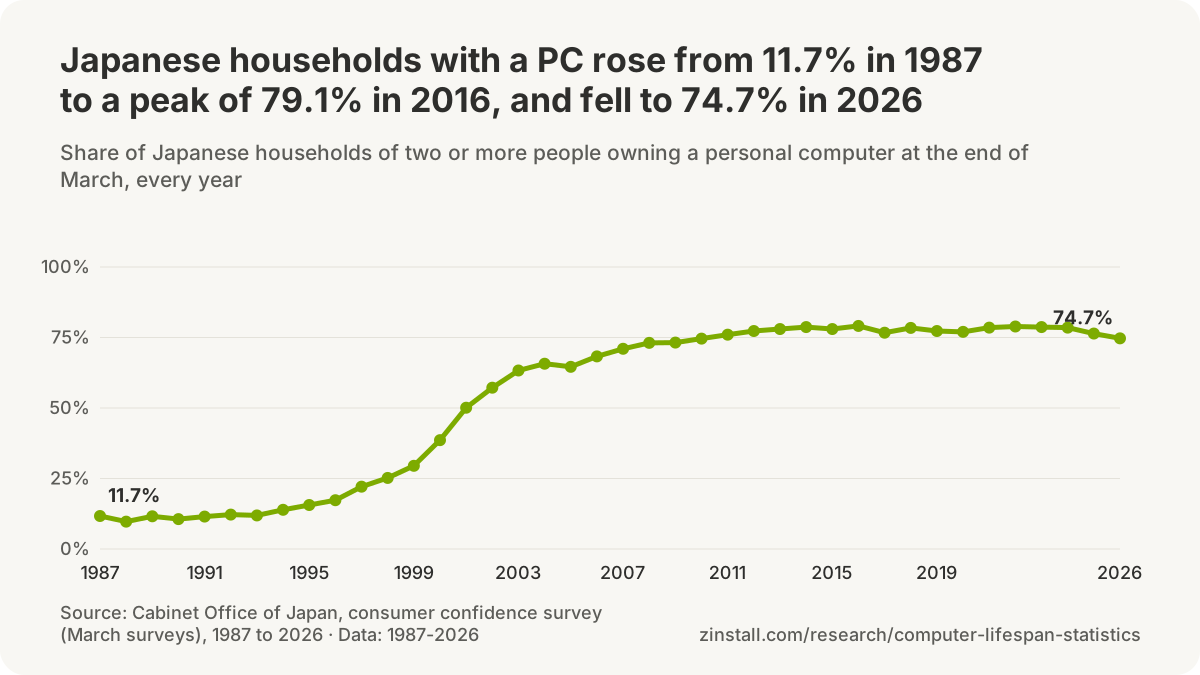

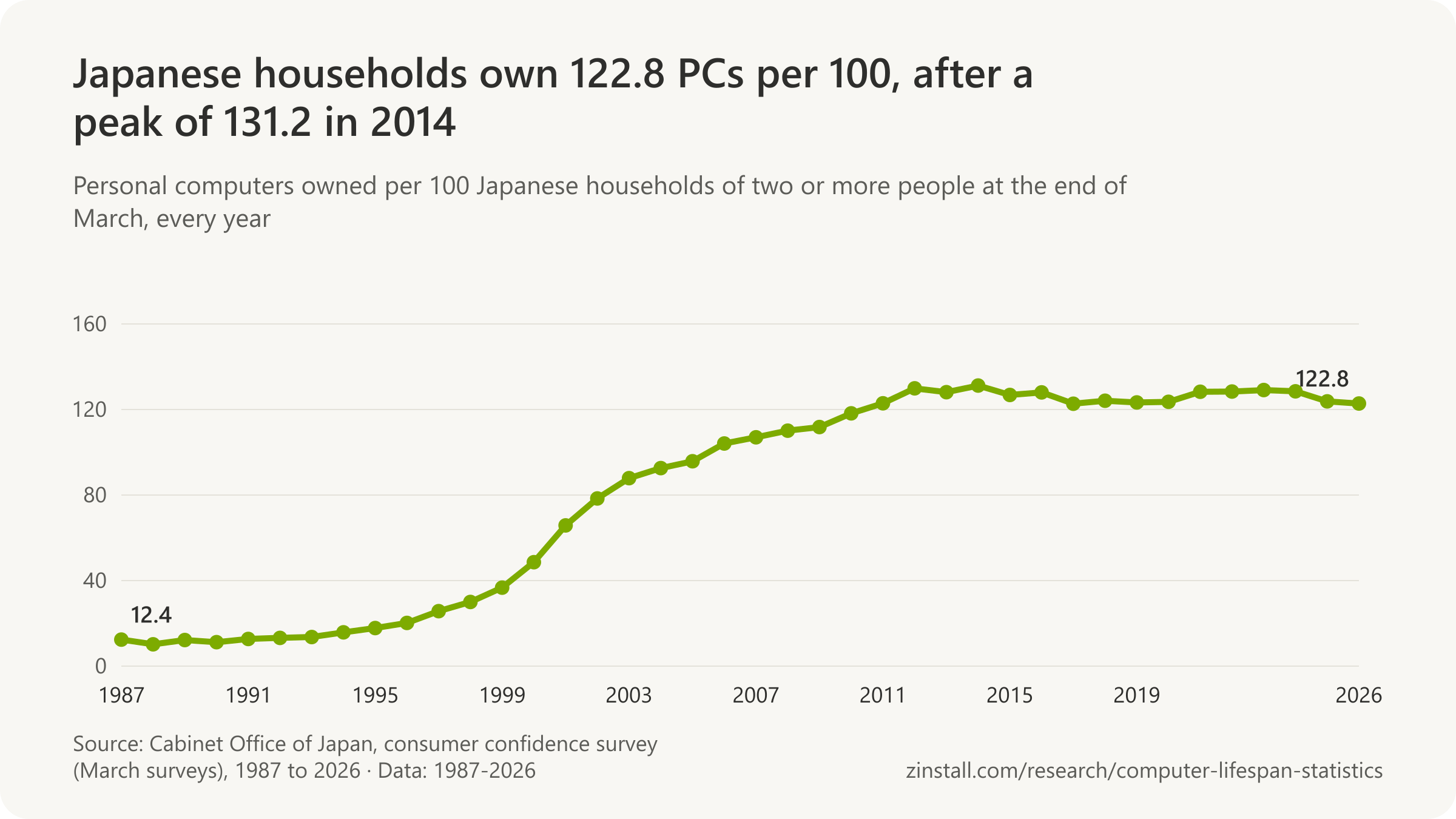
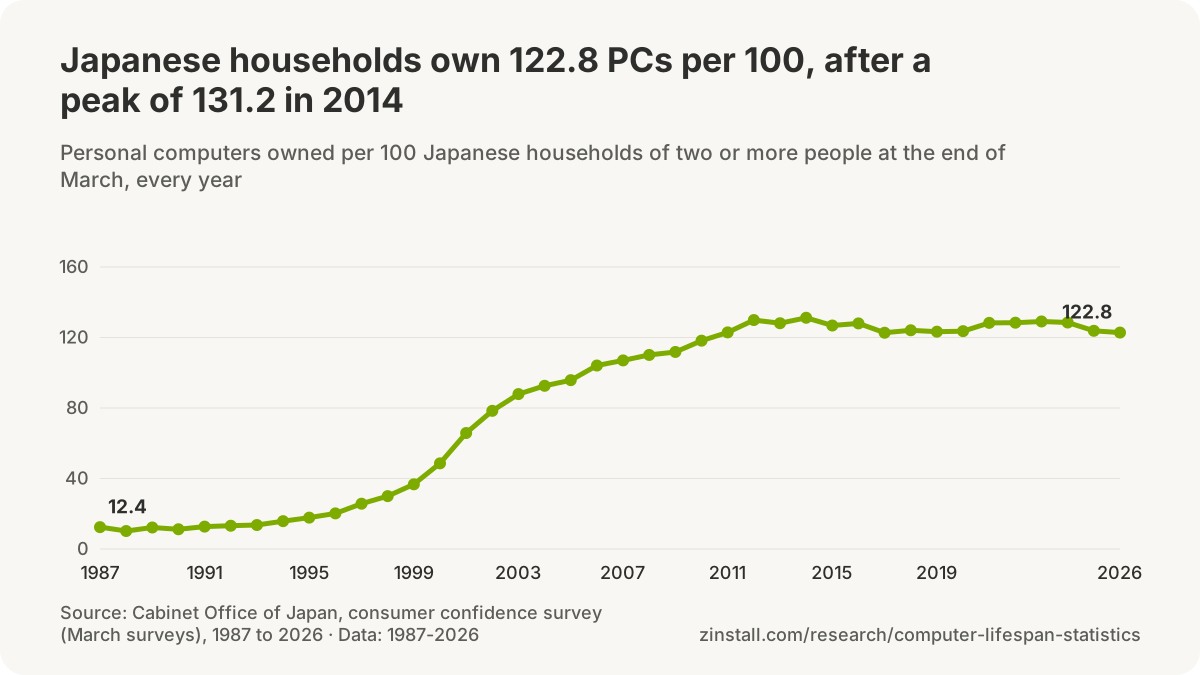
- 67.4% of all Japanese households owned a personal computer at the end of March 2026 (74.7% of households of two or more people and 54.7% of single-person households), in the Cabinet Office's consumer confidence survey (Cabinet Office of Japan, 2026).
- 43.2% of Japanese households of two or more people owned a tablet at the end of March 2026, against 74.7% for personal computers, in the Cabinet Office's consumer confidence survey (Cabinet Office of Japan, 2026).
- 83.2% of Japanese households of two or more people whose head was in their fifties owned a personal computer at the end of March 2026, against 66.2% where the head was 70 or older and 62.1% where the head was under 30 (Cabinet Office of Japan, 2026).
- 9.9% of U.S. households had a smartphone but no other type of computer in 2024, and 3.4% had no computer at all (U.S. Census Bureau, 2025).
- About 106.9 million U.S. households, 80.5% of 132.7 million, had a desktop or laptop computer in 2024 (U.S. Census Bureau, 2025).
- 92.9% of households in Germany had access to a computer in 2017 (Eurostat, 2024).
- 84.1% of households in France had access to a computer in 2017 (Eurostat, 2024).
- 72.5% of households in Italy had access to a computer in 2017 (Eurostat, 2024).
- 78.4% of households in Spain had access to a computer in 2017 (Eurostat, 2024).
- 81.8% of households in Poland had access to a computer in 2017 (Eurostat, 2024).
- 97.6% of households in Netherlands had access to a computer in 2017 (Eurostat, 2024).
- 91.7% of households in the United Kingdom had access to a computer in 2017 (Eurostat, 2024).
- 94.8% of German households owned a personal computer at the start of 2024: 79.1% a laptop or notebook and only 40.7% a desktop PC (Destatis, 2026).
- 257 personal computers per 100 German households were in use at the start of 2024, including 116 laptops or notebooks, 90 tablets and 51 desktop PCs (Destatis, 2026).
- About 45 million laptops and 20 million desktop PCs were in German households at the start of 2024, by Destatis' counts per 100 households (Destatis, 2026).
- 41.8% of German households had a desktop PC in 2023, down from a peak of 62.1% in 2008, while 89.2% had a laptop, netbook or tablet, which Destatis counts as mobile PCs (Destatis, 2025).
- 64.4% of Japanese households owned a personal computer in August 2025, down from 74.0% in 2018, while 91.8% owned a smartphone (MIC Japan, 2026).
- 83.4% of Japanese households owned a personal computer at the end of 2010, the high point of the 2010-2015 series (MIC Japan, 2016).
- 77.2% of South Korean households owned a computer (desktop, laptop or tablet) in July 2024, down from a peak of 82.3% in 2012 (MSIT and NIA, 2025).
- 49.7% of households worldwide had a computer in 2019 by ITU's estimate: 82.3% in developed countries, 38.5% in developing countries and 9.5% in the least developed (ITU, 2019).
- Almost half of all households worldwide had at least one computer in 2018, up from just above a quarter in 2005, ITU estimated (ITU, 2018).
Sources: Apple (2016, 2026); Intel; Dell Technologies (2025, 2026); Microsoft Corporation (2016-2026); Gartner, Inc.; Forrester Research; TechCrunch; Microsoft; Cabinet Office of Japan, Economic and Social Research Institute (2026); U.S. Census Bureau (2017-2025); Eurostat; Statistisches Bundesamt; Ministry of Internal Affairs and Communications of Japan (2016, 2026); Ministry of Science and ICT and NIA; International Telecommunication Union (2018, 2019)
How many PCs are sold each year?
284.7 million PCs were shipped worldwide in 2025, up 8.1% on 2024 (IDC, 2026).

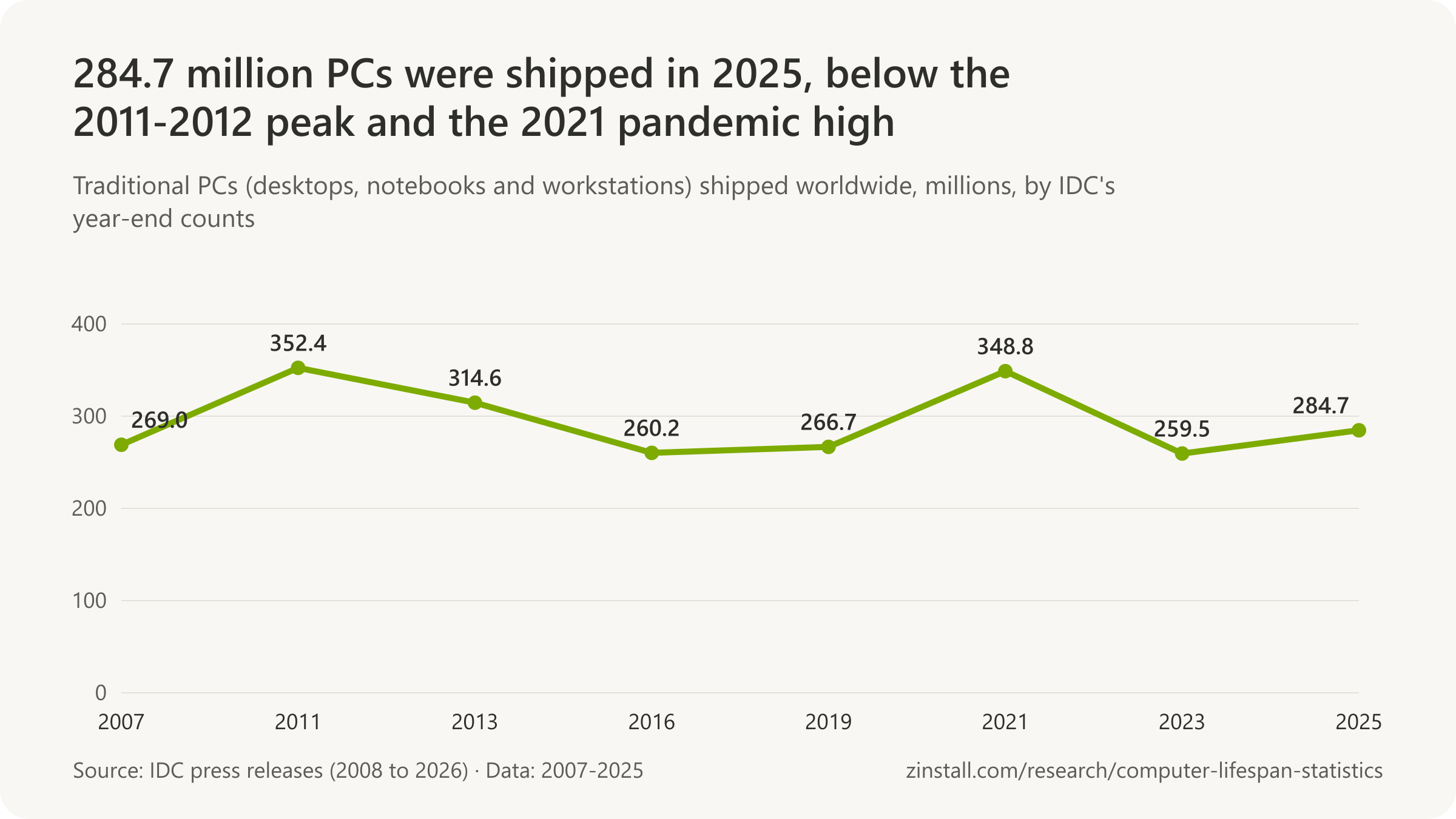
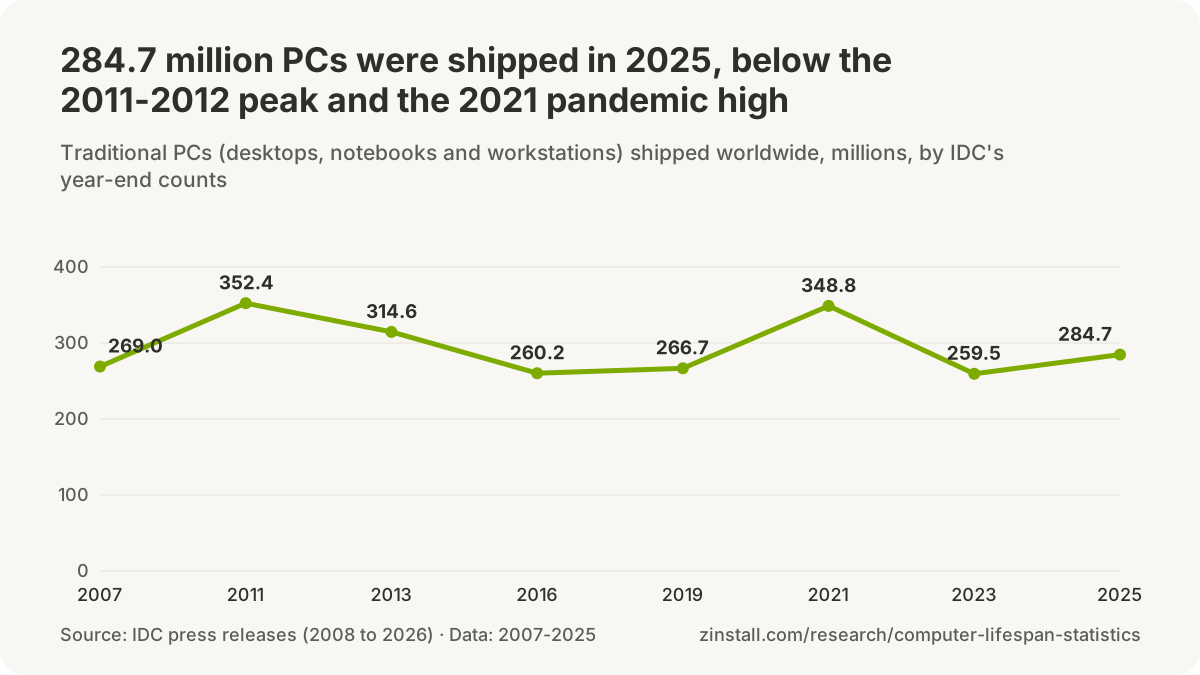
- It would take 5.3 years of 2025's shipments to replace every PC in use, against 3.3 years in 2008.
- 219.7 million notebooks and 59.1 million desktops were shipped worldwide in 2025.
- PC shipments were forecast to fall 11.3% in 2026, as memory shortages pushed prices up.
- 18.1 million PCs were shipped in Japan in the year to March 2026, a record, driven by the Windows 10 refresh.
| Firm, measure and period | Figure |
|---|---|
| Gartner: PCs shipped, 2025 | 270.2 million |
| Omdia: PCs shipped, 2025 | 278.7 million |
| Gartner: PCs shipped in the 2011 peak year | 352.8 million |
| IDC: PCs shipped in the pandemic year 2021 | 348.8 million |
| IDC: PCs shipped in Q3 2026 | 62.7 million |
| Share of the installed base replaced in 2008, Gartner's forecast | 16% |
| Chromebooks shipped, 2020 | 30.6 million |
| Macs sold, fiscal 2018 (the last year Apple reported units) | 18.2 million |
| Gartner: forecast change in shipments, 2026 | -10.4% (forecast) |
| AI PCs' share of shipments, 2025 estimate | 31% |
Sources: International Data Corporation (2008-2026); Dell Technologies and IDC; Omdia; MM Research Institute; Gartner, Inc. (2008-2026); Omdia, incorporating Canalys; Canalys; Apple Inc.
Related guides: HP's migration tool and alternatives · A new HP laptop or desktop
More statistics (67)
Three analyst firms count PC shipments, each with its own definition, so their totals differ by millions in the same year. Shipments peaked in 2011 and 2012, fell for most of a decade as people kept PCs longer, jumped during the pandemic and rose again with the Windows 10 refresh of 2025, before memory prices sent them down in 2026. Dividing the installed base by a year's shipments gives a rough measure of how often PCs are replaced, though not a lifespan.
Shipments by year

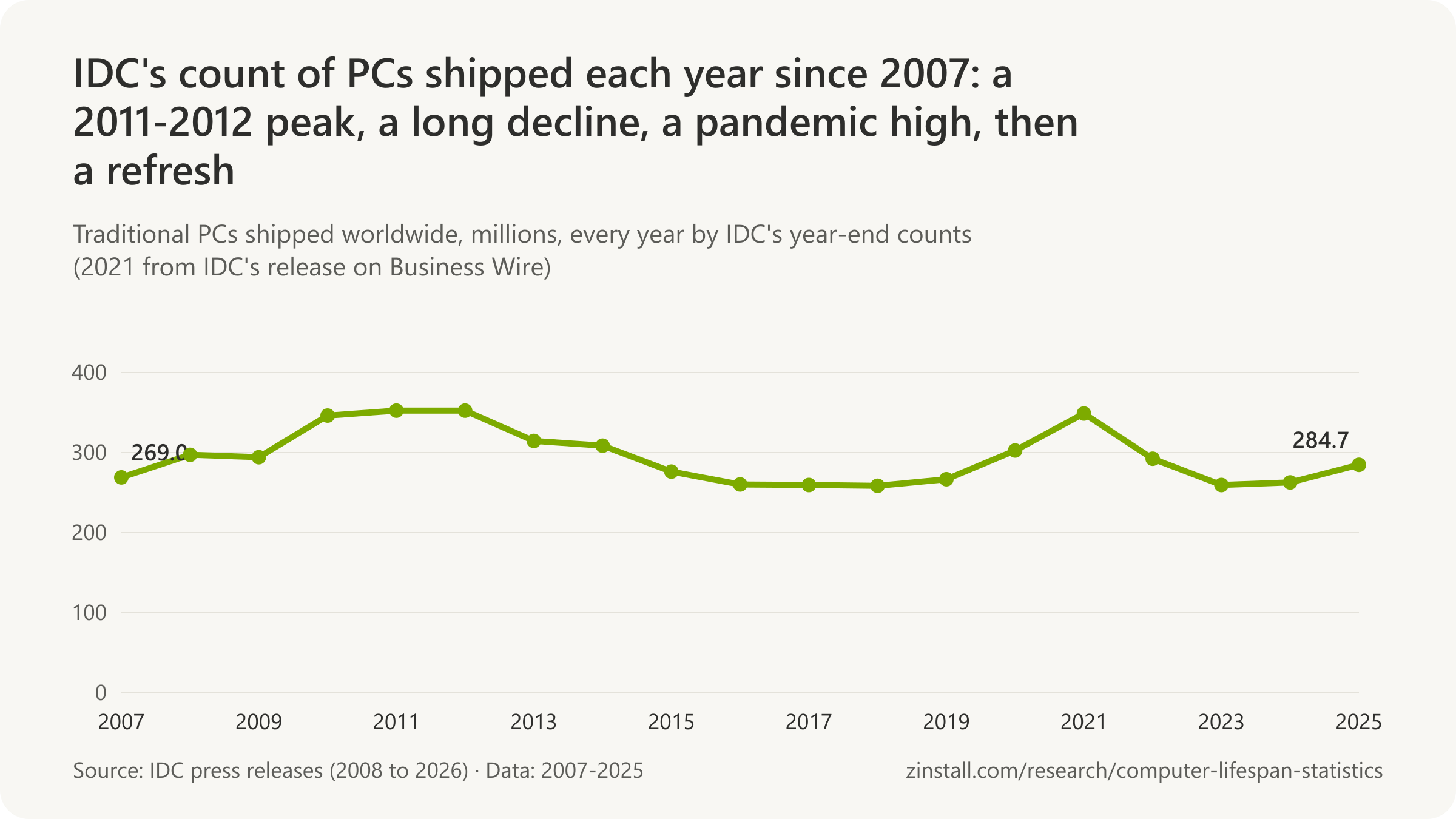
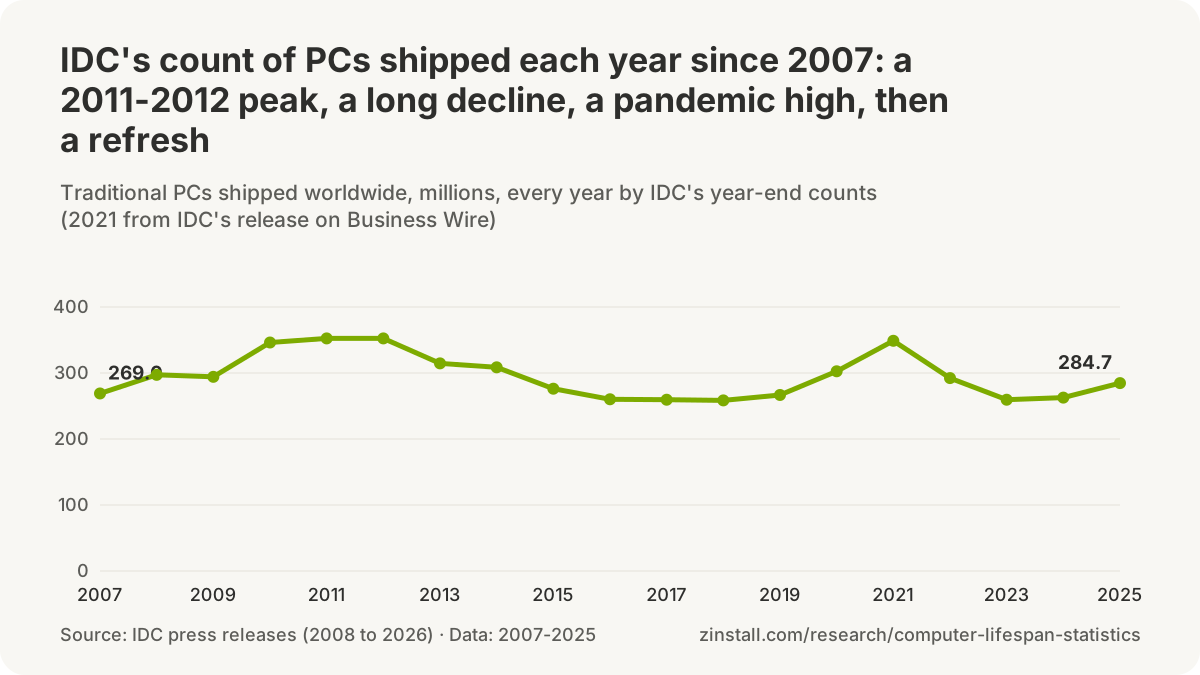

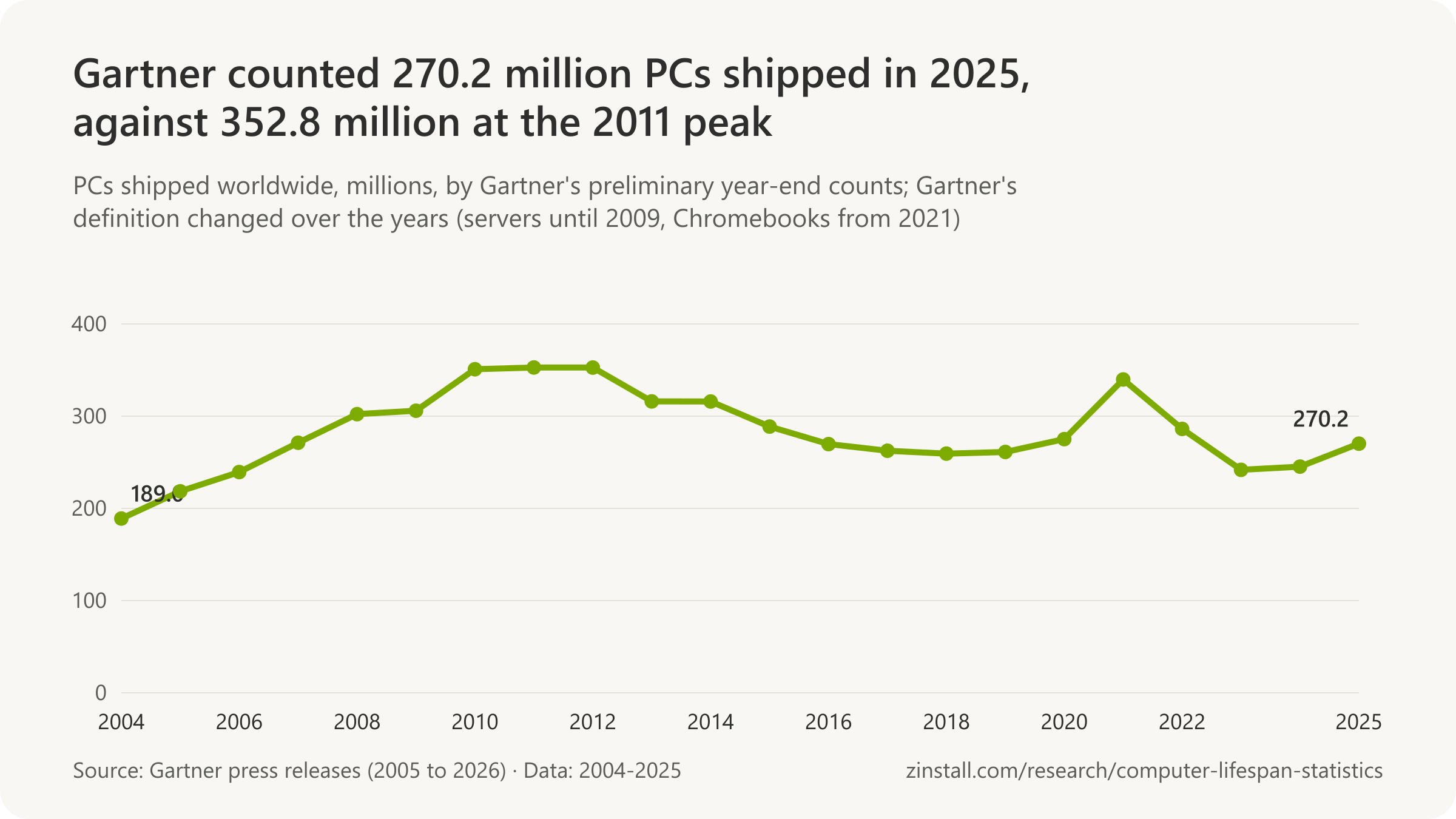
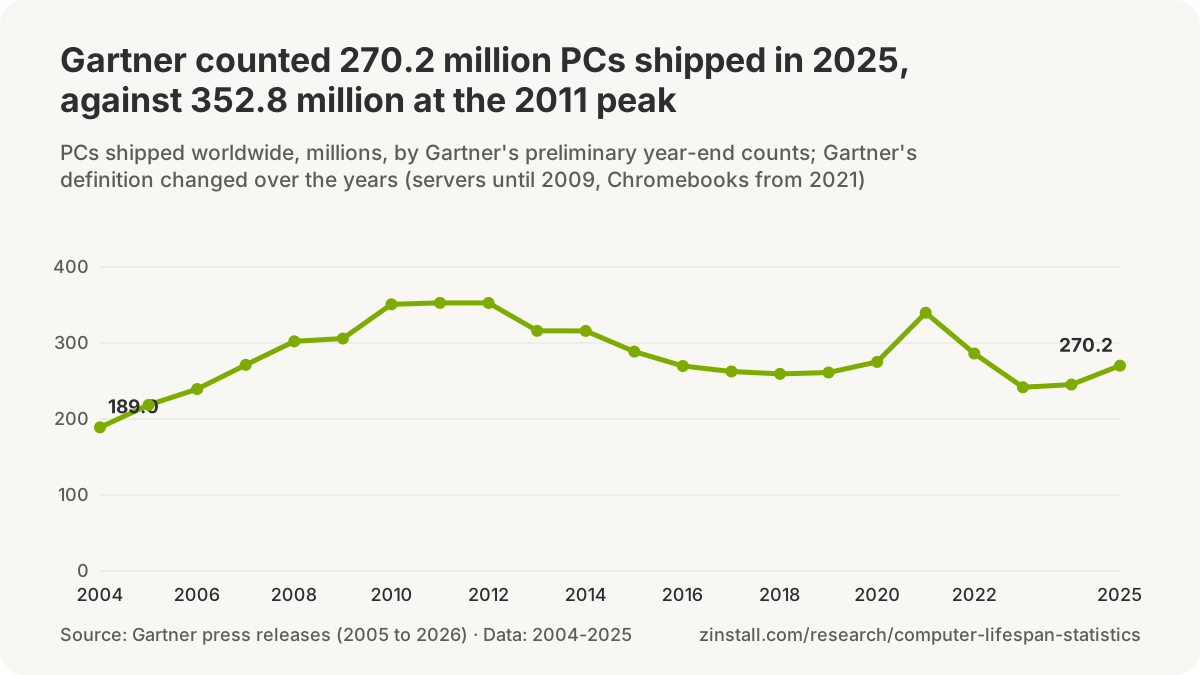

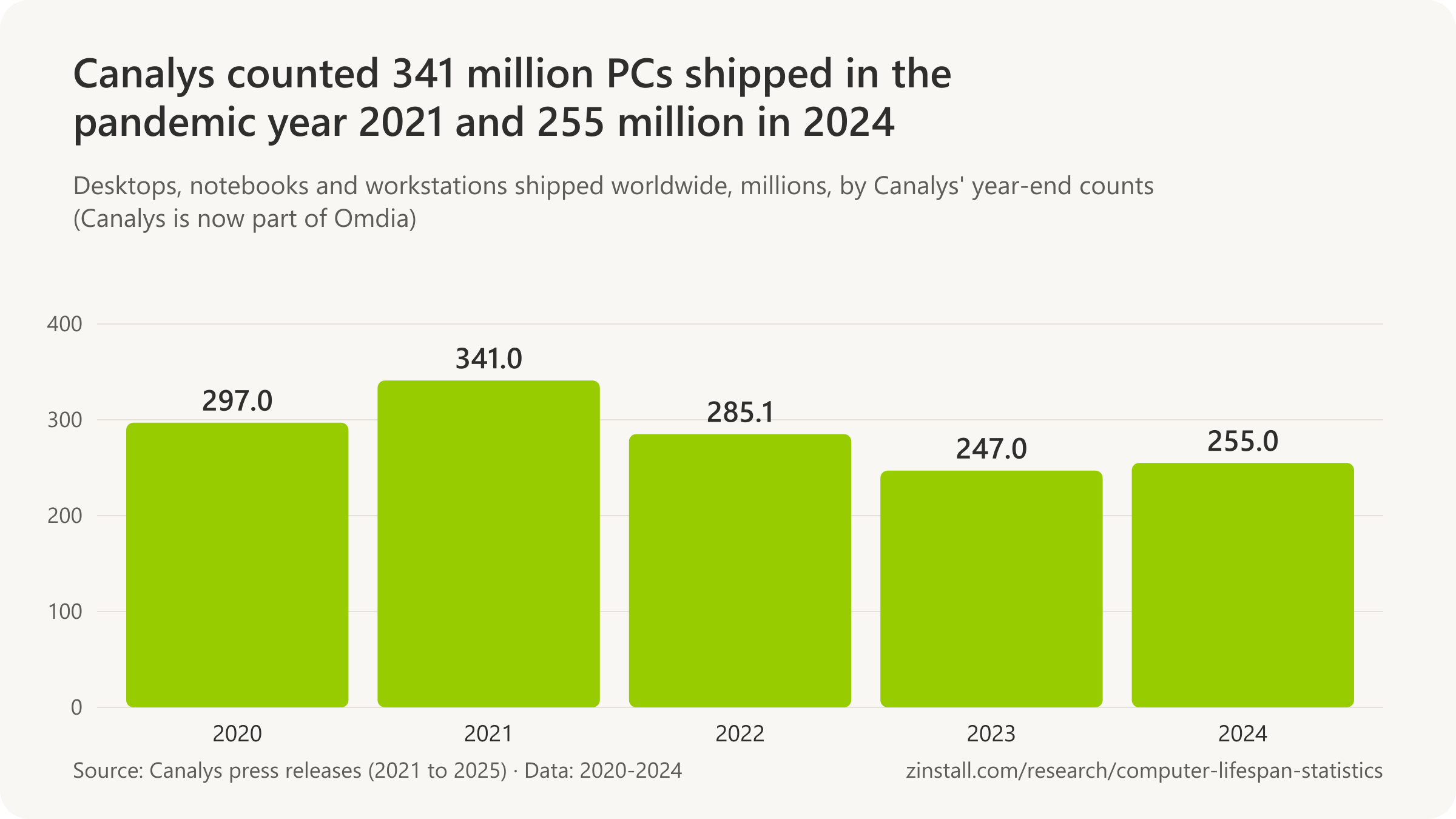
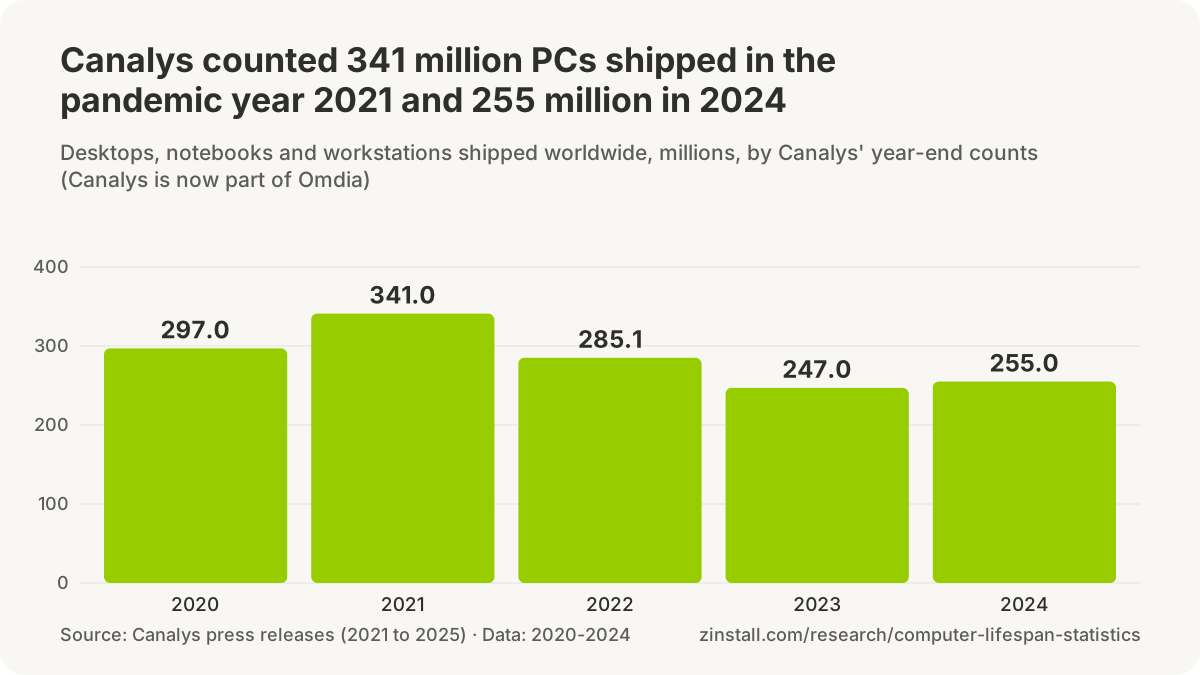

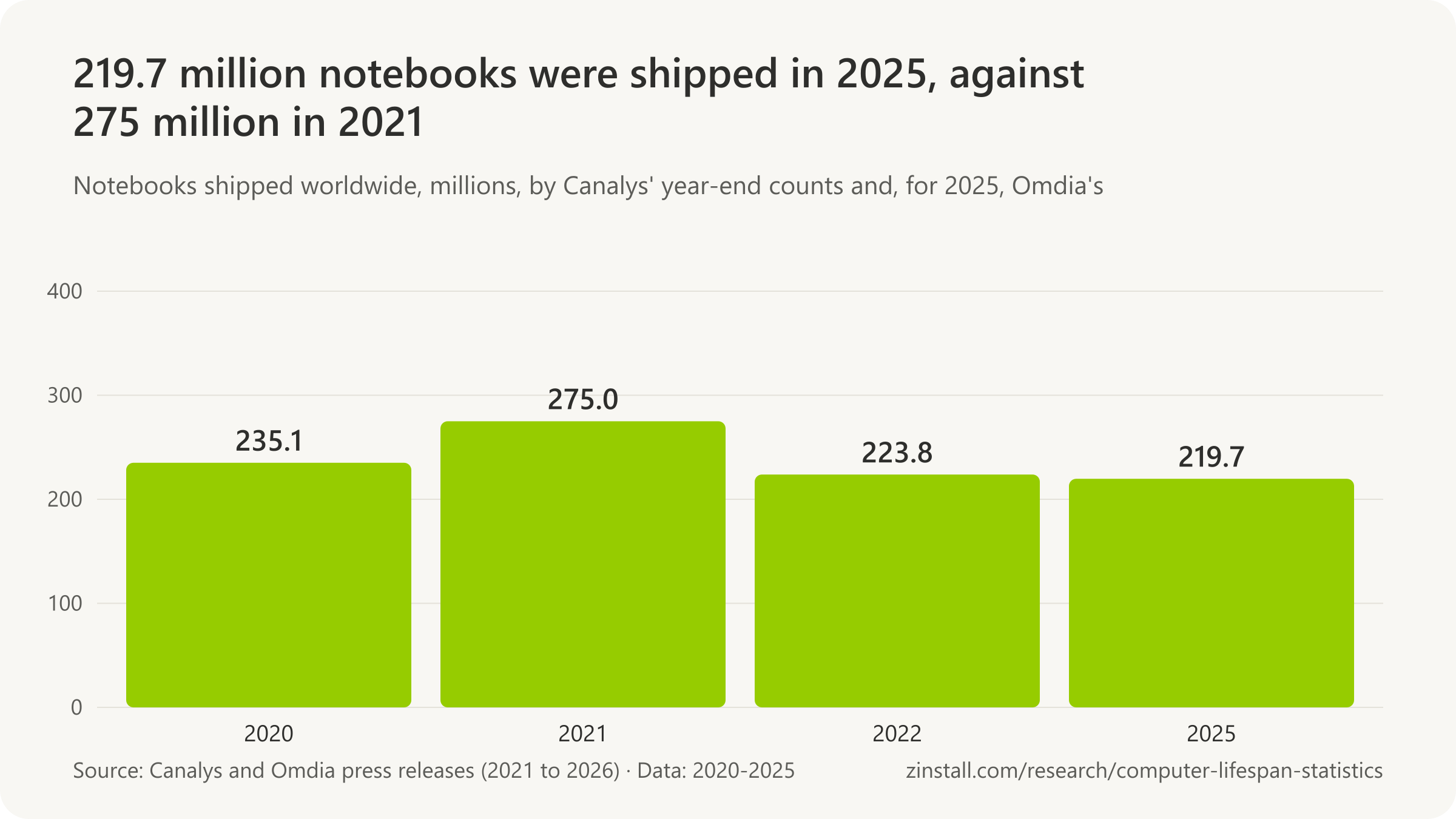
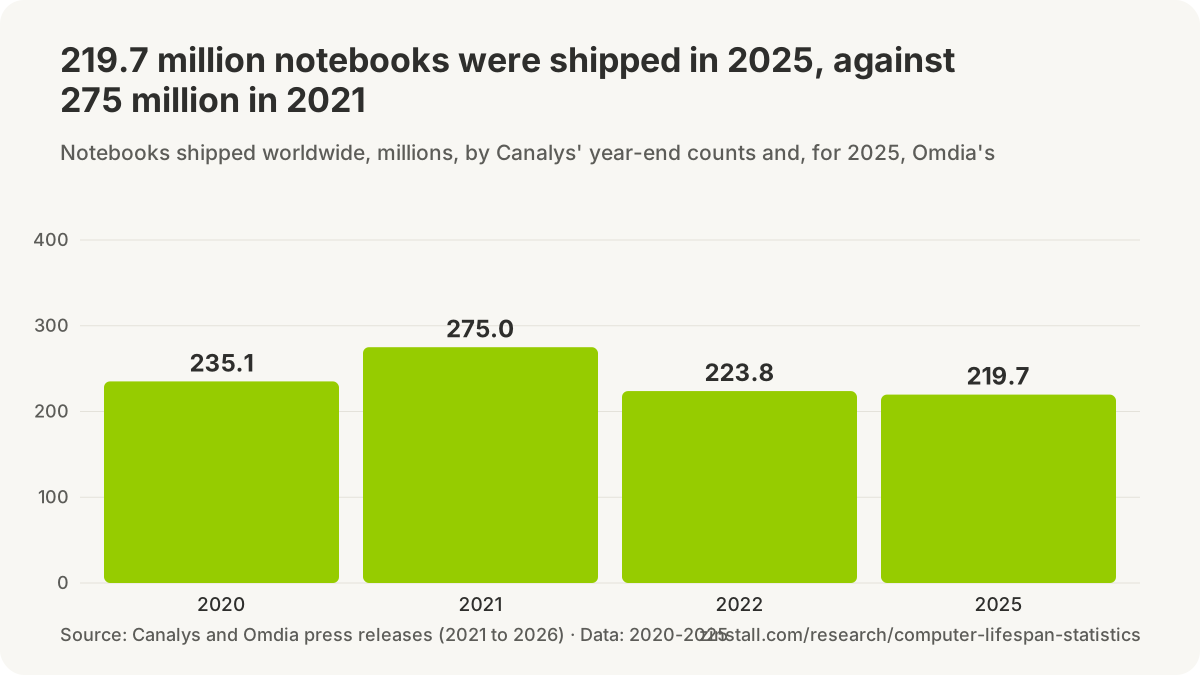
- 128.1 million PCs were shipped worldwide in 2001, down 4.6% from 2000, the first annual decline since 1985, in a Gartner Dataquest count not comparable with Gartner's later series (Gartner Dataquest preliminary, 2002).
- A larger than normal share of PCs shipped during the pandemic were new additions to the installed base rather than replacements, especially for education and remote work, Canalys said in January 2022 (Canalys, 2022).
- Education devices deployed at the pandemic peak would reach the end of their life cycle by 2024, Canalys said in January 2023, three to four years after purchase (Canalys, 2023).
- AI-capable PC shipments were forecast to surpass 100 million in 2025, 40% of all PC shipments, after an estimated 48 million (18%) in 2024 (Canalys forecast, 2024).
- 278.7 million desktops, notebooks and workstations were shipped worldwide in 2025, up 9.1% from 2024 (Omdia, 2026).
The Windows 10 refresh and the 2026 memory shock

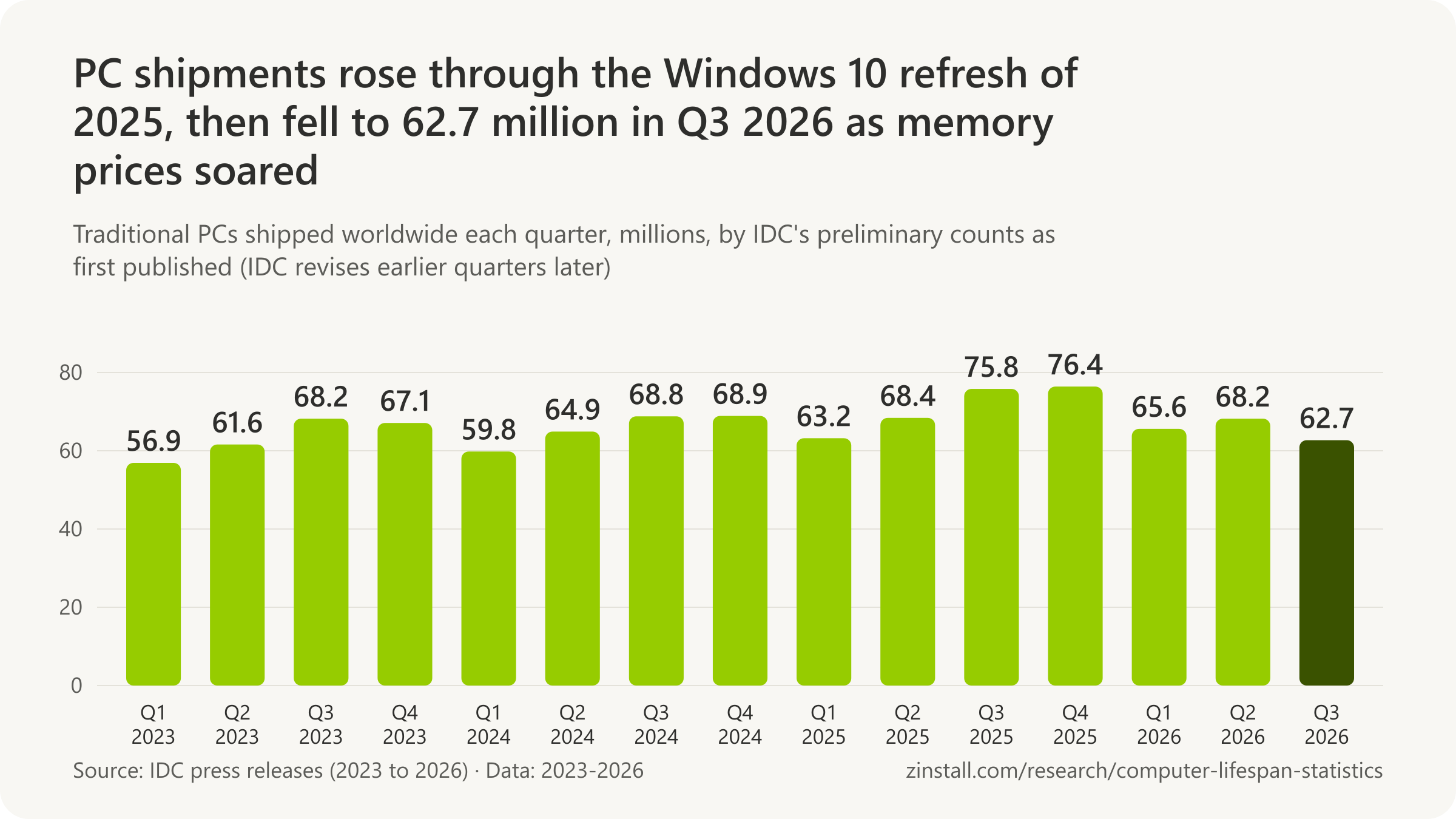
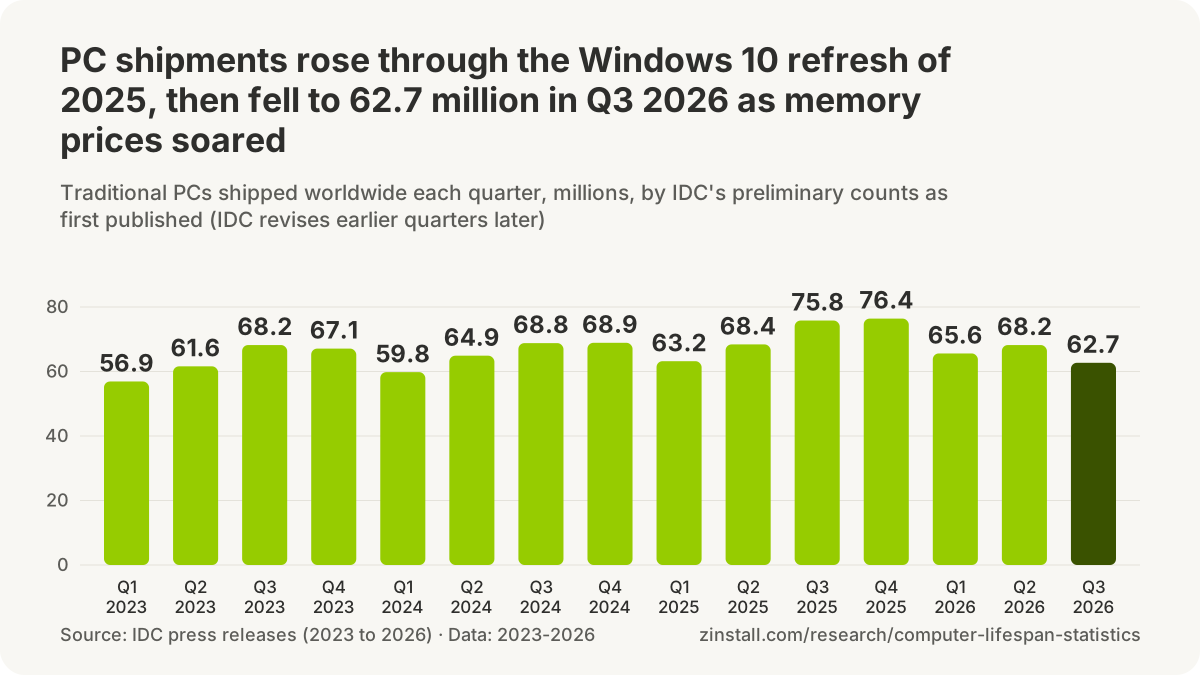

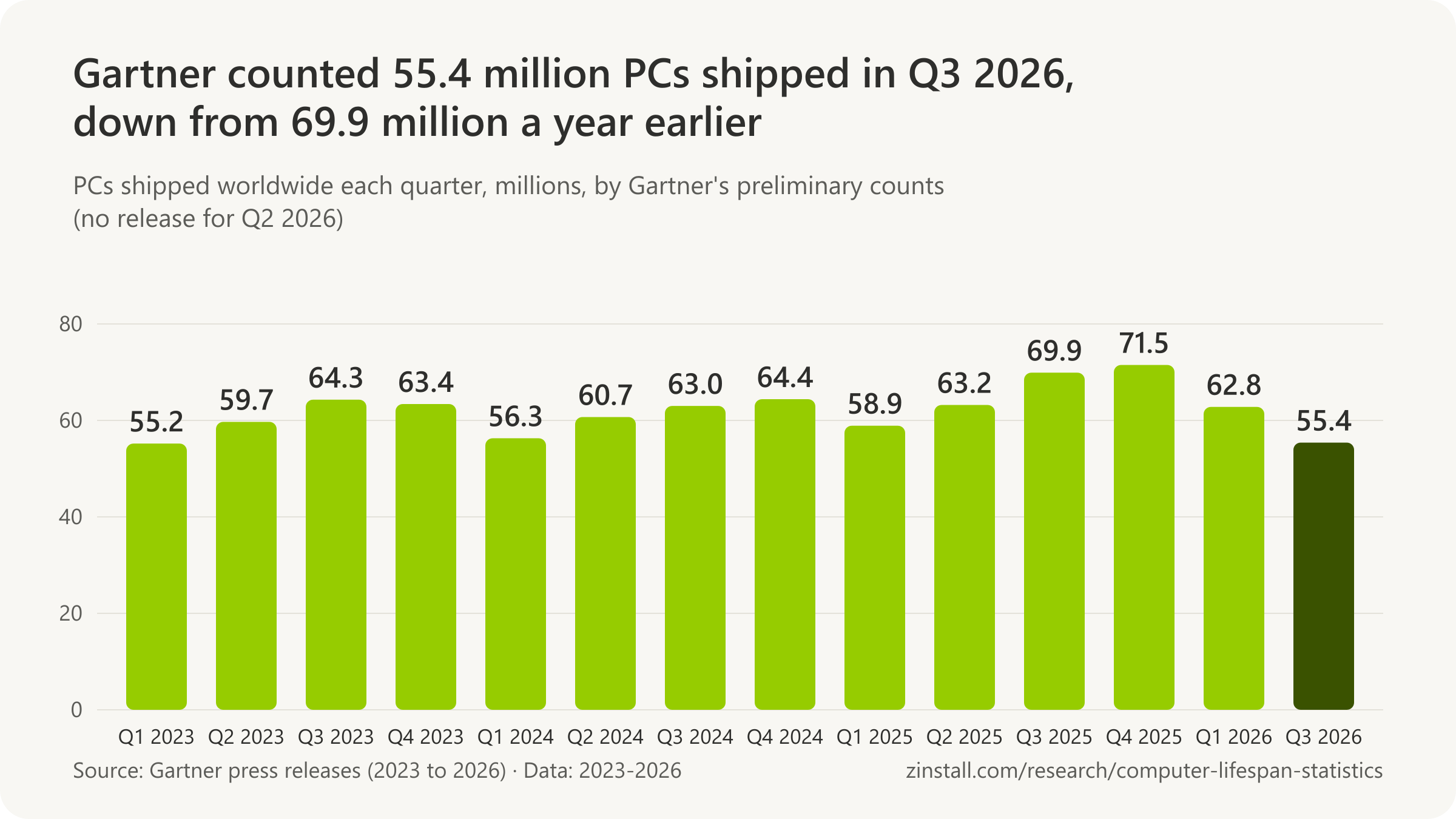
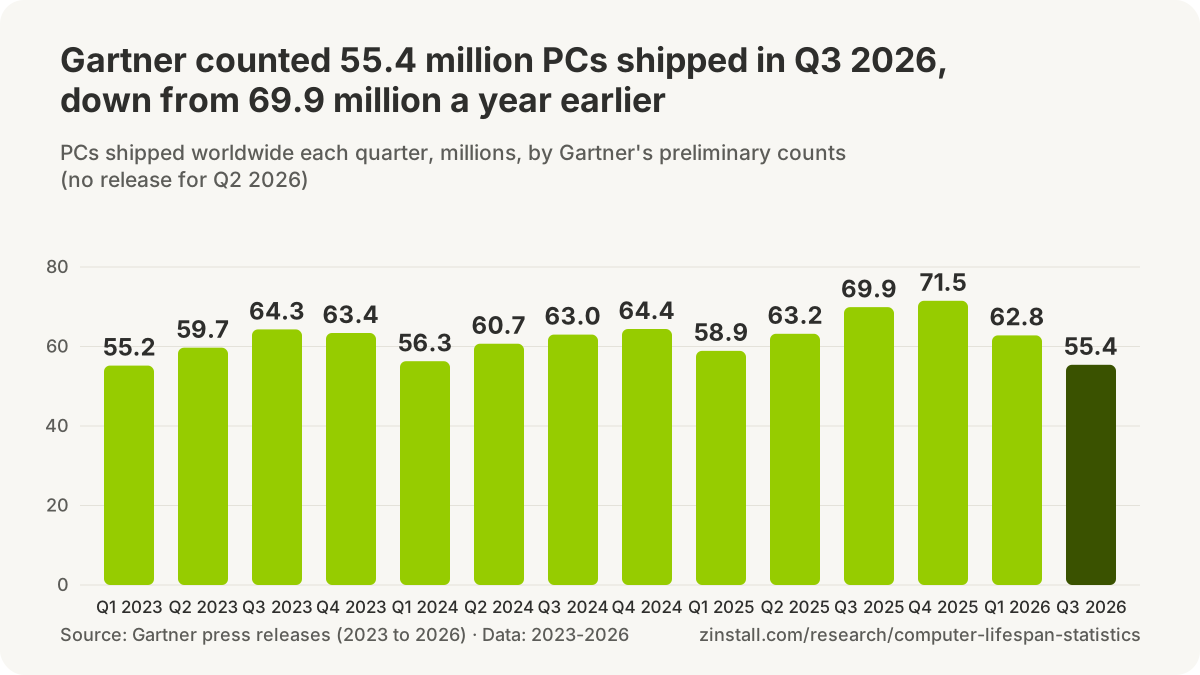

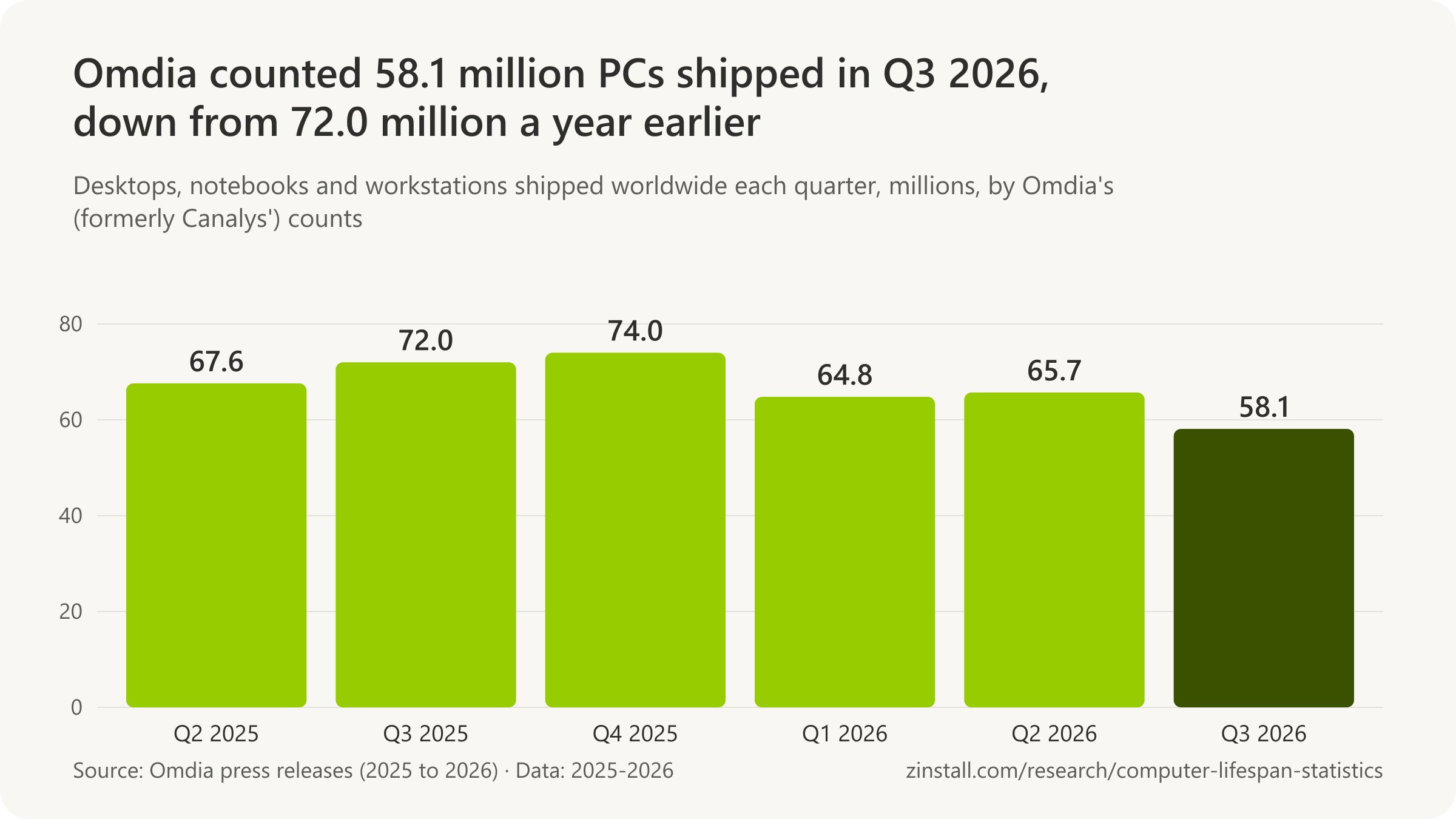
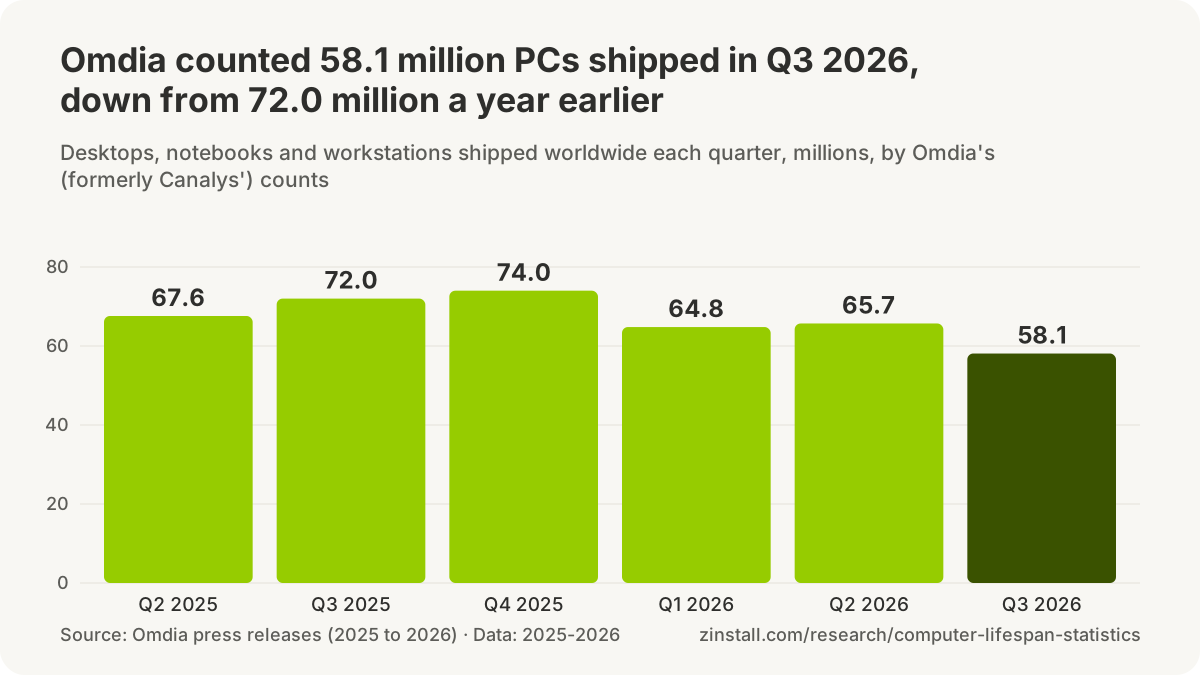
- 11.2 million PCs are forecast to ship in Japan in fiscal 2026, down 37.8%, as the Windows 10 and GIGA School refresh ends and memory costs push prices up more than 20% (MM Research Institute, 2026).
- A 130% surge in combined DRAM and SSD prices by the end of 2026 was expected to raise PC prices by 17% compared with 2025 levels (Gartner forecast, 2026).
- Worldwide PC shipments decreased moderately year on year in the second quarter of 2026, impacted by higher memory costs, according to Gartner's preliminary market share alert (Gartner, 2026).
- The business PC market was ready for its next replacement cycle driven by Windows 11 upgrades, Gartner said when reporting the third quarter of 2023 (Gartner, 2023).
- Demand for the Windows PC refresh driven by the end of Windows 10 support in 2025 did not fully pick up in the third quarter of 2024, Gartner said (Gartner, 2024).
- Gartner expected solid PC shipment growth in 2025 reflecting delayed Windows 11 PC refresh demand, after only modest growth of 1.4% in the fourth quarter of 2024 (Gartner, 2025).
- 15.6% year-on-year PC shipment growth in Japan in the first quarter of 2025 was driven by strong business PC demand for Windows 11 replacements and Chromebook adoption (Gartner, 2025).
- Gartner reported in the second quarter of 2025 that the expected surge in new device purchases had been subdued because many organizations chose to update existing PCs to Windows 11 rather than invest in new hardware (Gartner, 2025).
- Gartner forecast in July 2025 that worldwide PC shipments would rise 2.4% in 2025, propelled by tariff-driven front-loading in the U.S. and Windows 11 replacement cycles elsewhere; the actual preliminary result was 9.1% (Gartner, 2025).
- Worldwide PC shipments in the third quarter of 2025 were driven by the Windows 10 end-of-support refresh cycle in most regions, while North America's growth was limited to 1.6% (Gartner, 2025).
- 31% of worldwide PC shipments in 2025 were expected to be AI PCs with integrated NPUs, up from 15% in 2024, according to Gartner's estimate made during the Windows 10 EOS refresh (Gartner, 2025).
- Tariff volatility, anticipated memory price hikes in 2026 and the rising cost of Windows 10 Extended Security Updates prompted businesses to prioritise replacing hardware in 2025, Gartner said (Gartner, 2026).
- The 4% year-on-year PC shipment growth in the first quarter of 2026 was artificially inflated by vendors and distributors building inventory ahead of expected second-quarter price hikes driven by memory price inflation, Gartner said (Gartner, 2026).
- DRAM costs surged five times year on year in the second quarter of 2026 and PC shipments in the third quarter fell to levels last seen in early 2023, Gartner said (Gartner, 2026).
- Worldwide PC shipments were forecast to decline 10.4% in 2026 compared with 2025 because of soaring memory costs (Gartner forecast, 2026).
- PC memory costs were expected to peak at 23% of the bill of materials in 2026, up from 16% in 2025, and the sub-$500 entry-level PC segment was expected to disappear by 2028 (Gartner forecast, 2026).
- IDC said in April 2023 that an aging installed base would start coming up for refresh by 2024, with businesses moving to Windows 11 (IDC, 2023).
- IDC said in October 2023 that a device refresh cycle and the end of support for Windows 10 would help drive PC sales in the second half of 2024 and beyond (IDC, 2023).
- Many businesses had begun refreshing PCs in preparation for the end of Windows 10 support by the third quarter of 2024, with Japan growing double digits and leading the transition (IDC, 2024).
- IDC said the underlying demand factors for PCs, such as the installed base upgrade ahead of Windows 10 end of support, remained strong in the first quarter of 2025 (IDC, 2025).
- Outside a flat US market, PC demand in the second quarter of 2025 was fuelled by an aging installed base and a steady transition to Windows 11, IDC said (IDC, 2025).
- IDC said third-quarter 2025 PC demand was driven largely by Japan's hardware refresh linked to Windows 10 end-of-support and the GIGA education project, with slower Windows 11 adoption elsewhere (IDC, 2025).
- IDC described 2025 as a year marked by the end of support for Windows 10, which drove a wave of upgrade demand, and by tariff concerns and memory shortages that pulled inventory forward (IDC, 2026).
- First-quarter 2026 PC shipment growth of 2.5% was mostly fuelled by anticipation of rising component prices, Windows 10 migration and new product introductions, IDC said (IDC, 2026).
- IDC said in July 2026 that the memory shortage was not expected to ease until early 2028 and that sustained cost pressure could temper the broader PC upgrade cycle (IDC, 2026).
- IDC said in October 2026 that PC prices would remain elevated and that the outlook for the next few quarters could get worse before it gets better, after shipments fell 20.1% in the third quarter (IDC, 2026).
- Global PC shipments were forecast to decline 11.3% in 2026, cut from a -2.4% outlook published in November 2025, because of memory shortages and supply constraints (IDC forecast, 2026).
- Despite an 11.3% unit decline, the worldwide PC market was forecast to grow 1.6% in value to $274 billion in 2026 because of higher average selling prices (IDC forecast, 2026).
- IDC expected fourth-quarter 2026 PC shipments to fall about 20% year on year and PC average selling prices to rise 17% in 2026, with no quick fix to the memory shortage (IDC forecast, 2026).
- PC vendors including Lenovo, Dell, HP, Acer and ASUS confirmed price increases of 15% to 20% as the memory shortage collided with the Windows 10 end-of-life refresh cycle, IDC wrote in December 2025 (IDC, 2025).
- Windows PCs, 83% of worldwide PC shipments, were forecast to decline 12% in 2026, Chrome devices 28% and Macs 5% (Omdia forecast, 2026).
- More than half of B2B channel partners polled by Omdia in June 2026 said their customers were putting off hardware refresh plans until the market stabilised, and 6% expected outright cancellations, eight months after the Windows 10 deadline (Omdia, 2026).
- Mainstream PC memory and storage costs rose by 40% to 70% between the first and fourth quarters of 2025, with the increases passed through to customers (Omdia, 2026).
- Worldwide shipments of desktops, notebooks and workstations were forecast to decline 12% to 245 million units in 2026 because of memory and storage price increases (Omdia forecast, 2026).
- Memory and storage costs for PCs had risen roughly five-fold and three-fold respectively since the first quarter of 2025 by April 2026, as AI data centres crowded consumer categories out of supply (Omdia, 2026).
Who sells the most

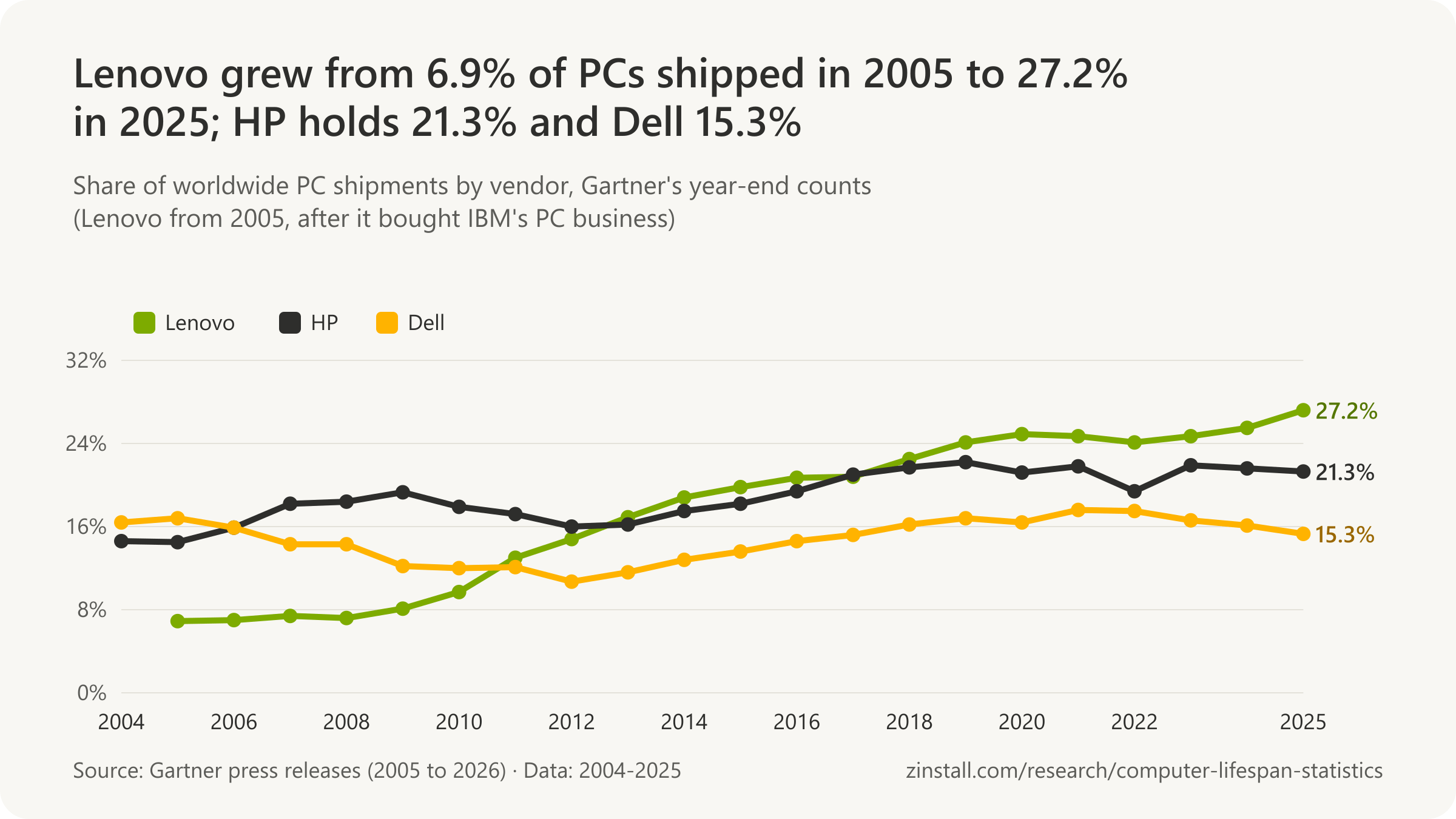
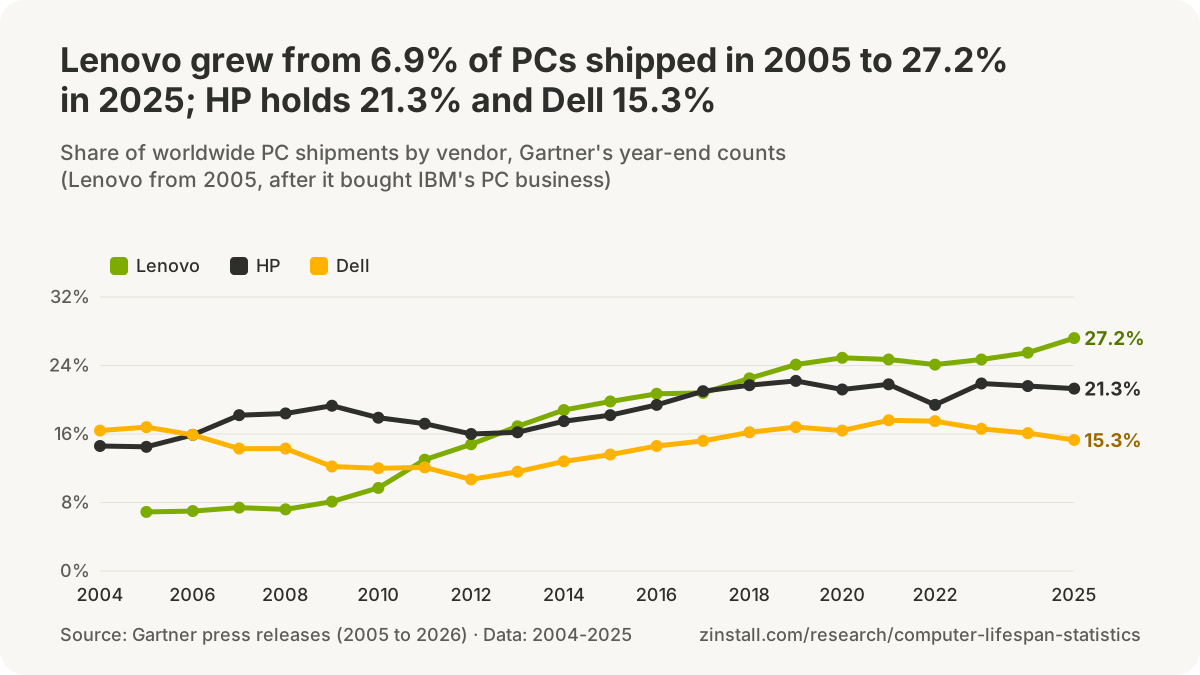

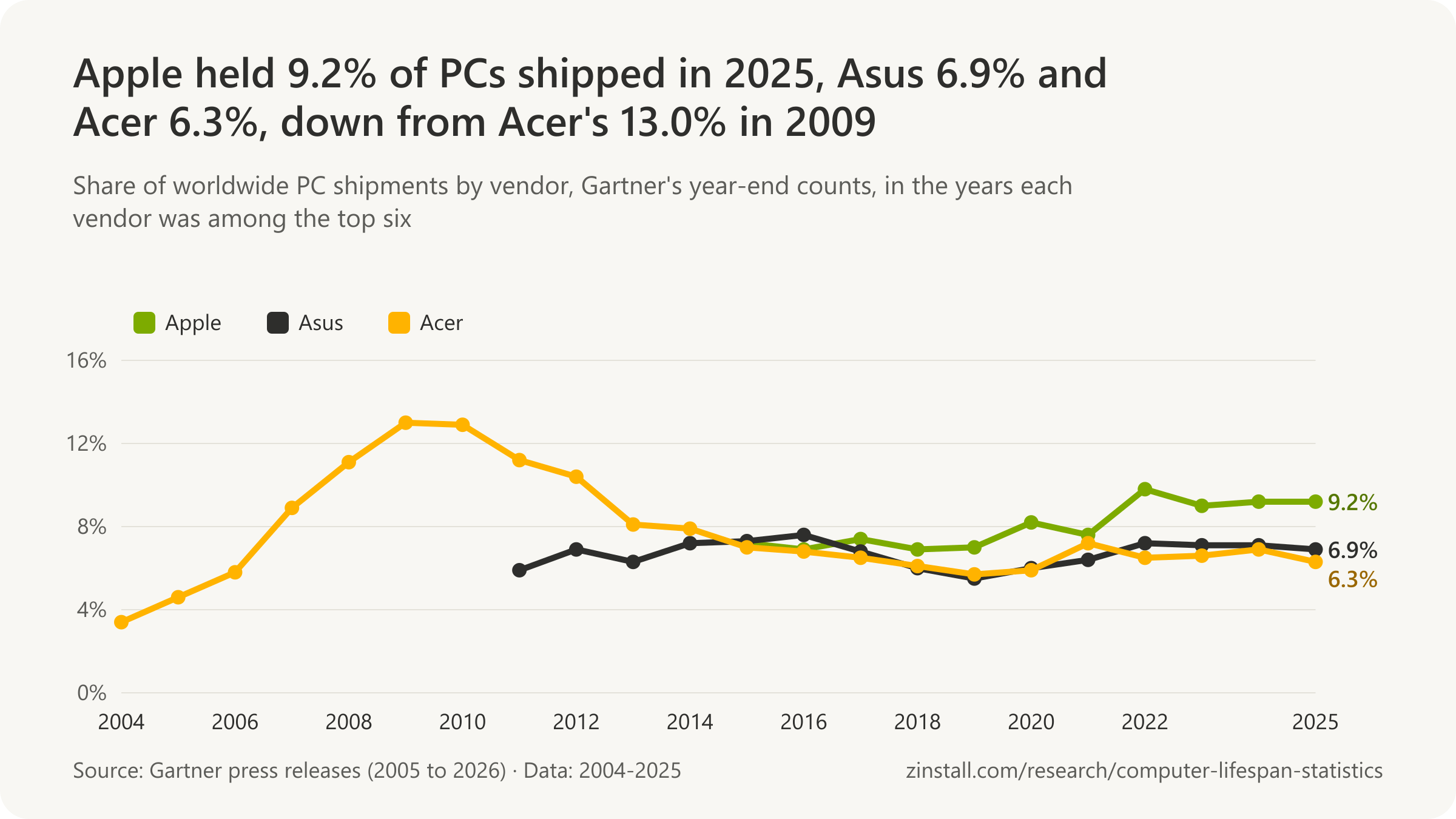
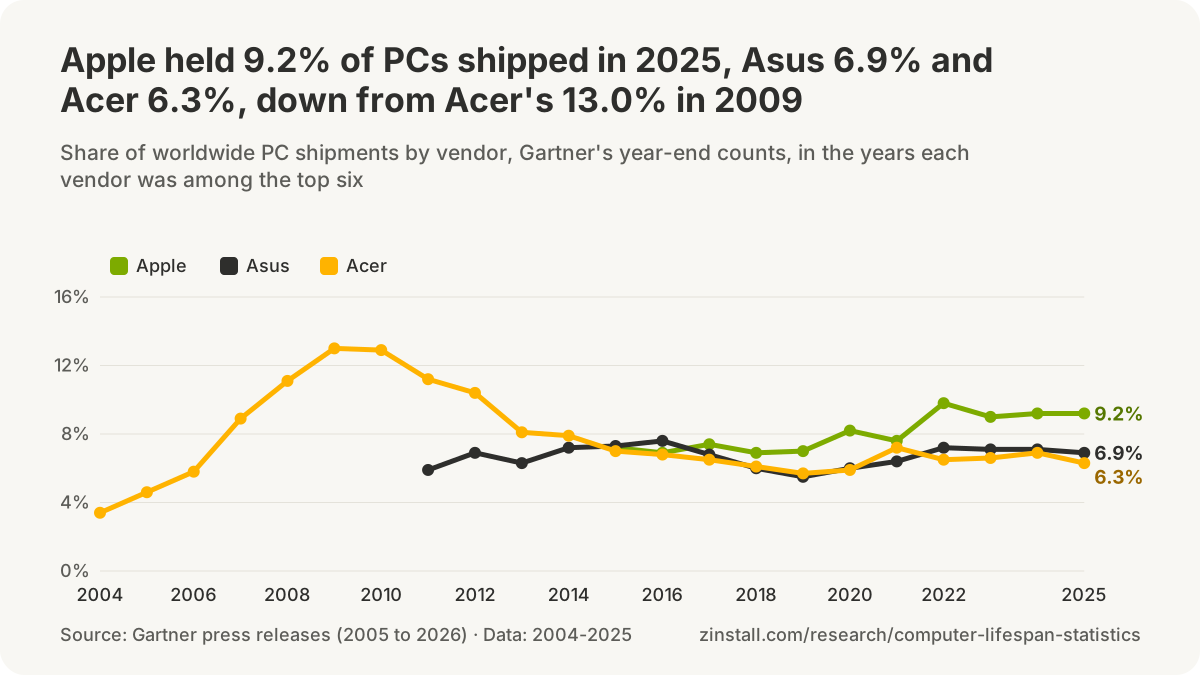

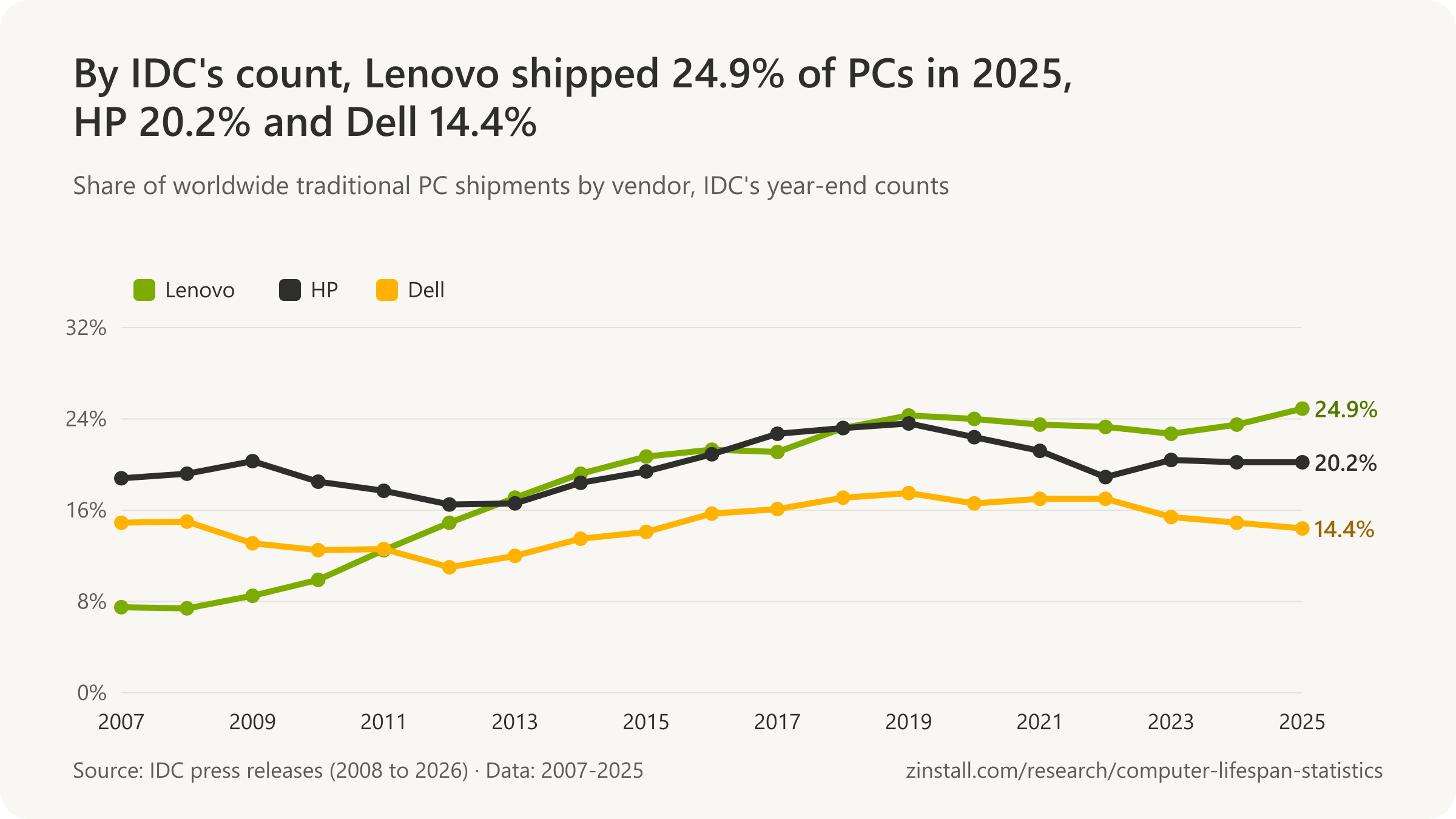
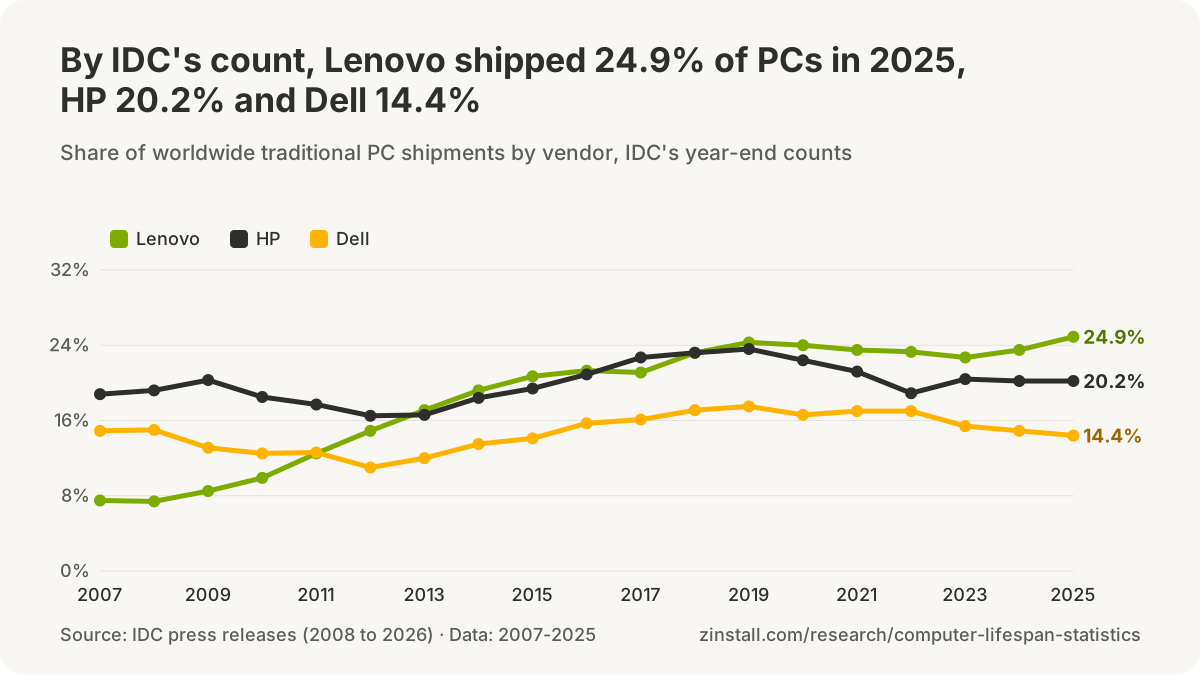

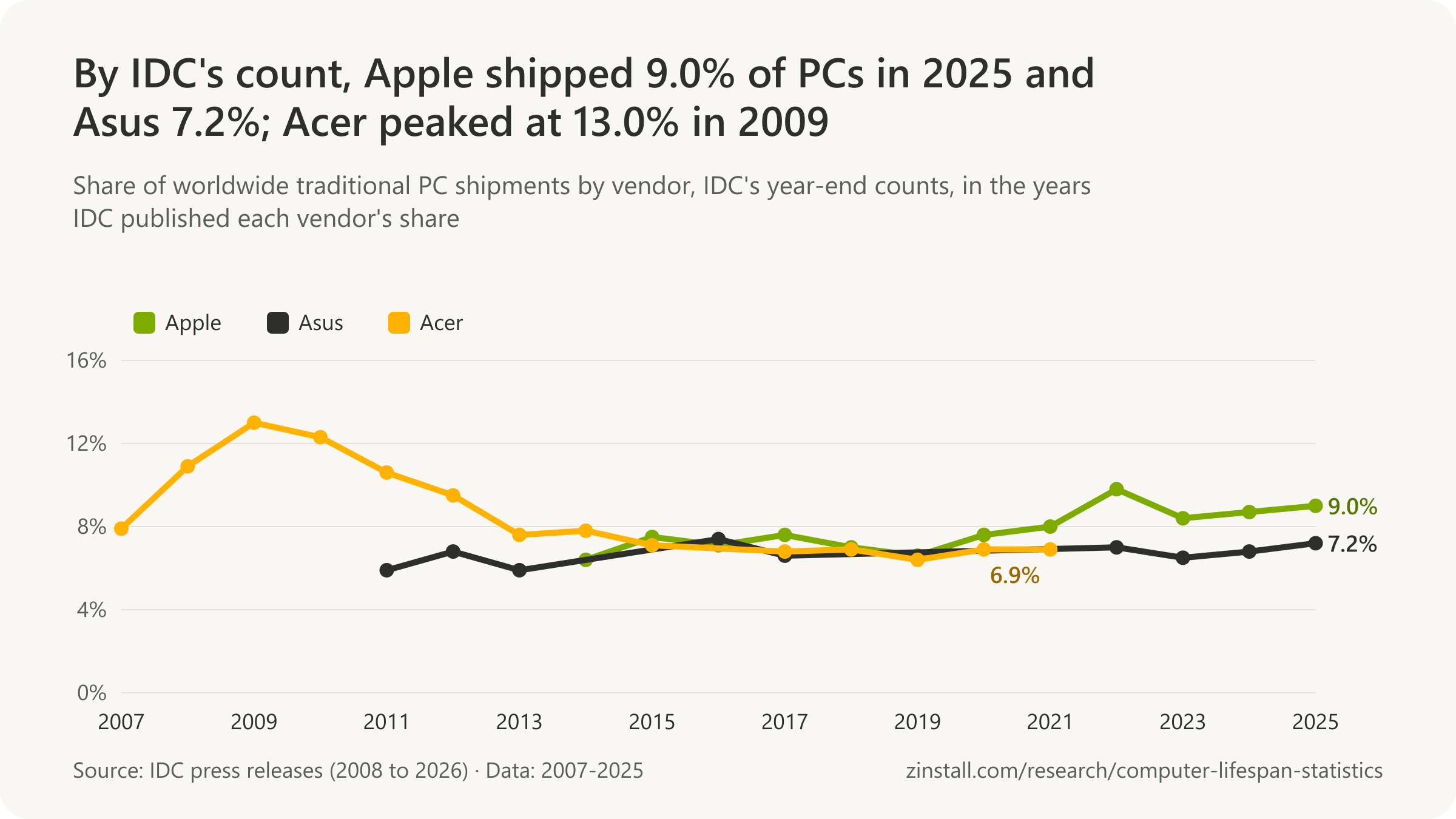
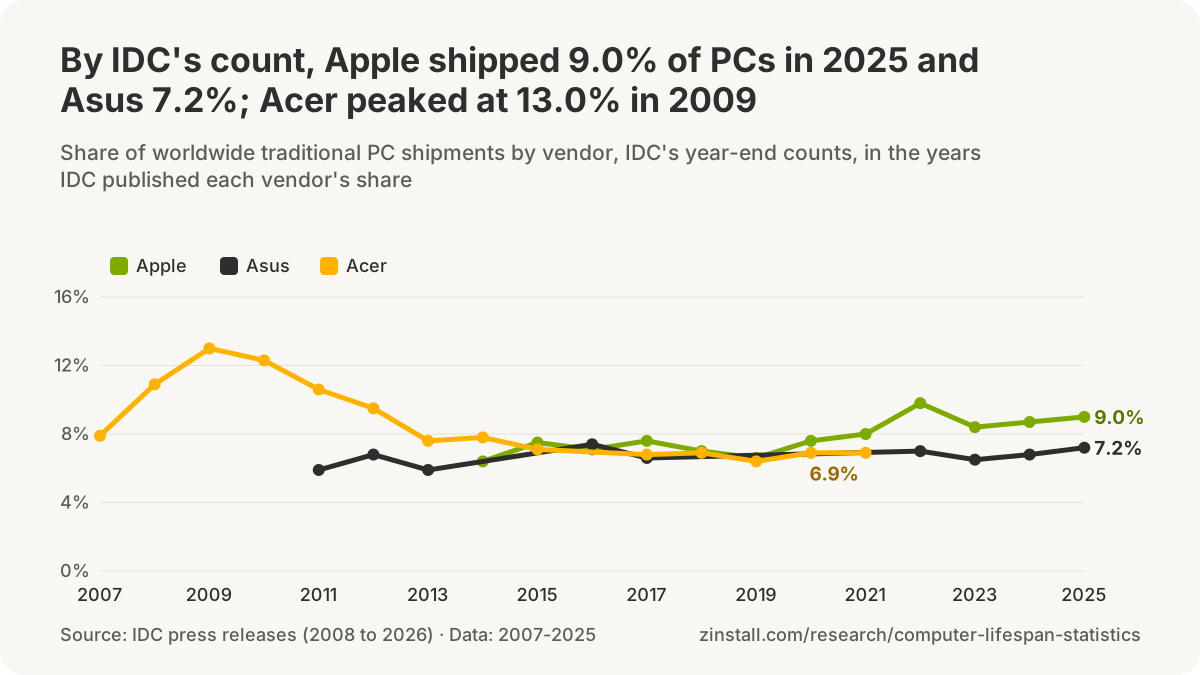
What shipments say about the replacement cycle

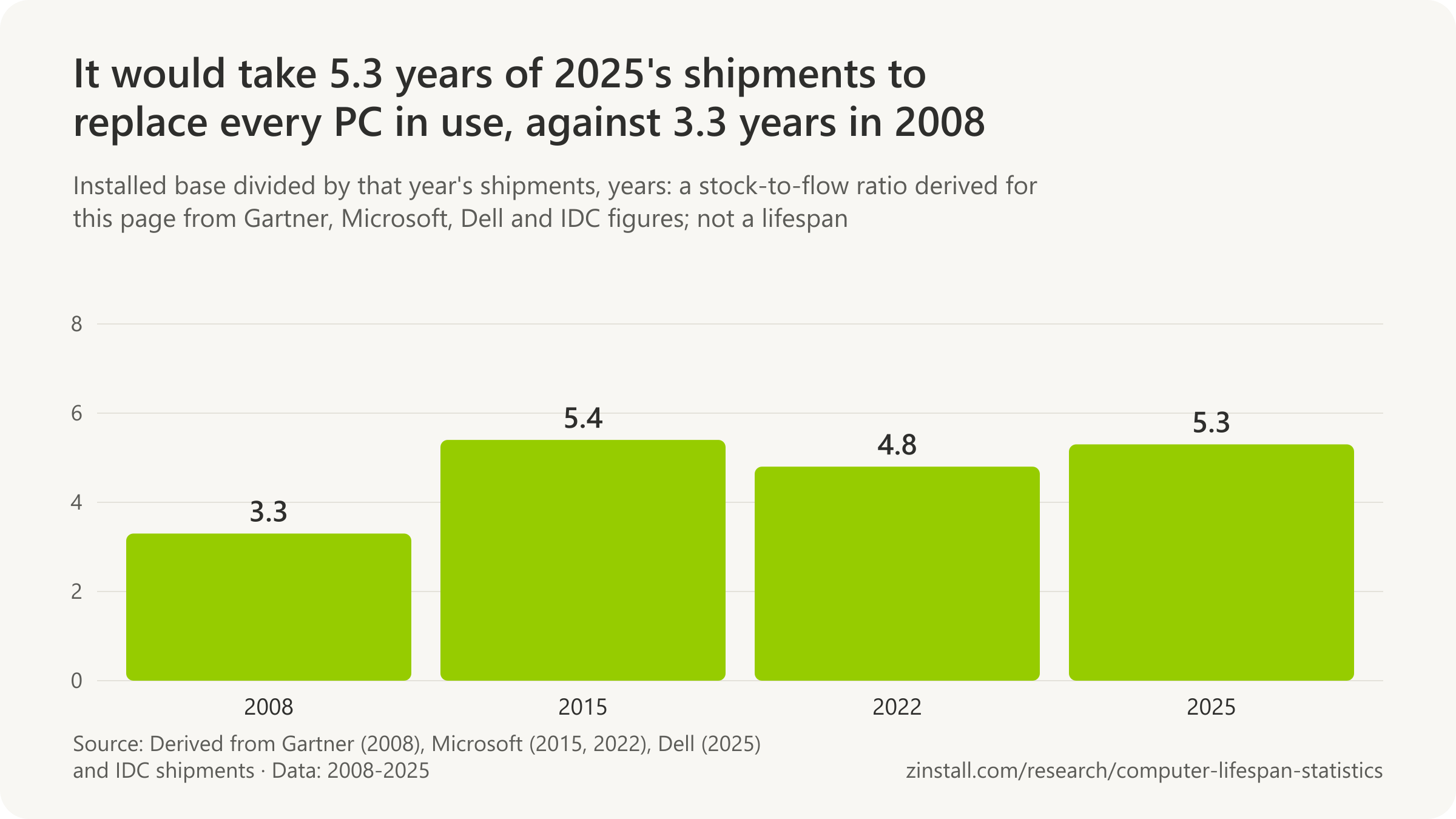
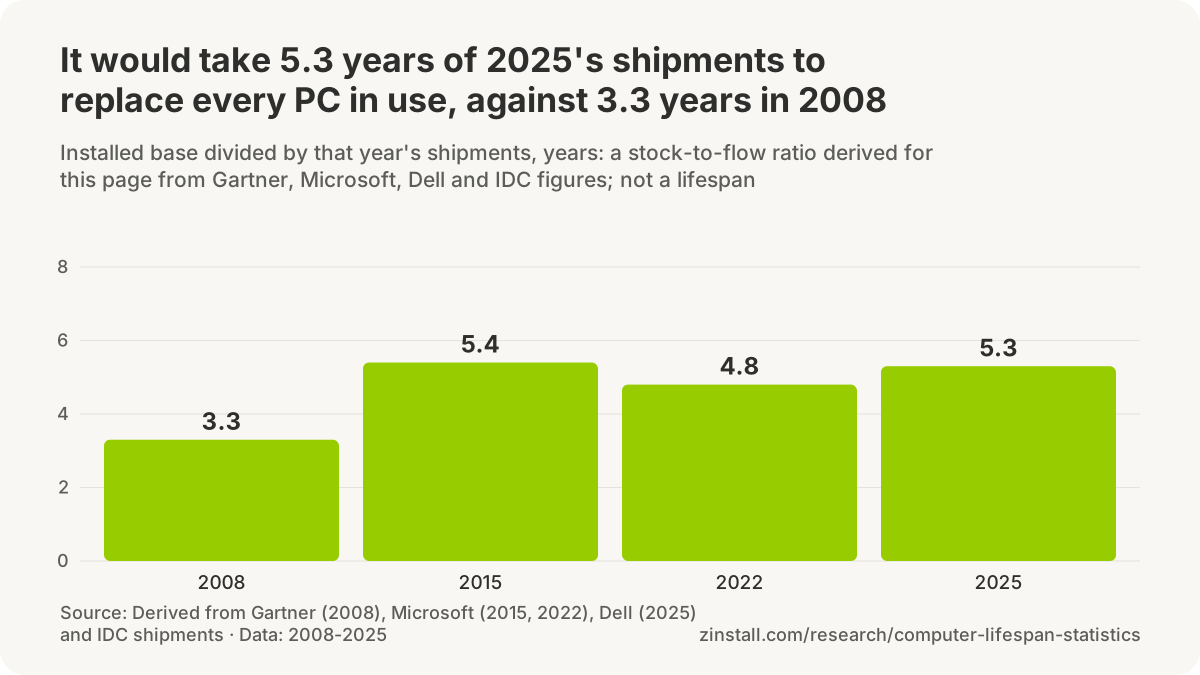
- 74% of the Macs Apple sold in fiscal 2012 were portables (13.5 million of 18.2 million), up from 62% in fiscal 2007, by Apple's reported unit sales (Apple 10-K, 2012).
- 180 million PCs, about 16% of the installed base, were forecast to be replaced in 2008, Gartner said, a replacement rate that implies PCs were kept about six years on average (Gartner, 2008).
- 35 million retired PCs, a fifth of the 180 million replaced in 2008, were estimated to be dumped into landfill with little or no regard for their toxic content (Gartner, 2008).
- About 6 years was the average PC replacement interval implied by Gartner's 2008 estimate that 16% of PCs in use would be replaced that year (derived from Gartner, 2008).
- Existing users were postponing PC upgrades because PCs already performed more than they needed, Gartner Dataquest said in January 2002, when shipments fell for the first time since 1985 (Gartner, 2002).
- Tablets led PC users to shift consumption to tablets rather than replace their older PCs, Gartner said in January 2013, expecting households to let secondary PCs age out (Gartner, 2013).
- Japan's PC market slumped in late 2014 after a surge of Windows XP replacements a year earlier, IDC reported, with fourth-quarter volume down 35% (IDC, 2015).
- Longer PC lifecycles, with mainstream desktops and notebooks seeing their lifetimes stretched ever longer, weighed on 2015 shipments, IDC said in January 2016 (IDC, 2016).
- Consumers who rely on smartphones and use PCs infrequently stretch PC life cycles longer, Gartner said in January 2017, and that segment outweighed enthusiast demand (Gartner, 2017).
- Enterprise buyers were extending PC lifecycles and delaying purchases as the economy slowed, Gartner said in January 2023, expecting no business-market growth until 2024 (Gartner, 2023).
- 'Demand for newer PCs ready for Windows 11 is likely to push well into 2026,' IDC said in October 2025, attributing the year's shipment growth to the Windows 11 transition and an ageing installed base (IDC, 2025).
Macs and Chromebooks

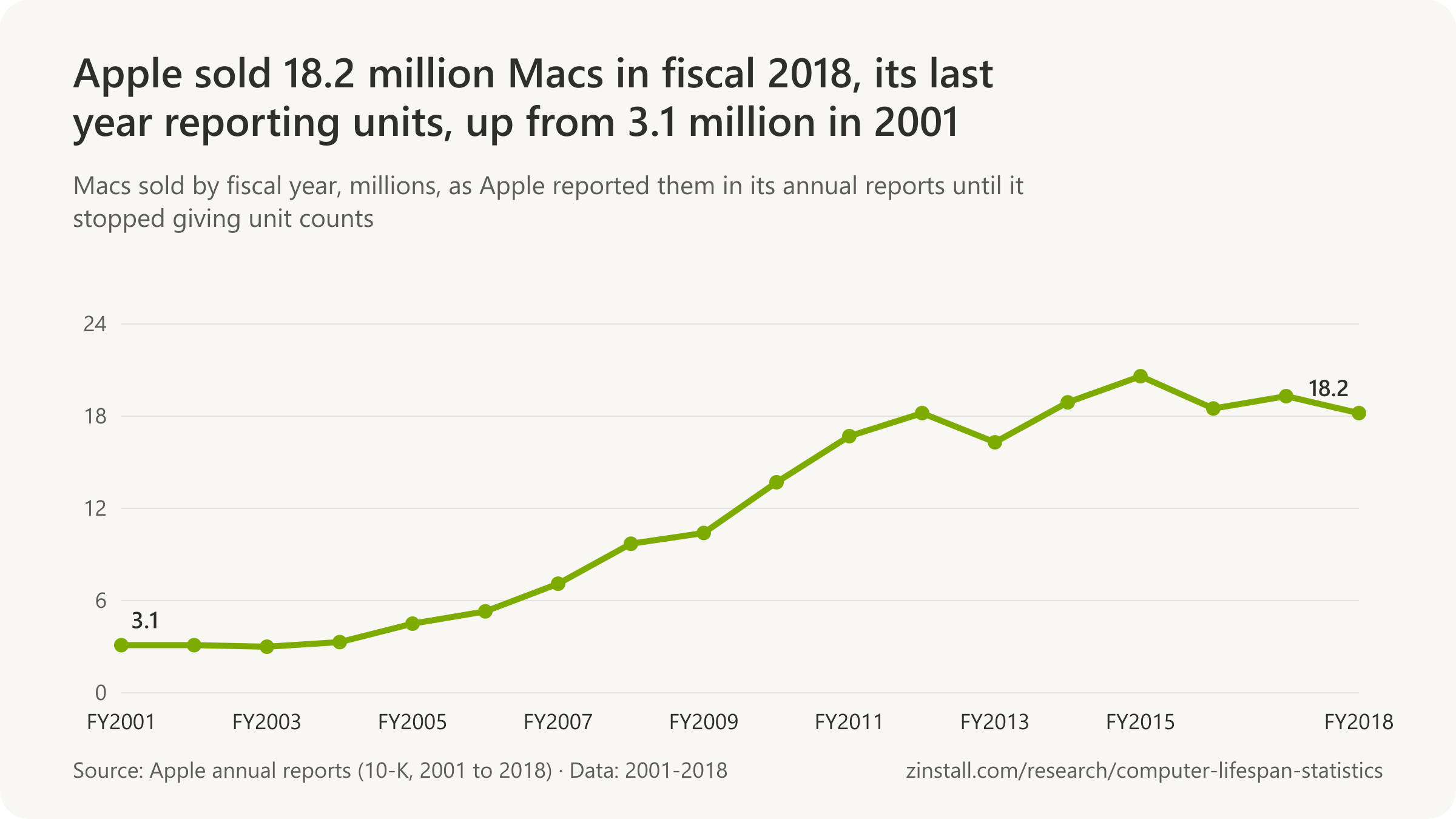
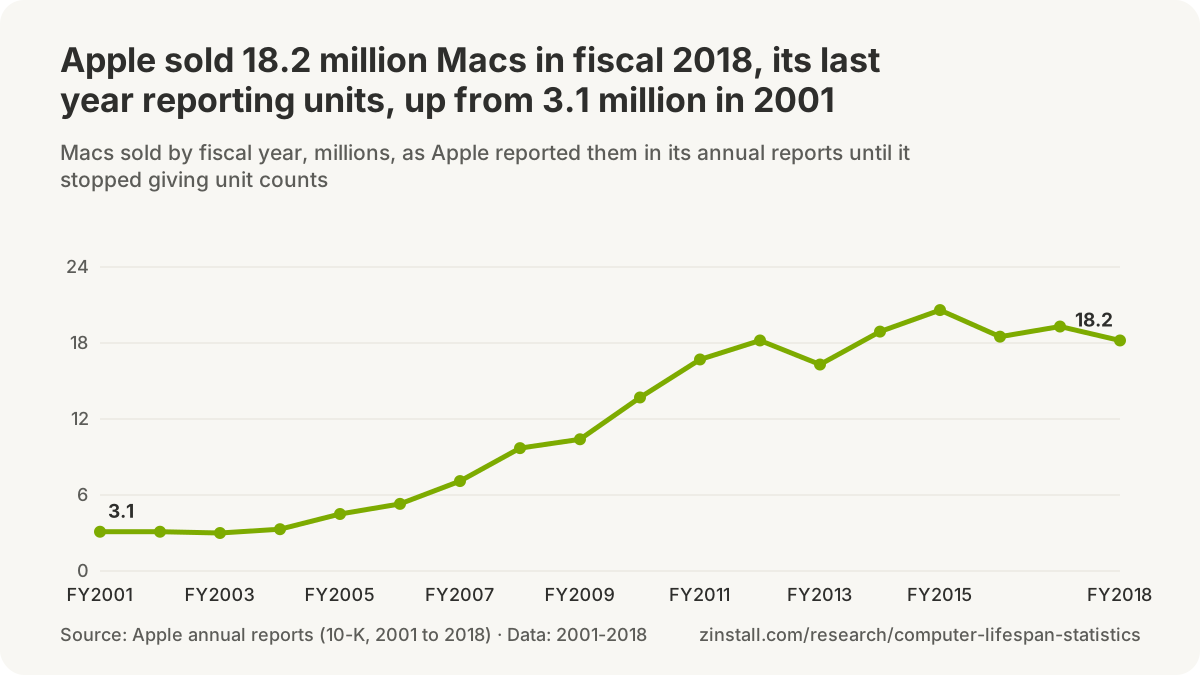
- 30.6 million Chromebooks were shipped worldwide in 2020, a record driven by remote learning, with 11.2 million in the fourth quarter alone, up 287% (Canalys, 2021).
- Nearly 30 million Chromebooks were shipped worldwide in 2020, up more than 80%, largely for North American schools, Gartner estimated (Gartner, 2021).
Japan
- 18.1 million PCs were shipped in Japan in fiscal 2025 (April 2025 to March 2026), up 32.6% and the most since records began in 1995, driven by Windows 10's end of support and the GIGA School device refresh (MM Research Institute, 2026).
Sources: Gartner, Inc. (2002-2026); Canalys (2021-2025); Omdia, incorporating Canalys (2025, 2026); MM Research Institute; International Data Corporation (2008-2026); Apple Inc. (2003-2018); IDC; Omdia; Microsoft and IDC (2016, 2022); Dell Technologies and IDC
What happens to old computers?
The world generated 62 billion kg of e-waste in 2022, 7.8 kg per person (Global E-waste Monitor, 2024).

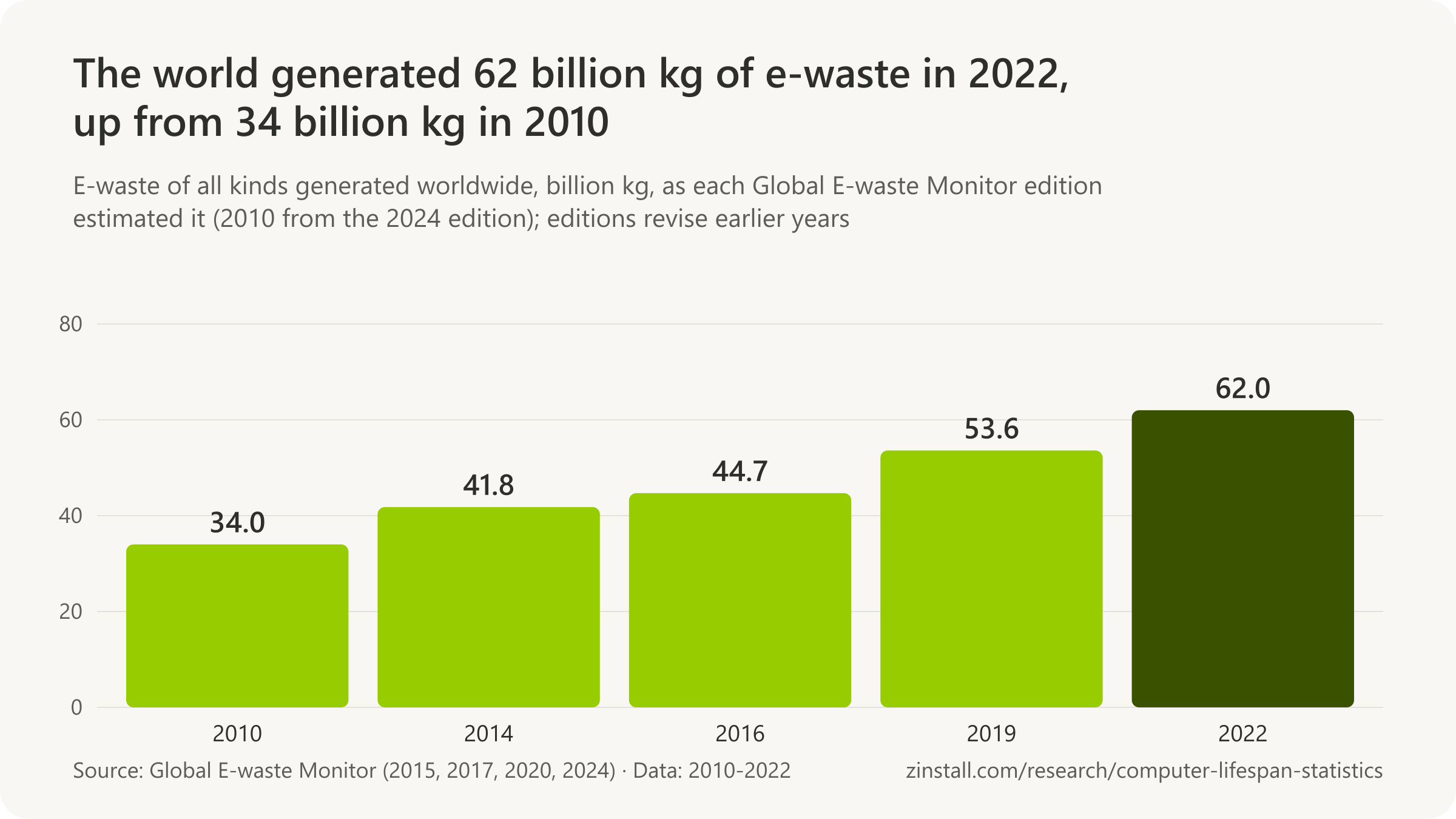
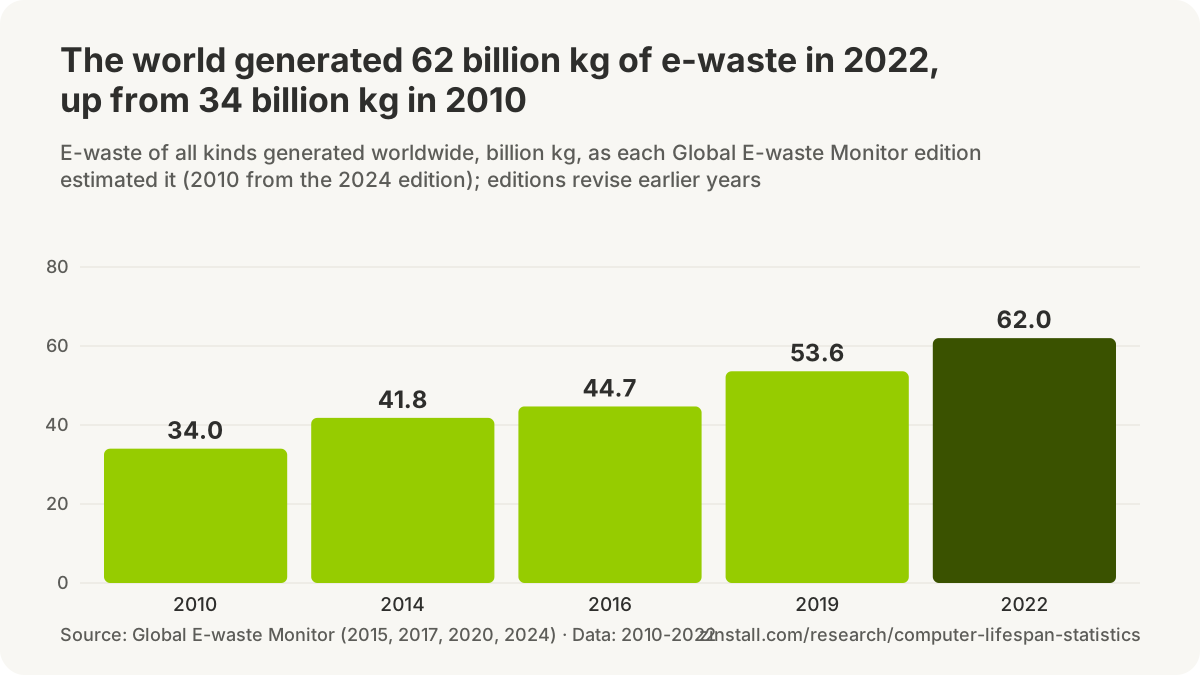
- Only 22.3% of the world's e-waste was documented as properly collected and recycled in 2022.
- 34% of people in the EU kept their old laptop or tablet at home after it went out of use; 11% recycled it.
- Japan's PC makers collected 12.3% more used household PCs in the year Windows 10 support ended.
- Carbon footprints of Macs assume four years of use, and those of Dell and HP business laptops do too.
- 137 kg of a 14-inch MacBook Pro's 197 kg CO2e lifetime footprint comes from making it.
| Measure, place and date | Figure |
|---|---|
| E-waste projected for 2030 | 82 billion kg (projection) |
| Screens and monitors e-waste (with laptops), 2022 | 5.9 billion kg |
| Small IT e-waste (with desktop PCs), 2022 | 5 billion kg |
| EU e-waste collection rate, 2024 | 39% |
| EU small IT e-waste prepared for reuse, 2024 | 5.4% |
| Notebooks among household PCs collected in Japan, fiscal 2025 | 82% |
| Dell: collected products recycled, fiscal 2025 | 89% recycled, 11% reused |
| Unused laptops per UK household, 2024 | 1.9 laptops |
| PCs expected to become e-waste over Windows 11, an estimate | 240 million |
| Electrical products hoarded in a European household | 13 of 74 |
Sources: UNITAR and ITU; Eurostat (2026, 2025); Japan PC 3R Promotion Association (2026a, 2026b); Apple; Dell Technologies; Material Focus; Canalys; WEEE Forum; United Nations University; UNU, ITU and ISWA; UNU/UNITAR SCYCLE, ITU and ISWA
Related guides: Back up your entire computer · Transfer with a USB drive
More statistics (51)
Most old computers are neither reused nor recycled through official channels: less than a quarter of the world's e-waste is documented as properly collected, and households keep old laptops in drawers. Making a computer causes most of its lifetime emissions, so the years it is used matter more than the power it draws, and makers assume only about four years of use when they calculate a computer's footprint.
E-waste worldwide

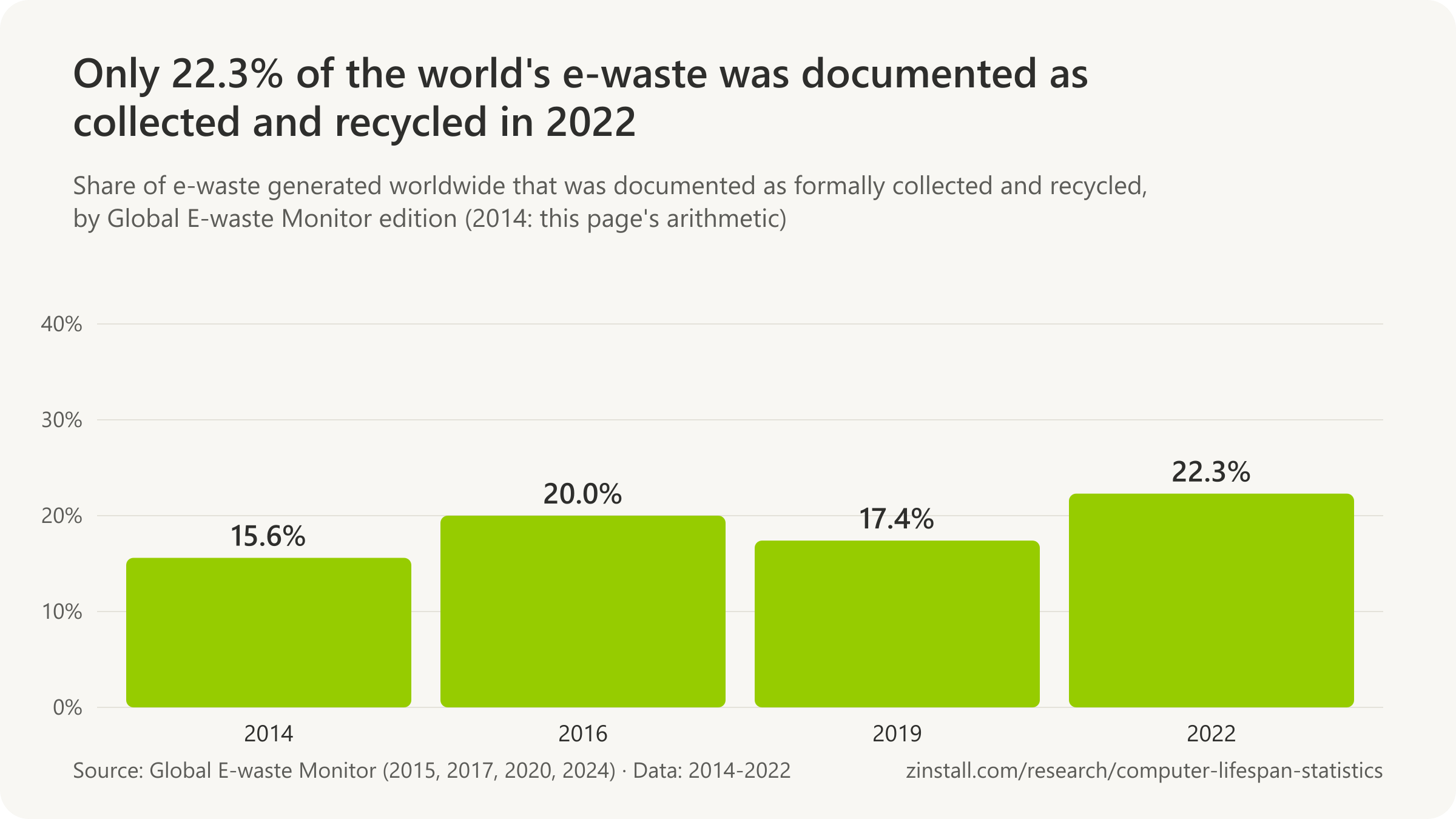
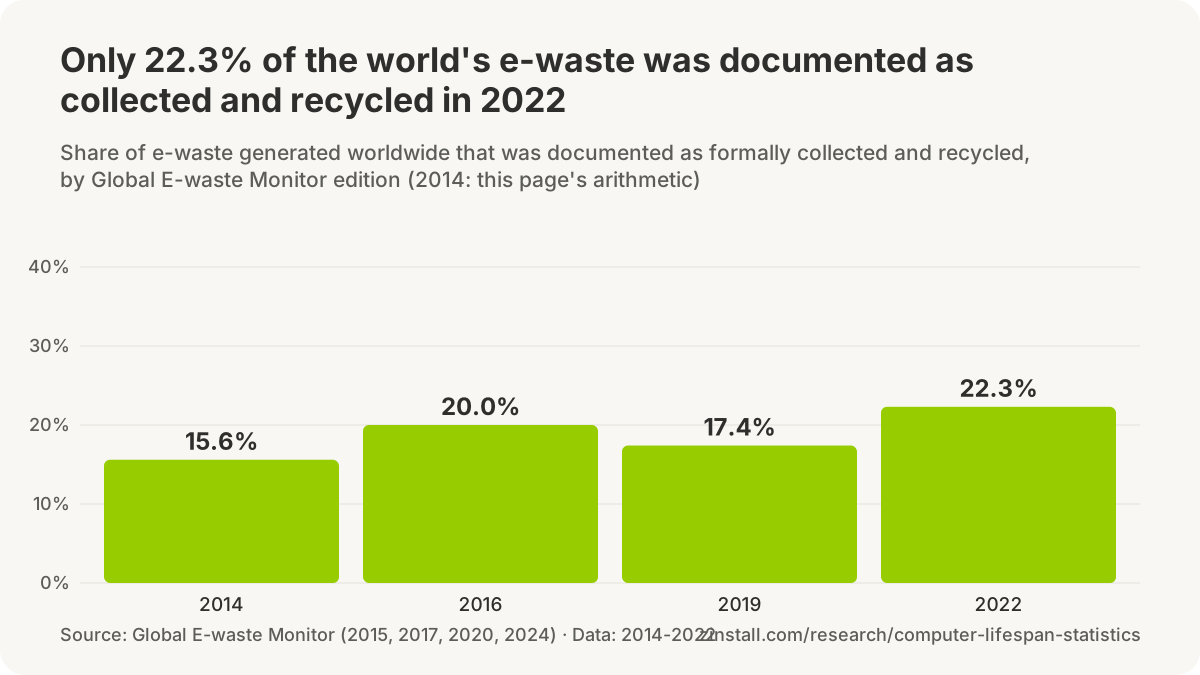

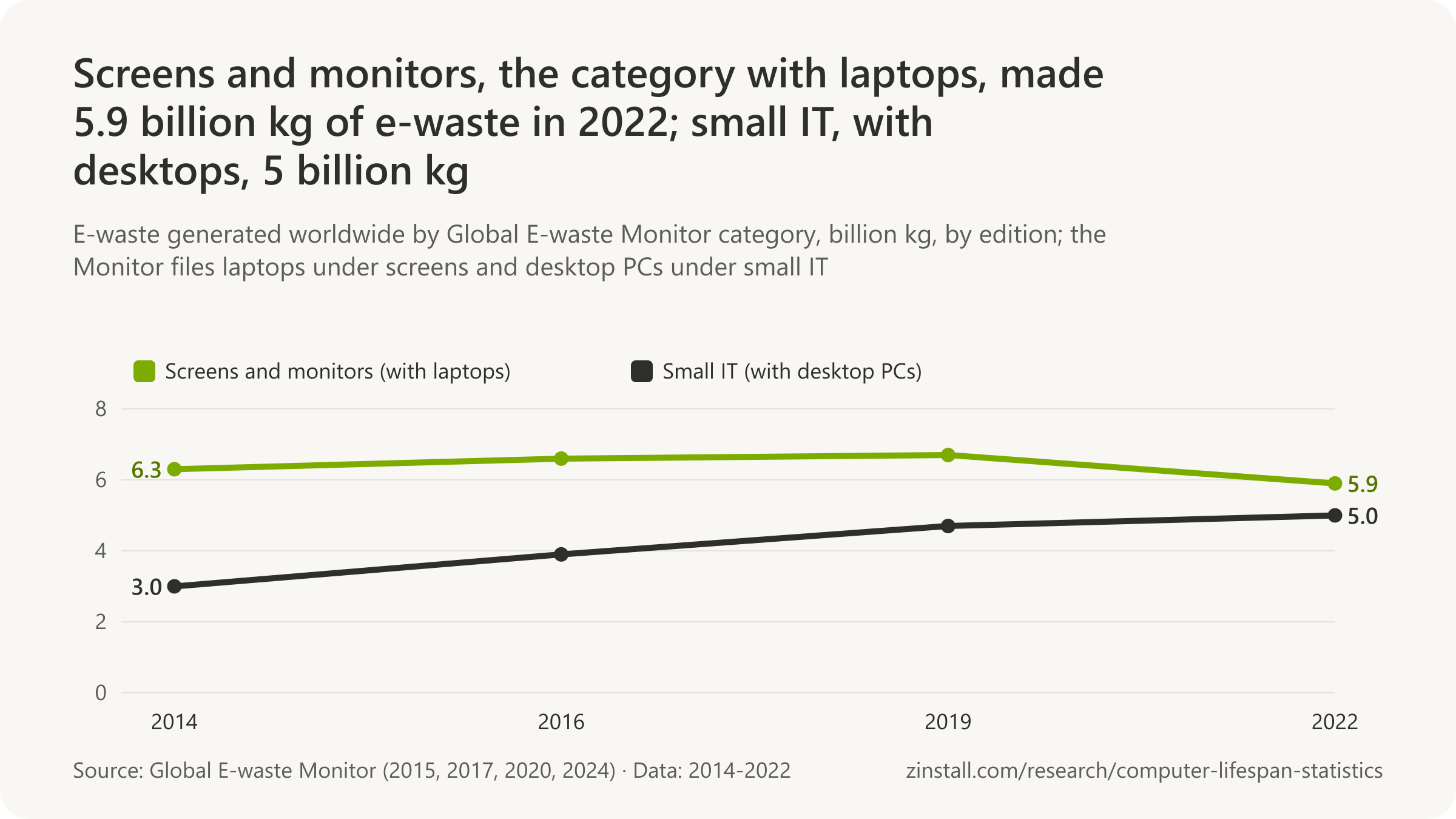
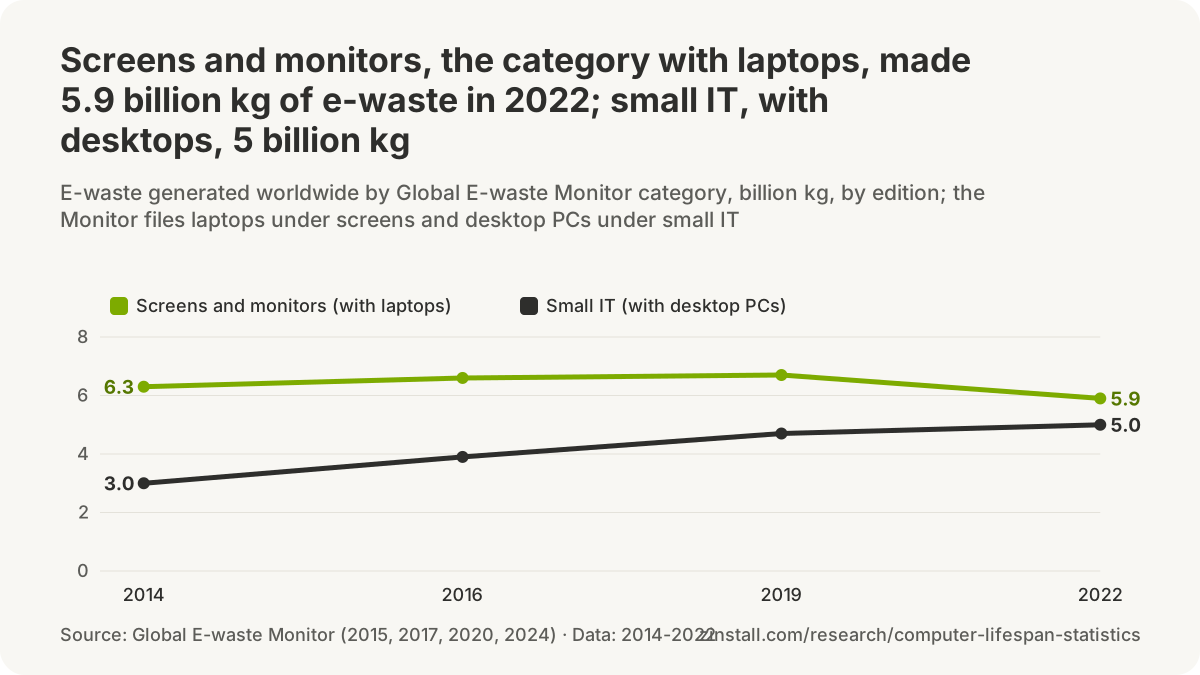
- 22% of small IT and telecommunication equipment e-waste (laptops, phones, routers) was documented as formally collected and recycled in 2022 (Global E-waste Monitor, 2024).
- 82 billion kg of e-waste is projected to be generated in 2030, with the documented collection and recycling rate falling to 20% under business as usual (Global E-waste Monitor, 2024).
- E-waste generation rose almost five times faster than documented formal recycling between 2010 and 2022: generation grew by 2.3 billion kg a year on average, recycling by 0.5 billion kg a year (Global E-waste Monitor, 2024).
- USD 62 billion worth of recoverable natural resources went unaccounted for in 2022 because less than a quarter of e-waste was documented as properly collected and recycled (ITU, 2024).
- 22% of small IT and telecommunication e-waste was documented as collected and recycled in 2022, and the Global E-waste Monitor suggests the rate trails heavier equipment partly because such devices contain personal data that owners may be reluctant to hand back (Global E-waste Monitor, 2024).
- 17.6 kg of e-waste per person was generated in Europe in 2022, the highest of any region, ahead of Oceania (16.1 kg) and the Americas (14.1 kg), with 7.53 kg per person documented as collected and recycled in Europe (Global E-waste Monitor, 2024).
- 7.2 billion kg of e-waste was generated in the United States in 2022, 21 kg per person, the largest total in the Americas (Global E-waste Monitor, 2024).
- 74.7 million tonnes of e-waste was projected for 2030 in the Global E-waste Monitor's 2020 edition, almost double the 2014 level in 16 years; the 2024 edition raised the 2030 projection to 82 billion kg (Global E-waste Monitor, 2020).
- Laptops, including tablets, are counted under screens in the Global E-waste Monitor's classification, while desktop PCs are counted under small IT, so no e-waste category equals computers (UNU, 2015).
The EU, the US and Japan

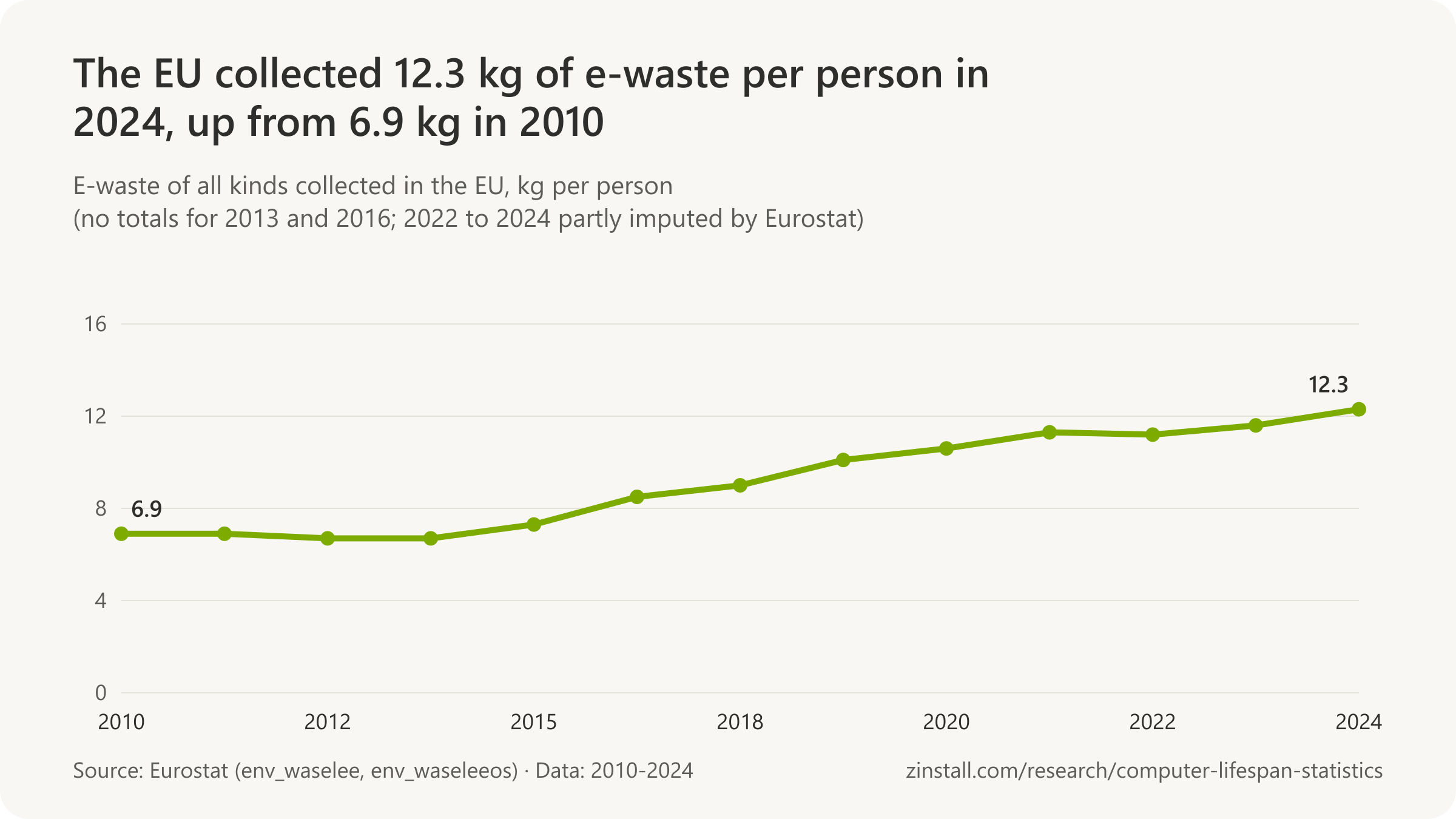
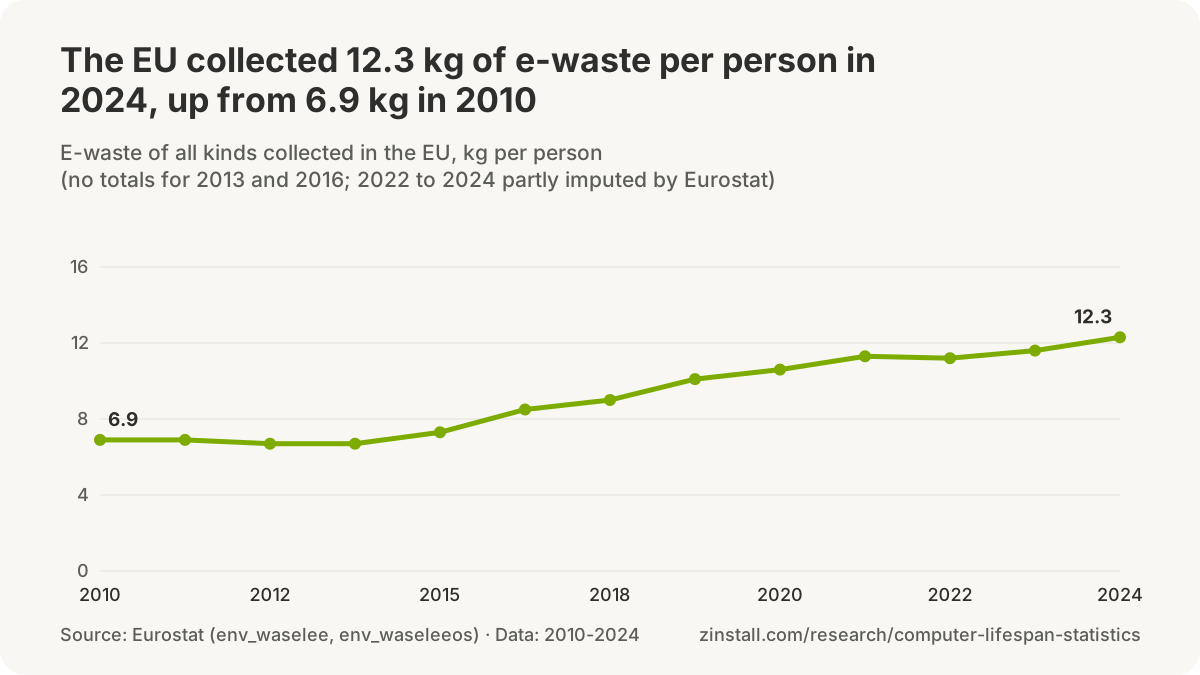

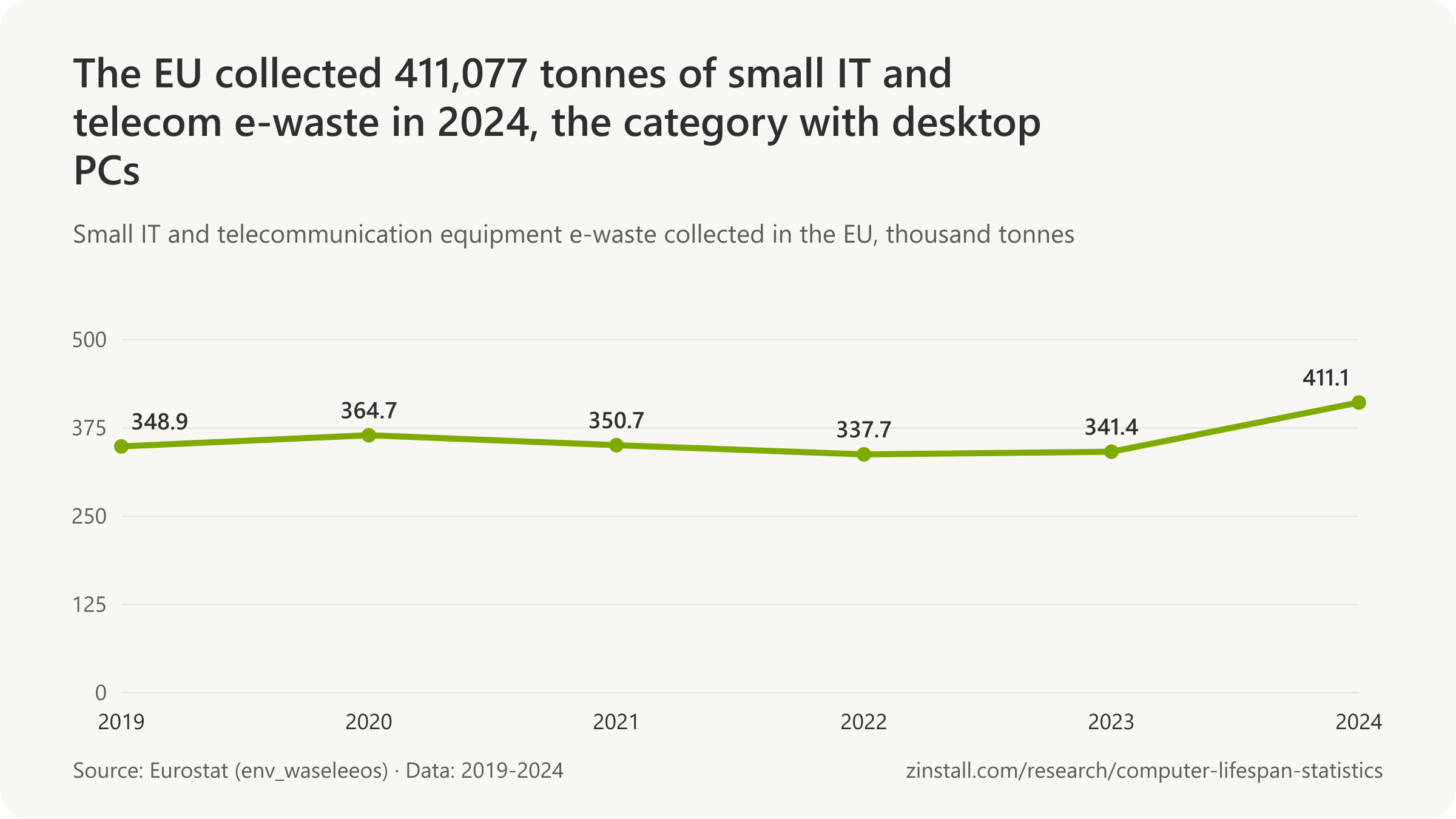
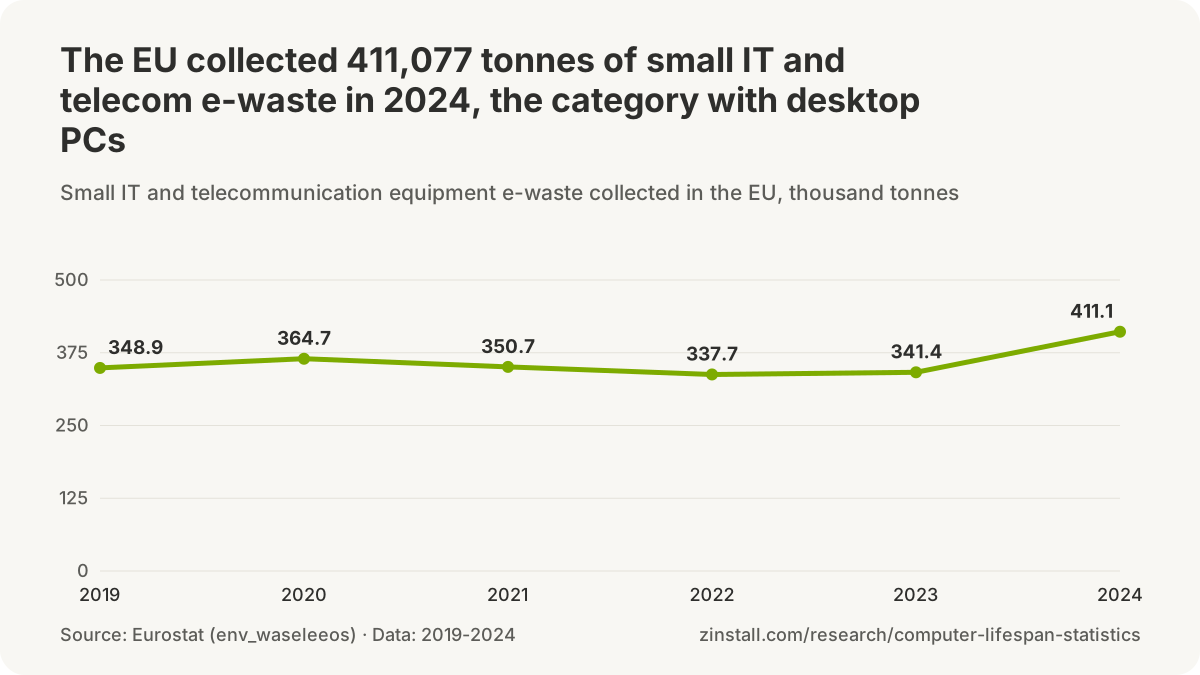

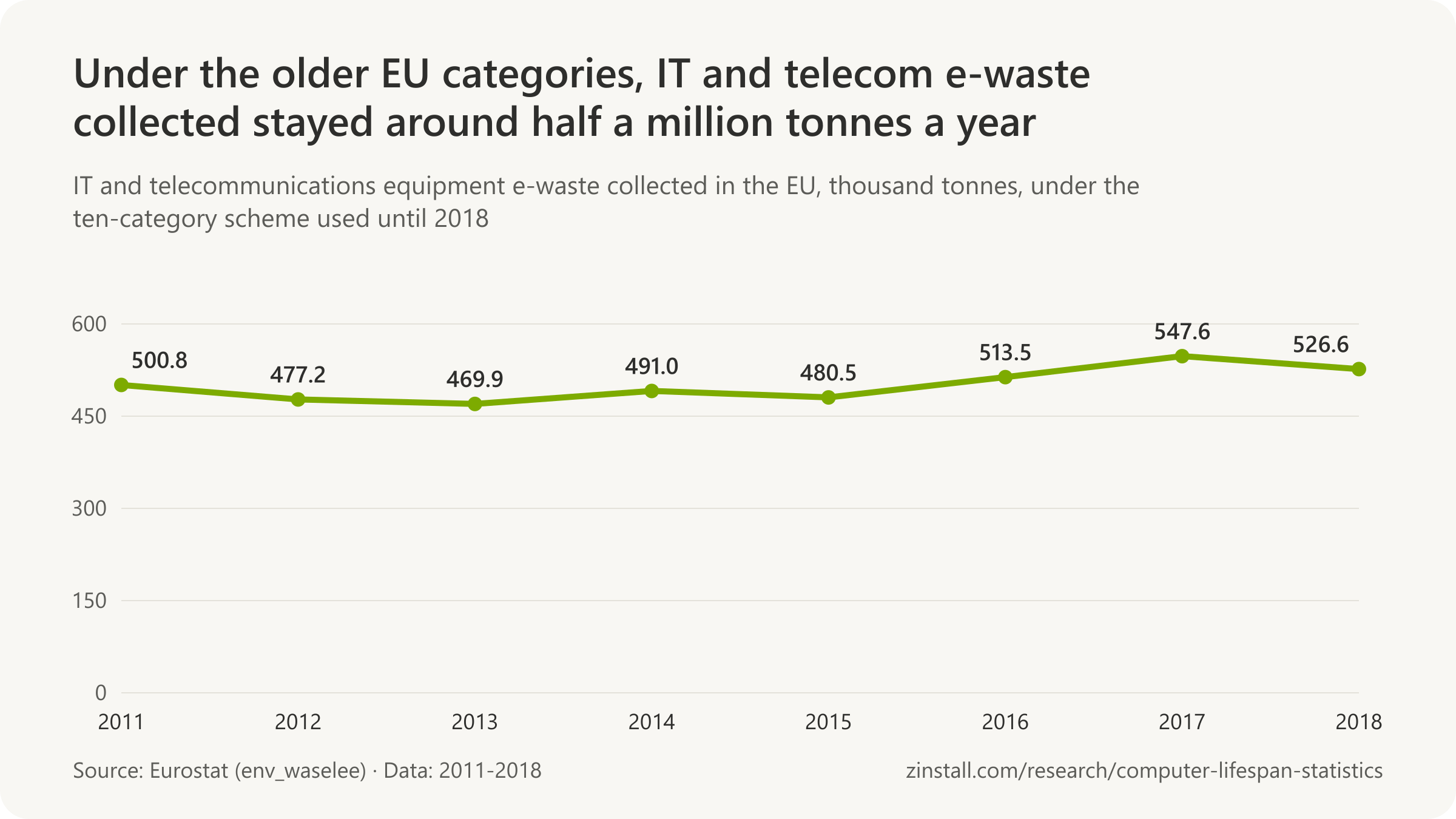
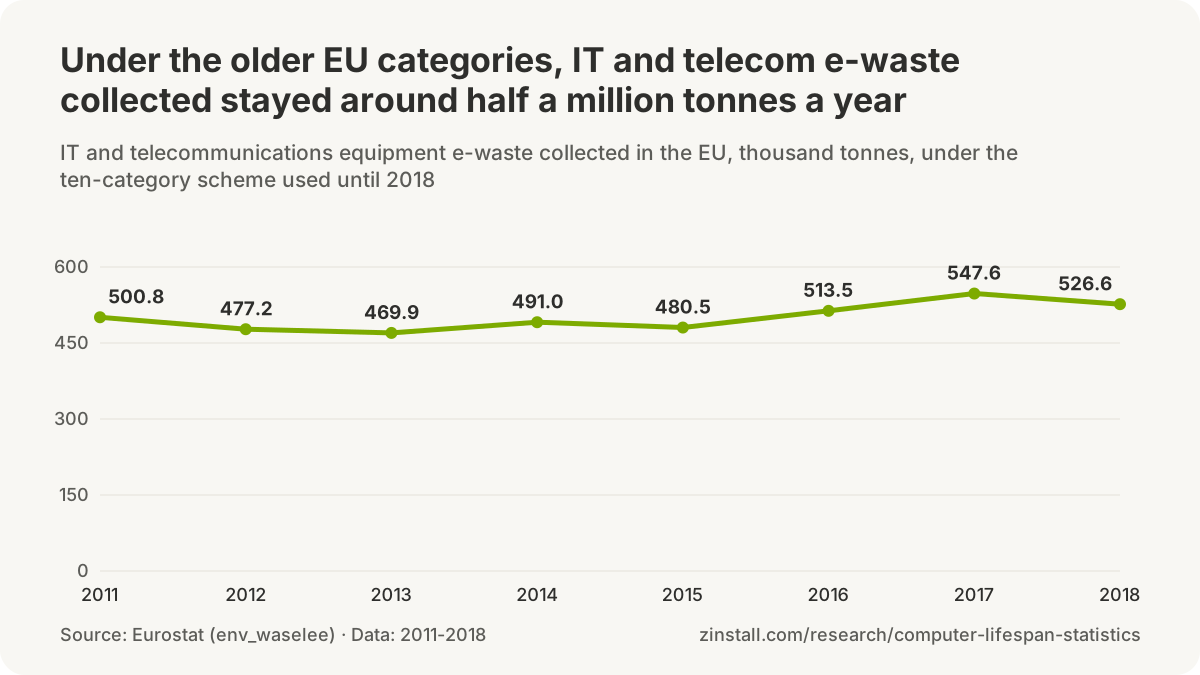

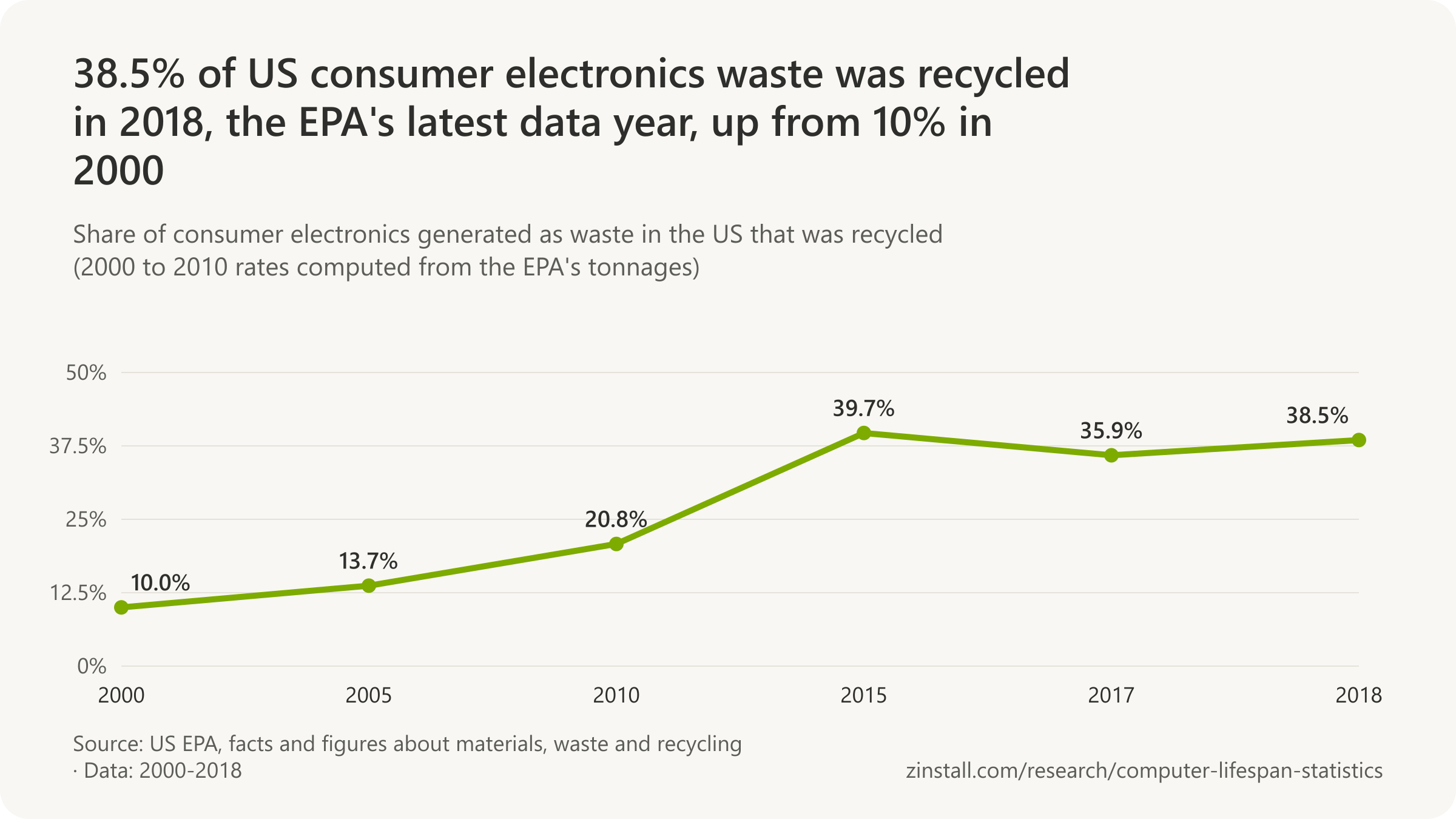
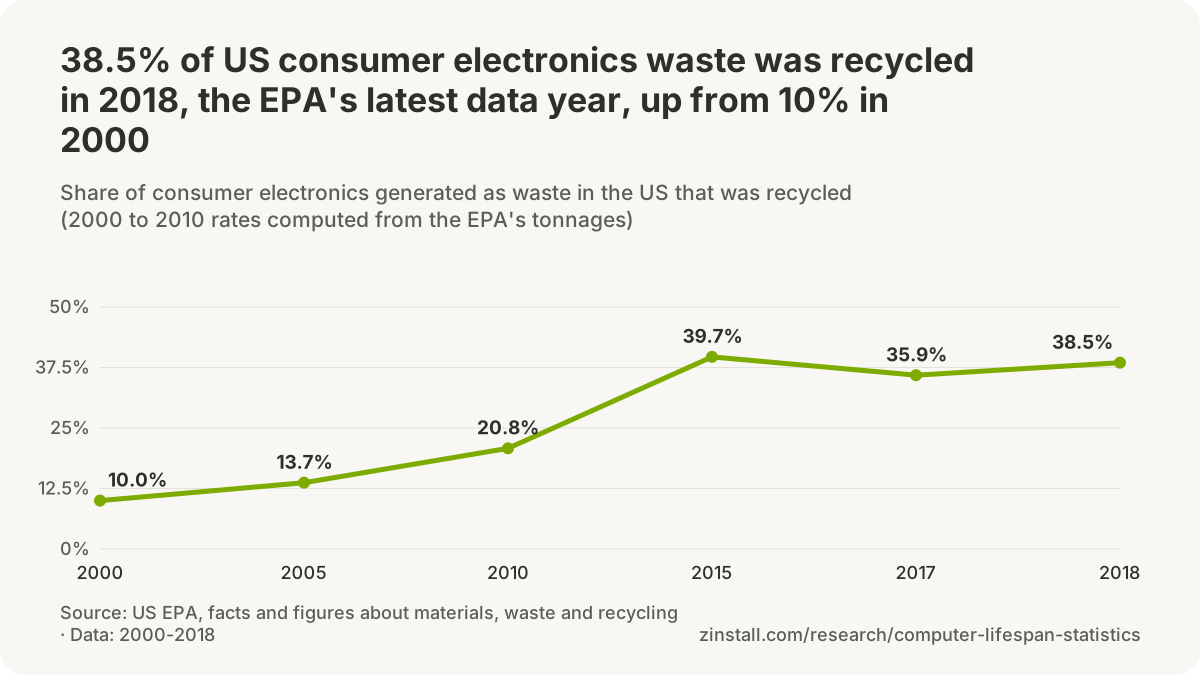

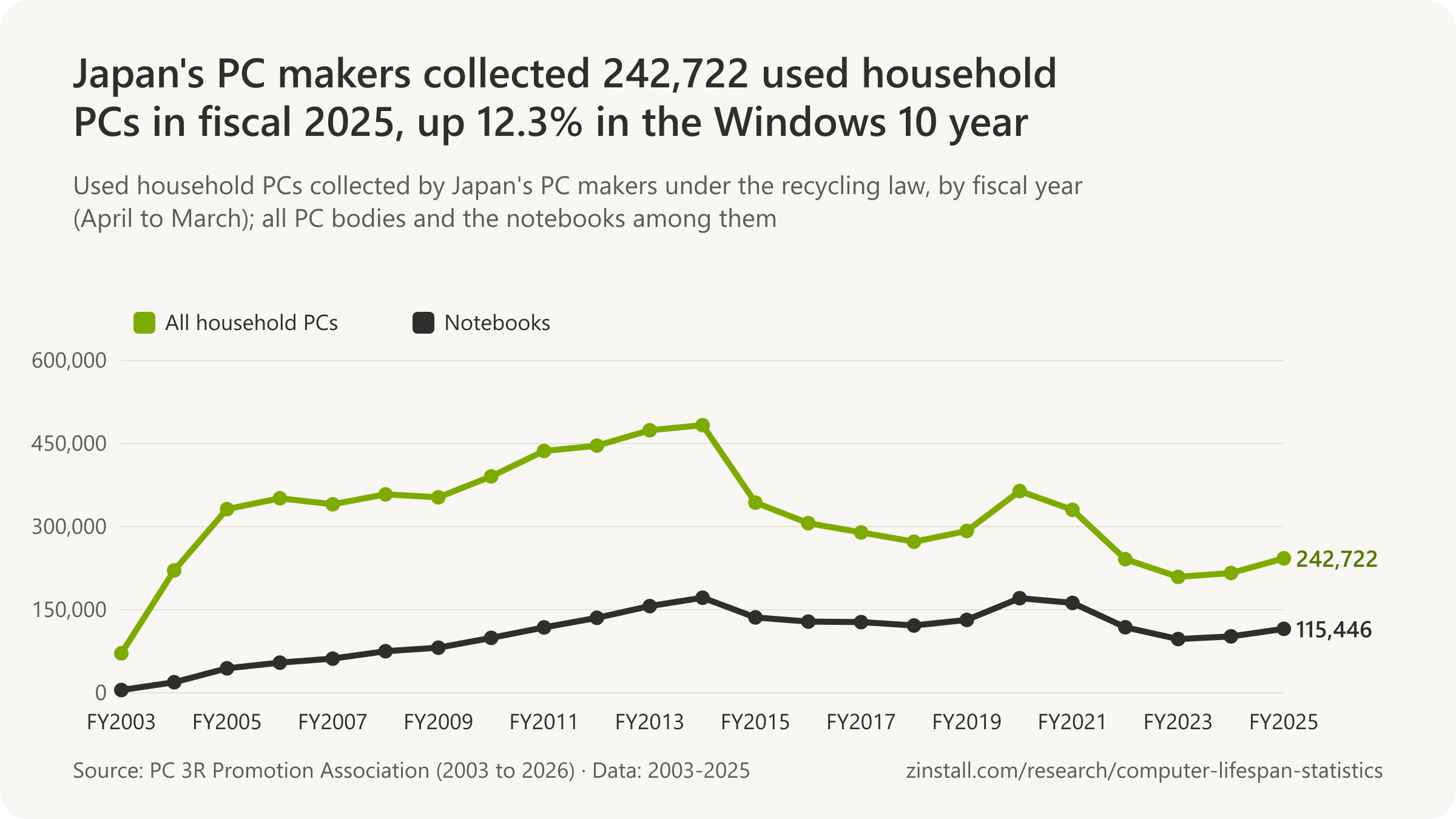
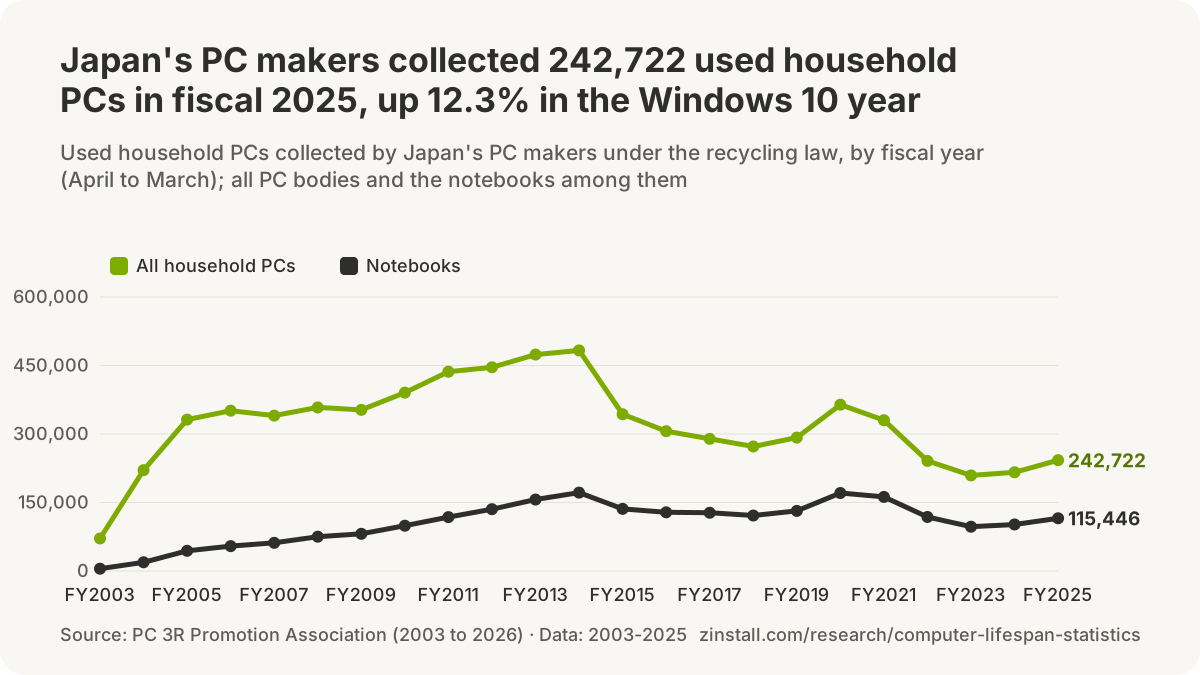
- 12.3% more used household PCs (242,700) were collected by Japan's PC makers in fiscal 2025 than a year earlier, a rise the PC 3R Promotion Association attributes to replacements at the end of Windows 10 support (PC 3R Promotion Association, 2026).
- 5.8% fewer used household PCs (272,700) were collected by Japan's PC makers in fiscal 2018, which the PC 3R Promotion Association put down to falling household PC sales and to part of the flow moving to the small home appliance recycling system (PC 3R Promotion Association, 2019).
- 82% of the household PC bodies (desktops and notebooks) collected by Japan's PC makers in fiscal 2025 were notebooks, up from 13% in fiscal 2003, the scheme's first year for households (PC 3R Promotion Association, 2026).
- 65.9% of the weight of household notebooks processed by Japan's PC makers in fiscal 2025 was recovered as reusable parts or materials, against 78.7% for desktop PC bodies (PC 3R Promotion Association, 2026).
- 81.3% of the small IT and telecommunications e-waste treated in the EU in 2024 was recycled or prepared for reuse (Eurostat, 2026).
- 5.4% of the small IT and telecommunications e-waste collected in the EU in 2024 (22,128 tonnes) was prepared for reuse, up from 10,987 tonnes in 2020; the rest went to recycling or other treatment (Eurostat, 2026).
- 400,760 tonnes of screens and monitors e-waste (the EU category that includes laptops and tablets with screens over 100 cm2) was collected in the EU in 2024, against 598,168 tonnes put on the market (Eurostat, 2026).
- 3.0 million tonnes of e-waste (6.9 kg per person) was collected in the EU in 2010 (Eurostat, 2026).
- 39% is the EU's e-waste collection rate for 2024 measured the WEEE Directive way, 5.54 million tonnes collected against an average of 14.21 million tonnes of equipment put on the market in 2021 to 2023, down from 46% in 2020 (Eurostat, 2026).
- 2.37 million tons of televisions, computers, cell phones and hard-copy peripherals were discarded by US consumers and businesses in 2009, and about 25% were collected for recycling (US EPA, 2014).
- 34% of people in the EU still had their old laptop or tablet at home after it went out of use, while 12% gave or sold it on, 11% recycled it and 1% threw it away, in Eurostat's 2024 ICT household survey (Eurostat, 2025).
- 19% of people in the EU still kept their old desktop computer in the household, while 15% recycled it, 9% gave or sold it on and 2% threw it away without recycling, in Eurostat's 2024 ICT household survey (Eurostat, 2025).
- 33% of people in the EU kept their old laptop or tablet in the household, while 11% gave or sold it on, 10% recycled it and 1% threw it away, in Eurostat's 2022 ICT household survey (Eurostat, 2023).
- 19% of people in the EU kept their old desktop computer at home, while 13% recycled it, 8% gave it away or sold it and 2% threw it away, in Eurostat's 2022 ICT household survey (Eurostat, 2023).
Old computers kept at home
- 13 of the 74 electrical and electronic products in the average European household were being hoarded, 9 unused but working and 4 broken, in WEEE Forum surveys of 8,775 households in 2022 (WEEE Forum, 2022).
- 2% of Europeans keeping unused electrical products gave the presence of sensitive data as their reason, while 46% said they might use the item again and 15% planned to sell or give it away, in WEEE Forum surveys in 2022 (WEEE Forum, 2022).
- 1.9 unused laptops sit in the average UK household, each worth roughly 175 to 400 pounds on resale sites, Material Focus estimated in January 2024 from Opinium surveys of 2,000 UK adults and eBay and Gumtree prices (Material Focus, 2024).
- 15% of Canadian households had unwanted computers to dispose of in 2021, the most common type of household e-waste ahead of cellphones and televisions (14% each), Statistics Canada's Households and the Environment Survey found (Statistics Canada, 2022).
Windows 10's end and the e-waste estimates
- 240 million PCs will become e-waste because they cannot run Windows 11, Canalys estimated in December 2023 for the period to Windows 10's end of support on 14 October 2025 (Canalys, 2023).
- 20% ('roughly a fifth') of PCs in use were expected to become e-waste through incompatibility with Windows 11 by October 2025, Canalys estimated in December 2023 (Canalys, 2023).
- 400 million ('up to') of the 1 billion Windows 10 devices in use would lose support at Windows 10's end of life, PIRG said when delivering 20,000 petition signatures in October 2023 (PIRG, 2023).
- 43% of computers running Windows 10 could not move to Windows 11 in 2022, 'around 400 million computers at that time', is the derivation behind PIRG's 400 million figure (PIRG, 2025).
- 1.6 billion pounds of electronic waste could result from the end of Windows 10 support, PIRG estimated in September 2025 (PIRG, 2025).
- 700 million kilograms or more of e-waste could be generated by computers discarded at Windows 10's end of support, Right to Repair Europe estimated in September 2025 (Right to Repair Europe, 2025).
- Ending Windows 10 support could eventually lead to 700 million kg of electrical waste, against 62 billion kg of e-waste produced globally each year, according to the Restart Project (The Restart Project, 2025).
- Up to 250 million devices could become e-waste because of the end of Windows 10 support, the End of 10 campaign claimed at its launch in May 2025, a rounding of the Canalys December 2023 estimate (End of 10, 2025).
- A refurbisher quoted by Back Market in 2025 warned that when Windows 10 devices reach their lowest price they become too cheap to work with, leaving no margin for refurbishment (Back Market, 2025).
- Back Market, generating over $3.5 billion in annual gross merchandise value with 18 million customers across 17 markets, launched an 'Ugly Computer' and ChromeOS Flex partnership in May 2026 to give a second life to PCs affected by the Windows 10 end of support (Back Market, 2026).
- Microsoft's Windows 10 end-of-support page directs users to trade-in offers from Microsoft and retail partners or to a Microsoft-approved recycling program in their region when buying a new Windows 11 PC (Microsoft, 2025).
The carbon cost of making a computer

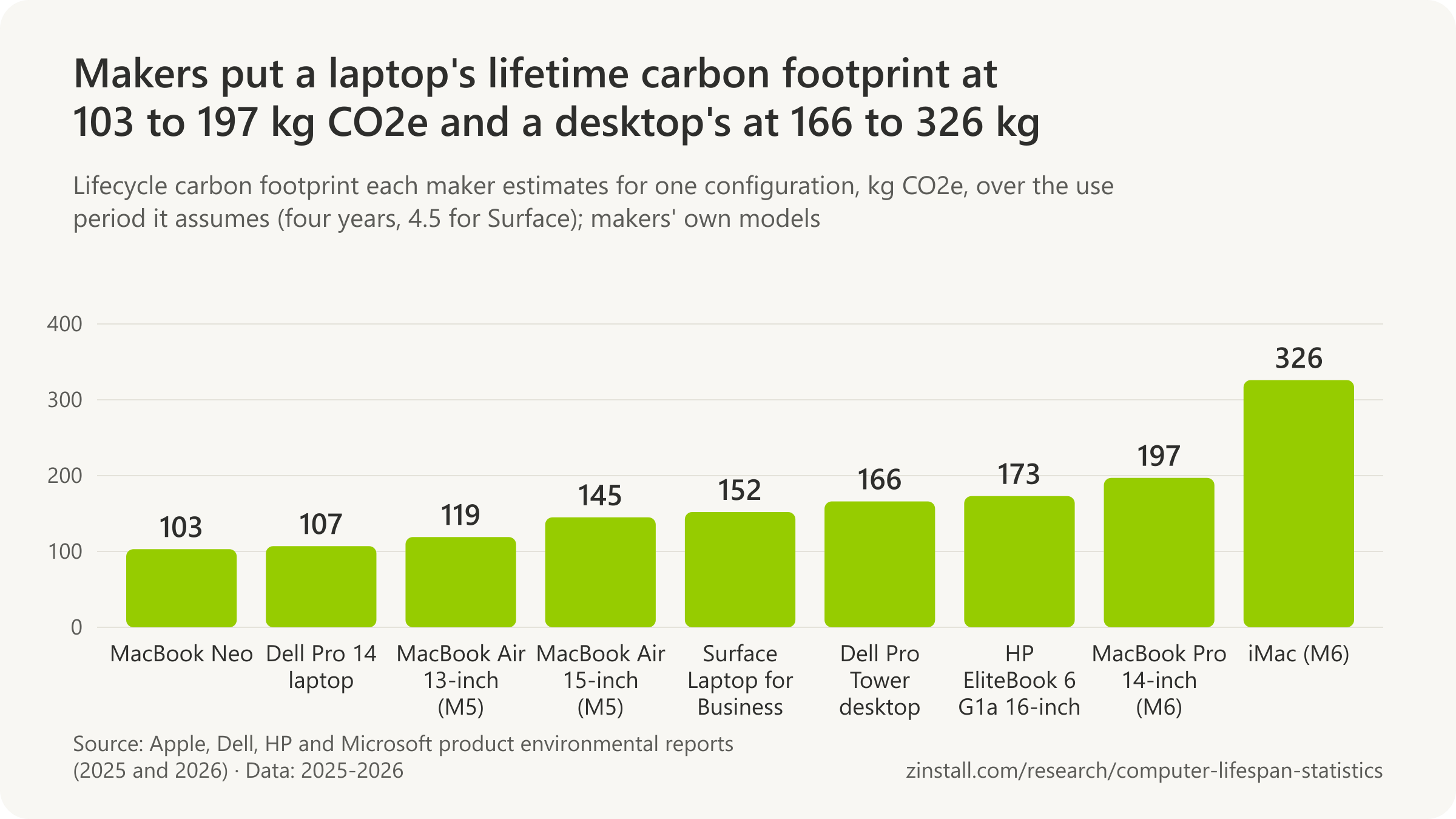
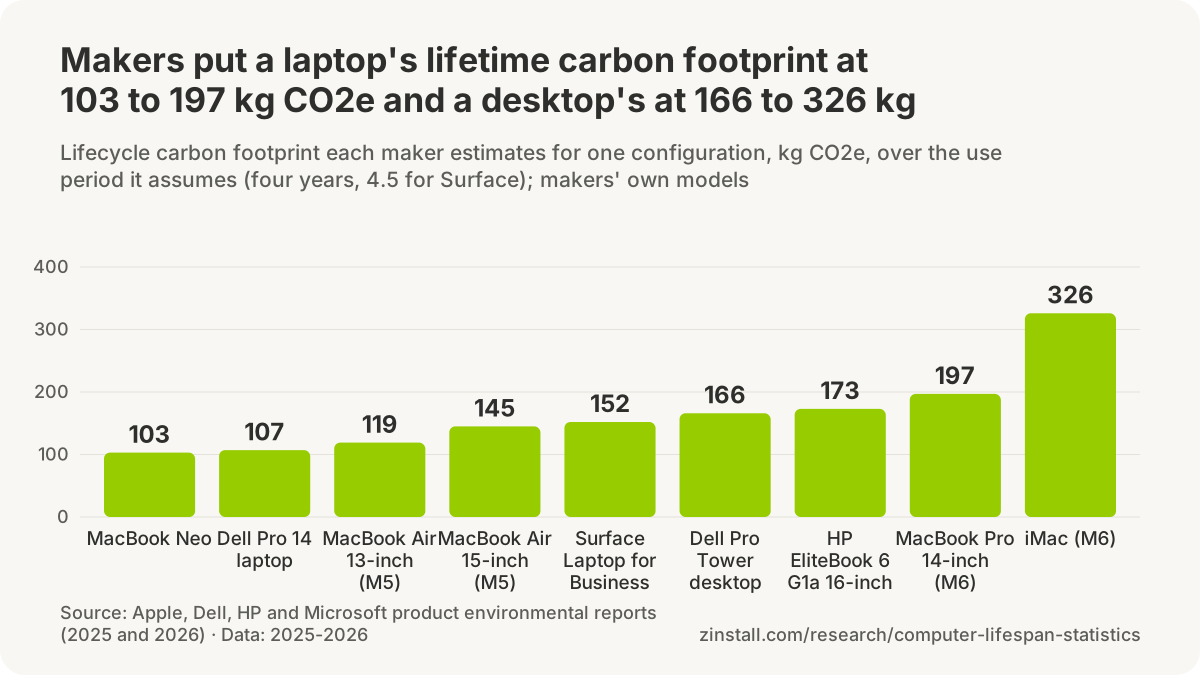

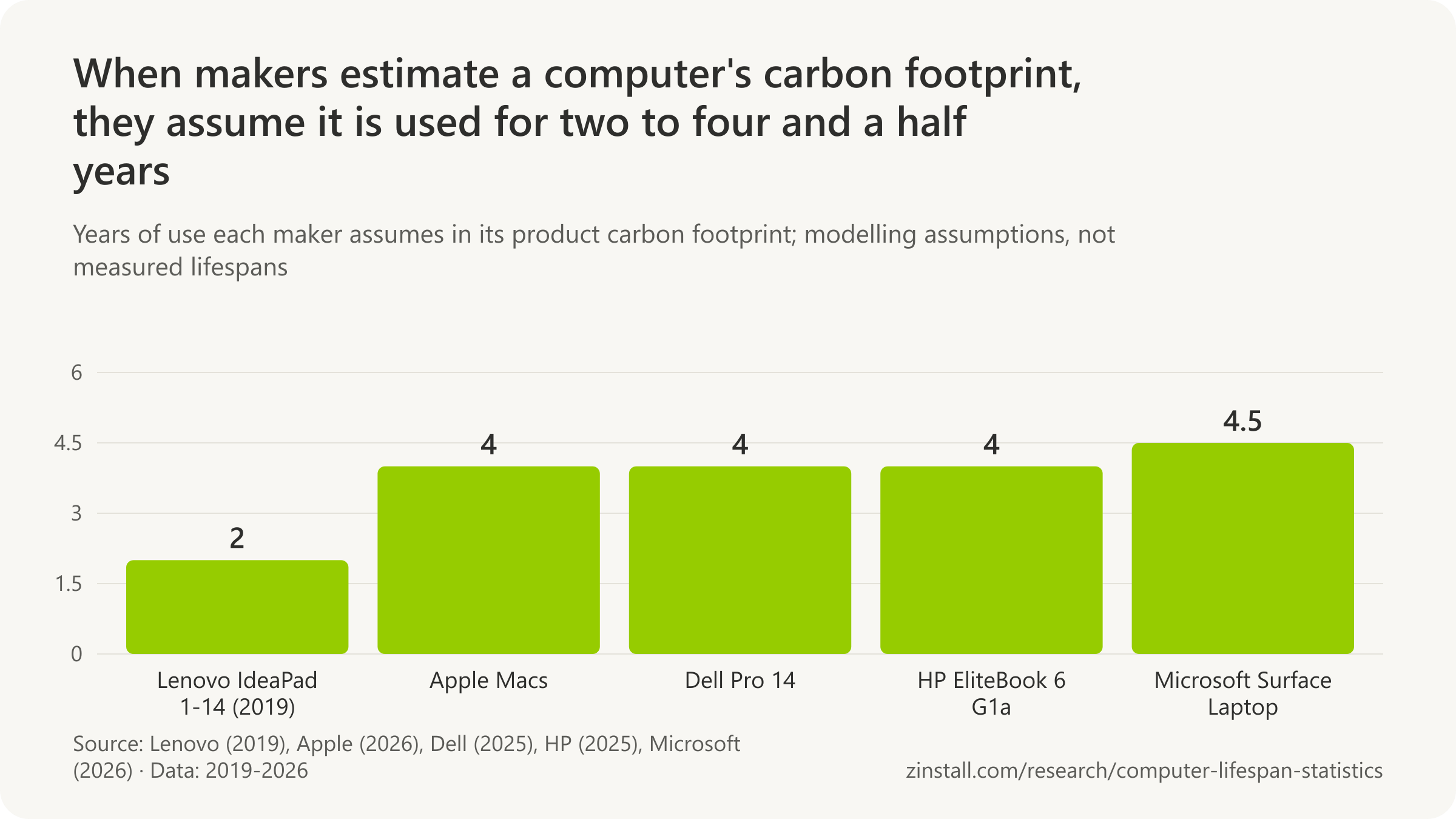
- Four years was already the use period Apple assumed for a Mac notebook in its 2010 MacBook Air environmental report, which put the 13-inch model's lifecycle emissions at 330 kg CO2e, 60% from production and 32% from customer use (Apple, 2010).
- 76% of the 161 kg CO2e lifecycle footprint Apple estimated for the 13-inch MacBook Air (M1, 2020) came from production, against 15% from customer use (Apple, 2020).
Take-back and reuse by makers

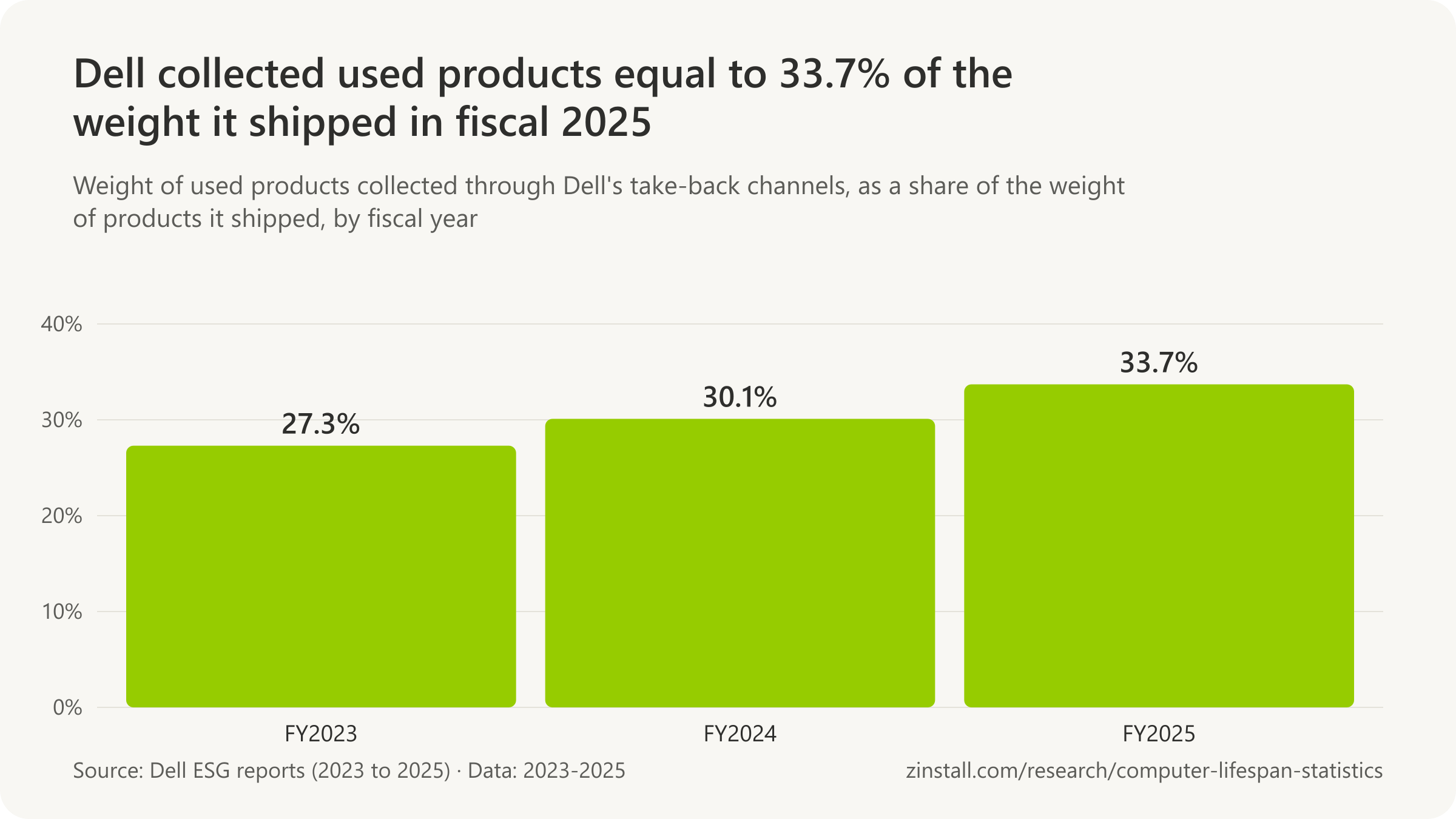

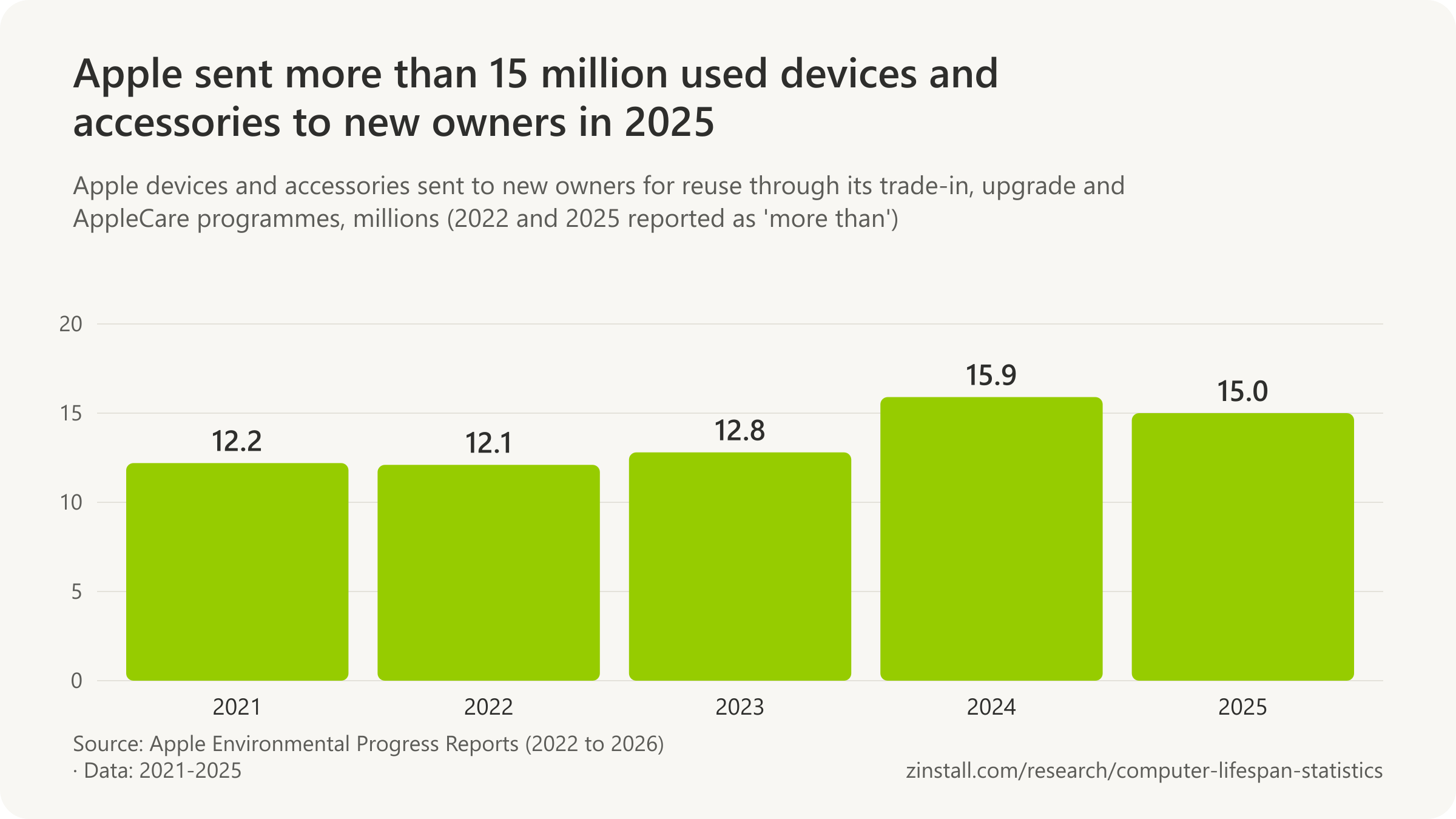
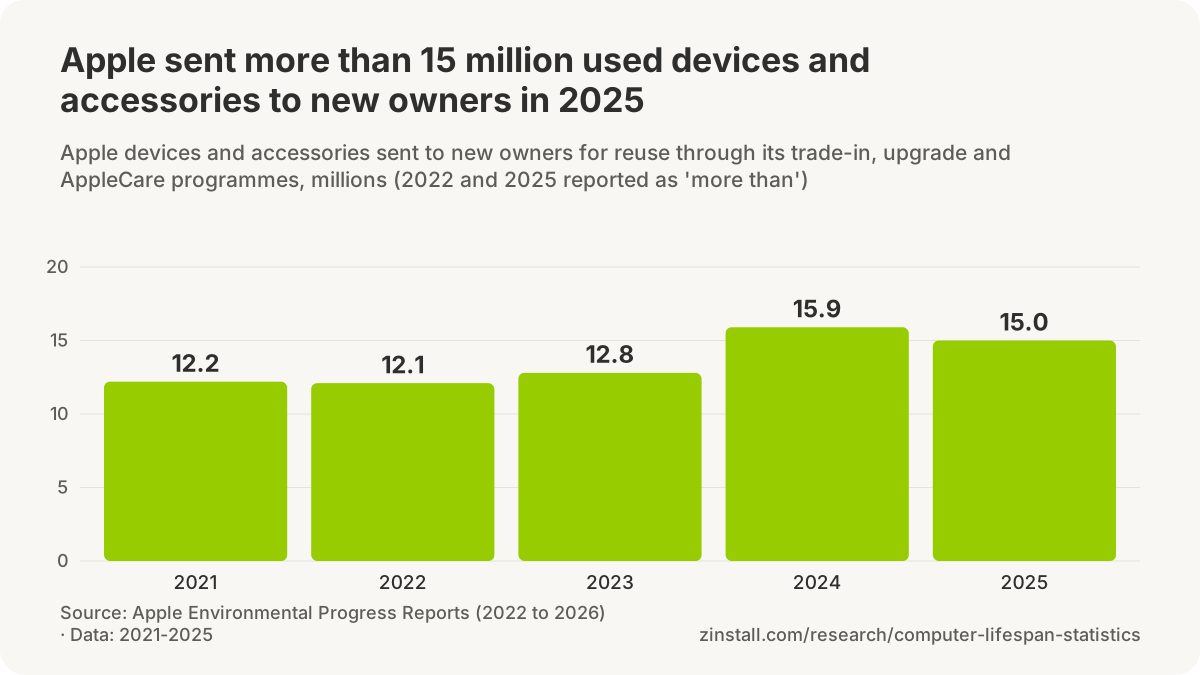
- 39% of channel partners already had capabilities for refurbishing and reselling secondhand devices in Canalys' 2023 sustainability survey (Canalys, 2023).
- 89.0% of the products Dell collected in fiscal 2025 were recycled and the remaining 11% were reused or resold (Dell, 2025).
- 1.9 million units of electronic equipment were refurbished and reused through HP's programmes in 2025 (HP, 2026).
- 111,300 tonnes of hardware and supplies were recycled through HP's take-back programmes in 2025, an overall recycling rate of 18%, bringing HP to its goal of 1.2 million tonnes recycled since 2016 (HP, 2026).
- 43,000 metric tons or more of electronic scrap was directed to recycling facilities by Apple's customer and employee programmes in 2025, up from nearly 40,000 tons in each of 2023 and 2024 (Apple, 2026).
- 7.4% of the 37,825 metric tons of end-of-life products handled by Lenovo's product end-of-life programme in 2024 was reused, 86.7% recycled, and the rest burned for energy, incinerated or landfilled (Lenovo, 2026).
- 800 million pounds (about 363 million kg) of end-of-life products had been recycled or reused through Lenovo's programmes since 2005 by fiscal 2025/26, meeting its target (Lenovo, 2026).
Numbers in circulation
- 4.6 million tonnes of e-waste in 2022 was small IT and telecommunication equipment such as laptops and phones, with a 22% documented collection and recycling rate, per the UNITAR press release (UNITAR, 2024).
- 1.6 billion pounds of e-waste 'have entered the graveyard' is PIRG's November 2025 restatement of its own September estimate, which had said the End of 10 'could result in' that amount (PIRG, 2025).
Sources: UNITAR and ITU; International Telecommunication Union; UNU/UNITAR SCYCLE, ITU and ISWA; United Nations University; Japan PC 3R Promotion Association (2004-2026); Eurostat (2023-2026); US Environmental Protection Agency (2014, 2020); WEEE Forum; Material Focus; Statistics Canada; Canalys; U.S. PIRG (2023, 2025); Right to Repair Europe; The Restart Project; End of 10 campaign; Back Market (2025, 2026); Microsoft (2025, 2026); Apple (2010-2026); Dell Technologies (2025); HP Inc. (2025, 2026); Lenovo Group; United Nations Institute for Training and Research; UNU, ITU and ISWA; Lenovo
Is it better to repair or replace a computer?
Only 12.3% of the business devices sent for decommissioning in 2019 to 2023 were actually faulty (Atos, 2024).

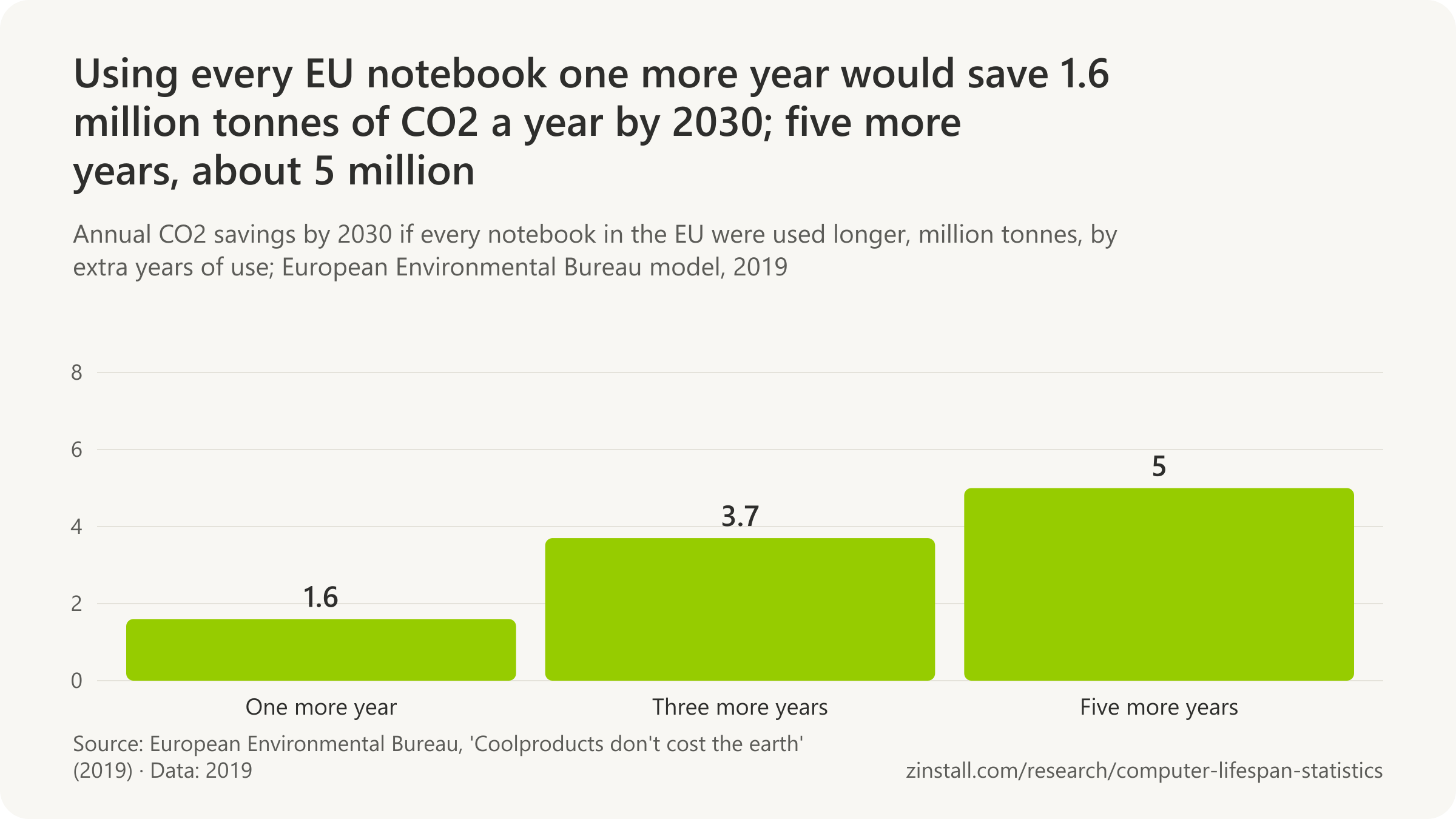
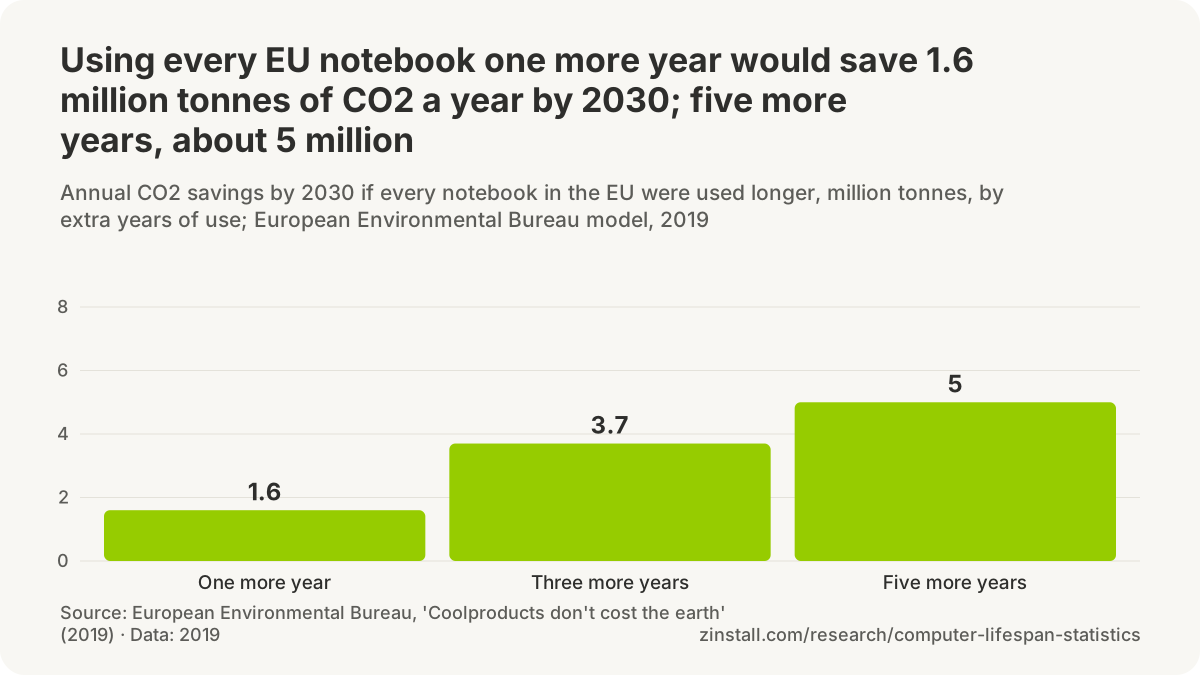
- 57.8% of the laptops brought to community repair events were fixed.
- 42% of UK owners whose laptop broke or slowed down bought a new one rather than having it fixed.
- Using every EU notebook one year longer would save 1.6 million tonnes of CO2 a year by 2030.
- Buying a laptop refurbished avoids 43% to 97% of its yearly environmental impact.
- Repairing Surface and Xbox devices instead of replacing them cut potential waste and emissions by up to 92%.
| Measure and source | Figure |
|---|---|
| Years before a 10% more efficient notebook pays back its production | 33 to 89 years |
| The same, for a 5% more efficient model | 20 to 44 years |
| Second-hand laptops: lower environmental impact than new | 39% to 50% lower |
| Yearly footprint of a notebook kept six years instead of three | 88.9 kg to 47 kg a year |
| France: digital footprint from making the equipment | 78% |
| Refurbished desktop: yearly impact avoided | 36% to 99% |
| Europeans who want to keep devices at least five years | 64% |
| EU buyers who weigh a longer life when buying, 2024 | 10% |
| Employees who would keep a work device longer | 75% |
| US schools surveyed that repair Chromebooks in-house | over 80% |
Sources: Atos (2024a, 2024b); Open Repair Alliance; Which?; European Environmental Bureau; ADEME, with Hubblo, DDemain and LCIE Bureau Veritas; Microsoft; Umweltbundesamt; Waste Management; TCO Development; ADEME and Arcep; European Commission; Eurostat; Google
Related guides: A hard drive with bad sectors · Windows detected a hard disk problem
More statistics (20)
A longer life is the cheapest way to cut a computer's footprint, and studies of laptops find that a repaired or refurbished machine avoids most of the emissions of a new one. Many computers are retired while they still work: most business devices sent for disposal were not faulty, and most laptops brought to community repair events were fixed. Yet many owners still buy new when a laptop breaks or slows down.
What a longer life saves
- 40% to 64% of a notebook computer's global warming impact comes from its non-use phases (manufacturing, transport and disposal) for lifespans of four to five years, according to the European Environmental Bureau's 2019 review of published studies (EEB, 2019).
- 20 to 44 years is how long a notebook would have to be kept before a new, 5% more efficient model made up for its production emissions, the European Environmental Bureau calculated in 2019, concluding that replacing a working notebook never pays off for the climate (EEB, 2019).
- About 56% of a notebook's lifecycle greenhouse gas emissions over five years of use came from producing it, 214 kg CO2e of the total, in the study the Oeko-Institut and Fraunhofer IZM carried out for Germany's Federal Environment Agency (UBA, 2012).
- 33 to 89 years is how long it would take a new notebook that is 10% more energy-efficient to make up for its production emissions, so replacing a working notebook early cannot be justified on environmental grounds, Germany's Federal Environment Agency study found (UBA, 2012).
- 47 kg CO2e a year instead of 88.9 kg is the annual footprint of a notebook kept for six years rather than three, and one extra year (three to four) cuts it by 23.5%, by TCO Development's calculation (TCO Development, 2025).
- 94% of a notebook's lifetime carbon footprint comes from its manufacturing when it is discarded after three years, according to TCO Development's model (TCO Development, 2025).
- 78% of the carbon footprint of digital technology in France comes from manufacturing equipment and 21% from using it, and user devices (computers, phones, screens and TVs) account for 79% of the total, according to the French environment agency ADEME and telecoms regulator Arcep (ADEME and Arcep, 2022).
Refurbished and repaired computers
- 39% to 50% lower environmental impacts came from using second-hand laptops, resold by a commercial reuse firm, instead of new ones, in a Chalmers University life cycle assessment in which reuse doubled 70% of laptops' lives from three to six years (Waste Management, 2019).
- 43% to 97% of a laptop's annual environmental impact is avoided by buying it refurbished rather than new, about 27 kg of greenhouse gases and 127 kg of raw materials per year of use, according to France's environment agency ADEME (ADEME, 2022).
- 36% to 99% of a desktop PC's annual environmental impact is avoided by buying it refurbished rather than new, about 42 kg of greenhouse gases and 259 kg of raw materials per year of use, according to ADEME (ADEME, 2022).
- Up to 92% less potential waste and greenhouse gas emissions came from repairing a Microsoft device instead of replacing it, across the seven Surface and Xbox devices in a 2022 study Oakdene Hollins carried out for Microsoft (Microsoft, 2022).
- More than 85% of the greenhouse gas emissions of replacing a Surface Pro 8 were avoided on average by repairing it at an authorised service provider, and over 70% for a Surface Pro 6 sent for factory repair, before transport, in Microsoft's 2022 repair study (Microsoft, 2022).
Working computers retired, broken ones fixed
- Only 12.3% of the business devices sent for decommissioning were actually faulty, and 88% could still function, in IT asset disposal data for 2019 to 2023 analysed by Atos and Tier1 (Atos, 2024).
- 42% of UK owners whose laptop developed a fault that made it unusable or slowed down bought a new laptop rather than having it fixed, in a Which? survey of 16,097 adults (10,978 laptop owners) in March 2022 (Which?, 2022).
- 7 years was the median age of the laptops brought to community repair events whose age was recorded, and 59% were six or more years old, in the Open Repair Alliance's open dataset to July 2026 (Open Repair Alliance, 2026).
- 57.8% of laptops brought to community repair events were fixed, 26.3% were judged repairable and 15.9% reached end of life, across 16,296 laptop repair attempts with a known outcome in the Open Repair Alliance's dataset to July 2026 (Open Repair Alliance, 2026).
- More than 80% of the U.S. schools that took part in a Google survey were repairing at least some of their Chromebooks in-house, Google said in September 2023 (Google, 2023).
What people say they want
- 10% of people in the EU considered the possibility of extending a device's life span important when buying a phone, tablet, laptop or desktop in 2024, against 69% for price and 53% for hardware such as processor speed (Eurostat, 2025).
- 64% of Europeans wanted to keep using their current digital devices for at least five years, and almost 8 in 10 said manufacturers should be required to make them easier to repair, in a Special Eurobarometer survey of 27,498 people in December 2019 (European Commission, 2020).
- 75% of employees said they would be happy to keep their work device for longer if they understood the environmental benefits, Atos reported in its 2024 workplace device study (Atos, 2024).
Sources: European Environmental Bureau; Umweltbundesamt; TCO Development; ADEME and Arcep; Waste Management; ADEME, with Hubblo, DDemain and LCIE Bureau Veritas; Microsoft; Atos (2024); Which?; Open Repair Alliance; Google; Eurostat; European Commission
Do laptops really last 3 to 5 years?
Laptops last 3 to 5 years and desktops 3 to 8, a PC maker's US guide said in 2024, citing no study (HP, 2024).
- A PC maker's 2026 US guide said desktops last 7 to 10 years and laptops 4 to 6.
- '3 to 5 years' was credited to IDC and Gartner; the IDC study linked reports a 3.9-year refresh cycle.
- The '3.7 years' credited to Gartner for enterprise laptops comes from a consultant's quote, not a Gartner document.
- A PC lifespan 'set at four years' matches Japan's tax useful life, not a measurement.
- 'Up to $17,000 a year per employee' for an old PC multiplies a survey estimate by an assumed salary.
| Page and claim | Figure claimed |
|---|---|
| HP UK, 2018: a mid-range laptop lasts 'roughly three years' | roughly 3 years |
| Computerworld, 2005: an analyst's 'three to four and a half years' | 3 to 4.5 years |
| Business Insider, 2022: Apple laptops '7 to 10 years' | 7 to 10 years |
| Macworld, 2026: macOS updates for '7 to 8 years' | 5 to 8 years (viable); 7 to 8 years (macOS updates) |
| Asurion, 2026: most laptops last '4 to 8 years' | 4 to 8 years |
| ITarian, 2025: gaming laptops '3 to 4 years' | 3 to 5 years (laptops); 3 to 4 years (gaming laptops) |
| iBUYPOWER, 2025: a gaming PC lasts '5 to 8 years' | 5 to 8 years |
| BGR, 2026: Chromebooks last '7.6 years' | 7.6 years (6.9 consumer; 8.1 education; 8.3 government) |
| Oeko-Institut, 2012: notebooks 'often under 3 years' | under 3 years (2.9 years, Japan 2005) |
| TCO Development, 2025: '250 million notebooks a year' | 250 million a year; 250 kg each |
Sources: HP Inc. (2026, 2024, 2018); Business News Daily; allwhere, quoting Dave Hatter; GEEKOM; Intel; Computerworld; Business Insider; Macworld; Asurion; ITarian; iBUYPOWER; BGR; Oeko-Institut and Fraunhofer IZM; TCO Development
More statistics (57)
The lifespans most often quoted for computers have no study behind them. Each figure below is what a page that ranks or is widely cited says, traced to its source, or to none: maker blogs whose ranges change from page to page, an analyst's 2005 estimate, a tax rule presented as a lifespan, survey estimates turned into costs per employee. A few restate their source faithfully.
'Laptops last 3 to 5 years'
- Laptops lasting three to five years and desktops three to eight years is how HP's UK buying guide put it in September 2024, citing no study or survey (HP, 2024).
- Laptops lasting 3 to 5 years and desktops 3 to 8 years is how HP's US guide to computer lifespan put it in September 2024, citing no source (HP, 2024).
- Desktops lasting three to eight years and laptops three to five is how HP India's guide put it in September 2022, the earliest dated HP version of the ranges we found, citing no source (HP, 2022).
- The average desktop PC lasting only 2 to 3 years, or 5 to 8 years with proper maintenance, is how an HP US article put it in October 2024, a month after HP's lifespan guide gave desktops 3 to 8 years (HP, 2024).
- Desktop PCs lasting 7 to 10 years and laptops 4 to 6 years is how HP's May 2026 upgrade-or-replace guide put it, longer ranges than HP's own 2024 guides gave, again without a source (HP, 2026).
- A typical laptop lifespan of three to five years was attributed to "industry research from IDC and Gartner" by Business News Daily in September 2025, but the IDC study it links reports a 3.9-year PC refresh cycle and the Gartner report's figures are paywalled (Business News Daily, 2025).
- Many companies replacing business computers within three to five years is what Business News Daily said Gartner notes, linking a paywalled Gartner report whose open summary gives no such figure (Business News Daily, 2025).
- Some computers staying in great shape for five to eight years with regular care is how Business News Daily put it in September 2025, linking an IDC study that measured refresh cycles, not lifespans (Business News Daily, 2025).
- $873 per PC, a 37% cut in life-cycle costs, is how Business News Daily restated IDC's 2024 study for Dell, correctly, though it omitted that the study was sponsored by Dell and measured users of life-cycle services (Business News Daily, 2025).
- Most Macs receiving macOS updates for around six years after launch is how Business News Daily summarised Apple's support in September 2025, pointing to the endoflife.date tracker rather than Apple (Business News Daily, 2025).
- An average laptop lasting four to five years is what Business Insider tells readers to expect, a range that traces to a 2022 quote from the head of a US IT refurbishing firm, not to a study (Business Insider, 2025).
- A typical laptop becoming unusable in about four to five years was the estimate Business Insider quoted in October 2022 from Corey Donovan, president of IT refurbisher Alta Technologies; no study stood behind it (Business Insider, 2022).
- Apple laptops lasting about seven to 10 years on average was the exception Business Insider quoted in October 2022 from the head of IT refurbisher Alta Technologies, an estimate the MacBook lifespan pages still echo (Business Insider, 2022).
- Most laptops lasting 4 to 8 years is how Asurion, a device-protection and repair company, answered in May 2026, citing its repair experience but no data (Asurion, 2026).
- Budget laptops 3 to 5 years, mid-range, gaming laptops and Chromebooks 4 to 6, premium and business laptops 5 to 8 is the lifespan table Asurion published in May 2026, without a source (Asurion, 2026).
- 7.7 years of average use and 56.7% of replacements caused by hardware failure is how mini-PC maker GEEKOM restated Japan's Cabinet Office survey in 2025, accurately but from the 2023 edition (GEEKOM, 2025).
- A standard PC lifespan "set at four years" is how GEEKOM put it in 2025, a phrase that matches Japan's four-year tax useful life for personal computers, a depreciation rule rather than a measured lifespan (GEEKOM, 2025).
- Mini PCs and desktops lasting 5 to 7 years and laptops 3 to 5 years is how mini-PC maker GEEKOM summed up PC lifespans in 2025, without a source for either range (GEEKOM, 2025).
- A UK government survey finding PCs used for about 7 to 8 years, with over half used "until it breaks", is a claim GEEKOM made in 2025 without naming or linking the survey; we could not trace it (GEEKOM, 2025).
- Desktops lasting 5 to 7 years, laptops 3 to 5 and mini PCs 4 to 6 is how mini-PC maker Acemagic answered in August 2025, the same ranges GEEKOM gives, again without a source (Acemagic, 2025).
- A gaming PC lasting five to eight years on average, three to four of them playing the latest games at high settings, is how gaming-PC seller iBUYPOWER put it in December 2025, without a source (iBUYPOWER, 2025).
- Desktops 6, 7, 8 or even 10 years old, with notebooks lasting about half as long, was one anonymous volunteer's experience of 150 client PCs in a 2017 Microsoft Q&A thread; it is an anecdote, not Microsoft data (Microsoft Q&A, 2017).
- Hard drives typically lasting 3 to 5 years and laptop batteries needing replacement after 2 to 4 years is what Microsoft's Surface guide to laptop lifespan said in April 2024; it gives no overall lifespan and no source (Microsoft, 2024).
- A PC's legal useful life is four years, a tax rule, while its lifespan is "about five years as a rule of thumb", Lenovo Japan's buying guide says, keeping the two apart but citing nothing for the five (Lenovo, 2026).
- An average computer lifetime of "roughly 5-7 years" is how the Coolproducts campaign (EEB and ECOS) summarised it on its computers page, without a source (Coolproducts, 2025).
- An average computer lifetime of 7 years was attributed to a recent Altroconsumo survey (Altroconsumo Inchieste, February 2024) by ANEC, which represents consumers in European standardisation, in its April 2024 comments on the EU computer rules (ANEC, 2024).
- An average enterprise laptop lifespan of about 3.7 years, with desktops around 4.6, was attributed to Gartner by an IT consultant quoted by device-procurement firm allwhere in April 2025; no Gartner document with those figures was found (allwhere, 2025).
- A PC life cycle of three to four and a half years was Yankee Group analyst Laura DiDio's estimate in Computerworld in November 2005, when the same article quoted Lenovo's chief architect saying "a desktop can last seven years easy" (Computerworld, 2005).
- Laptops lasting 3 to 5 years and gaming laptops typically 3 to 4 is how IT-management vendor ITarian answered in July 2025, without a source (ITarian, 2025).
- Notebooks "often have a useful lifetime of less than 3 years" is how a 2012 study for Germany's Federal Environment Agency put it, citing a 2005 survey of 1,000 Japanese households that measured 2.9 years of use as the primary device (Oeko-Institut for UBA, 2012).
- "A standard 3-5 year device lifespan on a fixed refresh cycle" against 8 to 10 years with condition-based refresh and remanufacturing is how IT services firm Atos framed its November 2024 research, without a source for the standard (Atos, 2024).
- A mobile PC replacement cycle that "typically runs every 4-5 years" is how market researcher NielsenIQ characterised laptops and tablets in October 2023; the measured part is that over 60% of 2022 replacers had used theirs for under five years (NielsenIQ, 2023).
- A typical mid-range laptop lasting "roughly three years" is what HP's UK guide to its longest-lasting laptops said in July 2018, and the page still advises buying an 8th-generation processor with Windows 10, a system Microsoft stopped supporting in October 2025 (HP, 2018).
Macs and Chromebooks
- Most Macs remaining viable for five to eight years, with Apple typically providing macOS updates for around seven to eight years, is how Macworld put it in September 2026; the support window, not a measured lifespan, is the likely root of "MacBooks last 7 to 8 years" (Macworld, 2026).
- A MacBook Pro's average lifespan of seven to ten years is what BGR attributed to "some reviewers and users" in December 2025, while the same article says MacBooks feel in need of an upgrade after three to five years (BGR, 2025).
- MacBook Pros lasting 7 to 10 years and MacBook Airs 5 to 7 years is how refurbished-device marketplace Back Market put it in 2026, from its writer's own experience, adding that most people replace MacBooks every 6 or 7 years (Back Market, 2026).
- MacBooks typically lasting 5 to 8 years against 3 to 5 for the average Windows laptop is how refurbished-Mac comparison site refurb.me put it in 2026, without a source for either range (refurb.me, 2026).
- Out-of-warranty repair rates down 78% between 2015 and 2022 is how refurb.me restated Apple's longevity white paper for MacBooks in 2026; Apple's paper gives 78% for in-warranty and 38% for out-of-warranty repairs, across Apple devices (refurb.me, 2026).
- An average Apple device lifespan of just over four years was how MacRumors reported analyst Horace Dediu's 2018 estimate, which covers iPhones, iPads, Watches and Macs together and was derived from active devices against cumulative sales, not measured (MacRumors, 2018).
- About 4 years and 3 months was the average lifespan of Apple devices that analyst Horace Dediu derived in March 2018 from 2.05 billion devices sold and 1.3 billion active, a method that counts all Apple devices together (Asymco, 2018).
- An average Chromebook lifespan of about 7.6 years, 6.9 for consumer models, is what BGR reported in January 2026 from a Chromebook fan site whose figures cite BGR in return; no method or data stands behind them (BGR, 2026).
- A 7.6-year average Chromebook lifespan, with Lenovo at 8.2 years and a 6.3% failure rate after five years, is what Chromebook fan site About Chromebooks published, citing "About Chromebooks, BGR" as its source; no data or method is shown (About Chromebooks, 2026).
What an old PC costs
- Laptops losing 60.8% of their retail price over their first three years is what device-procurement firm allwhere found in its 2025 study of eBay sold listings, its own data with no published method beyond the listing counts (allwhere, 2025).
- Four-year-old PCs having a 53% higher security incident rate than new PCs, and three-year-old PCs 30% higher, were figures Intel presented in April 2009 from a Wipro survey of 106 enterprises it commissioned, as The Register reported (The Register, 2009).
- A three-year PC refresh cycle being ideal, with 32% of companies having delayed refreshes in the previous six months, came from a 2009 Wipro survey of 106 enterprises commissioned by Intel, an early source of the "replace your PC every 3 years" advice (The Register, 2009).
- Enterprises refreshing PCs about every three years while small businesses hold onto them for five to seven years is what Intel asserted in a 2013 article urging small firms to upgrade, citing no source for either cycle (Intel, 2013).
- 39% of 1,200 PC users felt that migrating from an old PC to a new one was reason enough to delay buying a new PC, in an Intel-sponsored survey cited by Laplink in 2011 (Laplink press release, 2011).
- A five-year-old computer costing $662 a year in repairs, with 43% of PCs over five years old malfunctioning each year against about 5% of new ones, is how Intel's small-business guide presented the J.Gold survey it commissioned; the figures are respondents' estimates (Intel, 2022).
- Up to $17,000 a year per employee lost to a five-year-old PC is Intel's arithmetic, not a survey finding: its footnote multiplies respondents' 29% productivity-loss estimate by an assumed $60,000 salary (Intel, 2022).
- $35,745 "per employee" as the average cost of a data breach is another derived figure on Intel's small-business page: its footnote multiplies the 34.47% of older PCs respondents said had been hacked by an average breach cost of $103,705 (Intel, 2022).
- Computers older than four years being breached three times as often as those under three is a claim Intel's small-business page made from 2022, and its footnote cites a 2020 blog post by a Texas IT services firm, not a study (Intel, 2022).
Other claims
- Voltage fluctuations over 10% shortening electronic components' lifespan by up to 40% is what Acemagic attributed to "an IEEE study" in 2025, without naming or linking it; we could not trace it (Acemagic, 2025).
- 15% to 20% of recurring blue-screen errors in older PCs being caused by hardware defects is what Acemagic attributed to "Microsoft diagnoses" in 2025, without a link; no Microsoft publication with that figure was found (Acemagic, 2025).
- "As many as 400 million laptops and computers at risk of becoming obsolete overnight" is how refurbished-device marketplace Back Market's UK site put Windows 10's end in 2025, restating PIRG's "up to 400 million" upper bound as a count of laptops (Back Market, 2025).
- Around 250 million new notebooks made each year, each with about 250 kg of greenhouse gases before first use, is how sustainability certifier TCO Development opened its October 2025 article, with no source for either figure (TCO Development, 2025).
Business PCs' age in 2010
- An average PC age of 4.4 years, "close to what many experts consider to be a 5-year maximum life for computers", is how Business News Daily first wrote the article that now gives laptops three to five years: its July 2010 version restated Microsoft's partner-conference figure and named no expert (Business News Daily, 2010).
- Business PCs averaging "getting close to five years" old, the oldest in over a decade, is what Microsoft's Windows CFO Tami Reller told its partner conference in July 2010, when she also put 74% of the 570 million business PCs on Windows XP (Microsoft, 2010).
Sources: HP Inc. (2018-2026); Business News Daily; Business Insider (2022, 2025); Asurion; GEEKOM; Acemagic; iBUYPOWER; Microsoft Q&A; Microsoft (2010, 2024); Lenovo Japan; Coolproducts campaign; ANEC; allwhere, quoting Dave Hatter; Computerworld; ITarian; Oeko-Institut and Fraunhofer IZM; Atos; NielsenIQ commentary; Macworld; BGR (2025, 2026); Back Market (2025, 2026); refurb.me; MacRumors; Asymco; About Chromebooks; allwhere; The Register, reporting Intel and a Wipro study it commissioned; Intel (2013, 2022); Laplink; TCO Development; BusinessNewsDaily
Data. All 1,174 statistics on this page, each with its source, verbatim quote and locator: CSV · JSON. Charts and figures on this page may be reused with a link to https://www.zinstall.com/research/computer-lifespan-statistics as the source. Original publishers retain attribution.
Data behind each chart (CSV, 58 files)
- Measured, computers stay in use for four to eight years, not the three to five usually quoted
- Japanese households now keep a PC 7.7 years before replacing it, up from 4.1 years in 2002
- Chromebooks now get 10 years of updates; Intel Macs got 5.8 years of macOS upgrades on average
- Windows 10 got 10.2 years of free updates, Windows XP 12.3: the software, not the hardware, often sets a PC's end
- Tax rules give a computer a life of one year in Germany, two for an Australian laptop and five in the United States
- Organisations replace PCs every three to five years: 3.9 years on average at US organisations that buy refresh services
- Businesses estimated that 43% of PCs over five years old break or malfunction each year, against 5% of new ones
- Makers draw the worn-out line for a laptop battery anywhere from 80% to 50% of its original capacity
- Since 2014, chip and PC makers have put the number of PCs four years old or more at 500 to 600 million
- 284.7 million PCs were shipped in 2025, below the 2011-2012 peak and the 2021 pandemic high
- The world generated 62 billion kg of e-waste in 2022, up from 34 billion kg in 2010
- Using every EU notebook one more year would save 1.6 million tonnes of CO2 a year by 2030; five more years, about 5 million
- Year by year, Japanese households have come to keep their PC longer: 4.1 years in 2002, 7.7 in 2026
- Breakdown overtook the wish for a better model among Japanese households' reasons to replace a PC; 'other' spiked when Windows support ended
- Japanese households with a PC rose from 11.7% in 1987 to a peak of 79.1% in 2016, and fell to 74.7% in 2026
- Japanese households own 122.8 PCs per 100, after a peak of 131.2 in 2014
- German households used a notebook 5.1 years before replacing it in 2012, down from 6 years in 2005 and 2006
- European laptop owners report an average lifespan of about seven years in consumer organisations' surveys
- Each year's 13-inch Intel MacBook Air got four to seven years of macOS upgrades, fewer for the later models
- Surface Pro models got between 4.2 and 7.4 years of driver and firmware updates before Microsoft's six-year rule
- Each macOS version got about three years of security updates after its release
- Chromebooks went from three years of updates at launch to ten for platforms released from 2021
- Nvidia's graphics cards got 8 to 11 years of game-ready drivers, then security fixes only
- Amazon stretched its servers' accounting life from three years to six, then cut some back to five for AI
- Canada lets businesses write off 55% of a computer's remaining value each year, up from 30% before 2004
- A three-year laptop refresh cost firms least per year in a 2009 study: $1,266, against $1,430 for five years
- Washington State's school districts expect to replace 974,979 student computers in four school years
- Businesses estimated losing 29.5% of an employee's productivity on a PC over five years old
- PC failures cost a business an estimated $662 a year per user once the PC is over five years old, against $55 when new
- Supporting a laptop cost firms $716 in its first year and $1,368 in its fifth, in a 2009 study
- Apple rates every Mac notebook battery since 2009 for 1,000 charge cycles, up from 300 in 2006
- Windows 10 went from 400 million active devices in 2016 to 1.3 billion in 2021
- 80.5% of US households have a desktop or laptop computer, a share barely changed since 2021
- 83.1% of EU households had a computer in 2017, the last year Eurostat measured it, up from 62.7% in 2007
- IDC's count of PCs shipped each year since 2007: a 2011-2012 peak, a long decline, a pandemic high, then a refresh
- Gartner counted 270.2 million PCs shipped in 2025, against 352.8 million at the 2011 peak
- PC shipments rose through the Windows 10 refresh of 2025, then fell to 62.7 million in Q3 2026 as memory prices soared
- Lenovo grew from 6.9% of PCs shipped in 2005 to 27.2% in 2025; HP holds 21.3% and Dell 15.3%
- Apple held 9.2% of PCs shipped in 2025, Asus 6.9% and Acer 6.3%, down from Acer's 13.0% in 2009
- By IDC's count, Lenovo shipped 24.9% of PCs in 2025, HP 20.2% and Dell 14.4%
- By IDC's count, Apple shipped 9.0% of PCs in 2025 and Asus 7.2%; Acer peaked at 13.0% in 2009
- Gartner counted 55.4 million PCs shipped in Q3 2026, down from 69.9 million a year earlier
- Omdia counted 58.1 million PCs shipped in Q3 2026, down from 72.0 million a year earlier
- Canalys counted 341 million PCs shipped in the pandemic year 2021 and 255 million in 2024
- 219.7 million notebooks were shipped in 2025, against 275 million in 2021
- It would take 5.3 years of 2025's shipments to replace every PC in use, against 3.3 years in 2008
- Apple sold 18.2 million Macs in fiscal 2018, its last year reporting units, up from 3.1 million in 2001
- Japan's PC makers collected 242,722 used household PCs in fiscal 2025, up 12.3% in the Windows 10 year
- The EU collected 12.3 kg of e-waste per person in 2024, up from 6.9 kg in 2010
- The EU collected 411,077 tonnes of small IT and telecom e-waste in 2024, the category with desktop PCs
- Under the older EU categories, IT and telecom e-waste collected stayed around half a million tonnes a year
- 38.5% of US consumer electronics waste was recycled in 2018, the EPA's latest data year, up from 10% in 2000
- Only 22.3% of the world's e-waste was documented as collected and recycled in 2022
- Screens and monitors, the category with laptops, made 5.9 billion kg of e-waste in 2022; small IT, with desktops, 5 billion kg
- Dell collected used products equal to 33.7% of the weight it shipped in fiscal 2025
- Apple sent more than 15 million used devices and accessories to new owners in 2025
- Makers put a laptop's lifetime carbon footprint at 103 to 197 kg CO2e and a desktop's at 166 to 326 kg
- When makers estimate a computer's carbon footprint, they assume it is used for two to four and a half years
Methodology
What we included. National statistics offices' household surveys (Japan's Cabinet Office, Destatis, Eurostat, the US Census Bureau and others); consumer organisations' owner surveys; makers' own lifecycle, warranty, battery and support pages, their product carbon footprints and take-back reports; tax authorities' rules and companies' annual reports; government and school refresh policies; analyst firms' shipment counts and estimates as published or first reported; surveys commissioned by Microsoft, Intel and Dell, labelled as such; peer-reviewed studies; e-waste statistics from the Global E-waste Monitor, Eurostat, the US EPA and Japan's PC recyclers; and the restatements of all of these on the pages that rank for computer-lifespan searches, traced to their origin. A few figures are this page's own arithmetic on published numbers (support spans from release and end dates, the installed base divided by shipments, averages across a maker's models), labelled derived with the method in each record. Official statistics, the trackers' own publications, company filings and transcripts, and peer-reviewed or analyst reports are preferred; vendor surveys and news reports are included only where no better source exists and are labelled as such in the dataset.
How each figure was verified. Every record carries the exact sentence or table cell from the source (the quote) and where it sits (the locator). A researcher confirmed each one against the source document; a script then re-fetched every source on November 11, 2026 and checked for the quote. Records the script could not confirm are kept only if the researcher's check was complete, and are marked for human review in the dataset. Restatements (a later outlet quoting an earlier figure) are recorded as restatements, with the primary figure alongside.
What we excluded. Lifespans with no measurement behind them (they appear only as restatement records, traced); figures whose only source is a roundup, a forum post or a content farm; a copy of a study when the original could be read; and any first-party Zinstall data. Where a source gives a figure only in a form we could not confirm (for example, a chart with no data table), the record is marked unverified and is not exported.
Rounding and derivation. Numbers are reproduced as published. Where a tracker publishes two decimals, statements and table cells give one decimal, rounded half up, and the dataset keeps the published value. In the short sentences at the top of the page and of each section, large counts and money amounts may be rounded to two or three significant figures; the exact figure follows in the section's full statements and in the dataset. Derived figures (a change between two months, a share computed from two counts) say so and name their inputs. The bold figure in each statement is a reading aid, not an edit.
Updates. Sources are re-checked and new figures added quarterly, with the monthly tracker series topped up as they are published; the next scheduled refresh is April 2027 (Japan's March consumer confidence survey), then IDC's and Gartner's quarterly shipment counts. Corrections are welcome through the contact page.
Measures. Each figure is given in its publisher's measure. Years in use before replacement count when people replaced a computer, not when it broke; an average age counts the machines still running; update periods, tax lives and warranties are rules, not measured lives; refresh cycles are policies and averages; the installed base divided by a year's shipments is a ratio, not a lifespan. Survey estimates of what old PCs cost come from studies commissioned by companies that sell PCs and software, and say so.
Cite this page
Zinstall. "How Long Do Laptops Last? Computer and PC Lifespan Statistics." https://www.zinstall.com/research/computer-lifespan-statistics. Updated 2026-11-11.
Frequently asked questions
How long do laptops last?
Measured, most laptops and PCs stay in use well past five years. Japanese households of two or more people kept the PC they replaced for 7.7 years on average in 2026, European laptop owners reported an average lifespan of 7 years, and the laptops brought to community repair events had a median age of 7. The common '3 to 5 years' has no study behind it.
How long do desktop computers last?
Desktops are kept longer than laptops where sources separate them: 70% of organisations surveyed by Spiceworks used desktops for five years or more, against 48% for laptops, and Australia's tax office gives desktops an effective life of 4 years against 2 for laptops.
How often do people and businesses replace their computers?
US organisations that buy refresh services replaced PCs every 3.9 years on average in IDC's 2024 study for Dell, and Gartner put a business notebook's average life at four years. Households replace far less often to get a better model: in Japan, only 18.1% of PC replacements in the year to March 2026 were to move to a better model, against 55.8% in 2002.
How long do MacBooks last?
Apple promises no period for macOS updates. Its Intel Macs of 2012 to 2020 got 5.8 years of macOS upgrades on average, and each macOS version then got about 2.9 years of security updates. Apple keeps parts for at least 5 years after it stops selling a model and calls it obsolete after 7.
How long do Chromebooks get updates?
Ten years from the platform's release, under the policy Google announced in September 2023; Chromebooks released before 2021 get the full ten only if their owners opt in. The first Chromebooks got three years of updates.
Can a PC last 10 years?
Many do: in Avast's 2017 count, nearly 28% of the PCs it protected were more than eight years old, and 59% of the laptops brought to community repair events were six years old or more. Software is the usual limit: Windows 10 was supported for 10.2 years, and the oldest processors Windows 11 accepts were 8.1 years old when Windows 10's support ended.
How long does a laptop battery last?
Apple rates every Mac notebook battery since 2009 for 1,000 charge cycles, designed to keep up to 80% of their capacity, and HP's batteries keep 80% after 300 cycles and 65% after 1,000. Dell says typical users notice reduced runtime after 18 to 24 months.
Which sources should I cite for computer lifespan statistics?
For how long people keep computers, Japan's Cabinet Office consumer confidence survey (yearly since 2002) and the Euroconsumers owner surveys; for update periods, Google's, Microsoft's and Apple's own pages; for business refresh cycles, IDC's 2024 study for Dell; for the installed base and shipments, IDC, Gartner and the makers' own statements, dated. Each figure in the dataset links its source.
Sources: Cabinet Office of Japan, Economic and Social Research Institute (2026); Test Aankoop / Test Achats, with consumer organisations in seven other countries; Open Repair Alliance; Spiceworks; Australian Taxation Office; IDC; The Register; Apple (2026); Google (2020, 2023); Avast; Microsoft; HP Inc.; Dell Technologies
Ready to transfer your programs and files?
Sources
Every source document behind the figures on this page, listed by publisher. The sources line under each section links each publisher to its document, and the dataset carries the verbatim quote and locator for every statistic.
Show all 438 sources
Loading the list of sources. It is also published as a file: JSON.
guaranteeAny PC, any Windows Buy now