
Home › Research › Most Reliable Laptop Brands: Failure Rate Statistics (2026)
Research data
Most Reliable Laptop Brands: Laptop Failure Rates and Reliability Statistics
Which laptop brands break least: warranty rates from 0.6% to 7.9% by brand, laptop failure rates, what breaks, repair costs, repairability and recalls.
Key laptop reliability statistics
- 16% of 75,923 US laptops bought from 2019 to 2025 broke or stopped working properly within three years (2026).
- 13 times as many Captiva notebooks as Apple ones became warranty cases within two years at a European retailer: 7.9% against 0.6% (2026).
- 17.8% of North Carolina's student laptops needed a repair in the 2025-26 school year, against 5.0% of student desktops (2026).
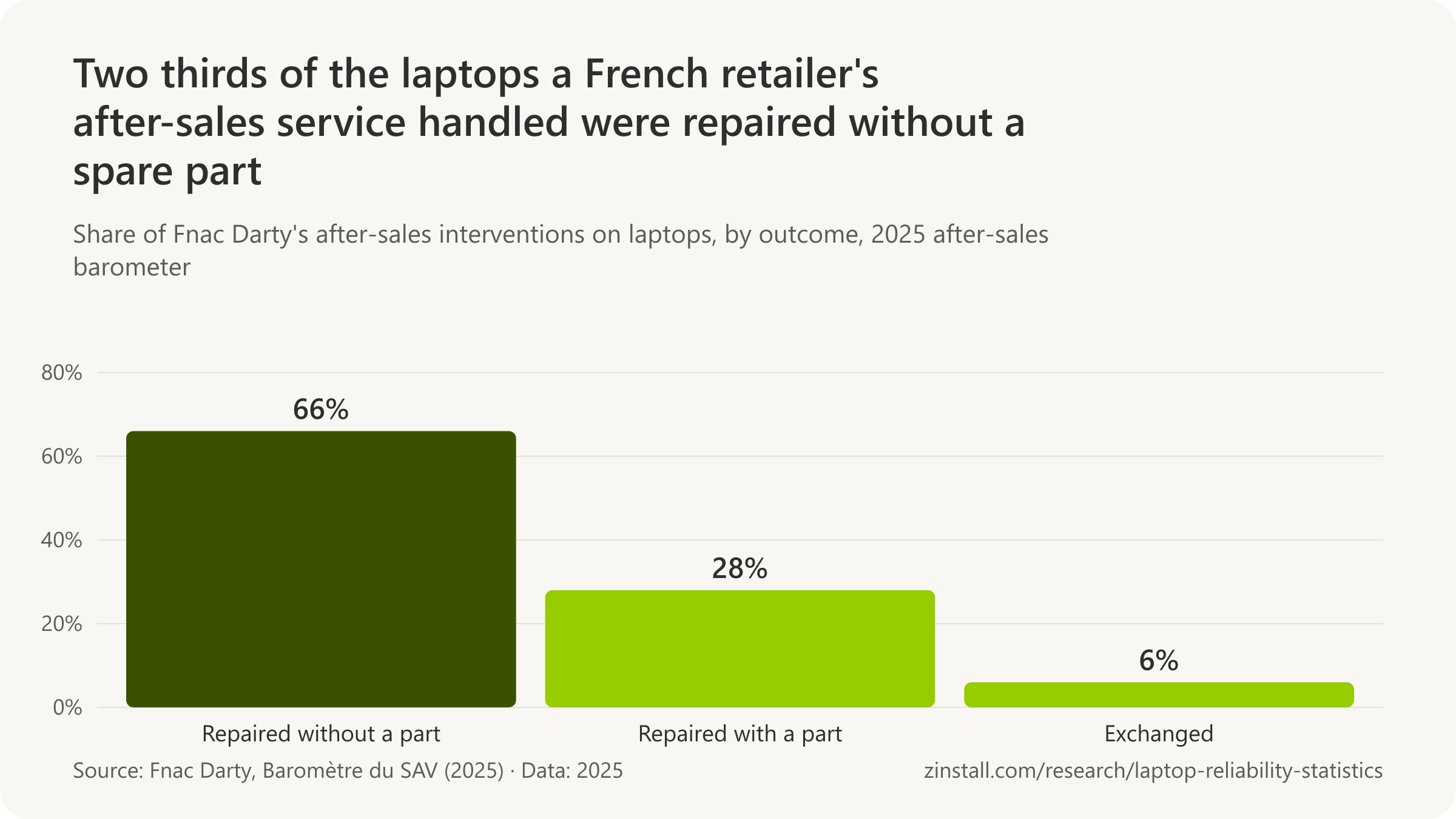
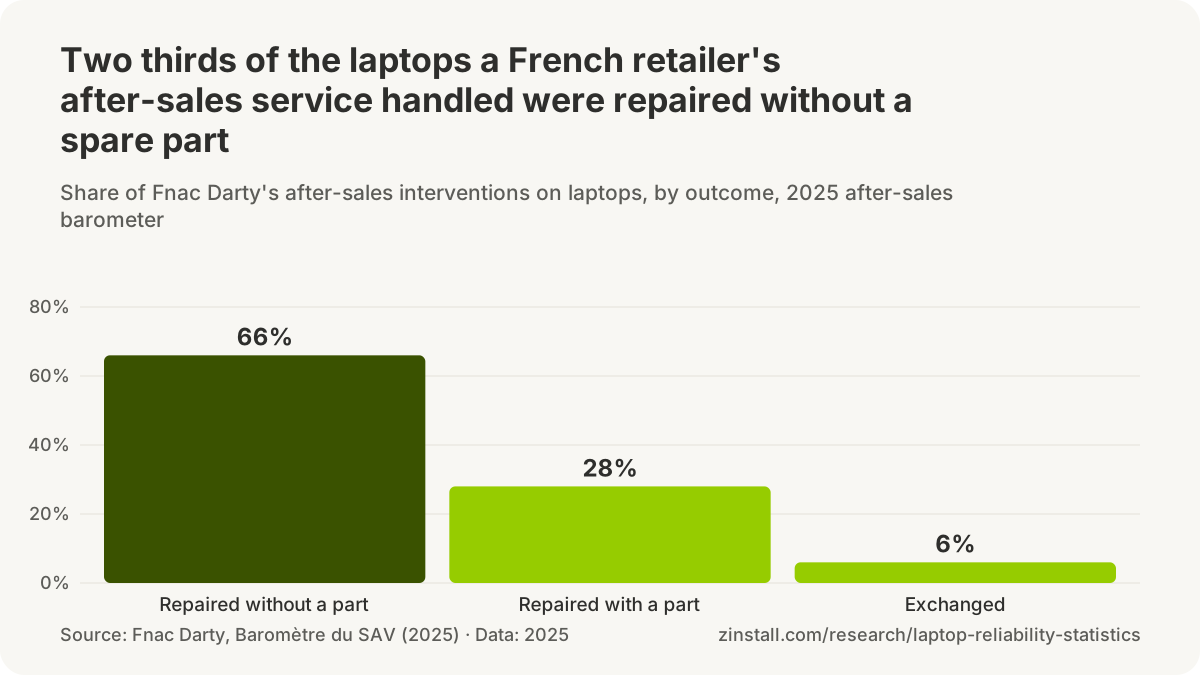
- 66% of the laptops a French retailer's after-sales service handled were repaired without a spare part (2025).
- A big PC maker's warranty costs fell by 1.09 percentage points of revenue in ten years, from 2.11% to 1.02% (2026).
- 7 of 63 laptops scored the top 10 out of 10 for repairability at a repair guide site, none of them Apple's (2026).
- 65% of the laptop battery units recalled in the US from 1993 to 2019 were recalled in 2006 alone (2026).
- About 27.9 million laptop power adapters, chargers and cords were recalled in the US, four times as many as laptop batteries (2026).
Sources: Consumer Reports, Inc.; Digitec Galaxus AG; North Carolina Department of Public Instruction; Fnac Darty; Lenovo; iFixit; U.S. Consumer Product Safety Commission
Which laptop brands are the most reliable, and how often do laptops fail? Most answers online are opinion lists, or an old warranty study quoted as if it were new. This page puts every source that has measured laptop reliability side by side: retailers' warranty and repair data by brand, consumer organisations' owner surveys, satisfaction scores, the makers' own warranty costs, repairability scores and the biggest recalls and defects, each with its measure, its date and its source. Mac and Windows laptops, gaming and business models and school Chromebooks are covered.
Which laptop brands are most reliable?
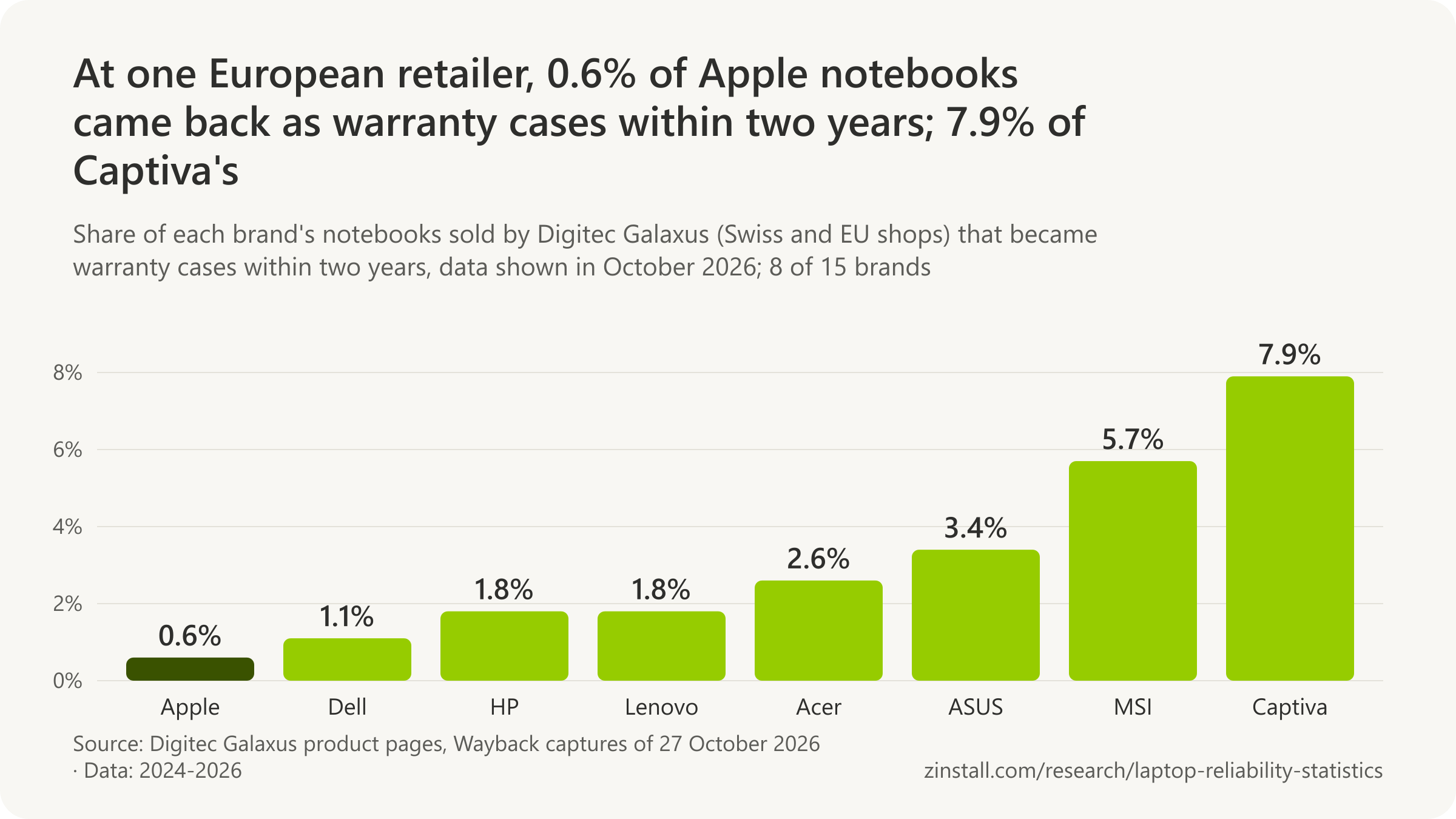
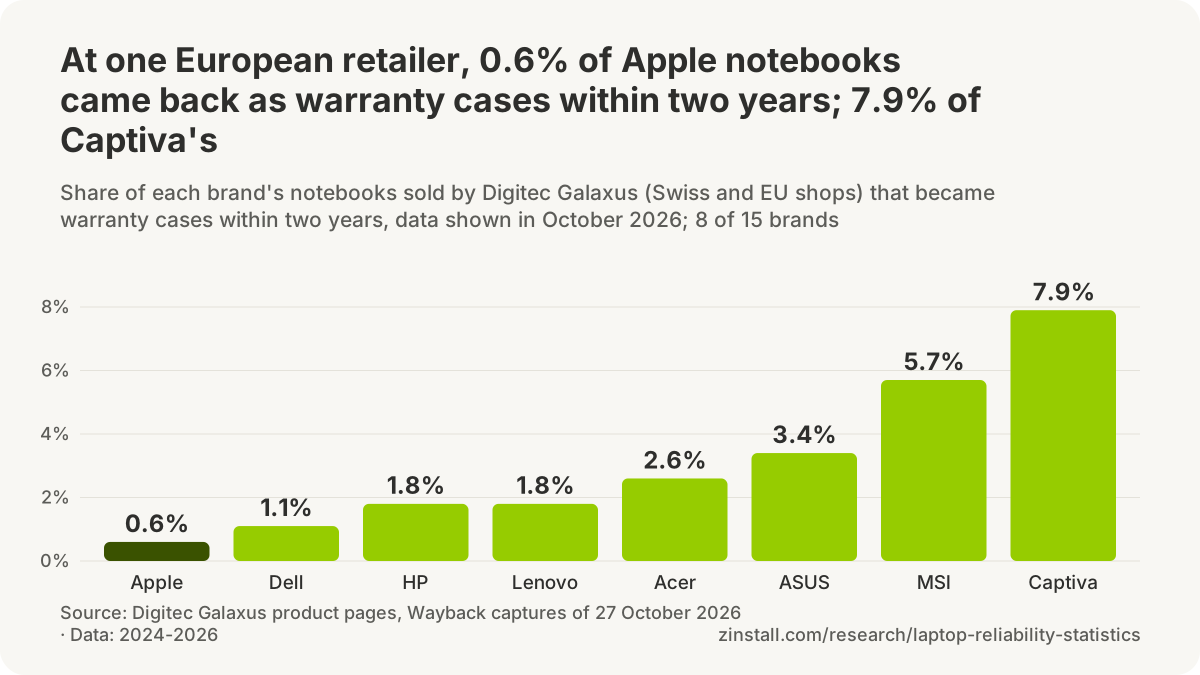
13 times as many Captiva notebooks as Apple ones became warranty cases within two years at a European retailer: 7.9% against 0.6% (Digitec Galaxus, 2026).

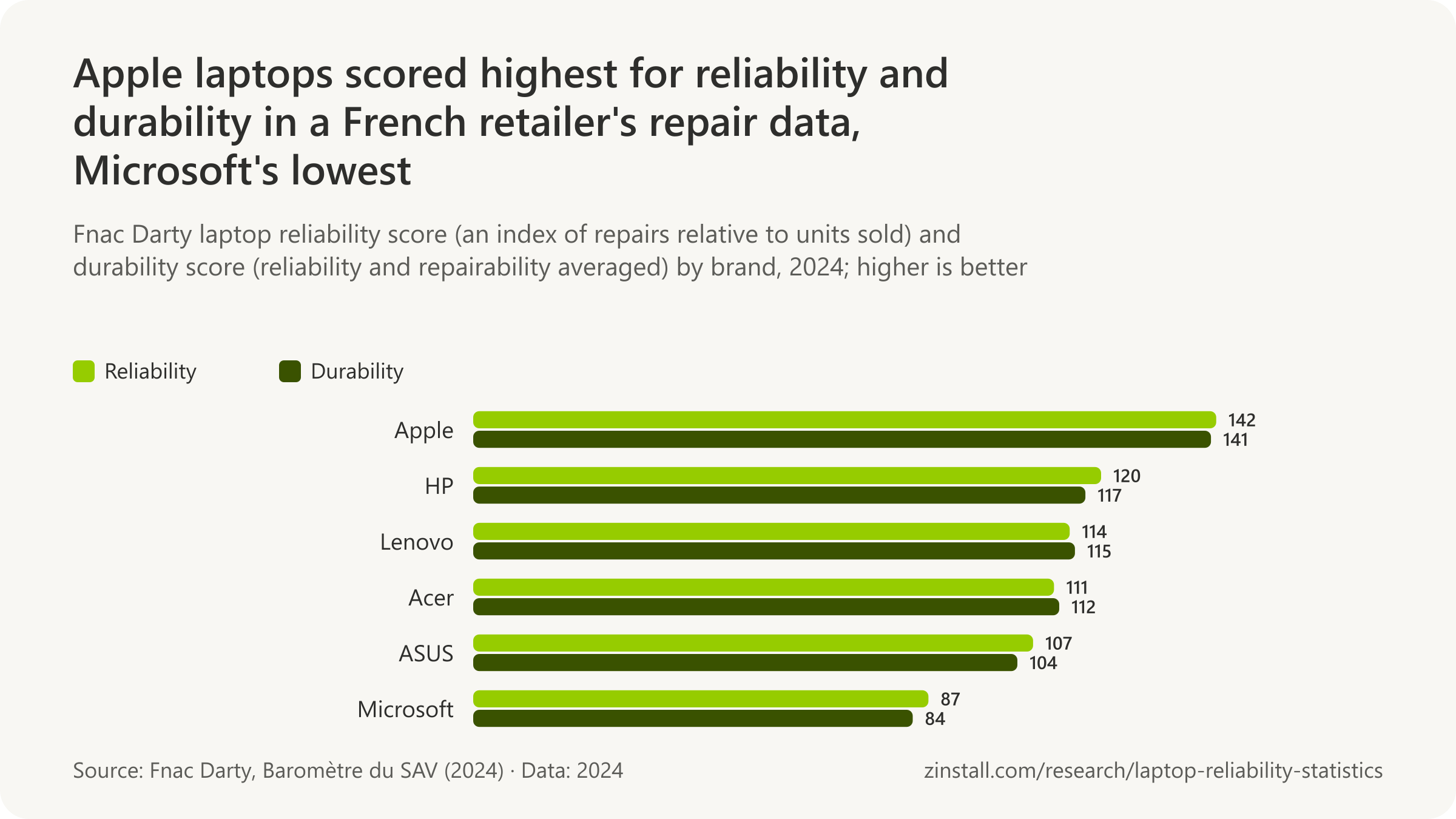
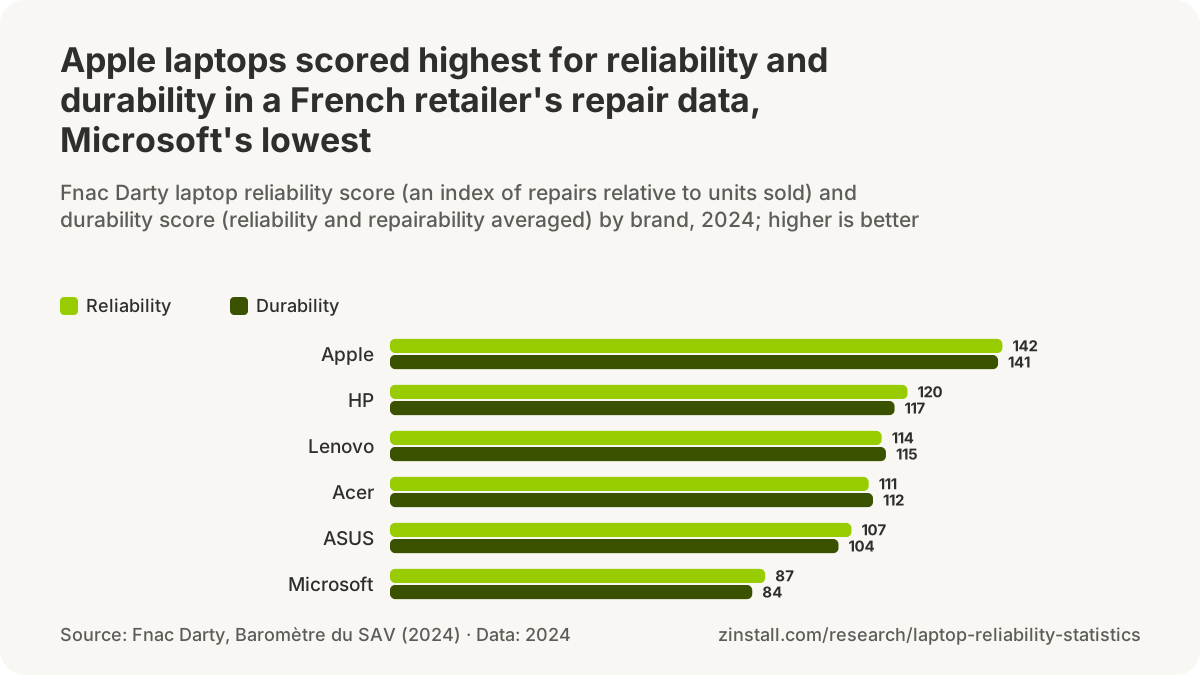
- Apple laptops scored 142 for reliability in a French retailer's repair data, the highest of six brands; Microsoft's scored 87.
- Samsung laptops lasted 8 years 1 month on average, the longest of any brand, in a 2026 European owner survey.
- More than a third of Toshiba laptops developed a fault within seven years, the least reliable brand in a UK owner survey.
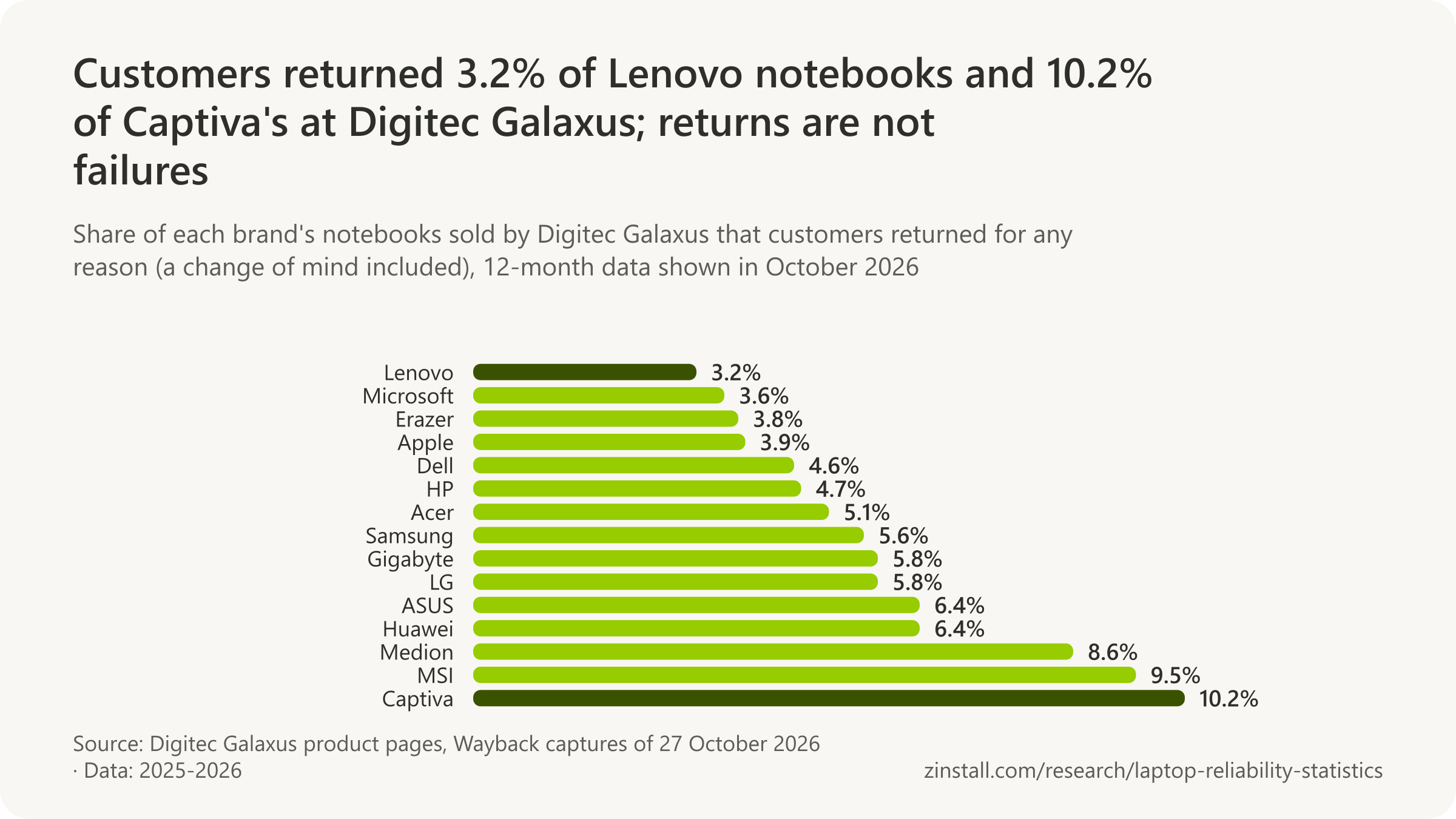
- Customers returned 3.2% of Lenovo notebooks and 10.2% of Captiva's at the same retailer, for any reason, a change of mind included.
- 0.92% of notebooks became warranty cases at the retailer in the 24 months to June 2023, more than twice the 0.4% for all products.
| Brand, measure and date | Figure |
|---|---|
| Microsoft notebooks: warranty cases, Swiss retailer, 2026 | 1.6% |
| Samsung notebooks: warranty cases, Swiss retailer, 2026 | 2.1% |
| Huawei notebooks: warranty cases, Swiss retailer, 2026 | 1.3% |
| LG notebooks: warranty cases, Swiss retailer, 2026 | 1.7% |
| Apple laptops: average lifespan, European owner survey, 2026 | 7 years 7 months |
| Microsoft laptops: average lifespan, the shortest, 2026 | 5 years 3 months |
| Acer laptops: French retailer's reliability score, 2024 | 111 |
| ASUS laptops: French retailer's reliability score, 2024 | 107 |
| Asus laptops: projected 3-year malfunction rate, the lowest, 2009 | 15.6% |
| Toshiba laptops: projected 3-year malfunction rate, 2009 | 15.7% |
Sources: Digitec Galaxus AG (2023, 2026); Fnac Darty; Testaankoop / Test Achats; Which?; SquareTrade, Inc.
Related guides: To a Dell from HP or Lenovo · To an HP from Dell or Lenovo · A new Lenovo laptop
More statistics (36)
Few sources count how often each brand's laptops actually break. The ones that do are two European retailers, which publish how many of each brand's machines came back for warranty repairs or needed their repair service, and consumer organisations' owner surveys, which ask whether a laptop developed a fault; the last warranty-claims study by brand is much older. Apple comes out on top in nearly every recent one, while the order of the other brands changes from source to source.
A Swiss retailer's warranty cases by brand


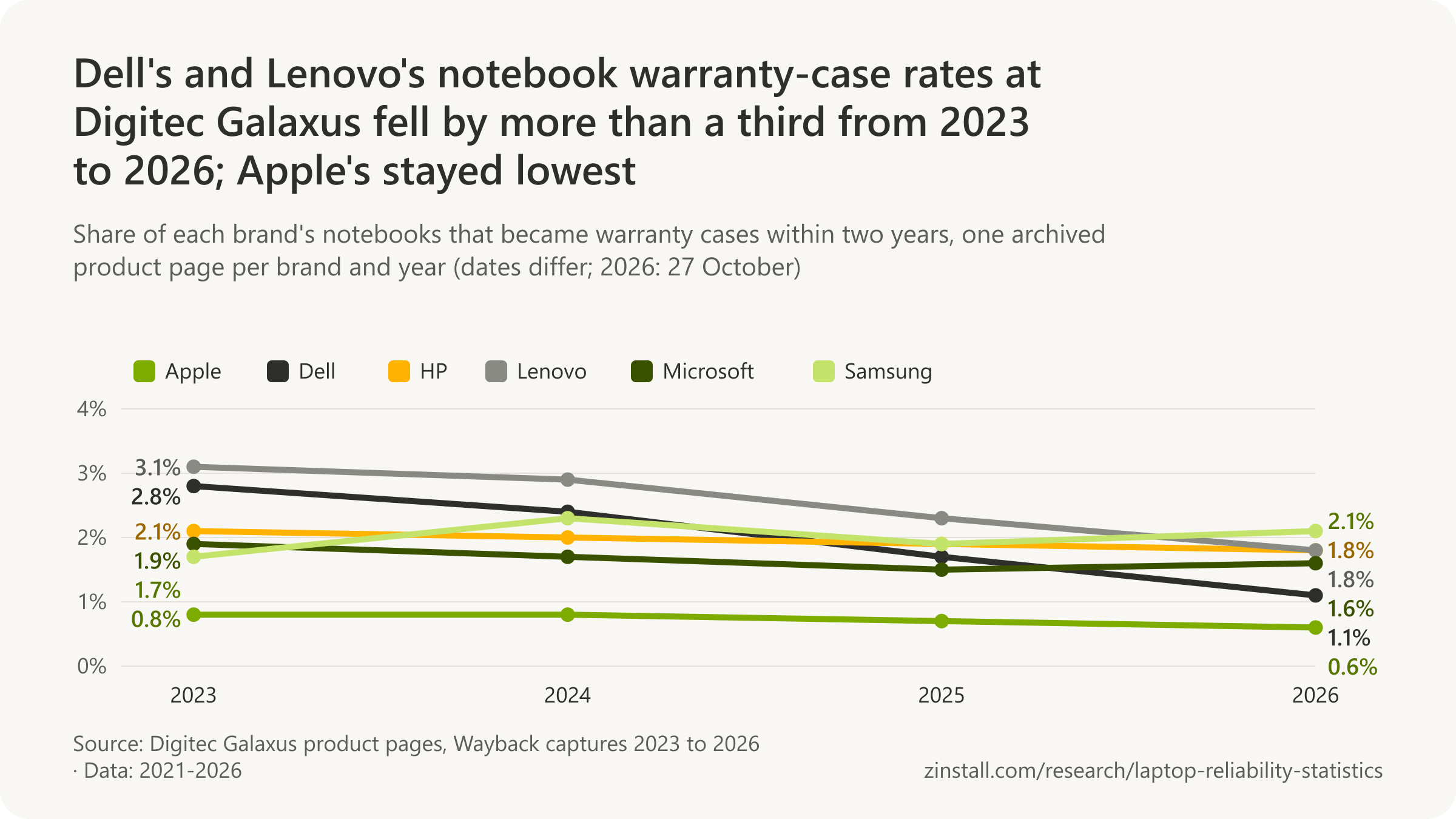

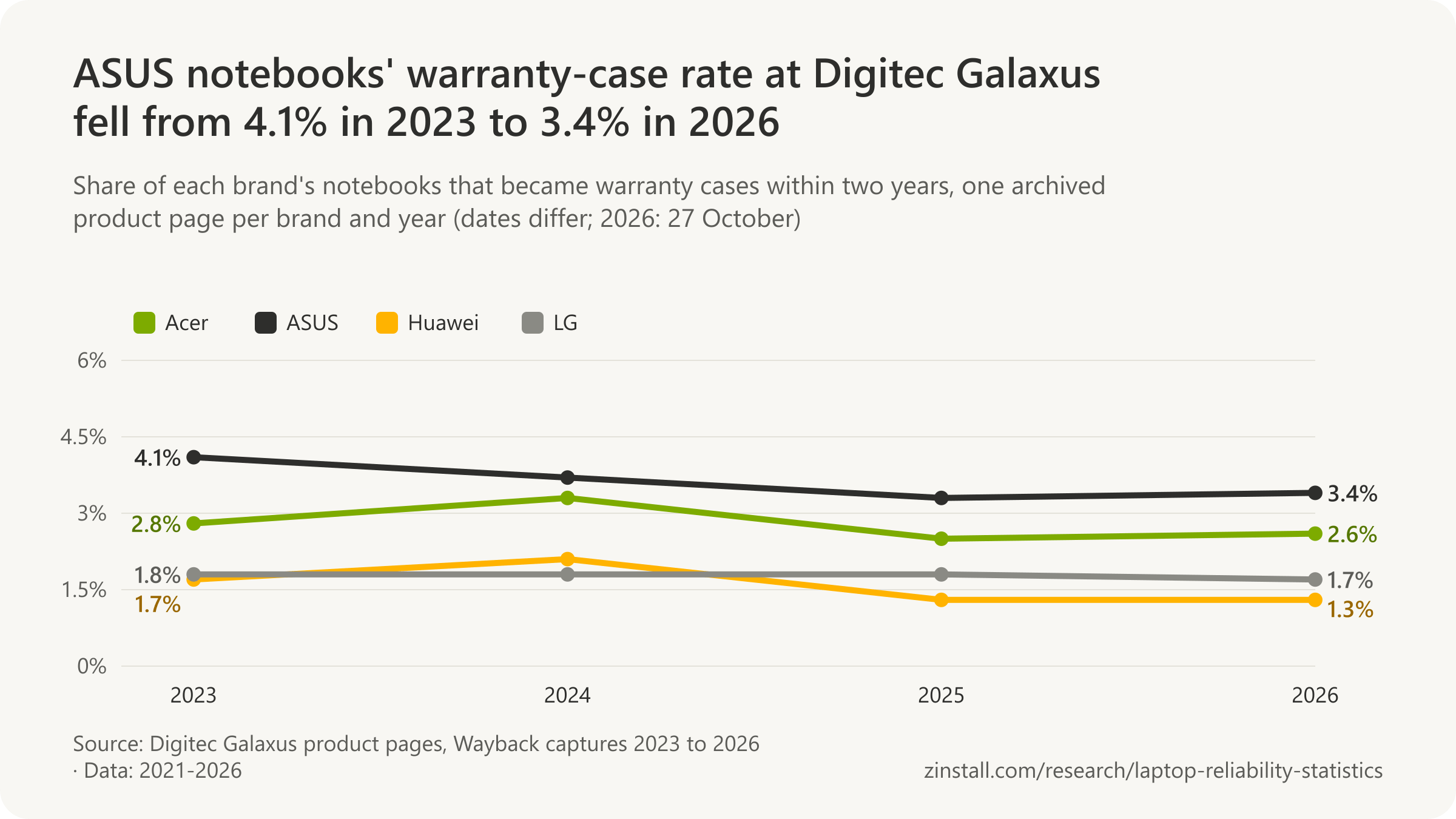
- 0.8% of Apple computers sold by Digitec and Galaxus became warranty cases within two years of purchase, in the Swiss retailer's own after-sales data published in January 2023 (Digitec Galaxus, 2023).
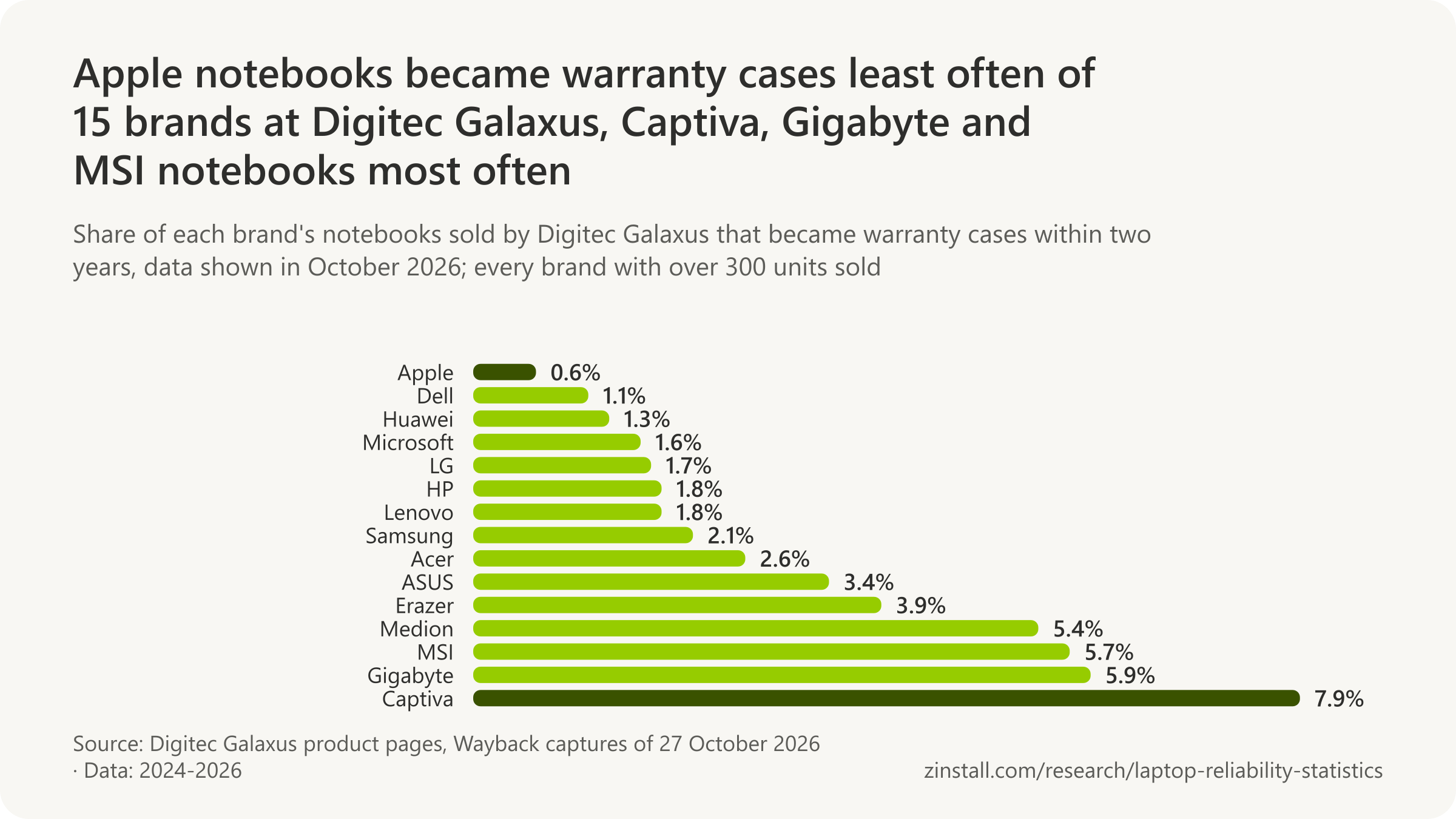
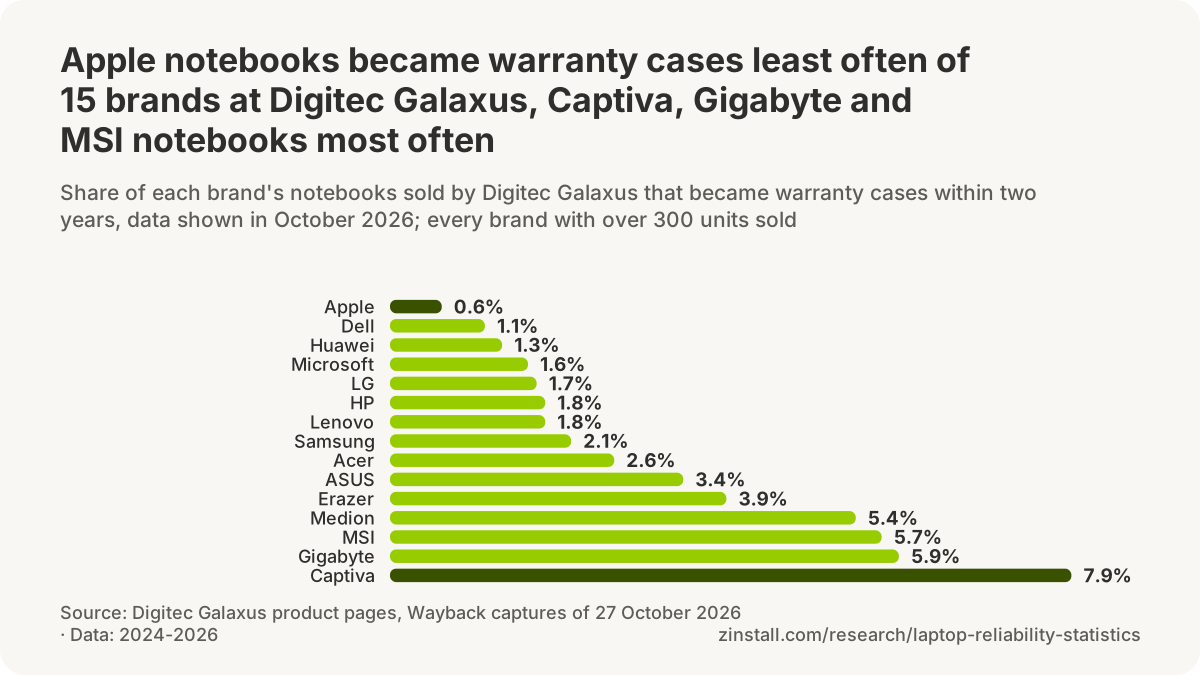
- 300 comparable products sold is the minimum before Digitec Galaxus shows a brand's warranty-case rate in a category, which counts warranty cases within two years over the last 24 months of sales (Digitec Galaxus, 2023).
- 13 times as many Captiva notebooks as Apple notebooks became warranty cases within two years (7.9% against 0.6%), the widest gap among the 15 notebook brands in Digitec Galaxus's data shown in October 2026 (Digitec Galaxus, 2026).
Returns are not failures

Notebooks against other products

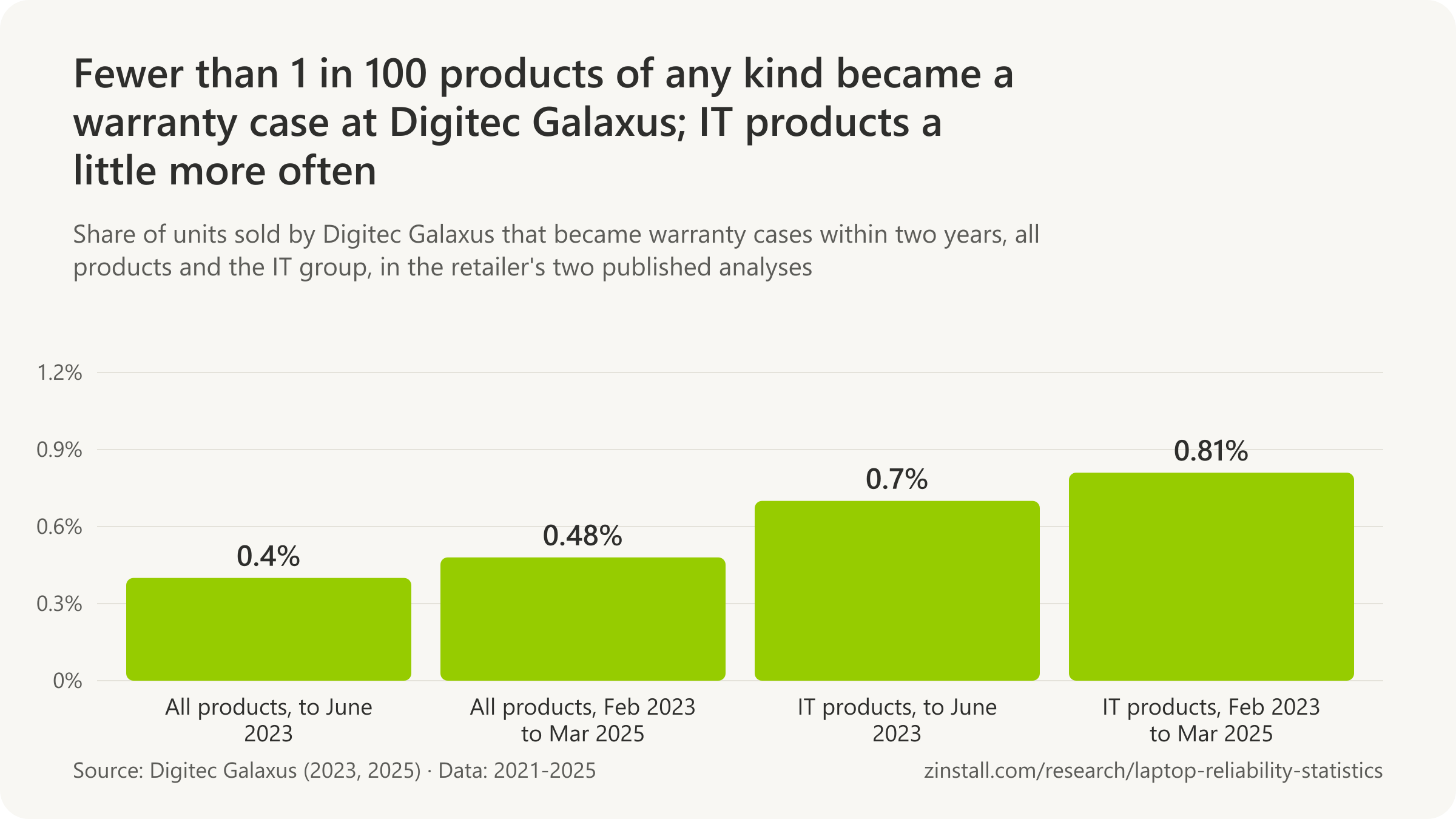
- 0.92% of notebooks sold by Galaxus and Digitec became warranty cases within two years of purchase, more than twice the 0.4% rate across all products, in the 24 months to June 2023 (Digitec Galaxus, 2023).
- 1.65% of PCs and workstations sold by Galaxus and Digitec became warranty cases within two years of purchase, against 0.92% of notebooks, in the 24 months to June 2023 (Digitec Galaxus, 2023).
- 0.98% of PC components sold by Galaxus and Digitec became warranty cases within two years of purchase, in the 24 months to June 2023 (Digitec Galaxus, 2023).
A French retailer's repair data

- 6 points was the rise in Lenovo's laptop durability score in Fnac Darty's 2026 after-sales barometer, part of gains on all five Lenovo families (desktops +27 points, tablets +12) that averaged 19 points (Fnac Darty, 2026).
- 591,271 after-sales interventions by Darty in 2017 and a survey of 27,543 Darty customers were the basis of Fnac Darty's first after-sales barometer, covering 15 product categories (Fnac Darty, 2018).
- Apple was the only brand that Fnac Darty's 2020 after-sales barometer cited as a reference for how long spare parts stay available for laptops and smartphones, as parts availability held back high-tech durability scores (Fnac Darty, 2020).
- Fnac Darty's durability score is the mean of a reliability score and a repairability score built from its after-sales data relative to the units the group sold over the previous two years, as defined in its 2021 barometer (Fnac Darty, 2021).
- Apple was on the laptop podium of Fnac Darty's 2019 after-sales barometer, one of the established brands Fnac said 'fully justify their image of reliability' (Fnac Darty, 2019).
Owner surveys by brand
- More than a third of Toshiba laptops developed some sort of fault within seven years of purchase, making Toshiba the least reliable brand in Which?'s 2026 survey of UK laptop owners (Which?, 2026).
- More than a third of Toshiba laptops developed some sort of fault within seven years of purchase, the least reliable brand in Which?'s February and March 2025 survey of 9,791 UK laptop owners (Which?, 2025).
- More than a fifth of Toshiba laptops developed some sort of fault within six years of purchase, the least reliable brand in Which?'s March and April 2024 owner survey (Which?, 2025).
- More than a fifth of Toshiba laptops developed some sort of fault within six years of purchase, the least reliable brand in Which?'s March 2023 survey of 8,314 UK laptop owners (Which?, 2023).
- 83 to 91 out of 100 was the range of laptop brand reliability scores in Testaankoop's 2026 European owner survey, with every brand rated excellent (Testaankoop, 2026).
- 76 to 87 out of 100 was the range of laptop brand satisfaction scores in Testaankoop's 2026 survey, and the most appreciated brand was not the most bought (Testaankoop, 2026).
- 8 years 1 month is the average lifespan of Samsung laptops, the longest of any brand, in Testaankoop's 2026 owner survey, which counts laptops replaced because they stopped working properly (Testaankoop, 2026).
- 7 years 7 months is the average lifespan of Apple laptops, the second longest, in Testaankoop's 2026 owner survey, which counts laptops replaced because they stopped working properly (Testaankoop, 2026).
- 5 years 3 months is the average lifespan of Microsoft laptops, the shortest of any brand, in Testaankoop's 2026 owner survey, which counts laptops replaced because they stopped working properly (Testaankoop, 2026).
- Apple laptops most often had below-average problem reports across components in Testaankoop's 2026 European owner survey (Testaankoop, 2026).
- 25% of Belgian respondents' laptops were HP, ahead of Lenovo (17%), Acer (14%), Apple (14%) and Asus (11%), in Testaankoop's 2026 survey (Testaankoop, 2026).
- 11% of Belgian respondents had bought a second-hand or refurbished laptop and 89% a new one in Testaankoop's 2026 survey, which gives both as shares of all Belgian respondents, 75% of whom owned a laptop (Testaankoop, 2026).
- 9% of Belgian respondents paid more than 1,500 euros for their laptop, while about half spent between 500 and 1,000 euros, in Testaankoop's 2026 survey (Testaankoop, 2026).
- Apple laptops were the most reliable again, followed by MSI, with Acer, Samsung, Asus, HP and Toshiba also standing out, in the 2025 European owner survey of almost 42,000 users by Spain's OCU and eight other consumer organisations (OCU, 2025).
- LG and Apple shared first place among laptop brands, followed by Huawei, and LG had the highest laptop satisfaction, in the 2022 European owner survey of more than 93,000 users by Spain's OCU and partners in Belgium, France, Italy and Portugal (OCU, 2022).
- Apple ranked first among laptop brands, followed by Huawei and Xiaomi, in the 2021 European owner survey of 80,911 users by Spain's OCU and partners in Belgium, France, Italy and Portugal, with Huawei a step lower on reliability (OCU, 2021).
- 6,971 UK laptop owners answered Which?'s February and March 2026 reliability survey, part of 15,755 people reporting on their tech products (Which?, 2026).
- 9,791 UK laptop owners answered Which?'s February and March 2025 reliability survey, part of 15,644 people reporting on their products (Which?, 2025).
- 50% of a laptop brand's Which? reliability rating is the share of products not faulty across five to seven years, with average time to first fault and the faults' impact 25% each, in Which?'s 2025 survey method (Which?, 2025).
- 10,243 laptops were covered by Which?'s March and April 2024 survey of 18,067 UK members and members of the public (Which?, 2025).
- 2,072 Apple, 2,043 HP, 1,473 Dell and 1,422 Lenovo laptops were the largest brand samples in Which?'s March and April 2024 owner survey, against 65 Toshibas (Which?, 2025).
- 8,314 UK laptop owners answered Which?'s March 2023 survey on laptop reliability and satisfaction (Which?, 2023).
- 16,097 Which? members and members of the public who owned laptops bought between 2015 and 2022 answered Which?'s March 2022 survey (Which?, 2022).
- 8,772 laptops owned by Which? members were covered by Which?'s July 2020 laptop reliability survey (Which?, 2020).
The last warranty-claims study by brand

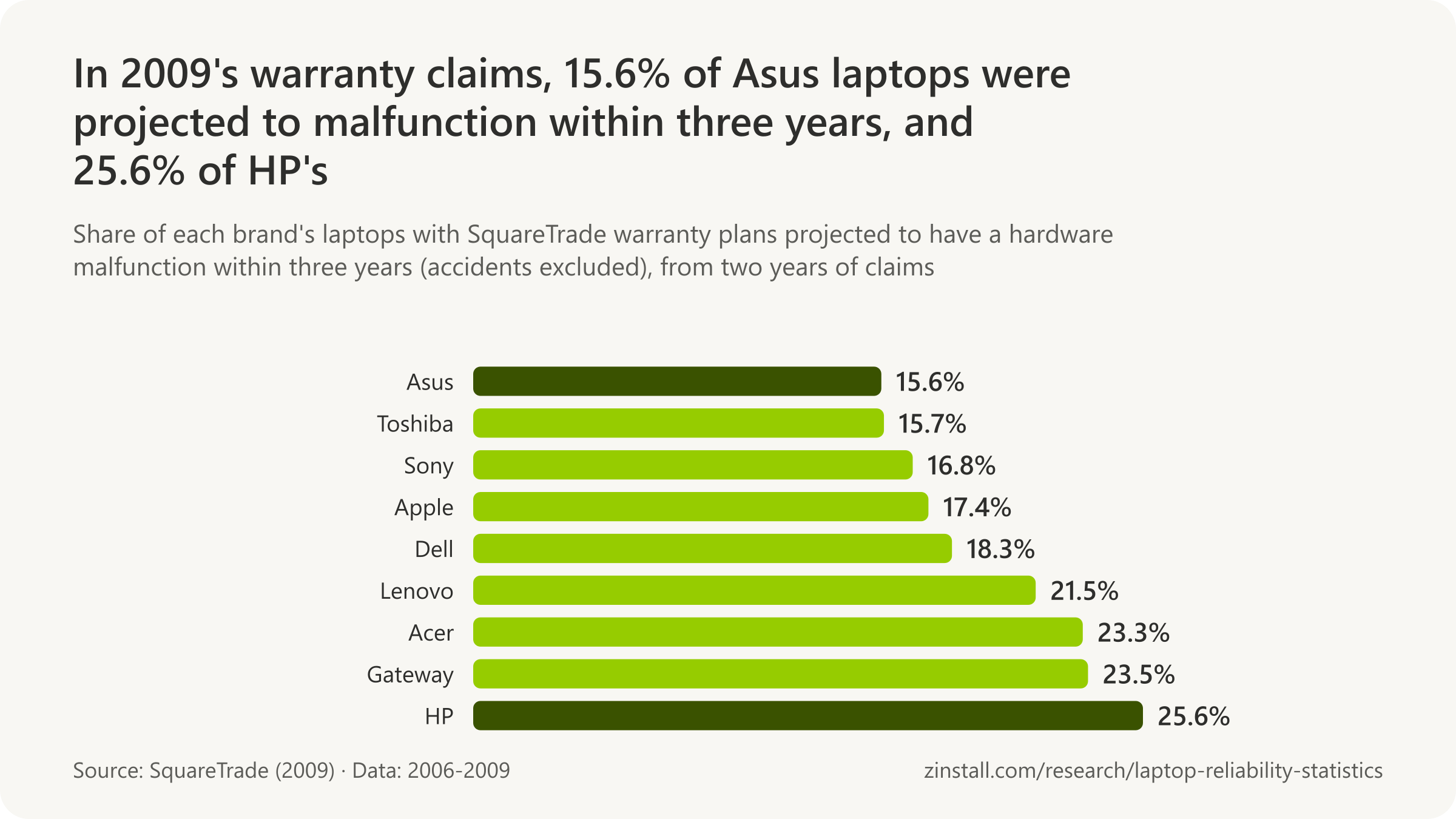
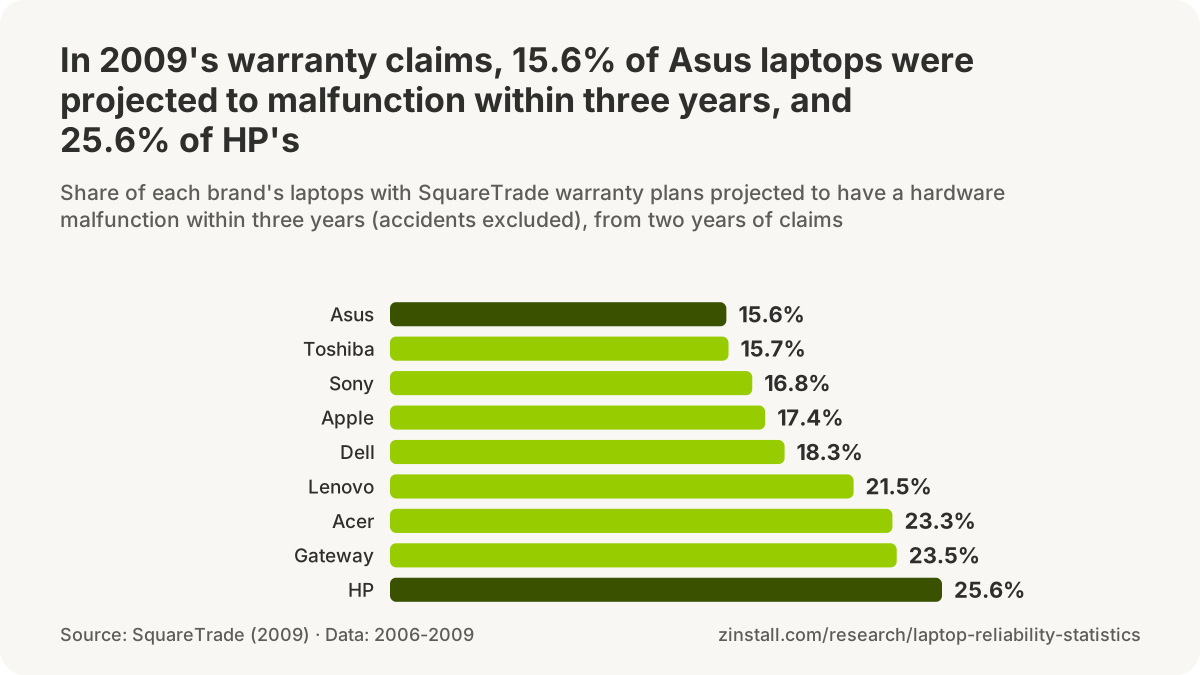
- Nearly 40% fewer Asus and Toshiba laptops than HP laptops were projected to malfunction within three years (under 16% against 25.6%), among laptops SquareTrade covered, SquareTrade wrote in November 2009 (SquareTrade, 2009).
Sources: Digitec Galaxus AG (2023, 2025, 2026); Fnac Darty (2018-2026); Which?; Testaankoop / Test Achats; OCU (2021, 2022, 2025); SquareTrade, Inc.
What are the most trusted laptop brands?
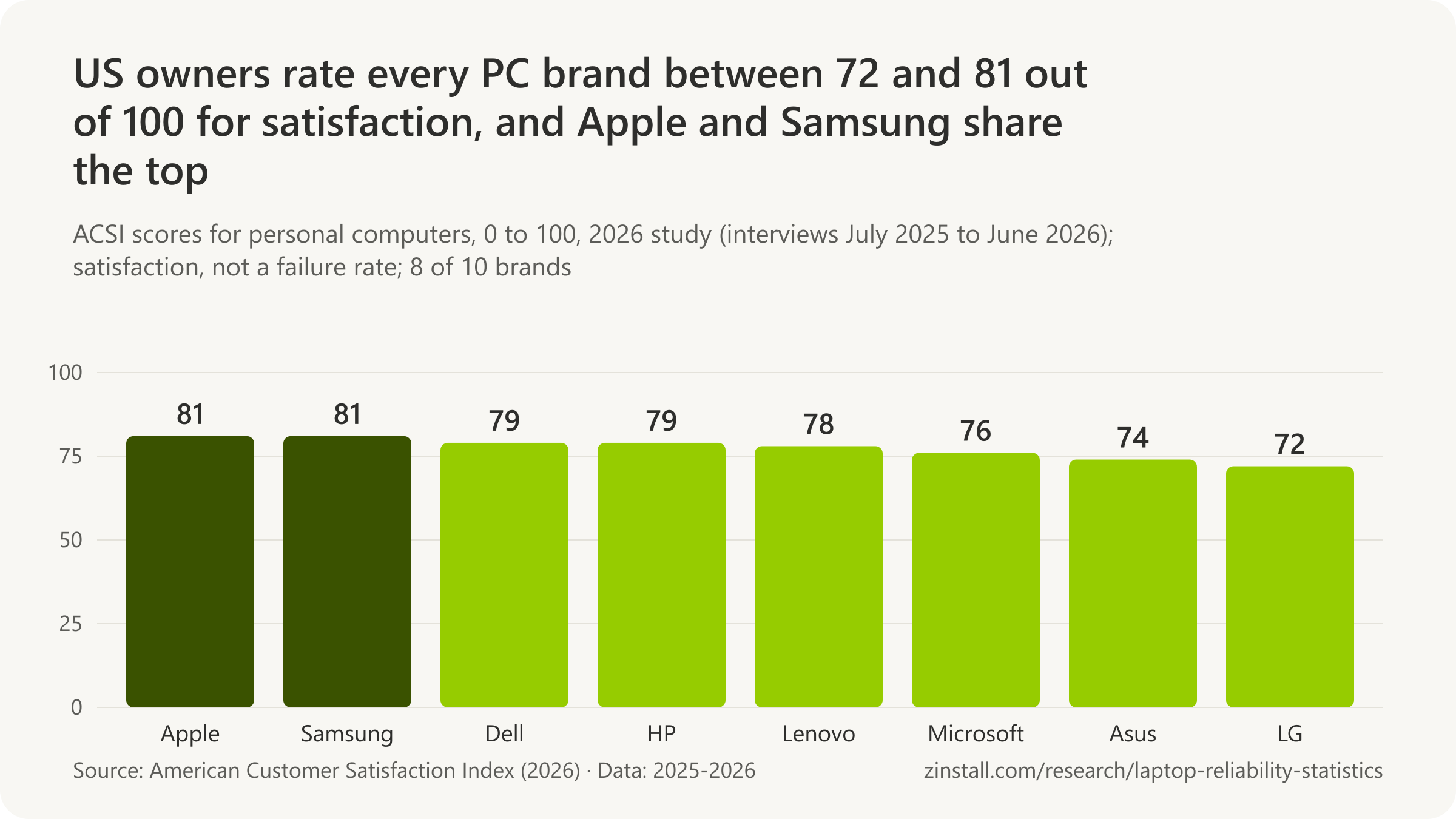
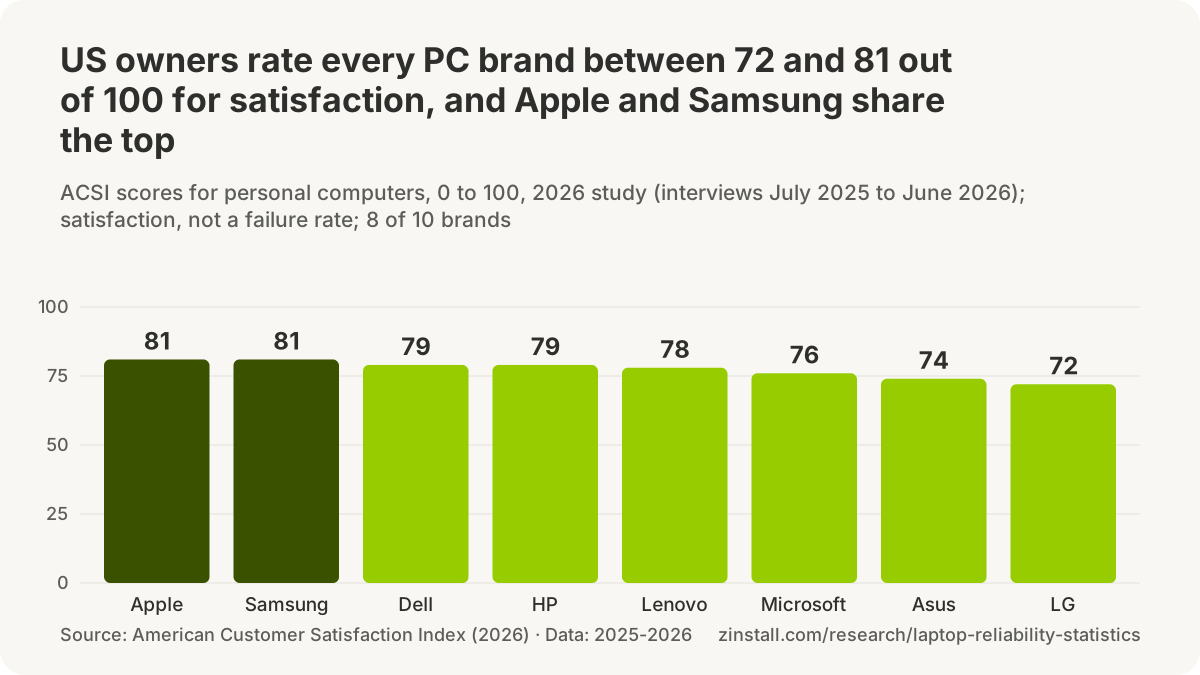
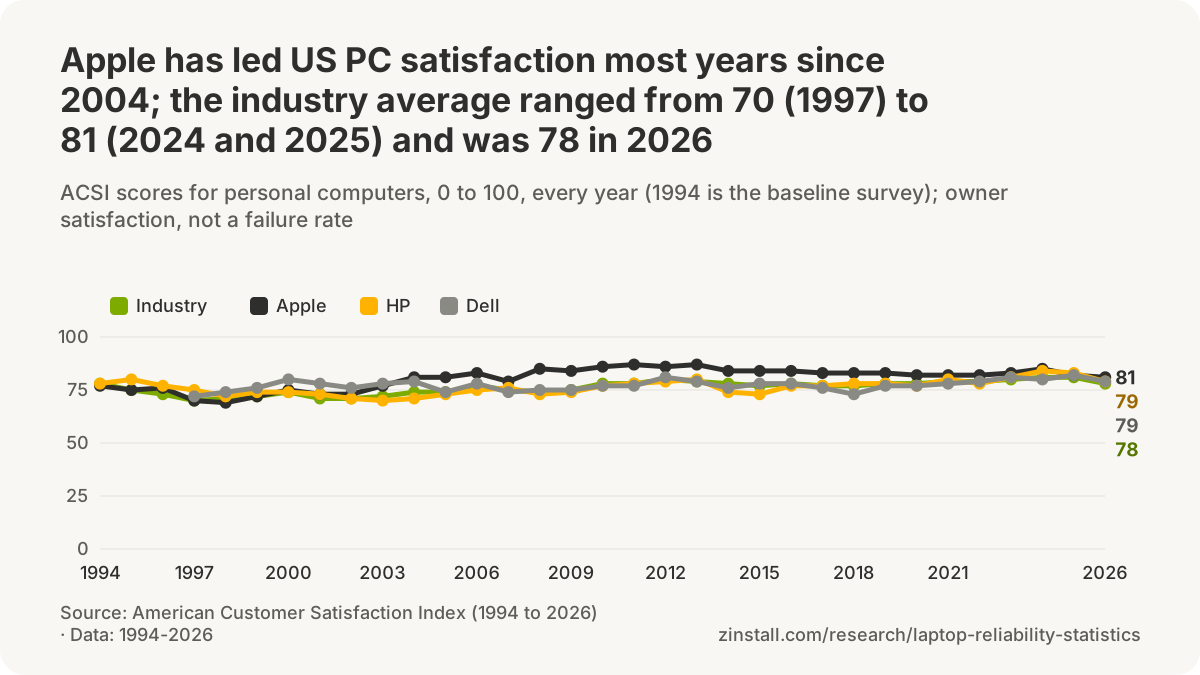
Apple and Samsung shared the top US satisfaction score for personal computers in 2026, 81 out of 100 (ACSI, 2026).

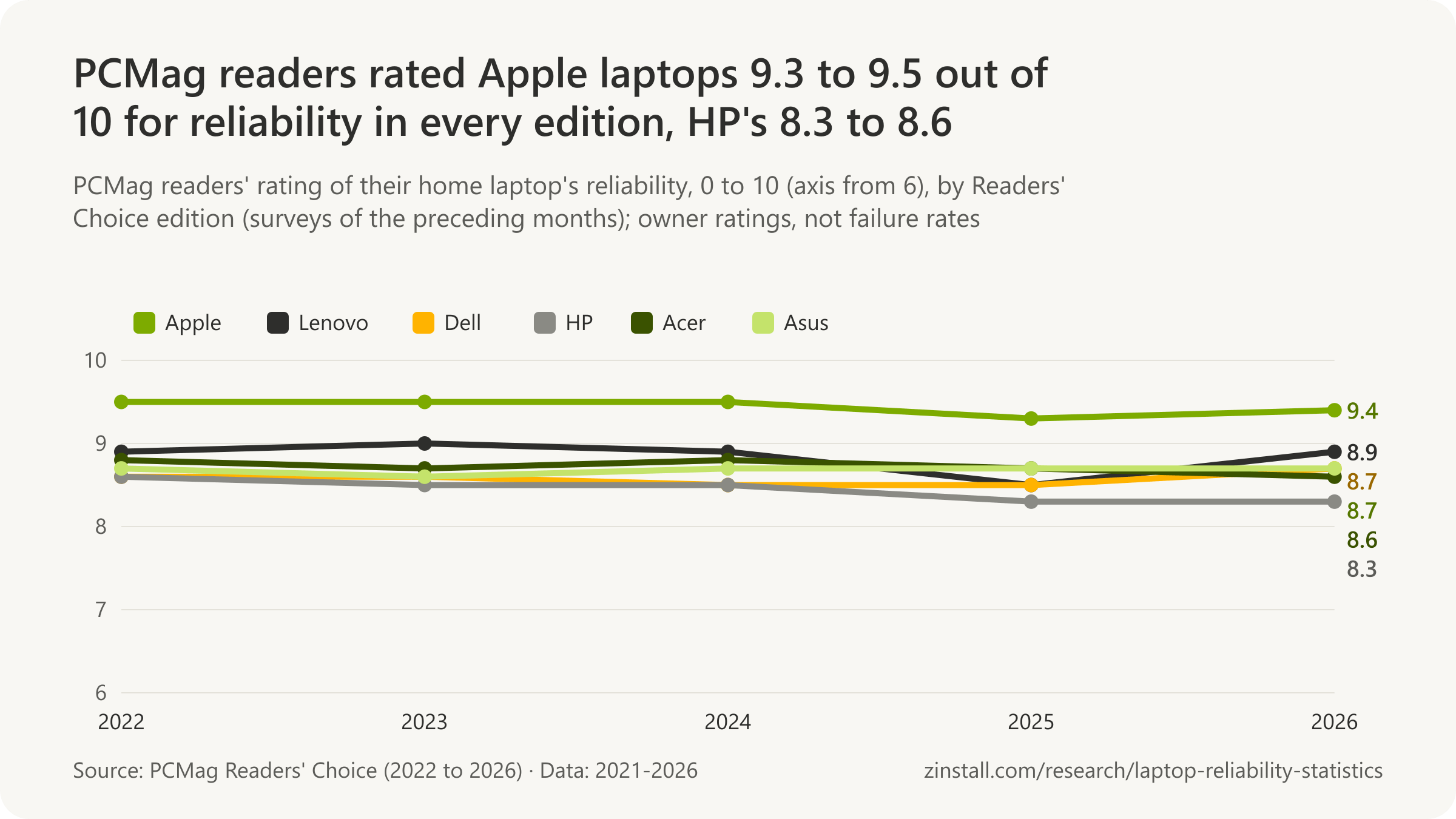
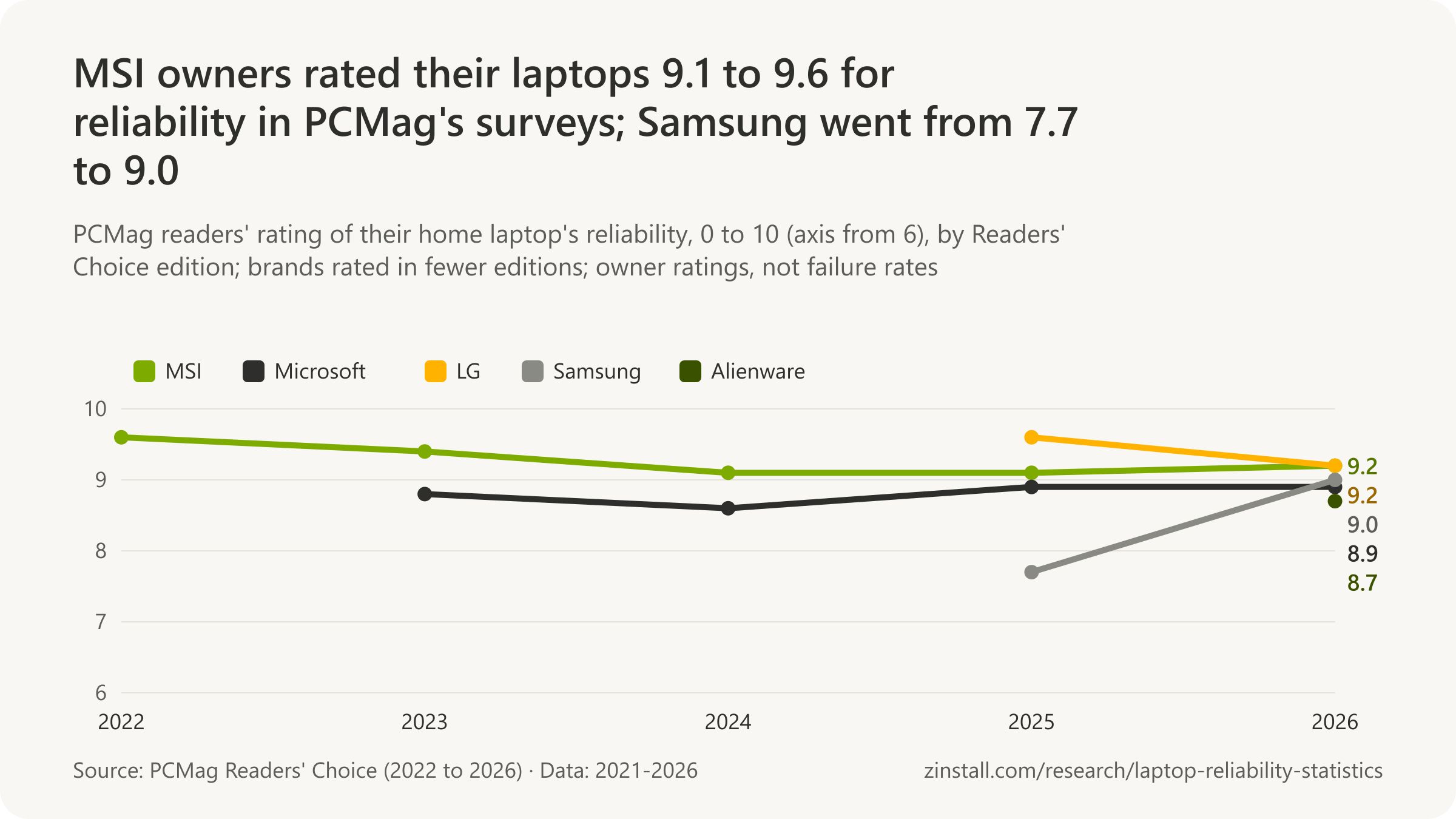
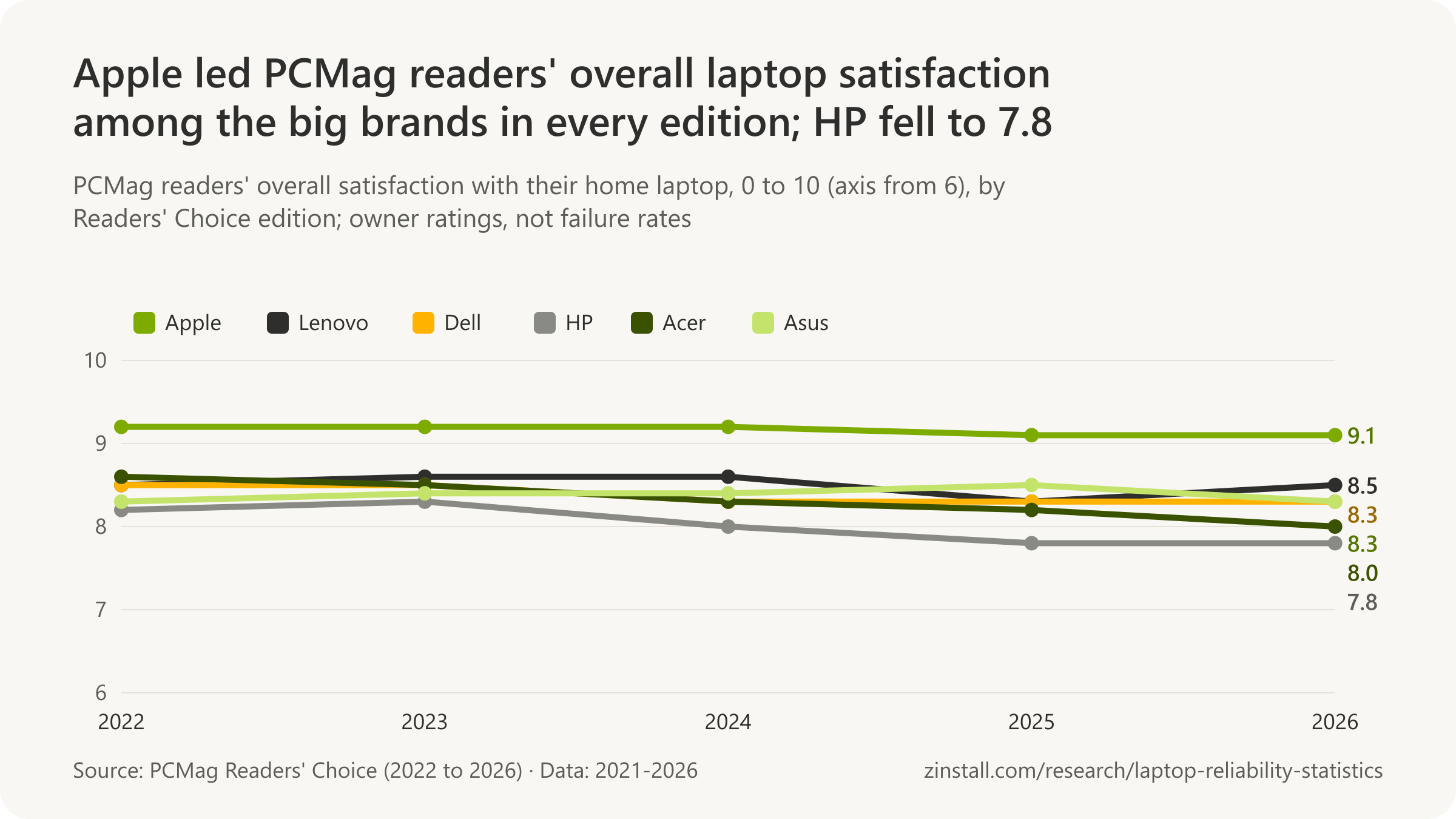
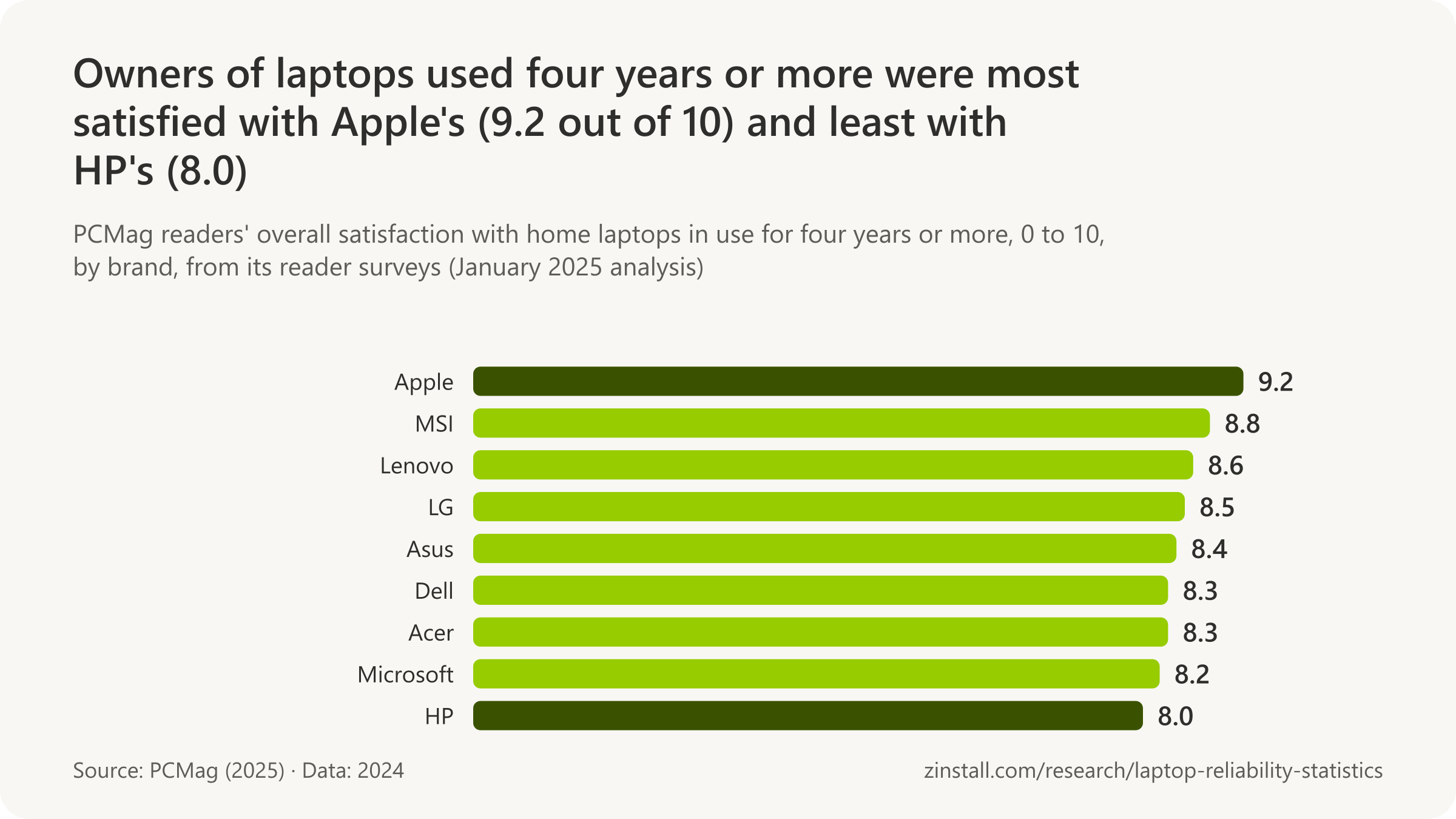
- Readers of a tech magazine rated Apple laptops 9.4 out of 10 for reliability in 2026, an owner rating rather than a failure rate.
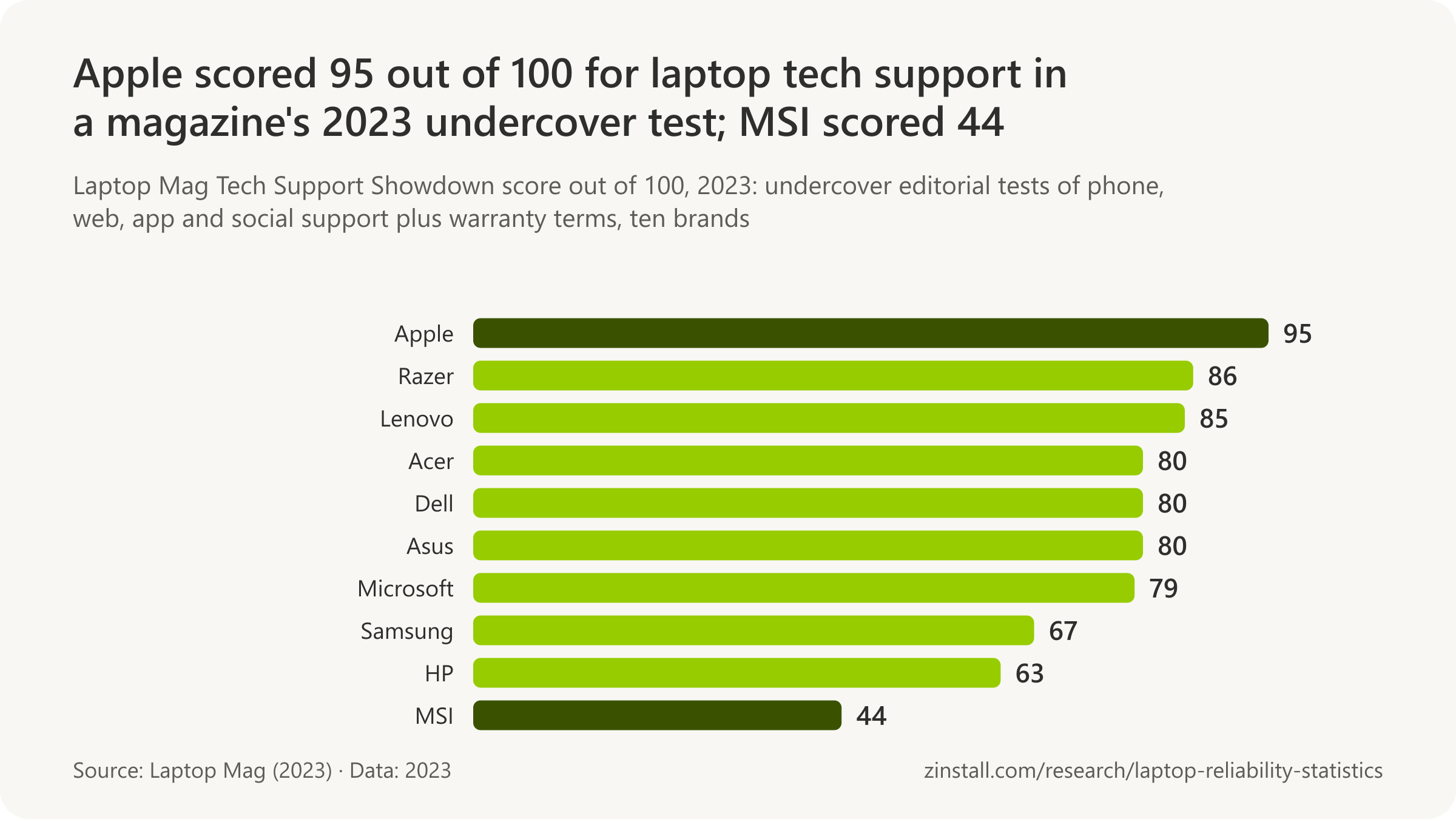
- Apple scored 95 out of 100 in a magazine's undercover test of laptop tech support in 2023; MSI scored 44.
- US owners rated their laptops 83 out of 100 for keeping system crashes to a minimum in 2026.
- US laptop owners rated the outcome of the maker's service repair 79 out of 100 in 2026.
- Only 2.1% of the calls one US repair firm handled in 2016's first half were hardware problems, yet its scores were sold as reliability.
| Brand | Rating |
|---|---|
| LG | 9.2/10 |
| Samsung | 9.0/10 |
| Microsoft | 8.9/10 |
| Lenovo | 8.9/10 |
| Dell | 8.7/10 |
| Asus | 8.7/10 |
| Alienware | 8.7/10 |
| Acer | 8.6/10 |
| HP | 8.3/10 |
Sources: American Customer Satisfaction Index LLC; PCMag; Laptop Mag; RESCUECOM Corporation
Related guides: Everything to a new Windows 11 PC · Clone or transfer
More statistics (24)
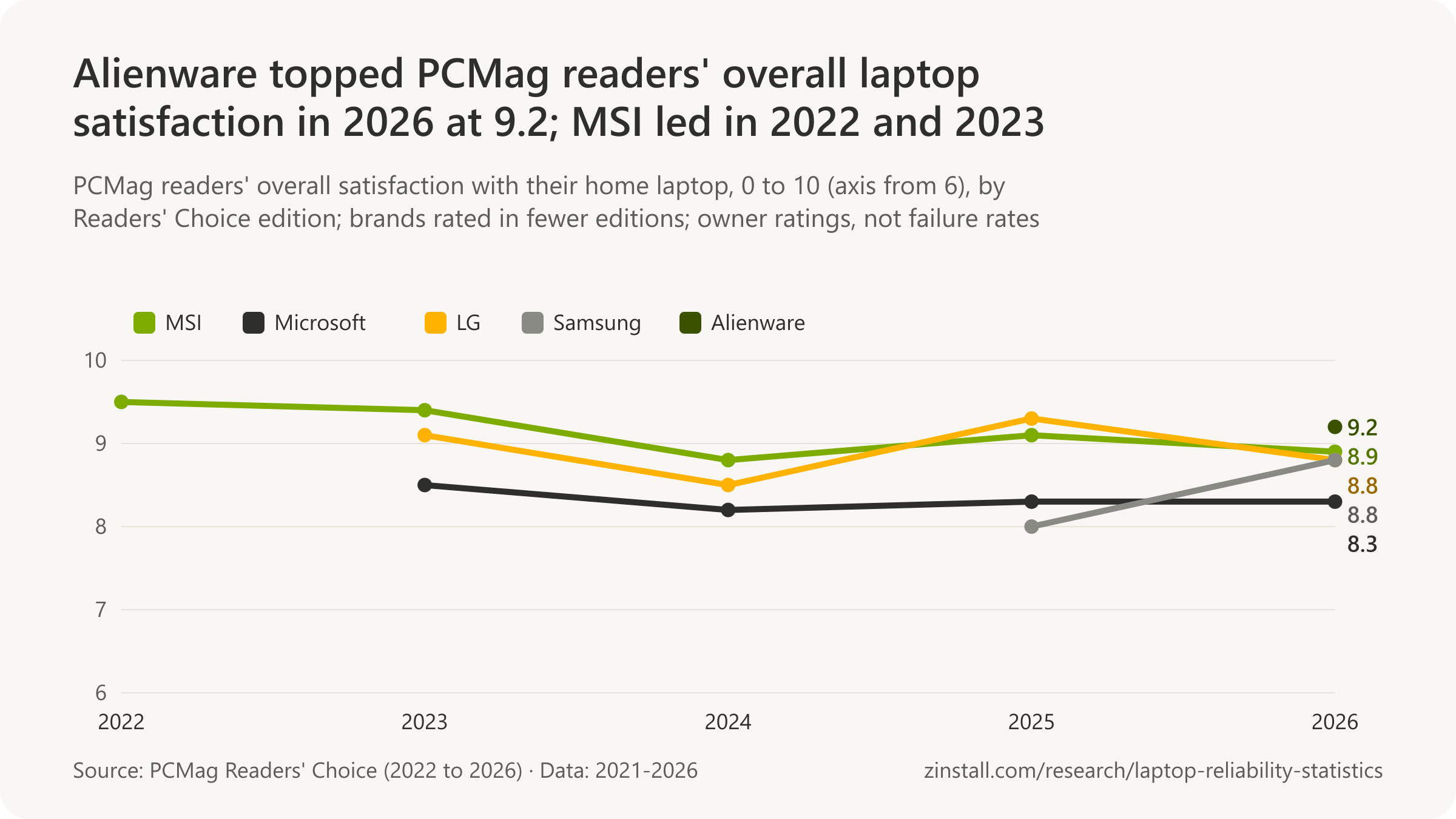
Satisfaction surveys and magazine rankings are the most quoted answers to brand questions, but they measure how owners feel about a brand, how a magazine rated it or how often people called one repair firm, not how often the laptops broke. The American Customer Satisfaction Index has rated PC brands every year since its first survey; PCMag asks its readers each year; RESCUECOM's reliability reports, which have ended, set each brand's market share against its share of the calls to RESCUECOM's own repair line.
US owner satisfaction

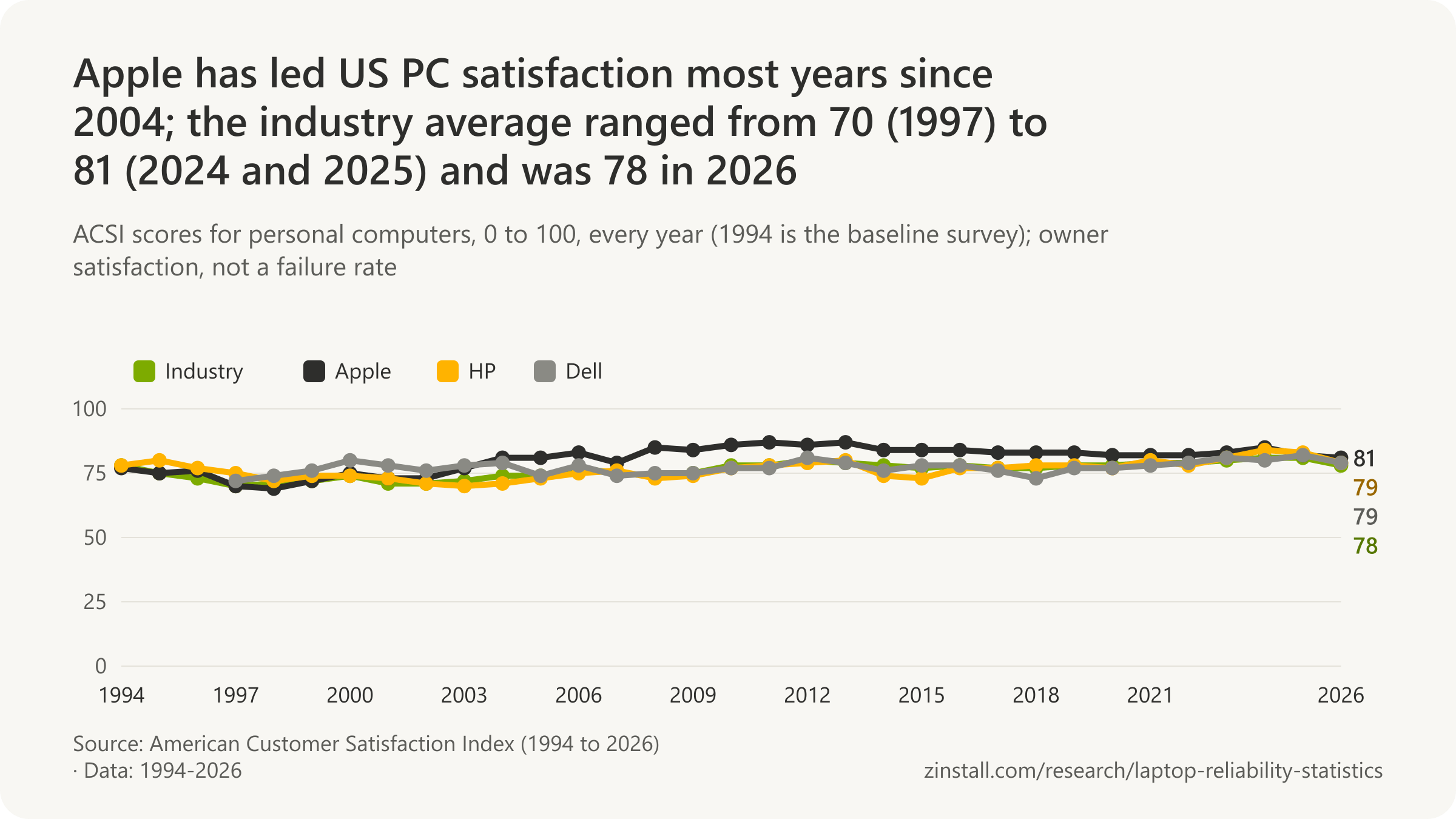

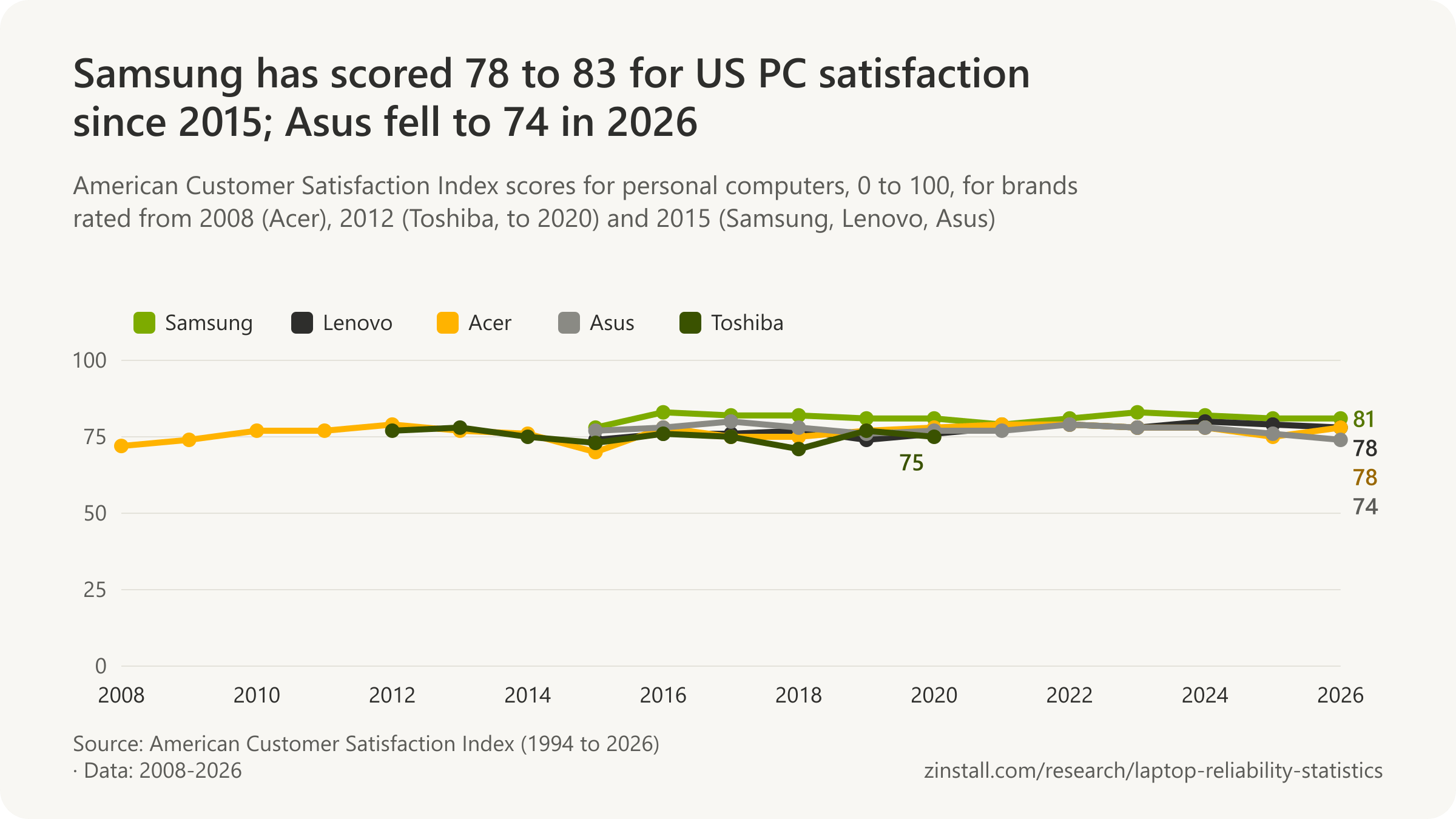

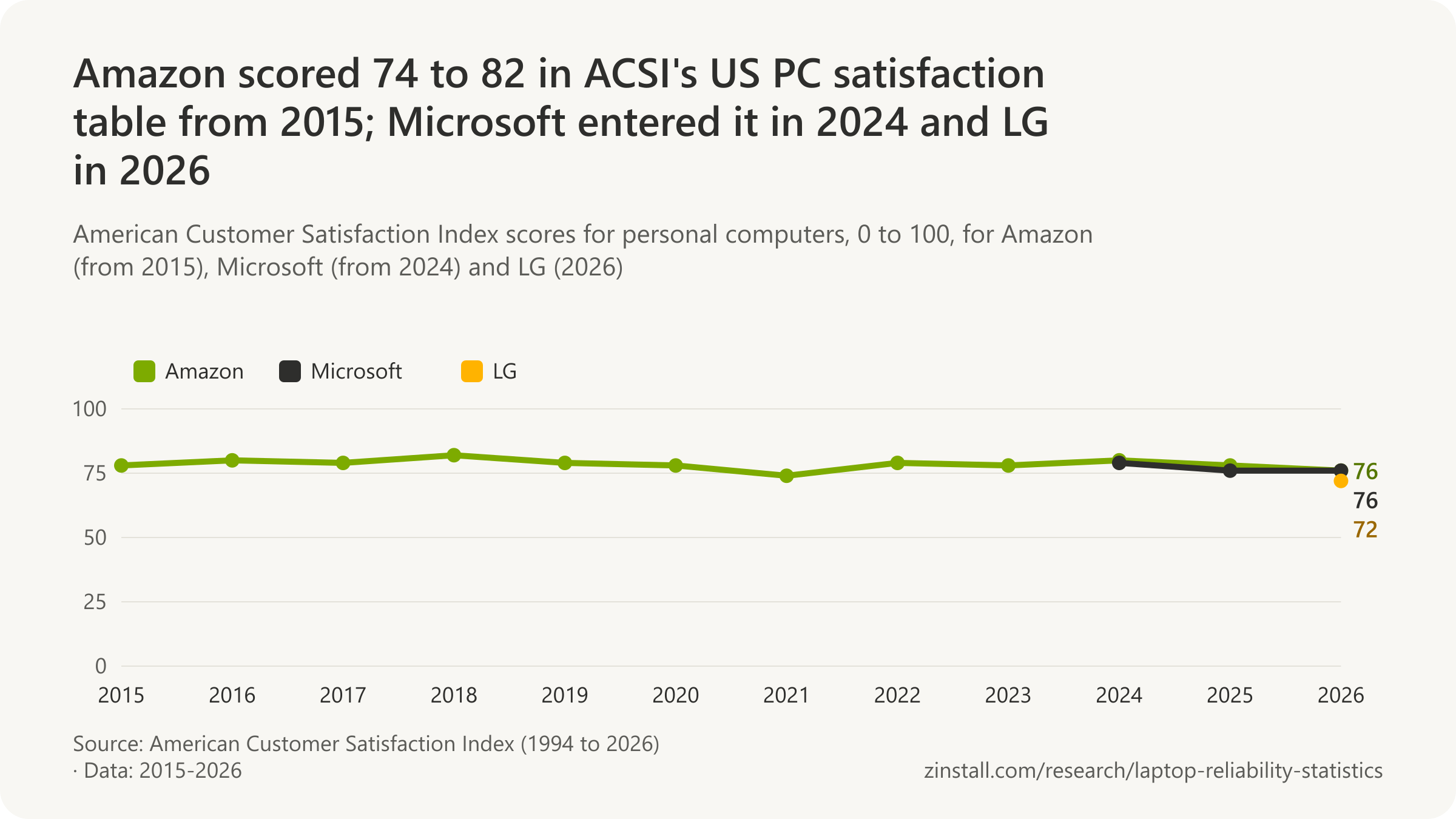

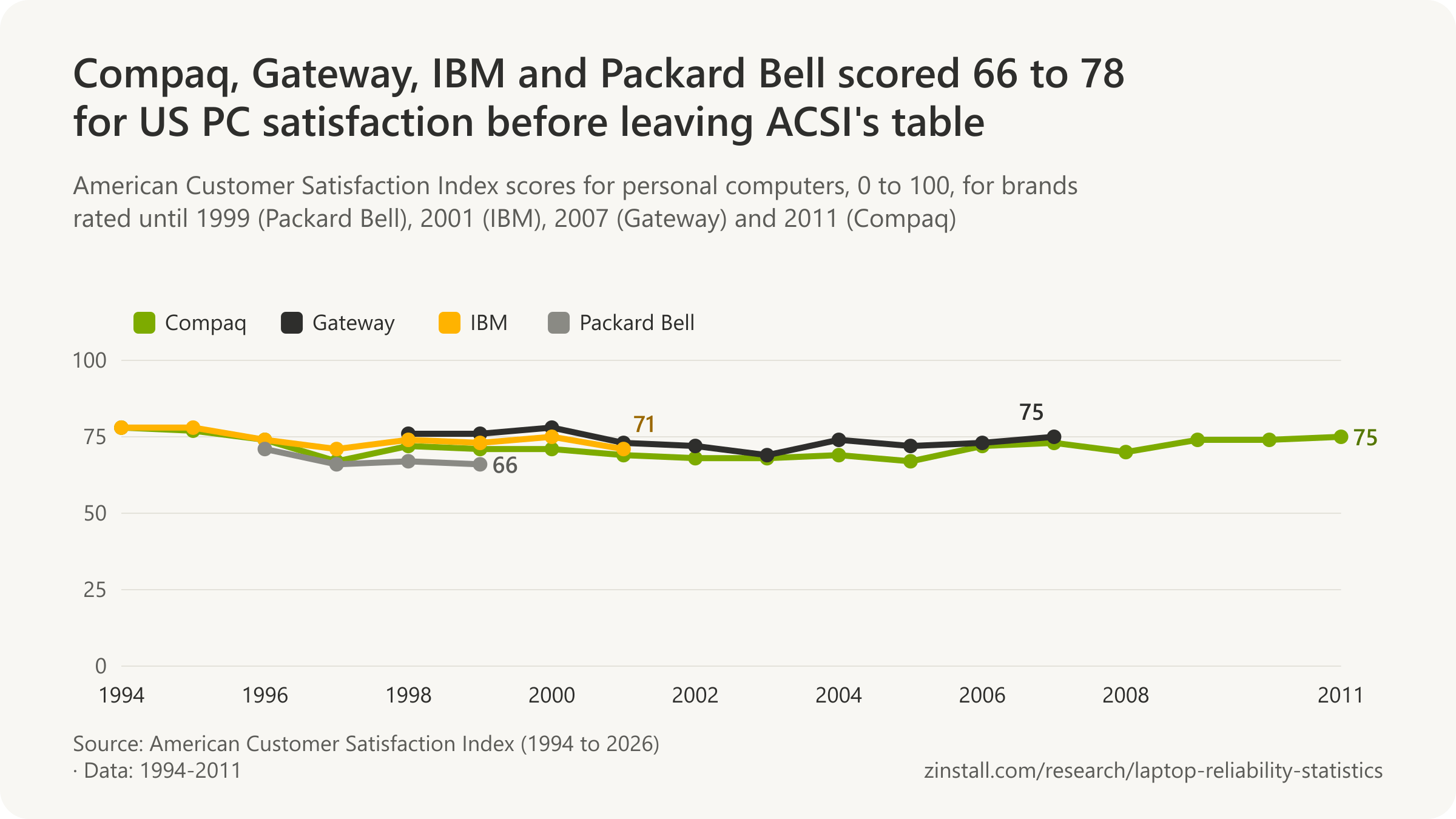

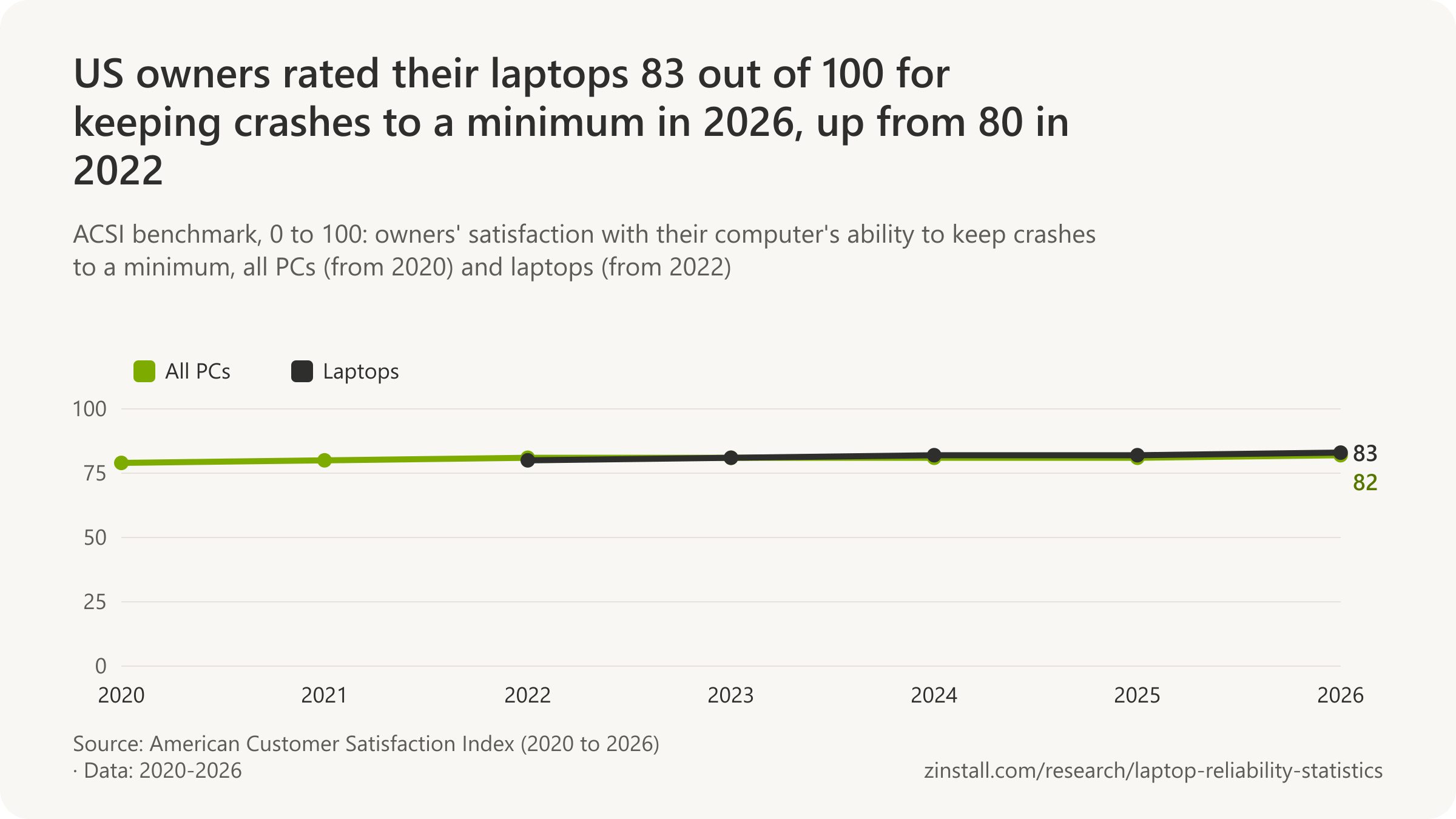
- 79 out of 100 was US laptop owners' satisfaction with the outcome of the maker's service repair in ACSI's 2026 study, against 75 for the ease of arranging service (ACSI, 2026).
PCMag readers' ratings





RESCUECOM's reliability reports

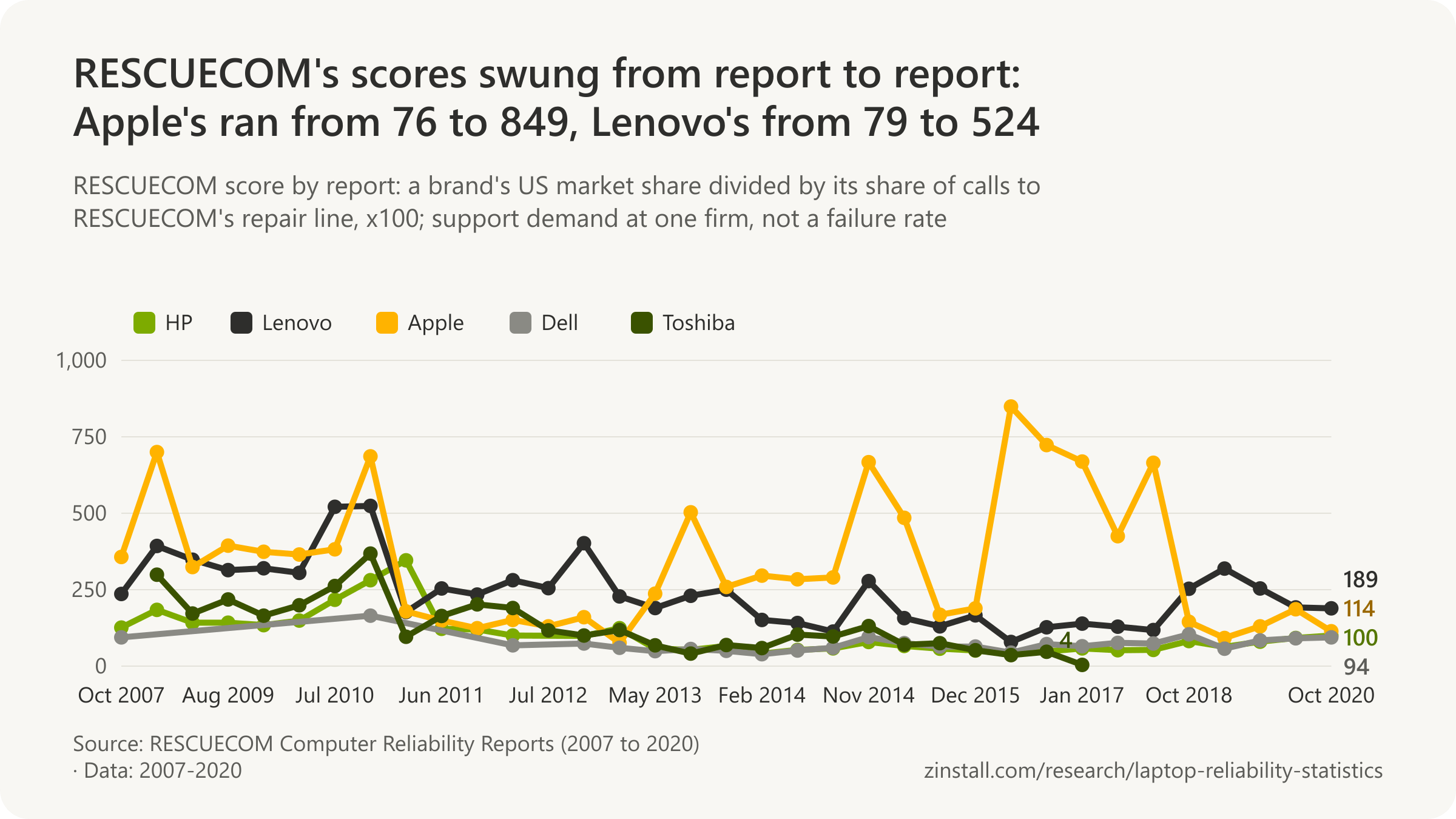

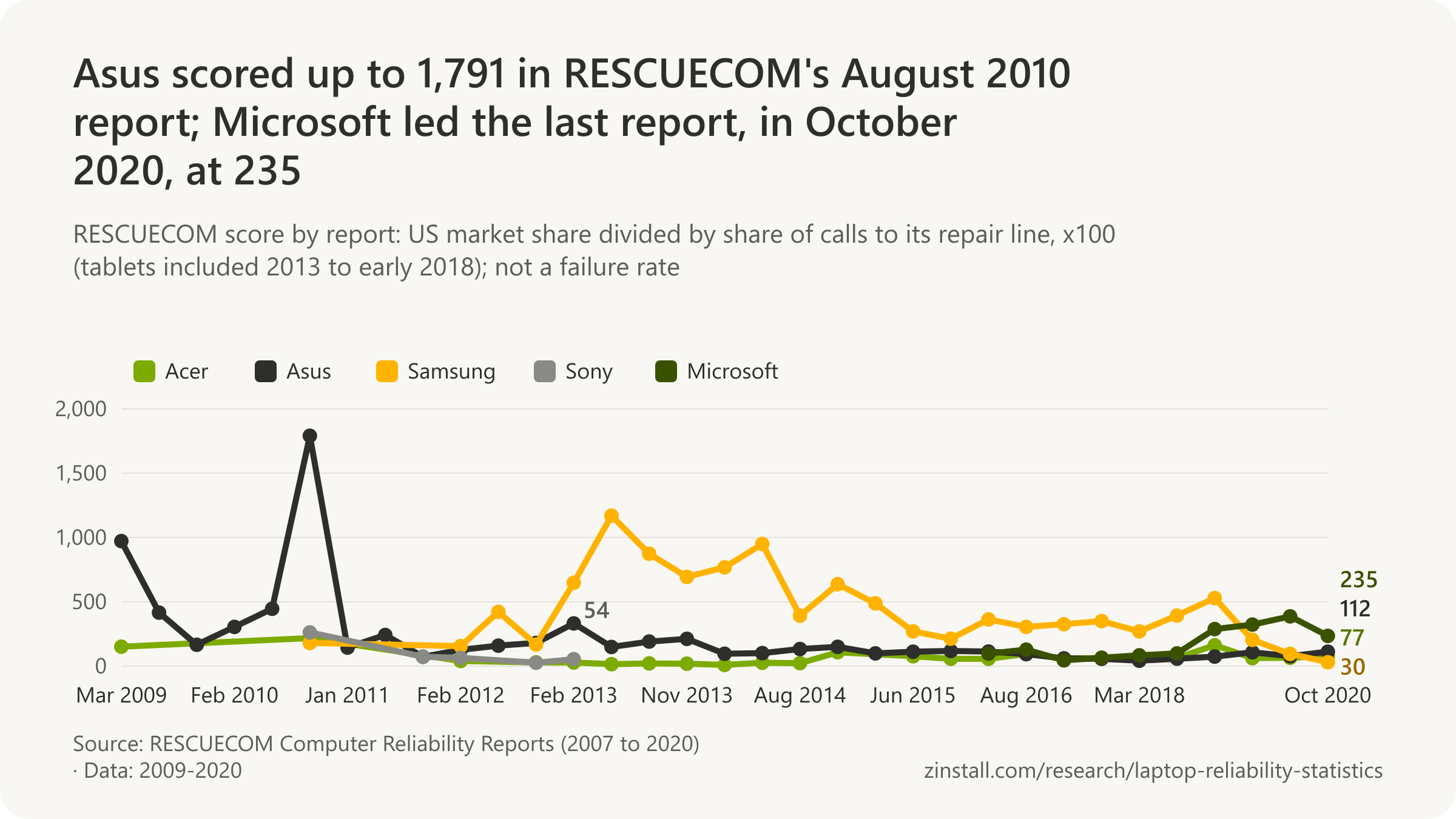

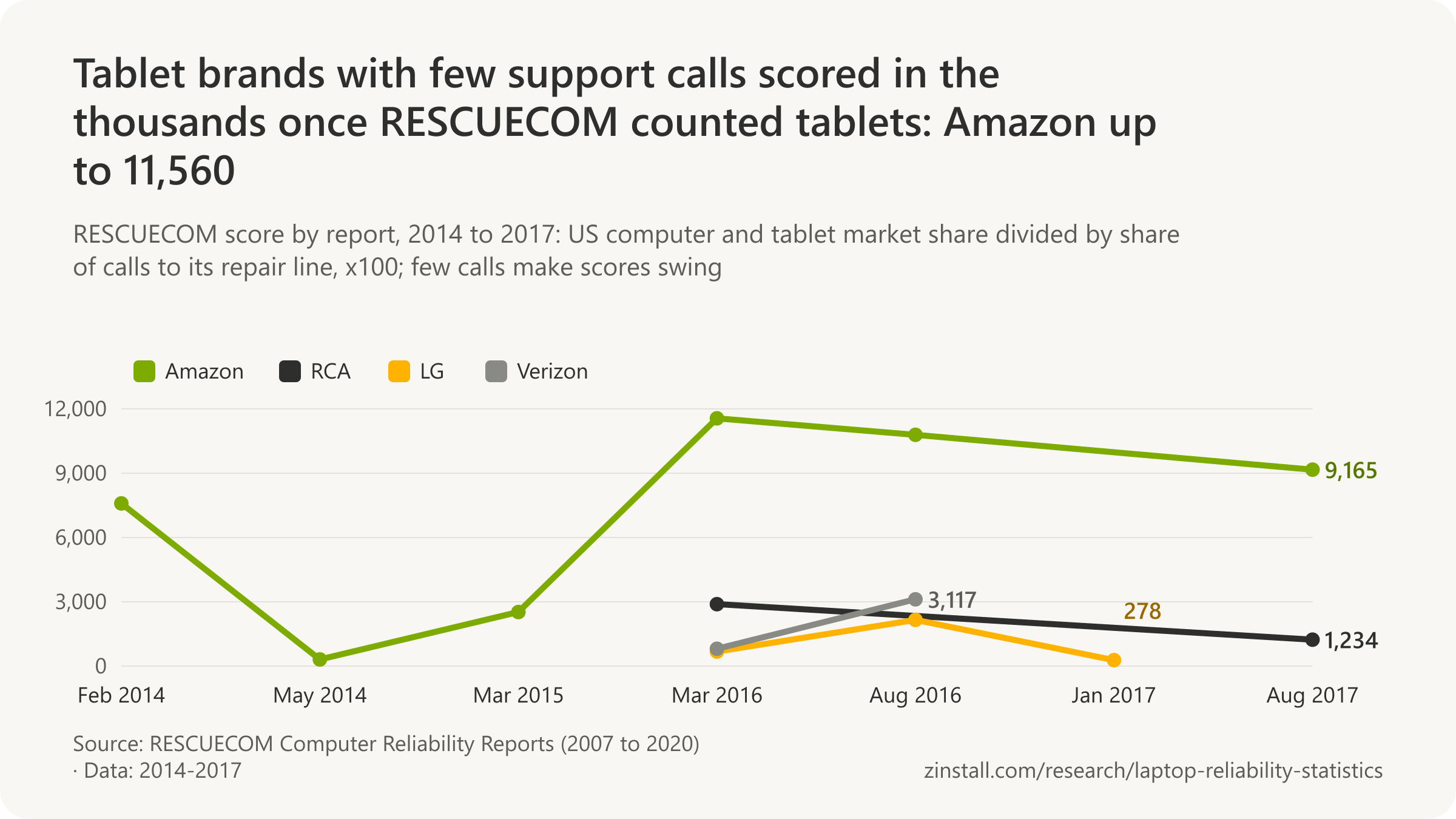
- Tablets entered both the market shares and the call counts of RESCUECOM's Computer Reliability Report from the first quarter of 2013, which lifted Apple's US share from 11.0% for computers alone to 26.2% (RESCUECOM, 2013).
- 57.0% of the calls RESCUECOM handled in the first half of 2016 were Windows operating-system and app problems, against 2.1% for PC or tablet hardware issues, in its semi-annual Computer Repair Report (RESCUECOM, 2016).
- 2.1% of the calls RESCUECOM handled in the first half of 2016 were PC or tablet hardware issues, and 3.0% were failures to boot or blue or blank screens, in its semi-annual Computer Repair Report (RESCUECOM, 2016).
- About 69% of the issues RESCUECOM customers sought help with in early 2019 involved Windows or Windows apps, RESCUECOM said in its 2019 Computer Repair Report for Microsoft Windows (RESCUECOM, 2019).
- 243 was IBM/Lenovo's reliability score, first of the five vendors named, in RESCUECOM's first annual Computer Reliability Report (October 2006), a percentage difference between a vendor's US market share and its share of RESCUECOM's support calls (RESCUECOM, 2006).
- 201 was Apple's reliability score, second of the five vendors named, in RESCUECOM's first annual Computer Reliability Report (October 2006), a percentage difference between a vendor's US market share and its share of RESCUECOM's support calls (RESCUECOM, 2006).
- 12 was HP/Compaq's reliability score, third of the five vendors named, in RESCUECOM's first annual Computer Reliability Report (October 2006), a percentage difference between a vendor's US market share and its share of RESCUECOM's support calls (RESCUECOM, 2006).
- 4 was Dell's reliability score, fourth of the five vendors named, in RESCUECOM's first annual Computer Reliability Report (October 2006), a percentage difference between a vendor's US market share and its share of RESCUECOM's support calls (RESCUECOM, 2006).
- -12 was Gateway's reliability score, fifth of the five vendors named, in RESCUECOM's first annual Computer Reliability Report (October 2006), a percentage difference between a vendor's US market share and its share of RESCUECOM's support calls (RESCUECOM, 2006).
- 103 was Gateway's reliability score, fourth of five brands, in RESCUECOM's second annual Computer Reliability Report (October 2007), which sets a brand's US computer market share against its share of RESCUECOM's support calls (RESCUECOM, 2007).
- 489 was Panasonic's reliability score, second of the top five published, in RESCUECOM's third annual Computer Reliability Report (December 2008), which sets a brand's US computer market share against its share of RESCUECOM's support calls (RESCUECOM, 2008).
- More than 20,000 calls to RESCUECOM's call center were the basis of its first annual (October 2006) Computer Reliability Report, the only sample sizes RESCUECOM published (RESCUECOM, 2006).
- 46,000 calls to RESCUECOM's call center were the basis of its second annual (October 2007) Computer Reliability Report, the only sample sizes RESCUECOM published (RESCUECOM, 2007).
- More than 36,000 calls to RESCUECOM's call center were the basis of its third annual (December 2008) Computer Reliability Report, the only sample sizes RESCUECOM published (RESCUECOM, 2008).
- 11,560 calls to RESCUECOM's call center were the basis of its second-quarter 2009 (August 2009) Computer Reliability Report, the only sample sizes RESCUECOM published (RESCUECOM, 2009).
- 15,000+ calls in the fourth quarter of 2008 were the sample behind RESCUECOM's first quarterly Computer Reliability Report, published in March 2009 (RESCUECOM, 2009).
Magazine and consumer-body rankings



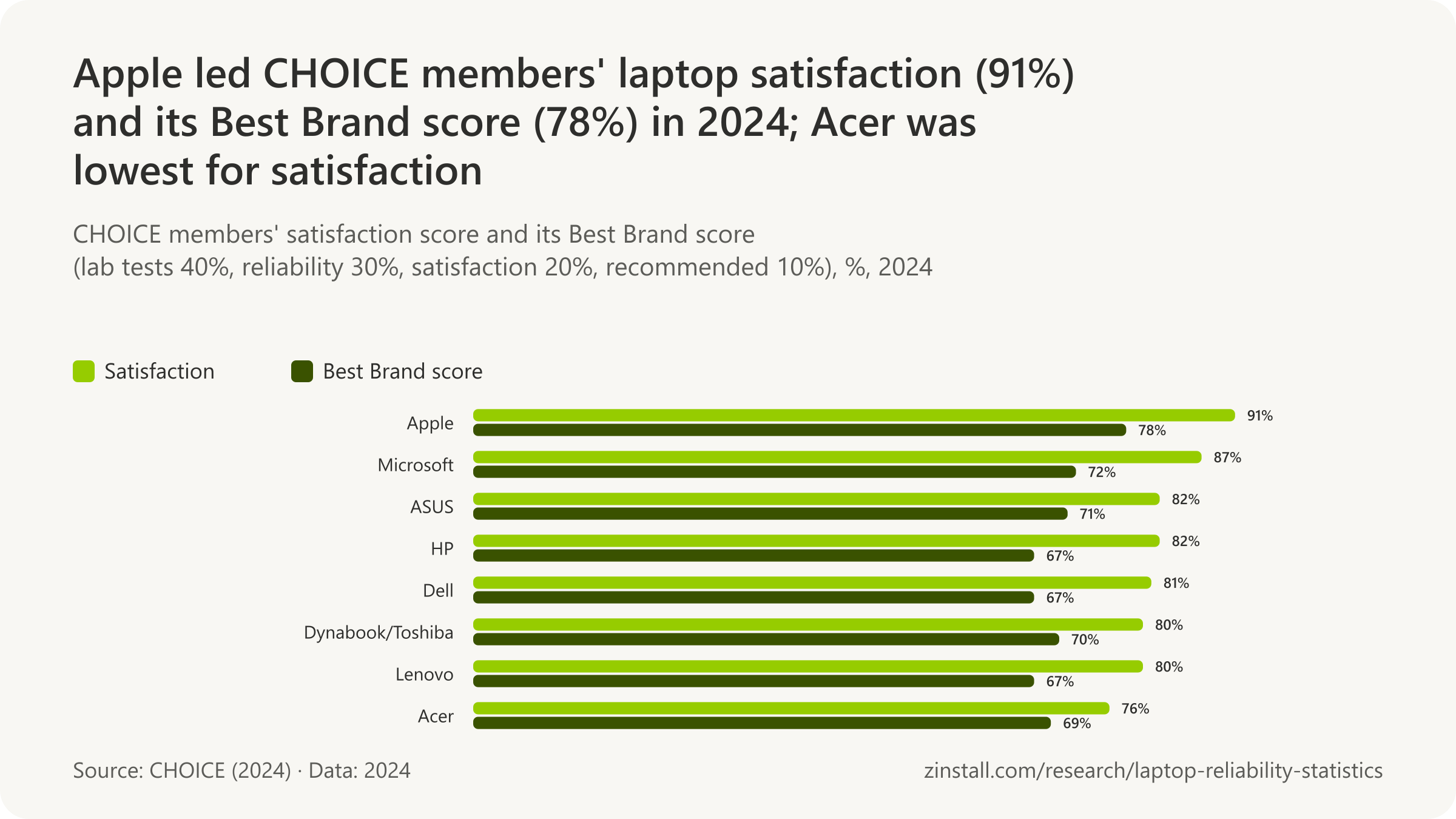
- 30% of CHOICE's Best Brand score for laptops is brand reliability from its member survey, with average lab test score 40%, customer satisfaction 20% and the share of recommended models 10% (CHOICE, 2024).
- More than 180 laptops had been tested by CHOICE since 2019 when it named its 2024 best laptop brand, alongside a survey of members about the laptops they own (CHOICE, 2024).
- Apple was CHOICE's best laptop brand in each year from 2020 to 2024, on lab results plus members' reliability and satisfaction reports (CHOICE, 2024).
- VAIO ranked first for overall satisfaction among client PC vendors in Nikkei Computer's 2025-2026 customer satisfaction survey of Japanese corporate IT buyers, from 904 valid responses, VAIO announced (VAIO, 2025).
- Apple ranked first for overall satisfaction among seven laptop brands, ahead of Dell, HP, Lenovo, Asus, Acer and Microsoft, in Canstar Blue's 2026 survey of 1,110 Australian laptop buyers (Canstar Blue, 2026).
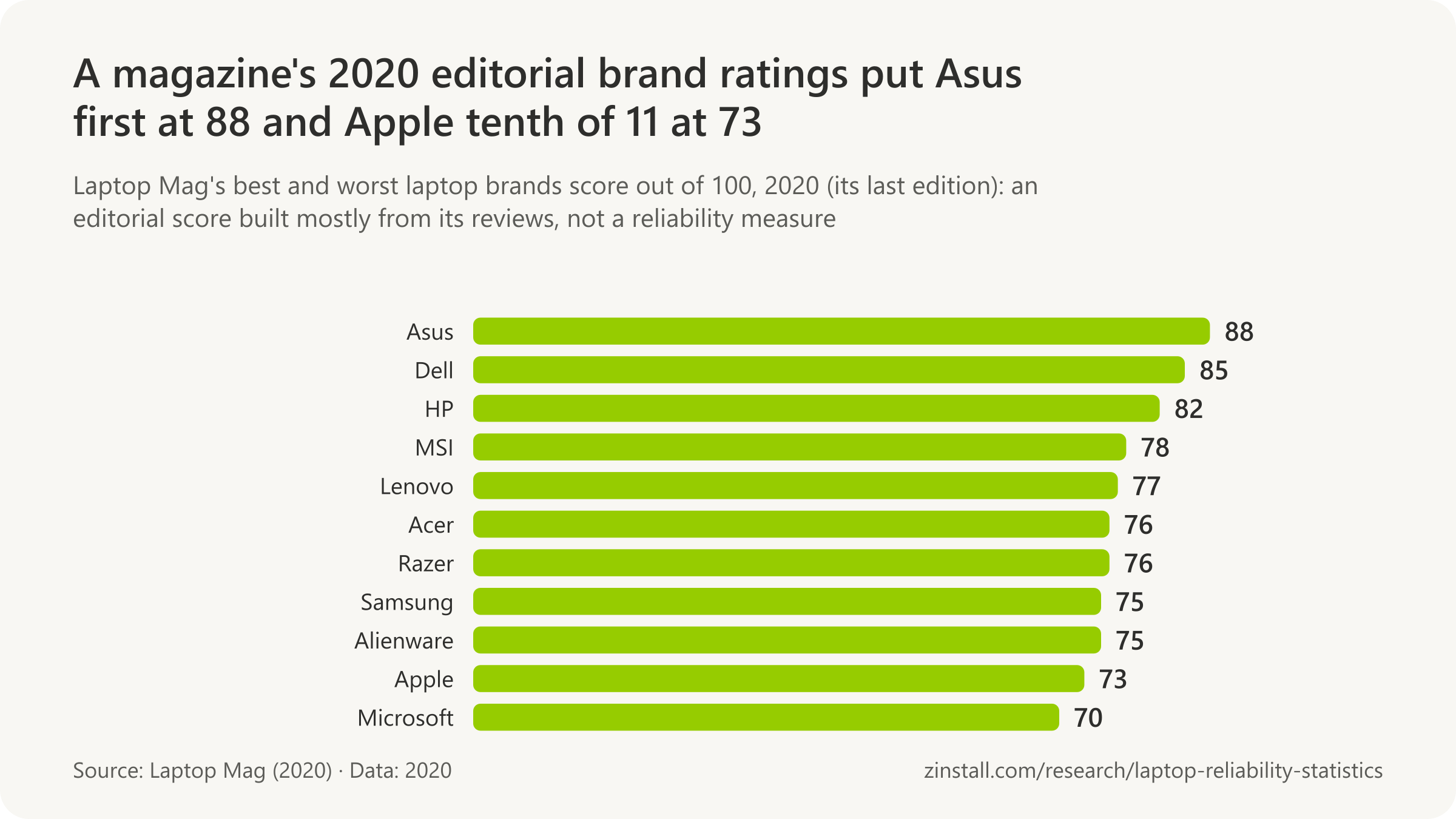
Sources: American Customer Satisfaction Index LLC (1994-2026); RESCUECOM Corporation (2006-2020); CHOICE; VAIO Corporation; Canstar Blue; PCMag (2022-2026); Laptop Mag (2020, 2023)
What is the laptop failure rate?
16% of 75,923 US laptops bought from 2019 to 2025 broke or stopped working properly within three years (Consumer Reports, 2026).

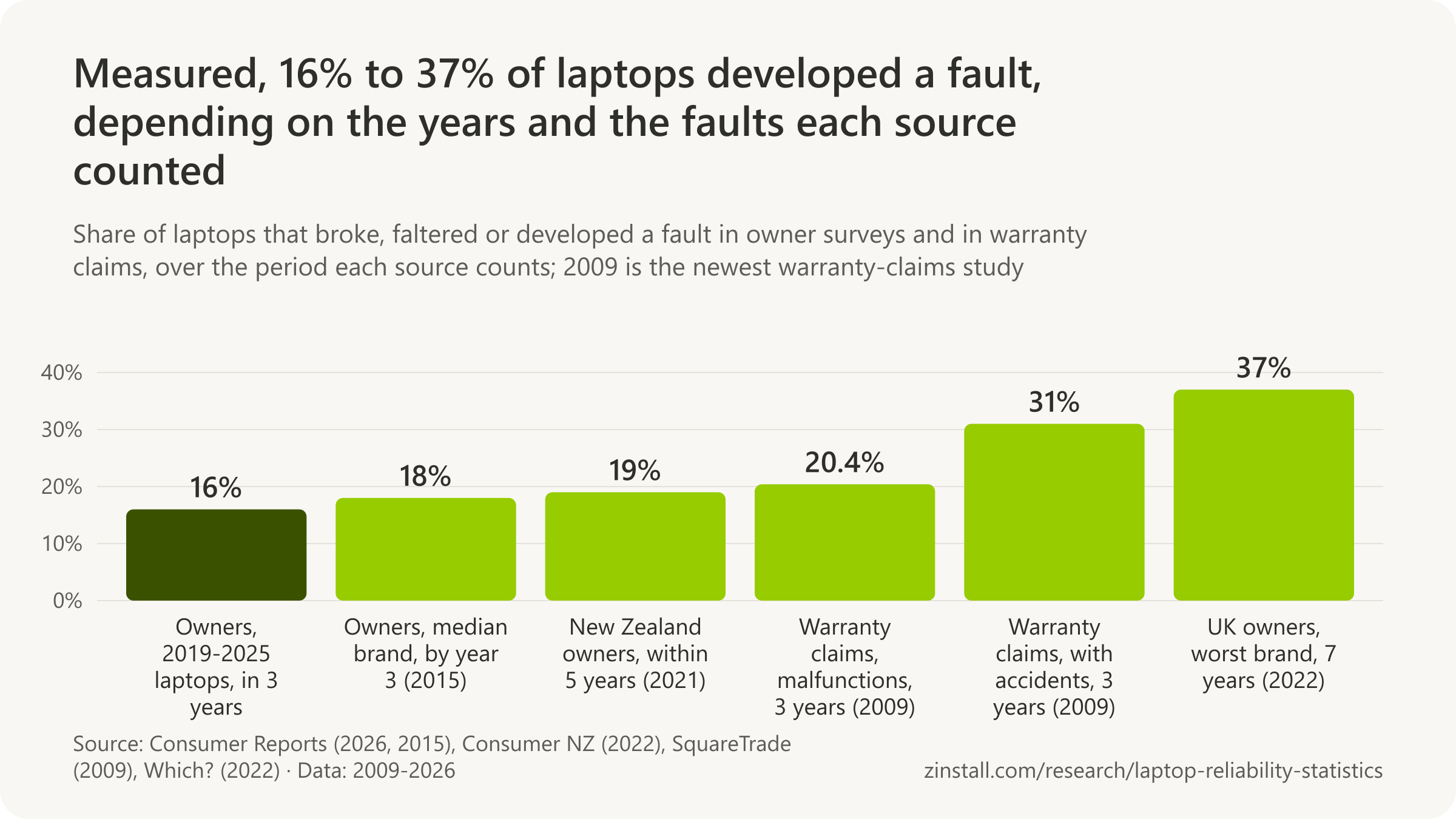
- 19% of 1,876 laptops bought in the previous five years had developed a fault, New Zealand owners reported in 2021.
- 44% of the laptop faults New Zealand owners reported appeared within the first 12 months after purchase.
- Half of laptops are still working nine years after purchase, French owners' reports showed in 2026.
- 31% of laptops with warranty plans failed within three years in 2009's claims data, accidents included, with third-year accidents projected.
- 15% of notebooks bought in 2005 and 2006 needed a hardware part replaced in their first year, three times the desktop rate.
| Source, measure and date | Figure |
|---|---|
| UK: laptops fault-free for seven years, best against worst brand, 2022 | 93% vs 63% |
| UK: years an average laptop lasts before a fault forces replacement, 2021 | just under 9 years |
| UK: worst brand's laptops with a problem within six years, 2020 | more than 1 in 3 |
| US: median brand failure rate by year three, 2015 | 18% |
| Warranty claims: malfunctions within three years, 2009 | 20.4% |
| Warranty claims: accidental damage within three years (projected), 2009 | 10.6% |
| New Zealand: laptop faults that were major or catastrophic, 2021 | 3 in 4 |
| Laptops against desktops: crashes from hardware faults, 2011 | 25% to 60% less likely |
| France: average age of laptops at repair, 2025 | 4 years 2 months |
| Gartner: notebooks' yearly failure rate in year four (projected), 2006 | 22% (projected) |
Sources: Consumer Reports, Inc. (2026, 2015); Consumer NZ; UFC-Que Choisir; SquareTrade, Inc.; Gartner; Which?; Microsoft Research; Fnac Darty
Related guides: A broken or dead computer · Back up to a USB drive, restore to a new PC
More statistics (33)
A laptop failure rate depends on what is counted and over how long: owner surveys ask whether a laptop broke or developed any fault over several years, warranty claims count only what a plan covered, and fleet studies count the machines needing a part each year. The newest large measurements come from consumer organisations' owner surveys; the warranty study behind the much-quoted one in three is from the late two-thousands, and Gartner's yearly rates are older still. Many faults appear in a laptop's first year.
Owner surveys
- 75,923 laptops bought new between 2019 and 2025 are behind Consumer Reports' 2026 laptop brand reliability scores, reported by members in CR's 2023, 2024 and 2025 surveys (Consumer Reports, 2026).
- 56% of Consumer Reports members ranked reliability above performance or affordability when choosing a laptop, the top factor in CR's survey (Consumer Reports, 2026).
- More than 150 laptop models were in Consumer Reports' ratings when it launched overall laptop brand scores in October 2025, which require at least three CR-tested models and good to great brand reliability (Consumer Reports, 2025).
- 44% of laptop faults reported in Consumer NZ's 2021 reliability survey appeared within the first 12 months after purchase (Consumer NZ, 2022).
- Three-quarters of the laptop faults reported in Consumer NZ's 2021 reliability survey were major or catastrophic, according to their owners (Consumer NZ, 2022).
- 3,009 laptop owners answered Consumer NZ's 2026 reliability and satisfaction survey, the basis of its predicted-reliability rating for each laptop brand with at least 30 responses (Consumer NZ, 2026).
- 5 years is how long Consumer NZ says it is reasonable to expect a new laptop to stay fault-free, the benchmark behind its predicted-reliability ratings (Consumer NZ, 2026).
- 93% of laptops from the best brand were fault-free in their first seven years, against 63% from the worst, in Which?'s March 2022 survey of 16,097 UK owners (Which?, 2022).
- 7,374 Which? members who owned laptops answered Which?'s July 2021 survey on laptop reliability, satisfaction and lifetimes (Which?, 2021).
- Just under nine years is how long an average laptop should last before a fault forces its replacement, Which? estimated from its July 2021 survey of 7,374 members (Which?, 2021).
- 8.4 to 9.6 years was the range of estimated laptop lifetimes before a fault forced replacement across the brands in Which?'s July 2021 survey, with brand names reserved for members (Which?, 2021).
- 7% of laptops from the top brand developed a minor fault in their first two years, against 16% from the worst performer, in Which?'s July 2020 survey of 8,772 laptops (Which?, 2020).
- More than 1 in 3 laptops from the worst-rated manufacturer had a problem within six years of ownership, in Which?'s July 2020 survey of 8,772 laptops (Which?, 2020).
- At least five years without developing a fault, and no major fault in the first year, is what Which? says a laptop should manage, a consumer organisation's expectation stated in 2020 (Which?, 2020).
- Half of laptops are still working nine years after purchase, according to Que Choisir's 2026 reliability survey of French owners, which puts the average laptop price at 800 euros (Que Choisir, 2026).
- 8 years and 11 months is how long French owners can expect to use a laptop, Que Choisir said from its October 2025 reliability survey, adding that some brands fall short (Que Choisir, 2025).
- A little over eight years is how long respondents keep a laptop on average, Que Choisir found in its August 2024 reliability survey, with battery and hard drive the usual causes of failure (Que Choisir, 2024).
- 6 years was the average laptop lifespan in Que Choisir's December 2022 reliability survey, with frequent battery, hard drive and power supply problems and differences between brands (Que Choisir, 2022).
- Up to 7 years was the laptop longevity Que Choisir reported in August 2021, the first time its annual high-tech reliability survey gave average lifespans, with batteries and hard drives the most affected parts (Que Choisir, 2021).
Warranty claims

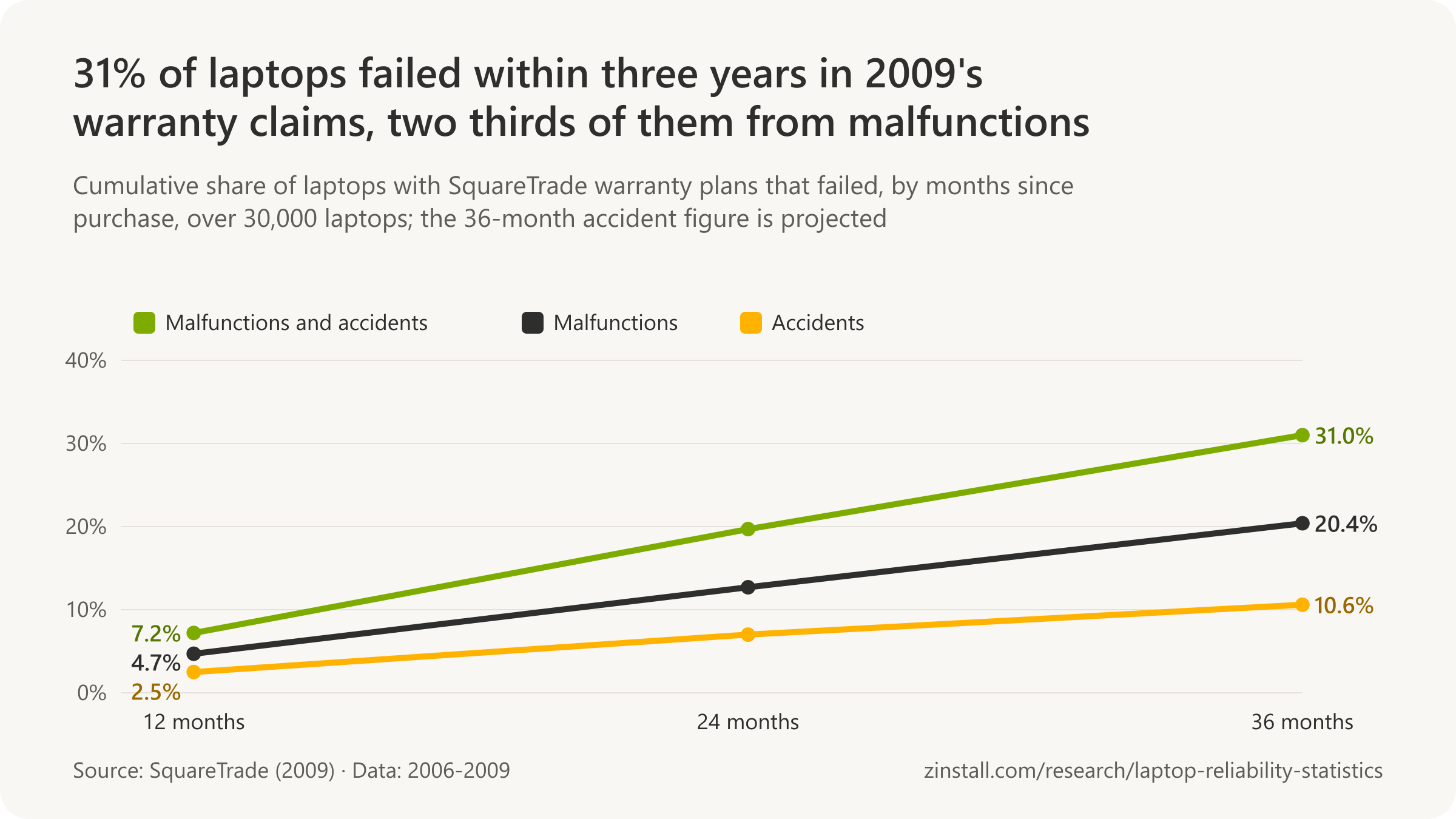
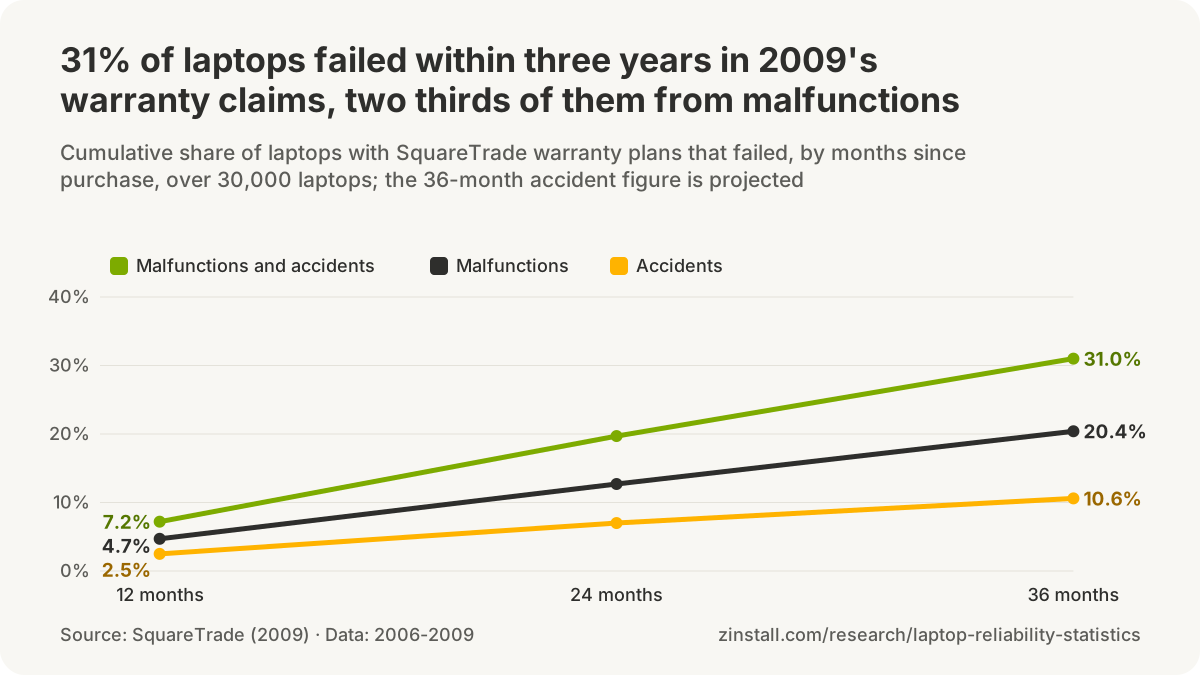

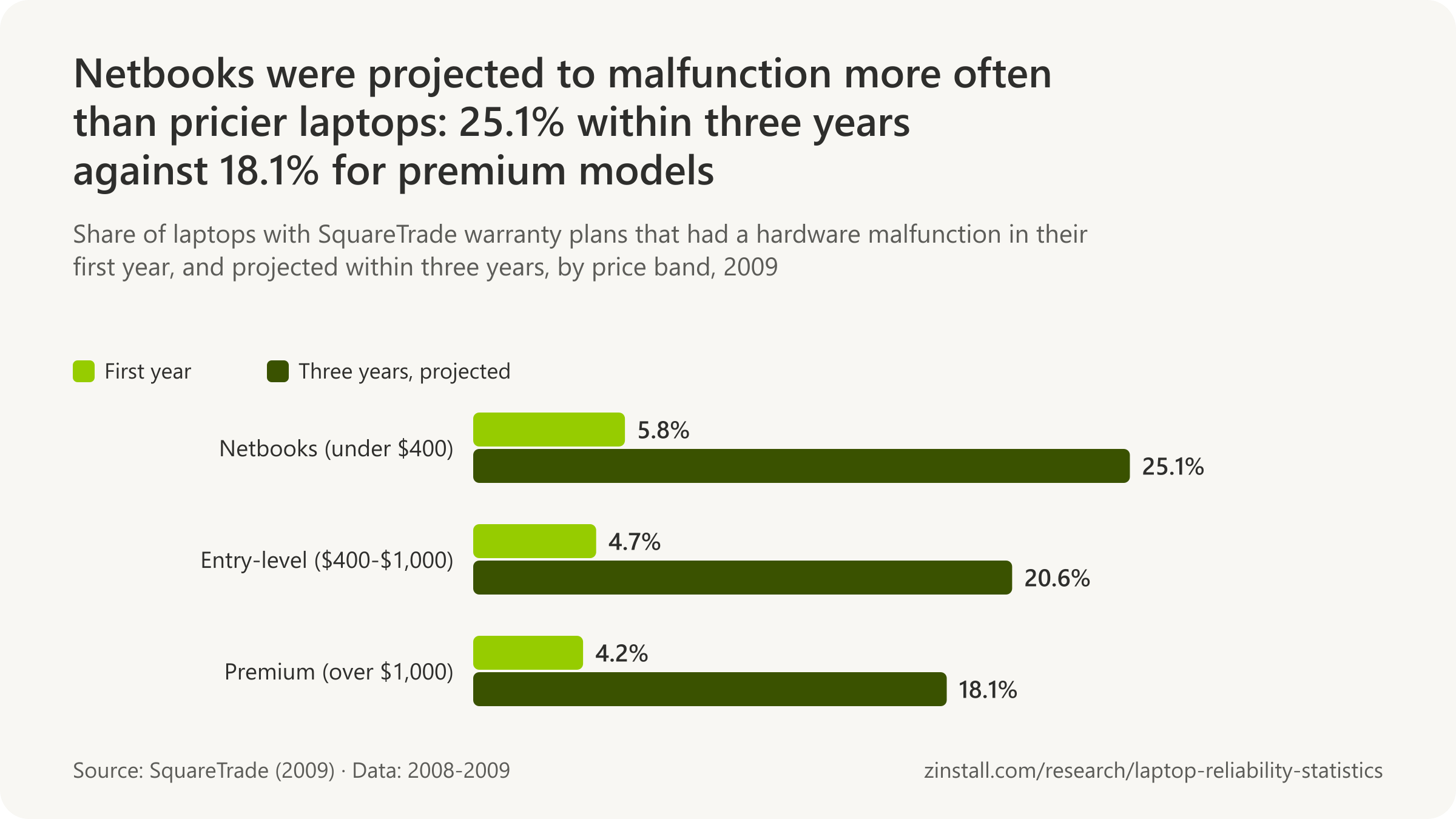
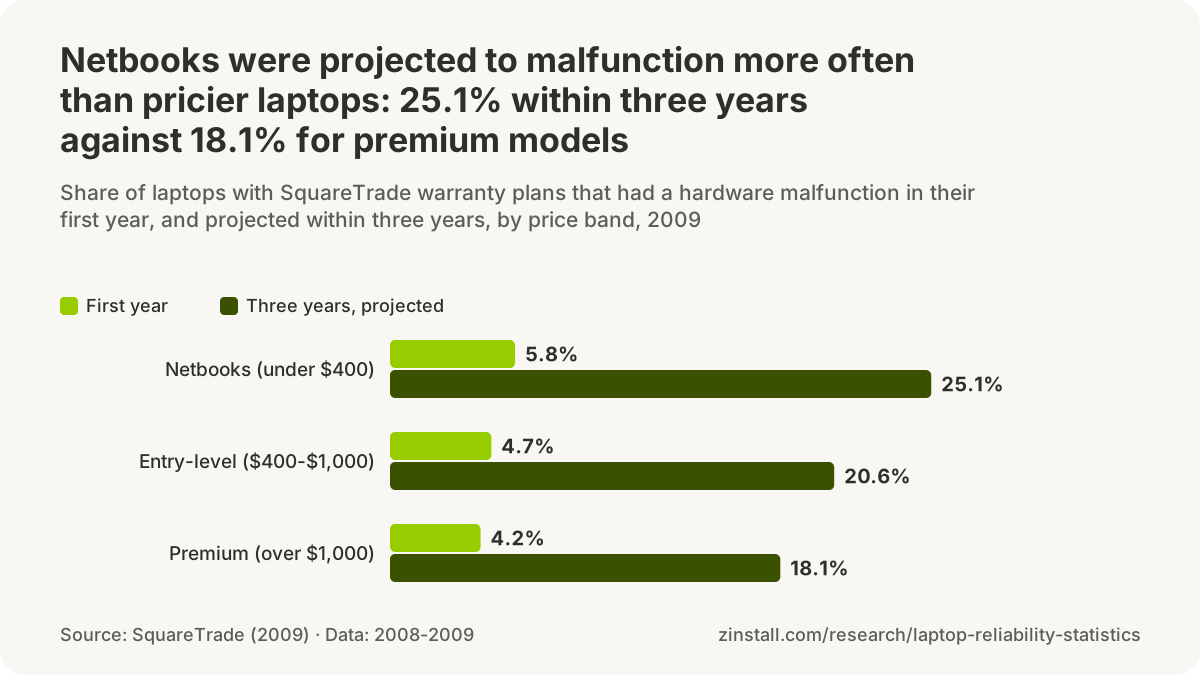
- Fewer than 5% of laptops covered by SquareTrade warranty plans malfunctioned in their first year, and about 8% more did in each of the next two years, in SquareTrade's November 2009 analysis (SquareTrade, 2009).
- 9 laptop brands had at least 1,000 units each in SquareTrade's November 2009 reliability study, enough for two-year failure rates that SquareTrade projected to three years (SquareTrade, 2009).
Yearly failure rates in fleets

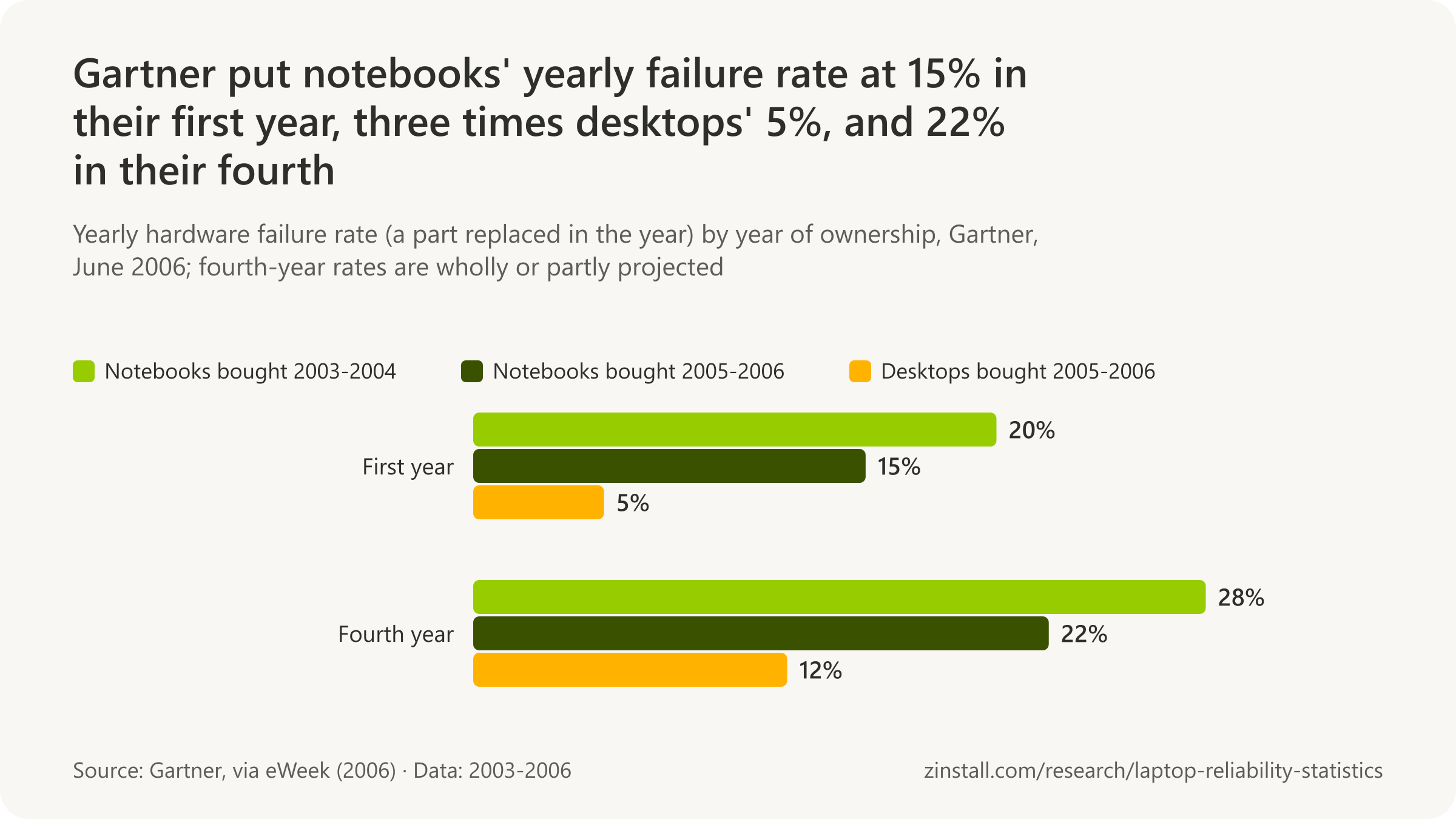
- About 25% was the cut PC makers made in the annual hardware failure rates of their desktops and notebooks over the two years to 2006, Gartner reported (Gartner, 2006).
- 60 to 90 days is when PC hardware failures level off after an early shakedown period in which they cluster, Gartner said in its 2006 failure-rate report (Gartner, 2006).
- 28% was the annualized hardware failure rate of notebooks in their third year, and up to 35% in their fourth, Gartner analyst Leslie Fiering told Computerworld in 2005, against about 15% for desktops (Gartner, 2005).
- 3 years is about as long as most laptops last without breaking, while 'a desktop can last seven years easy', Lenovo's chief architect for mobile and desktop development told Computerworld in 2005, a maker's estimate (Lenovo, 2005).
Laptops against desktops
- 25% to 60% less likely than desktops to crash from a hardware fault were laptops in Microsoft Research's 2011 study of nearly a million consumer Windows PCs, depending on the component (Microsoft Research, 2011).
- 1 in 310 laptops crashed from a CPU fault in their first 30 days of CPU time, against 1 in 120 desktops, in Microsoft Research's study of consumer Windows PCs (Microsoft Research, 2011).
- 1 in 280 laptops crashed from a disk-subsystem fault in their first 30 days of CPU time, against 1 in 180 desktops, in Microsoft Research's study of consumer Windows PCs (Microsoft Research, 2011).
- 1 in 190 consumer PCs with at least 30 days of CPU time crashed from a CPU fault over eight months, and 1 in 3.3 of those crashed again, Microsoft Research found (Microsoft Research, 2011).
- 1 in 950 white-box desktops crashed from a memory bit flip in their first 30 days of CPU time, against 1 in 2,700 brand-name desktops, Microsoft Research found (Microsoft Research, 2011).
- 39% to 80% less likely to crash from hardware faults over eight months were consumer PCs whose CPUs ran slightly below rated speed, Microsoft Research found, while even small overclocking raised failures (Microsoft Research, 2011).
How old laptops are when they are repaired or replaced
- 4 years and 2 months was the average age of laptops repaired by Fnac Darty's after-sales service, against 8 years and 4 months for desktop computers and 3 years and 6 months for the PC gamer family, in the 2025 barometer (Fnac Darty, 2025).
- 8.1 years was the average time Darty customers said they had used their previous laptop before replacing it, against 10.6 years for desktop computers and 6.5 years for gaming PCs, in the 2025 barometer (Fnac Darty, 2025).
Sources: Consumer Reports, Inc. (2025, 2026); Consumer NZ (2022, 2026); Which?; UFC-Que Choisir; SquareTrade, Inc.; Gartner (2005, 2006); Lenovo; Microsoft Research; Fnac Darty
Is Dell or HP more reliable?
1.1% of Dell notebooks became warranty cases within two years at a European retailer, against 1.8% of HP's (Digitec Galaxus, 2026).

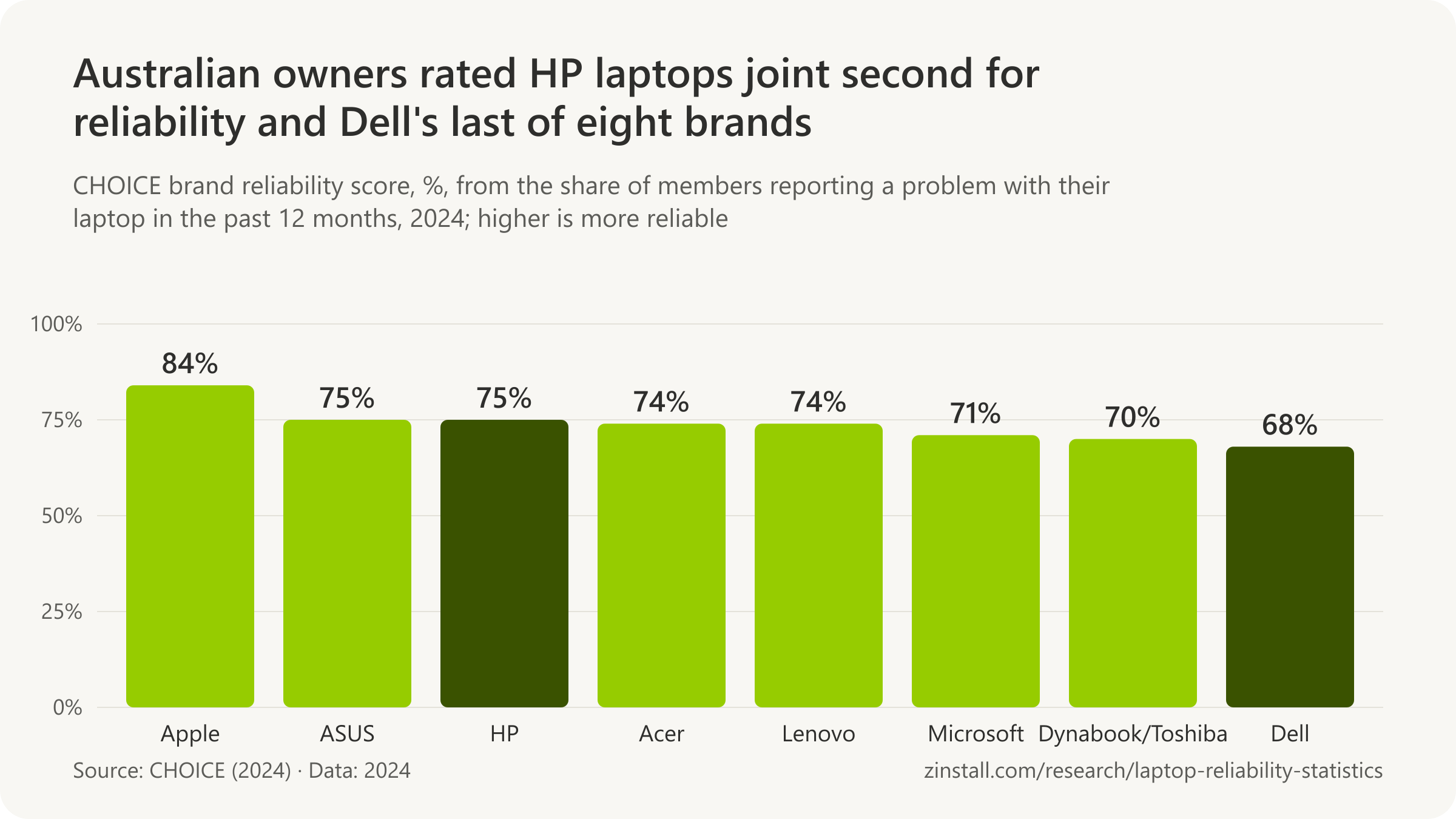
- Australian owners rated Dell laptops' reliability 68%, the lowest of eight brands, against 75% for HP's.
- HP laptops had the highest projected three-year malfunction rate of nine brands in 2009's warranty claims, 25.6%.
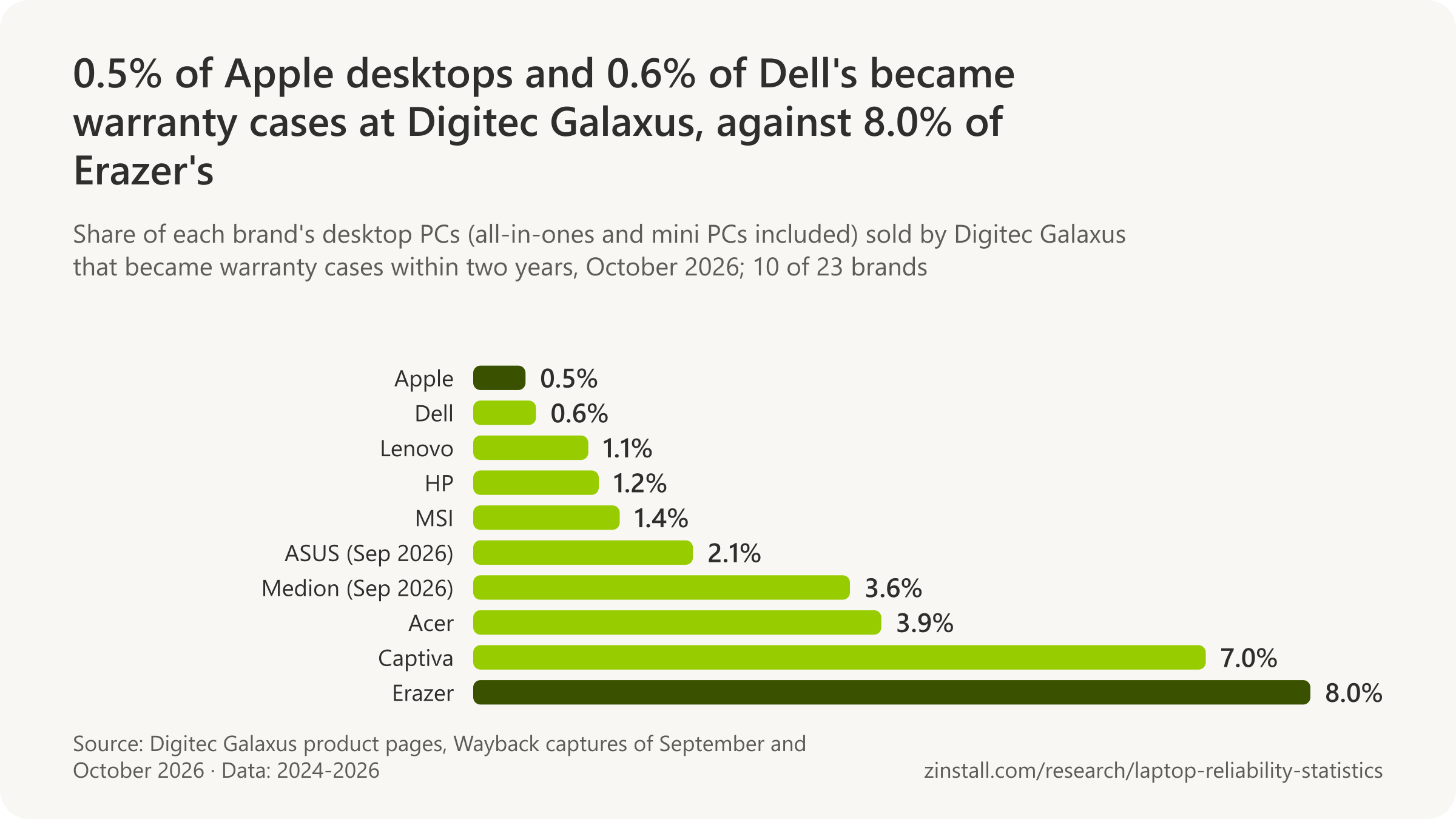
- 0.6% of Dell desktop PCs became warranty cases within two years at the same retailer, second only to Apple's 0.5%.
- HP laptops scored 120 for reliability in a French retailer's repair data, second of six brands.
| Brand, measure and date | Figure |
|---|---|
| Lenovo notebooks: warranty cases, Swiss retailer, 2026 | 1.8% |
| HP desktop PCs: warranty cases, Swiss retailer, 2026 | 1.2% |
| Lenovo desktop PCs: warranty cases, Swiss retailer, 2026 | 1.1% |
| Lenovo laptops: Australian owners' reliability score, 2024 | 74% |
| Lenovo laptops: French retailer's reliability score, 2024 | 114 |
| Dell laptops: projected 3-year malfunction rate, 2009 | 18.3% |
| Lenovo laptops: projected 3-year malfunction rate, 2009 | 21.5% |
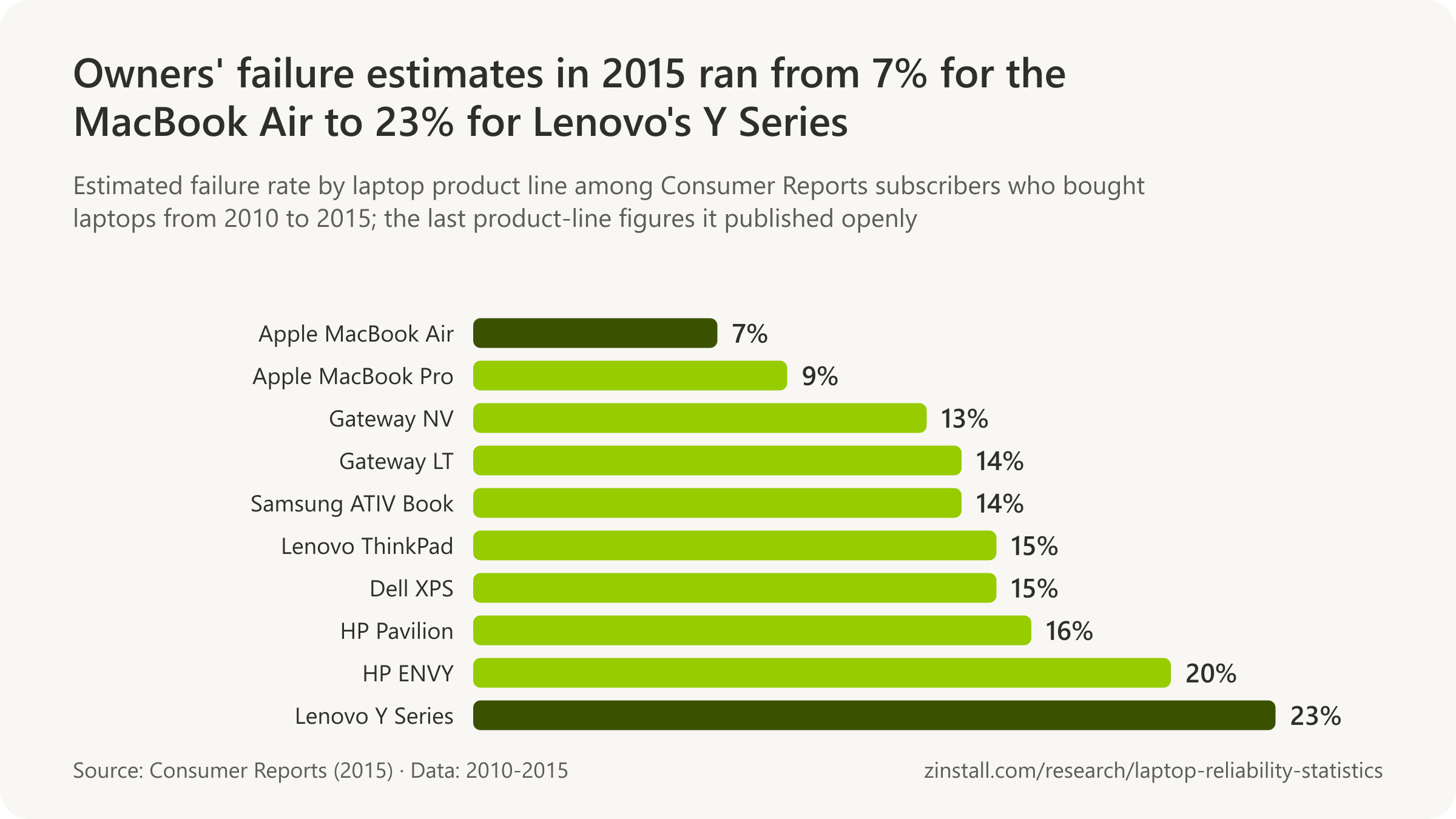
| Dell XPS: owners' estimated failure rate, 2015 | 15% |
| HP Pavilion: owners' estimated failure rate, 2015 | 16% |
| Lenovo ThinkPad: owners' estimated failure rate, 2015 | 15% |
Sources: Digitec Galaxus AG (2026a, 2026b, 2026c, 2026d); CHOICE; SquareTrade, Inc.; Fnac Darty; Consumer Reports, Inc.
Related guides: A new Dell laptop · HP's migration tool and alternatives
More statistics (1)
Where a source rates both, Dell and HP land close together and their order flips: a Swiss retailer's warranty data puts Dell's notebooks ahead, Australian owners rate HP's more reliable, and the old warranty-claims study had HP last of nine brands. For desktops, the Swiss retailer's data puts Apple and Dell first. Lenovo sits in the middle of most tables.
Owner surveys by brand

- Dell laptops had above-average problem rates for batteries, keyboards, power supplies, USB ports, speakers and microphones, and Lenovo for wifi, hinges, USB ports, screens, speakers and microphones, in Testaankoop's 2026 survey (Testaankoop, 2026).
Desktop PCs


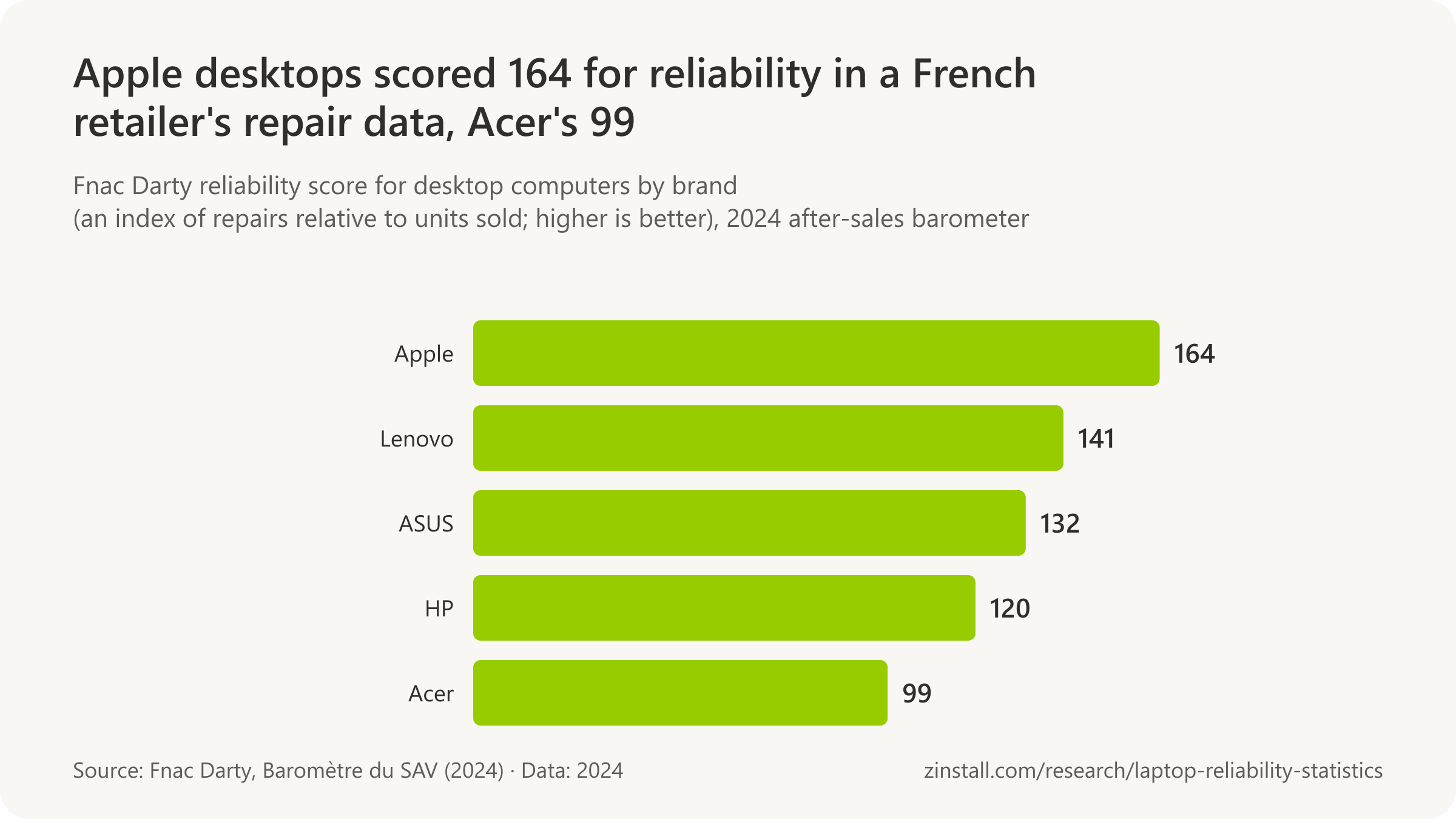
Sources: Testaankoop / Test Achats; Consumer Reports, Inc.; Digitec Galaxus AG (2026); Fnac Darty
Do gaming laptops break more often?
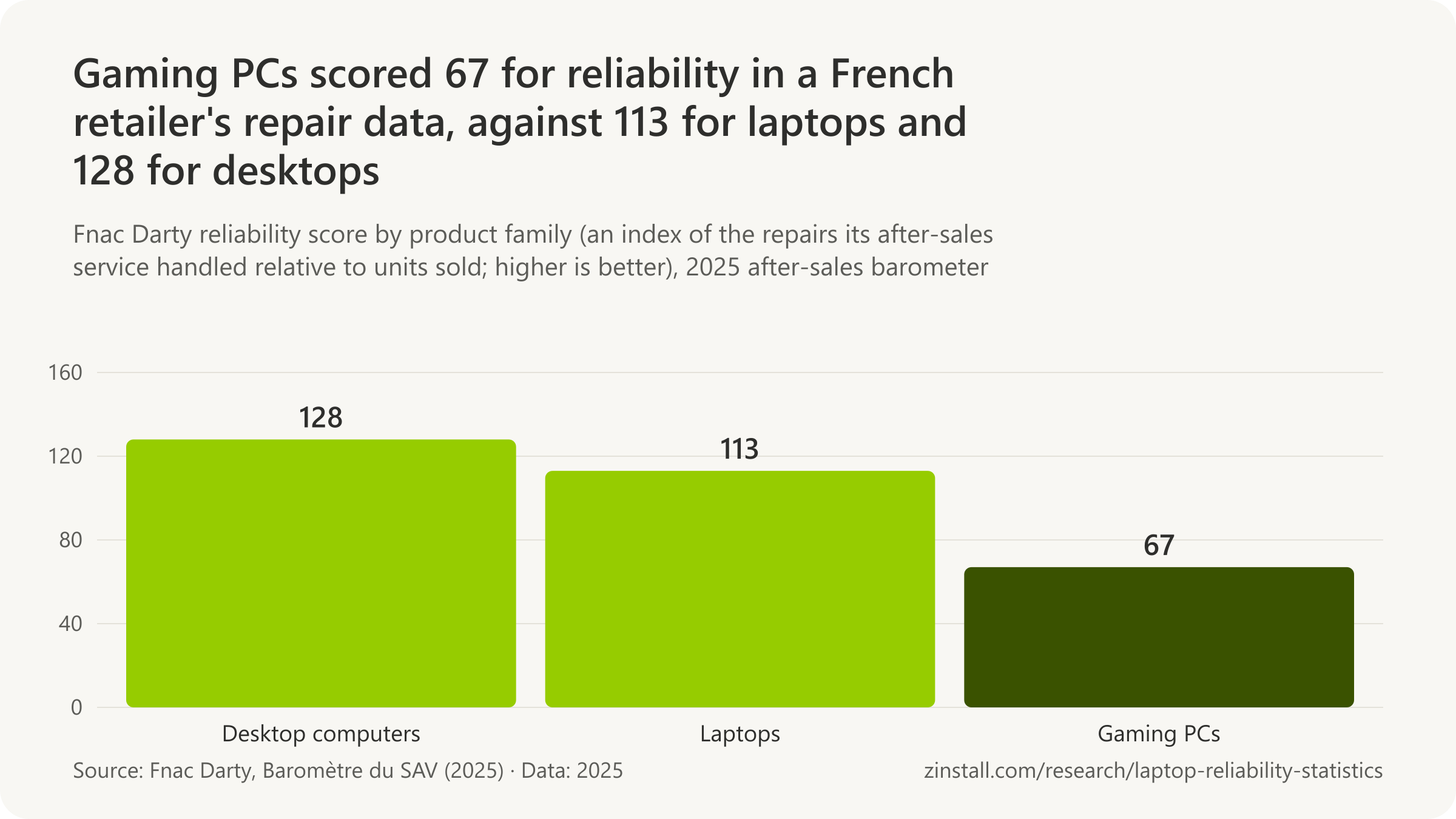
Laptops scored 113 for reliability in a French retailer's 2025 repair data; gaming PCs scored 67 and desktops 128 (Fnac Darty, 2025).

- 5.7% of MSI notebooks became warranty cases within two years at a European retailer, the third-highest of 15 brands.
- 7.0% of Captiva desktop PCs and 8.0% of Erazer's became warranty cases within two years at the same retailer.
- Just under 6.4% of Medion PCs became warranty cases within two years, the retailer's own example when it began publishing rates.
- Readers of a tech magazine rated MSI laptops 9.2 out of 10 for reliability in 2026, among the highest.
| Brand, measure and date | Figure |
|---|---|
| Captiva notebooks: warranty cases, Swiss retailer, 2026 | 7.9% |
| Gigabyte notebooks: warranty cases, Swiss retailer, 2026 | 5.9% |
| Medion notebooks: warranty cases, Swiss retailer, 2026 | 5.4% |
| Erazer notebooks: warranty cases, Swiss retailer, 2026 | 3.9% |
| HP gaming PCs: French retailer's reliability score, 2024 | 118 |
| Acer gaming PCs: French retailer's reliability score, 2024 | 74 |
| ASUS gaming PCs: French retailer's reliability score, 2024 | 72 |
| Dell gaming PCs: French retailer's reliability score, 2024 | 67 |
| MSI gaming PCs: French retailer's reliability score, 2024 | 63 |
| Lenovo gaming PCs: French retailer's reliability score, 2024 | 55 |
Sources: Fnac Darty (2025, 2024); Digitec Galaxus AG (2026a, 2026b, 2026c, 2023); PCMag
Related guides: Programs and files to a new computer · Free ways to transfer programs
More statistics (3)
Retailers' after-sales data puts gaming brands and gaming PCs well below ordinary laptops and desktops. A Swiss retailer finds its highest notebook warranty-case rates among brands that build gaming machines, and a French retailer's reliability index for gaming PCs is far below its index for laptops. Owners see it differently: PCMag's readers have rated MSI's laptops among the most reliable in every edition of its survey.
Gaming brands at a Swiss retailer

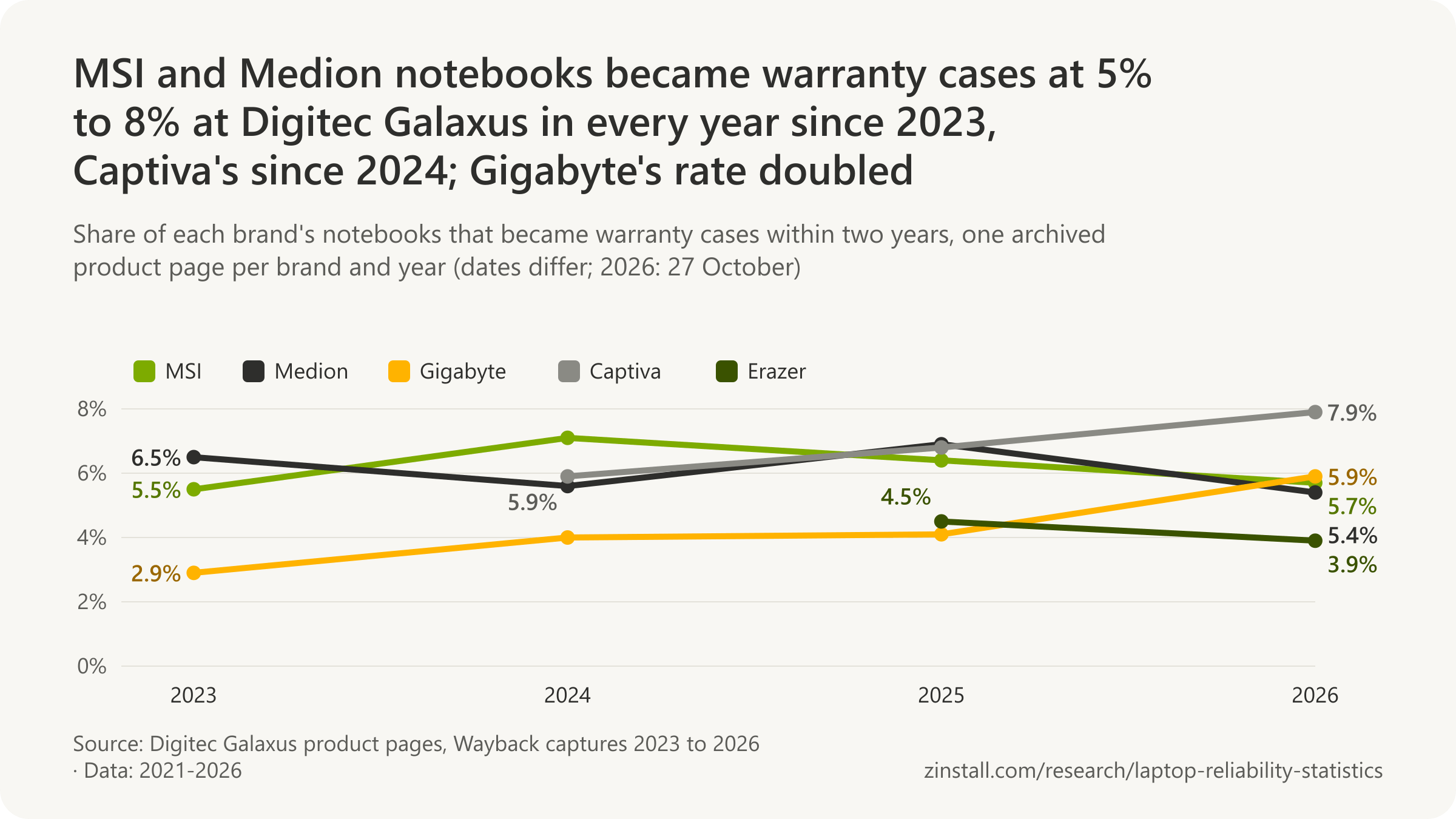
- Just under 6.4% of Medion PCs sold by Digitec and Galaxus became warranty cases within two years of purchase, in the Swiss retailer's own after-sales data published in January 2023 (Digitec Galaxus, 2023).
- Mass-market PC makers had relatively low warranty-case rates at Galaxus and Digitec, while smaller brands and gaming-PC specialists had higher ones, according to the retailer's category manager in June 2023 (Digitec Galaxus, 2023).
Gaming PCs at a French retailer

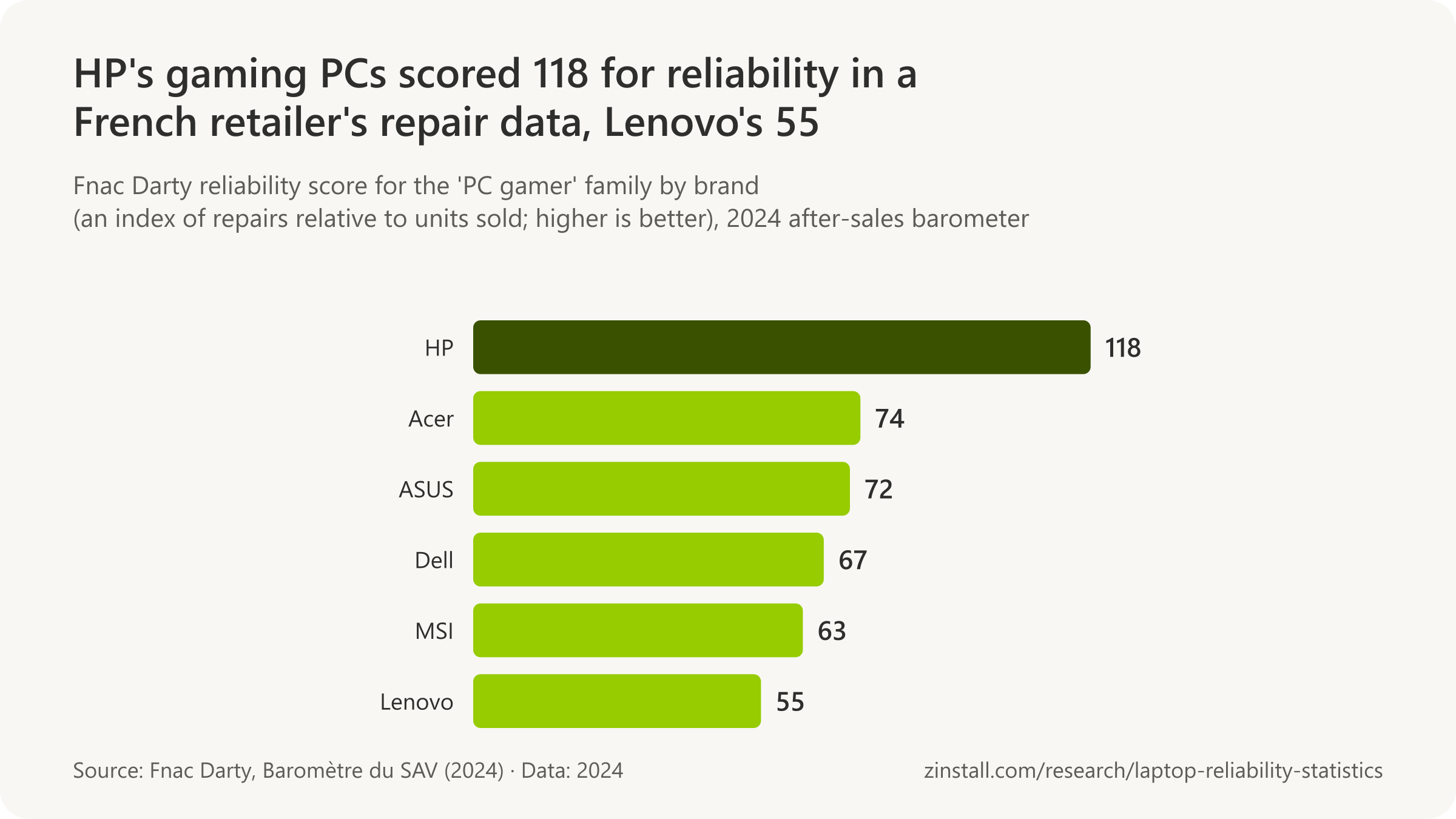
- Gaming PCs were one of the three product families whose durability score fell most in Fnac Darty's 2025 after-sales barometer, with coffee makers and wet-and-dry stick vacuums (Fnac Darty, 2025).
Sources: Digitec Galaxus AG (2023, 2026); Fnac Darty (2024, 2025)
What breaks most often on a laptop?
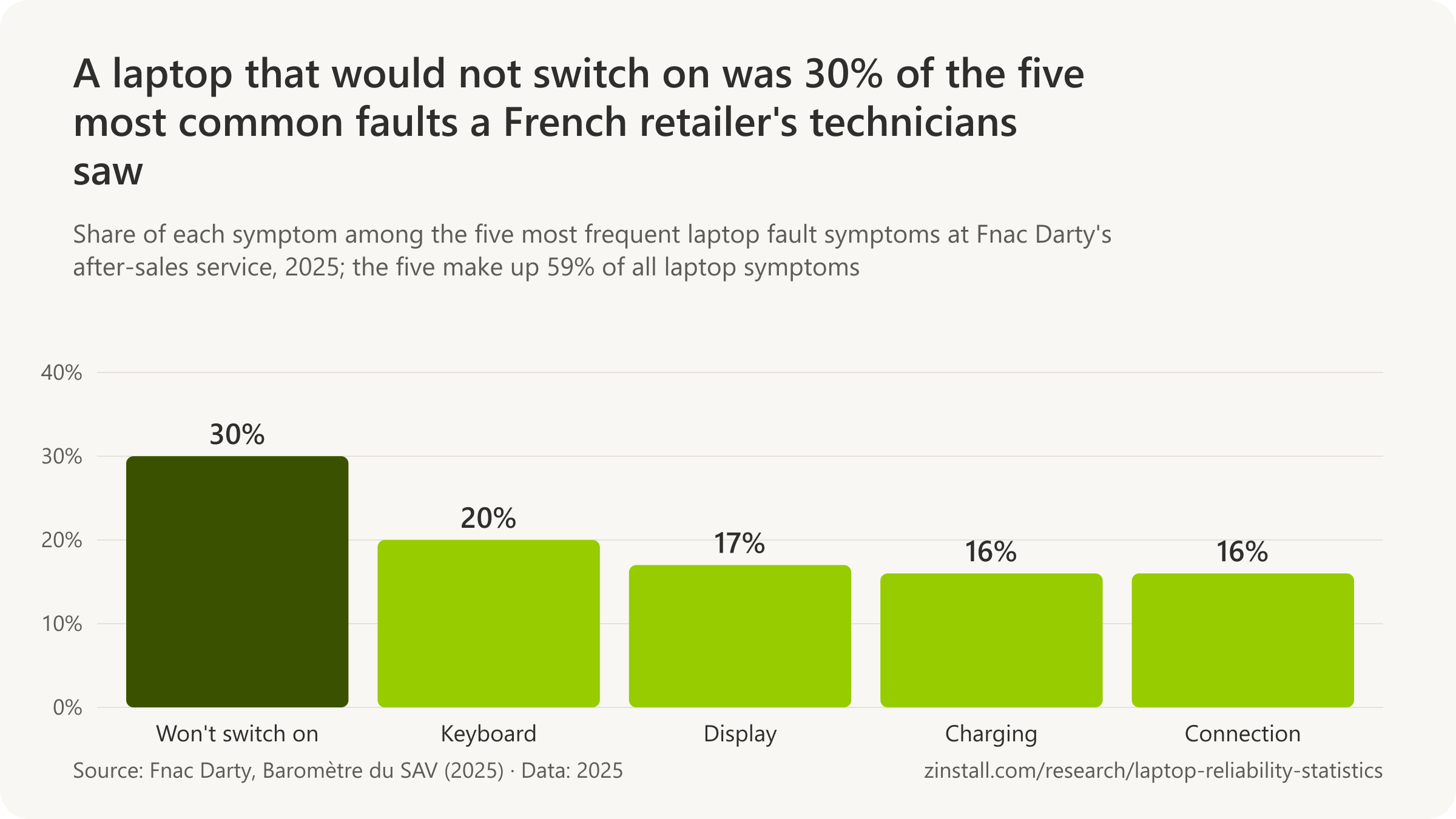
A laptop that would not switch on was 30% of the five most common faults a French retailer's technicians saw (Fnac Darty, 2025).

- A quarter of the laptop problems UK owners reported were battery life getting worse quickly, the most common fault for every brand.
- 16% of laptop owners in a 2026 European survey had had a battery problem, the most common fault.
- 20% of the problems owners reported with laptops were battery problems, in a 2025 survey of almost 42,000 Europeans.
- 15.7% of laptops brought to community repair events were slow or crashing, the most common fault.
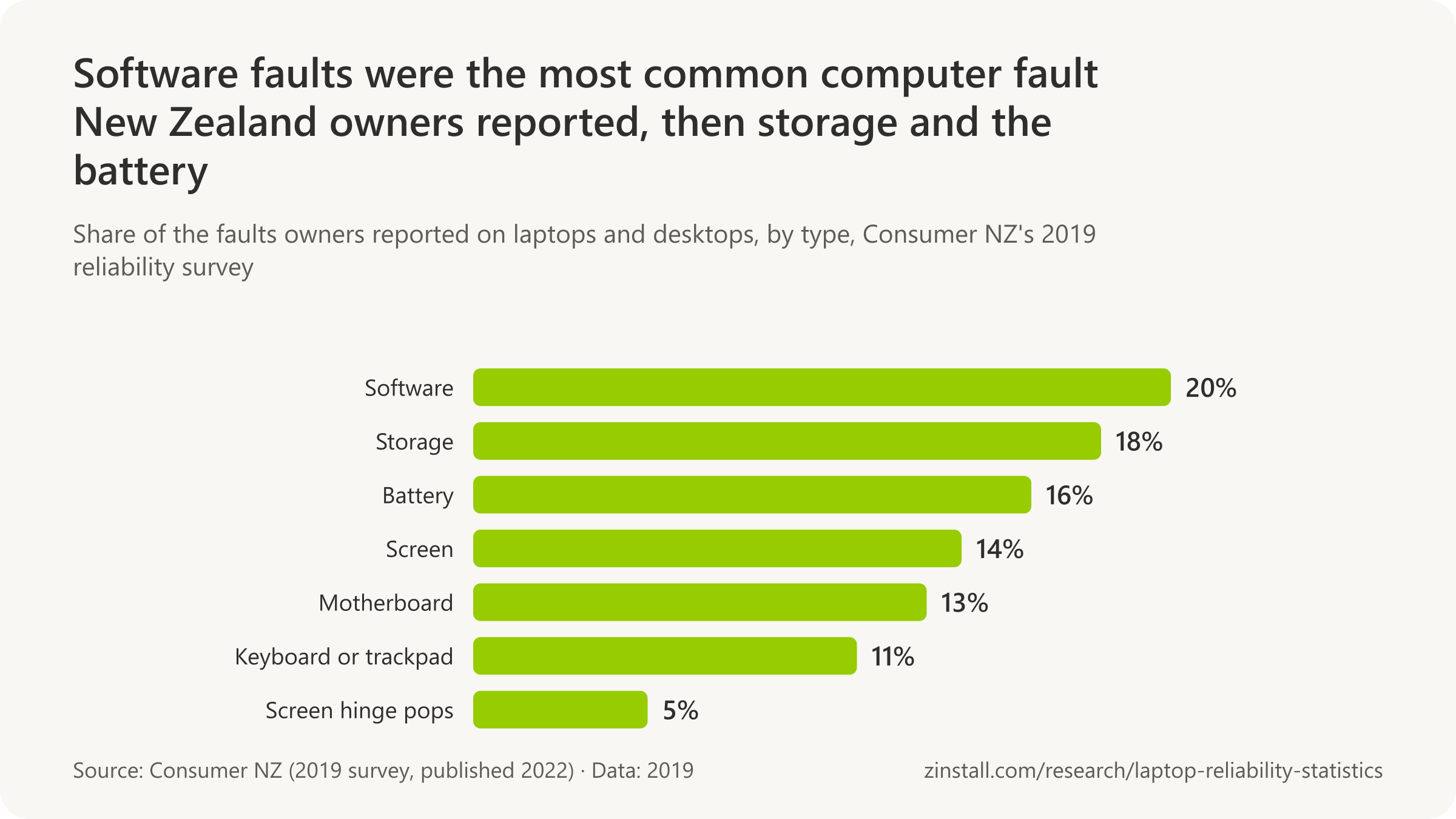
- Software faults were 20% of the computer faults New Zealand owners reported, the most common type.
| Source, measure and date | Figure |
|---|---|
| UK: battery and speed problems among laptop faults, 2022 | 22% and 21% |
| UK: Windows updates, battery and screen faults, 2020 | 15%, 14%, 4% |
| Repair events: laptops with a software-type fault | 36.6% |
| New Zealand: storage faults among computer faults, 2019 | 18% |
| New Zealand: battery faults among computer faults, 2019 | 16% |
| New Zealand: screen faults among computer faults, 2019 | 14% |
| France: laptop symptoms in the five most common types, 2025 | 59% |
| UK: laptop insurance claims for accidental damage, 2002 | up to 60% |
| US: notebooks' share of an insurer's PC claims, 2000 | 92% |
| Laptop memory modules that failed at a PC builder, 2025 | 0.55% |
Sources: Fnac Darty; Which?; Testaankoop / Test Achats; OCU; Open Repair Alliance; Consumer NZ; Complete Computer Cover; Safeware; Puget Systems
Related guides: A laptop with a broken screen · A hard drive with bad sectors
More statistics (18)
Batteries top owners' lists of laptop faults in Belgium and Spain, and topped the UK's until recently, while repair services most often see laptops that will not switch on, keyboards and screens. A large share of the problems people report are software: slow running, crashes and failed updates, which community repair events, New Zealand computer owners and the newest UK survey rank first. In the early two-thousands, accidents, drops and spills made up most of the insurance claims for laptops.
What a repair service sees
- 59% of all laptop fault symptoms seen by Fnac Darty's after-sales service fell into five types (won't switch on, keyboard, display, charging, connection), in the 2025 barometer (Fnac Darty, 2025).
- More than 2 million customer breakdowns were analysed for the symptom data in Fnac Darty's 2025 after-sales barometer, covering 100 product categories (Fnac Darty, 2025).
What owners report

- Running slowly, battery problems, keyboard or touchpad problems, and crashing or freezing were the four most common laptop faults reported in Which?'s 2026 survey of nearly 7,000 UK owners (Which?, 2026).
- A quarter of all laptop problems reported in Which?'s March and April 2024 owner survey were battery life getting worse over a short period, the most common fault for every brand (Which?, 2025).
- A quarter of all laptop problems reported in Which?'s March 2023 owner survey were battery life getting worse over a short period, the most common fault for every brand (Which?, 2023).
- 22% of laptop faults reported in Which?'s March 2022 survey were battery related and 21% were drops in speed and performance, the two most common problems (Which?, 2022).
- 15% of laptop faults in Which?'s July 2020 survey were blamed on Windows 10 updates, 14% were battery related and 4% were screen issues (Which?, 2020).
- 16% of respondents had had one or more battery problems with their laptop, the most common fault, ahead of hard drive or SSD (6%), keyboard (6%), power supply (5%) and wifi (4%), in Testaankoop's 2026 survey (Testaankoop, 2026).
- 20% of the problems owners reported with laptops were battery problems, the category's main weakness, in the 2025 European owner survey of almost 42,000 users by Spain's OCU and partner organisations (OCU, 2025).
Faults at community repair events

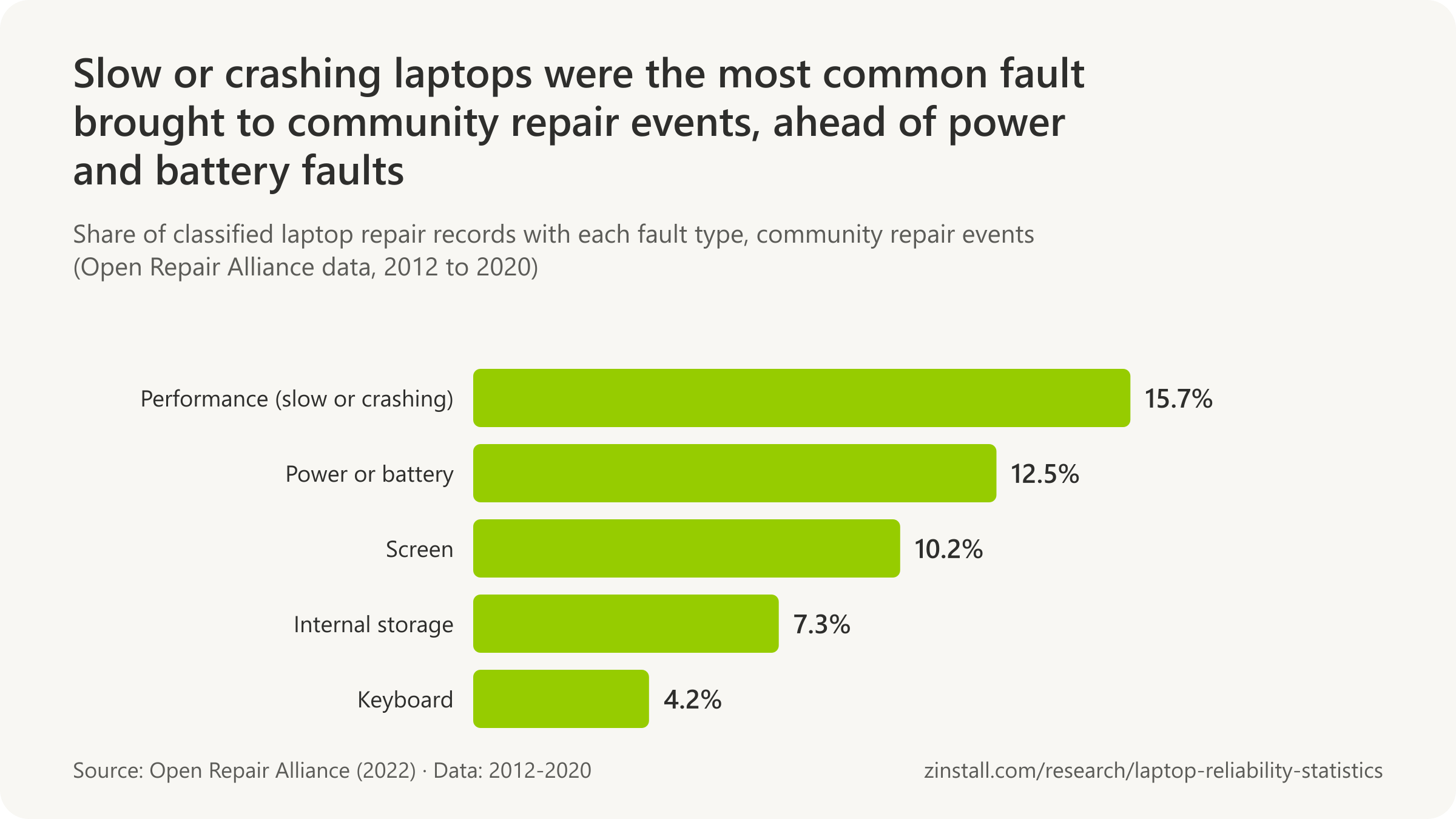
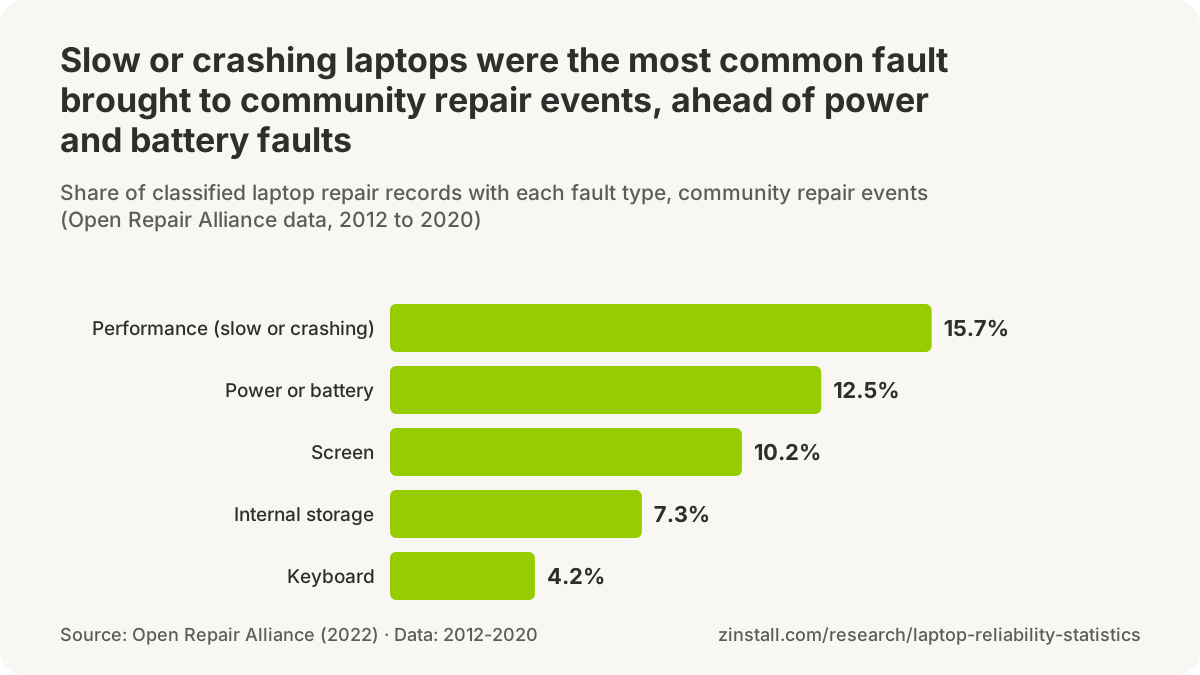
- 36.6% of laptops brought to community repair events had a software-type fault (slow performance, configuration, operating system or malware) rather than broken hardware, in the Open Repair Alliance's 2012-2020 data (Open Repair Alliance, 2022).
Accidents and insurance claims

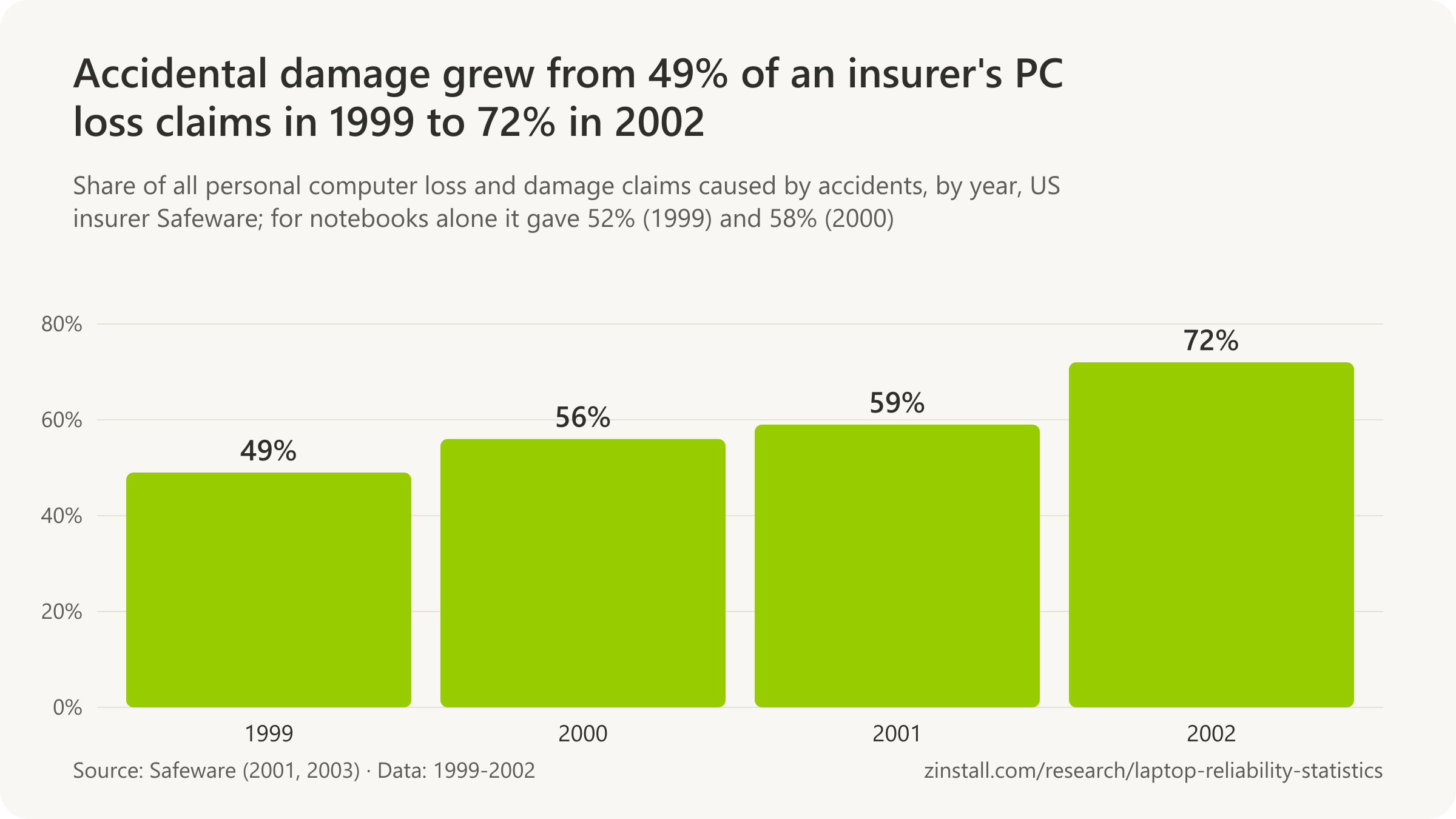
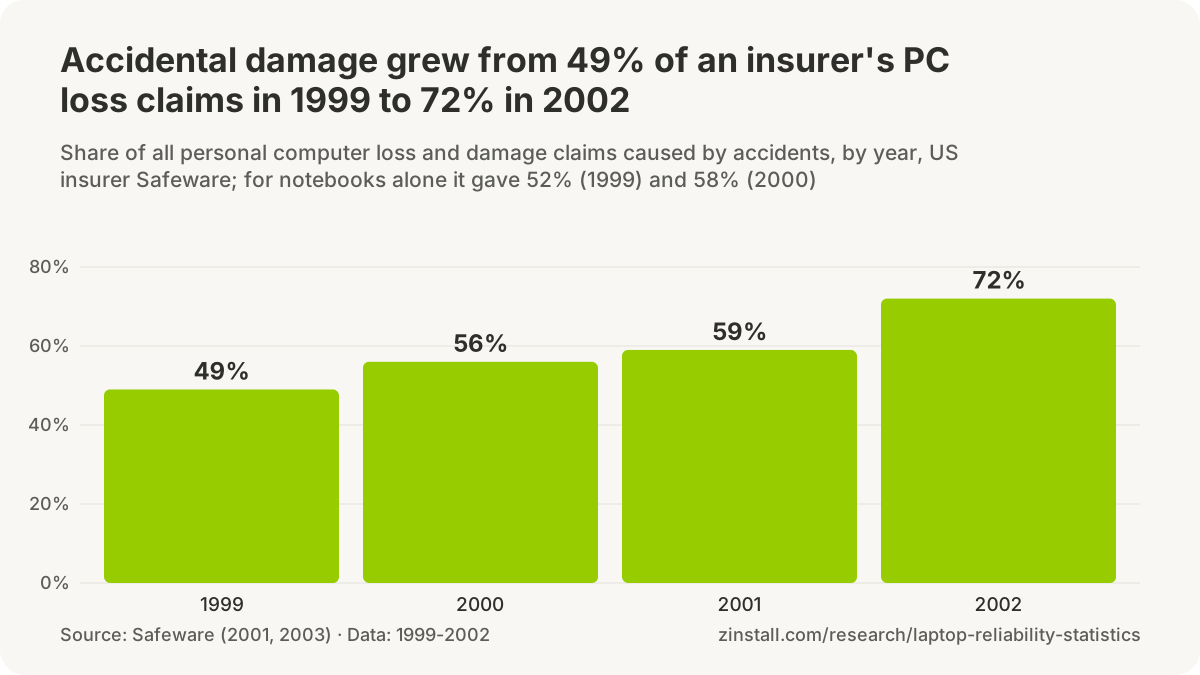
- 92% of the PC claims insurer Safeware processed in 2000 were for notebooks, and notebooks made up over 95% of accidentally damaged units (Safeware, 2001).
- 58% of reported notebook losses in 2000 were accidental damage, up from 52% in 1999, while thefts stayed at about 28% of claims, according to insurer Safeware (Safeware, 2001).
- Up to 60% of laptop insurance claims received by UK insurer Complete Computer Cover were for accidental damage and the rest for theft, with knocks and drops the most common cause, it said in 2002 from five years of claims (Complete Computer Cover, 2002).
Components in a PC builder's records
- 5% to 6% of the motherboards Puget Systems put into its desktop workstations failed in recent years, the highest of any core component, with more than three quarters caught before shipping, the builder reported in 2026 (Puget Systems, 2026).
- 2.5% of the AMD Ryzen 9000 and Intel Core Ultra 200 desktop processors Puget Systems sold in 2025 failed (2.52% and 2.49%), the builder found, too close to call a winner (Puget Systems, 2026).
- 0.25% of NVIDIA's Founders Edition GeForce RTX cards that Puget Systems sold in 2025 failed, the most reliable consumer graphics cards it carried, ahead of ASUS at 0.40% and PNY at 0.45% (Puget Systems, 2026).
- 0.55% of the Kingston laptop memory modules (SODIMMs) Puget Systems used in 2025 failed, against 0.15% of its desktop modules, the builder's records show (Puget Systems, 2026).
- 0.47% of the Super Flower LEADEX power supplies in Puget Systems' workstations failed in 2025, and 0.24% in customers' hands, the builder reported (Puget Systems, 2026).
Sources: Fnac Darty (2025); Which?; Testaankoop / Test Achats; OCU; Open Repair Alliance; Safeware; Complete Computer Cover; Puget Systems; Consumer NZ; Safeware, The Insurance Agency (2003)
Is it better to repair or replace a laptop?
66% of the laptops a French retailer's after-sales service handled were repaired without a spare part (Fnac Darty, 2025).

- Nearly 6 in 10 US laptops that broke were taken in for repair rather than replaced, in a consumer magazine's member survey.
- The average spare part used in laptop repairs cost 6% of the laptop's price, about 39 euros.
- 53.9% of the laptops brought to community repair events with a known outcome were fixed.
- 72% of laptop replacements in a 2026 European survey followed a technical problem, such as a breakdown or no spare parts.
- 34% of laptop purchases at a French retailer replaced a laptop that no longer worked; 47% were bought for pleasure.
| Source, measure and date | Figure |
|---|---|
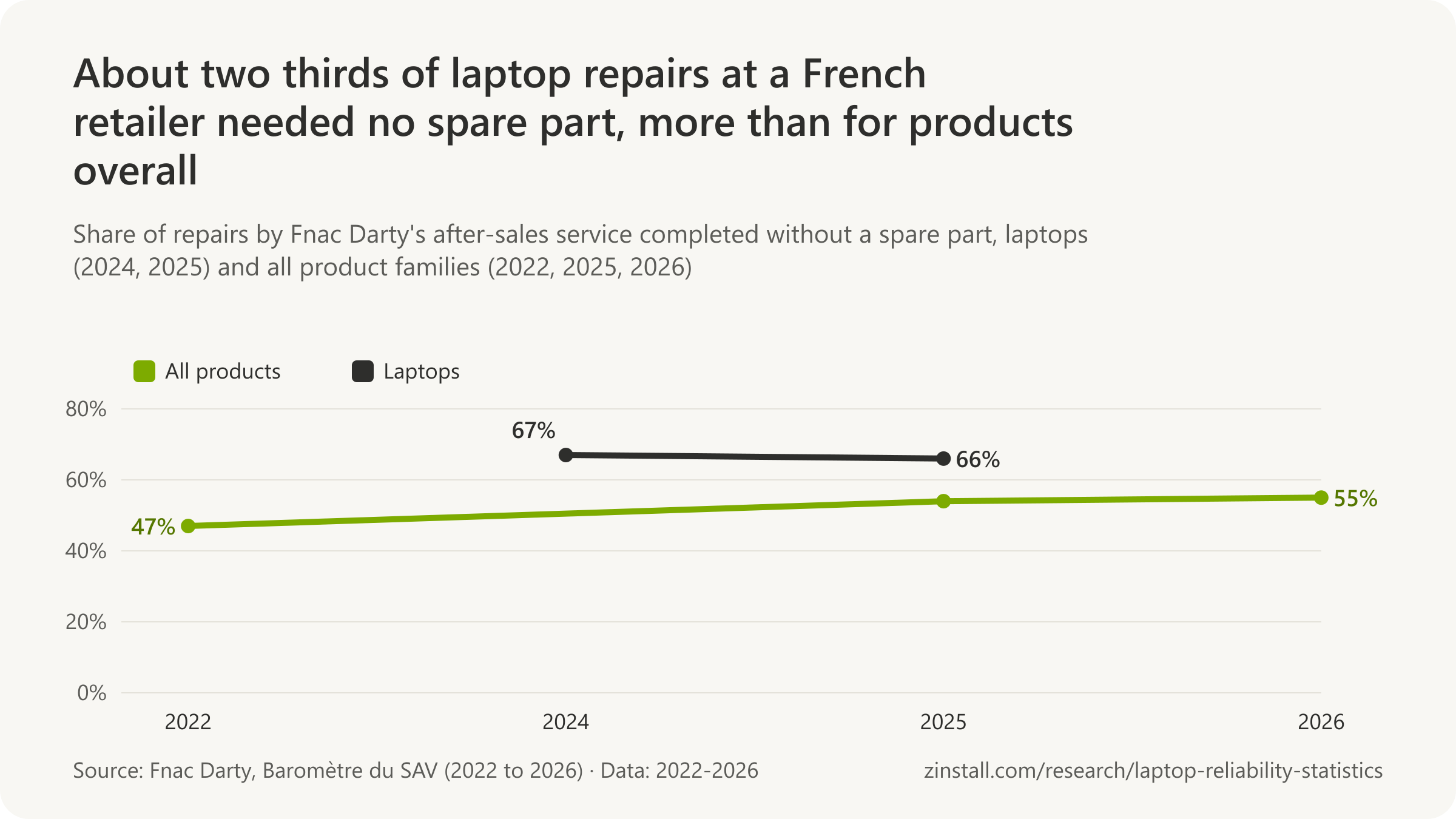
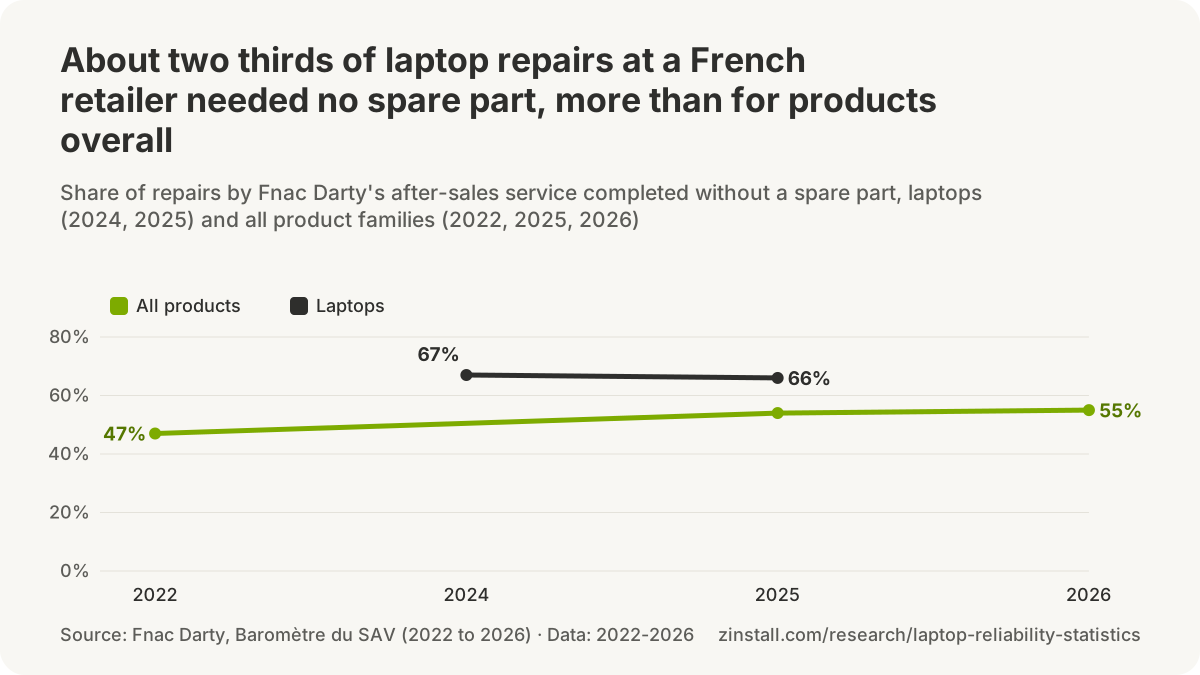
| France: laptop interventions repaired without a part, 2024 | 67% |
| France: all repairs done without a part, 2022 | 47% |
| France: all repairs done without a part, 2025 | 54% |
| France: all repairs done without a part, 2026 | 55% |
| France: buyers replacing a broken laptop, change 2018 to 2023 | -36 points |
| Switzerland: days a notebook warranty case took, 2023 | 9 days |
| US: laptops covered by an extended warranty, 2019-2025 | 22% |
| France: repairs paid a repair bonus, to January 2026 | 1.9 million repairs |
| France: people who turn to repair first, 2025 | 27% |
| Australia: buyers expecting to replace a laptop sooner, 2026 | 26% |
Sources: Fnac Darty (2022-2026); Consumer Reports, Inc.; Open Repair Alliance; Testaankoop / Test Achats; Digitec Galaxus AG; ecosystem; Canstar Blue
Related guides: Windows detected a hard disk problem · Old PC to new PC
More statistics (18)
Many laptop faults are cheaper to fix than they look: most of the laptops a large French retailer's service handled needed no spare part at all, and the parts it used cost a small share of a new laptop's price. Most broken laptops of American consumer-magazine members went in for repair. Surveys disagree on why people replace laptops: in Belgium most replacements followed a technical problem, while at the French retailer only about a third of laptop purchases replaced one that had broken.
Repairs that needed no part

- 6% of a laptop's purchase price was the average cost of a spare part used in Fnac Darty repairs (about 39 euros against an average laptop price of 656 euros), in the 2025 barometer (Fnac Darty, 2025).
Why people replace a laptop
- 72% of laptop replacements were due to a technical problem (broken, too costly to repair, no parts, outdated or out of software updates), while 20% of respondents simply wanted a new laptop, in Testaankoop's 2026 survey (Testaankoop, 2026).
- 34% of laptop purchases by Fnac Darty customers replaced a laptop that no longer worked, while 47% were bought for pleasure and 18% to replace an obsolete one, in the 2025 barometer's customer survey (Fnac Darty, 2025).
- One purchase in two at Fnac Darty is made to replace a product that has broken down, according to its 2025 after-sales barometer (Fnac Darty, 2025).
- 36 points was the fall, between 2018 and 2023, in the share of French buyers who said they bought a new laptop because their old one had broken down, the steepest of any category in Fnac Darty's barometer (Fnac Darty, 2023).
- 55% of purchases by Darty customers followed a breakdown of the product they replaced, across 15 product categories, in Fnac Darty's first after-sales barometer (Fnac Darty, 2018).
- 26% of Australian laptop buyers believed they might need to replace their laptop sooner than expected or wanted, in Canstar Blue's 2026 survey of 1,110 buyers (Canstar Blue, 2026).
- 16% of Australian laptop buyers said the savings on their laptop were not worth the problems or upgrades it then needed, in Canstar Blue's 2026 survey of 1,110 buyers (Canstar Blue, 2026).
Repairs: how many, how long, what age
- Nearly 6 in 10 laptops that broke were taken in for repair rather than replaced, among laptops bought 2019 to 2025 by Consumer Reports members (Consumer Reports, 2026).
- 22% of laptops bought between 2019 and 2025 by Consumer Reports members were covered by an extended warranty or service contract (Consumer Reports, 2026).
- 53.9% of laptops brought to community repair events with a known outcome were fixed, in the Open Repair Alliance's 2012-2020 data; 12.4% were judged end of life (Open Repair Alliance, 2022).
- 1,896,996 repairs of out-of-warranty electrical and electronic devices received France's repair bonus between its launch in December 2022 and January 2026, an average of 33 euros each (ecosystem, 2026).
- 27% of French people say they turn to repair spontaneously although 91% have a good image of repair, and 61% of those who do not repair name cost as the first obstacle, in the ecosystem and ELABE survey of 2025 (ecosystem, 2026).
- 9 days was the average time a notebook warranty case took at Galaxus and Digitec (from arrival at the service centre until the customer had it back), against 3 days across all products, in the 24 months to June 2023 (Digitec Galaxus, 2023).
- 11 days was the average time a PC or workstation warranty case took at Galaxus and Digitec, the longest of any product type, in the 24 months to June 2023 (Digitec Galaxus, 2023).
- 7 years and 3 months was the average age at repair of the three most durable product families in Fnac Darty's 2025 after-sales barometer, against 3 years and 9 months for the three least durable (Fnac Darty, 2025).
- 6 years and 8 months was the average age of products repaired by Fnac Darty's after-sales service in 2026, up from 6 years and 3 months in 2025 and 4 years and 7 months in 2020 (Fnac Darty, 2026).
- 5 years and 2 months was the average age of products repaired for Darty Max repair-subscription customers, against 1 year and 4 months for customers without the service, in Fnac Darty's 2023 barometer (Fnac Darty, 2023).
Sources: Fnac Darty (2018-2026); Testaankoop / Test Achats; Canstar Blue; Consumer Reports, Inc.; Open Repair Alliance; ecosystem; Digitec Galaxus AG
What do warranty costs say about laptop reliability?

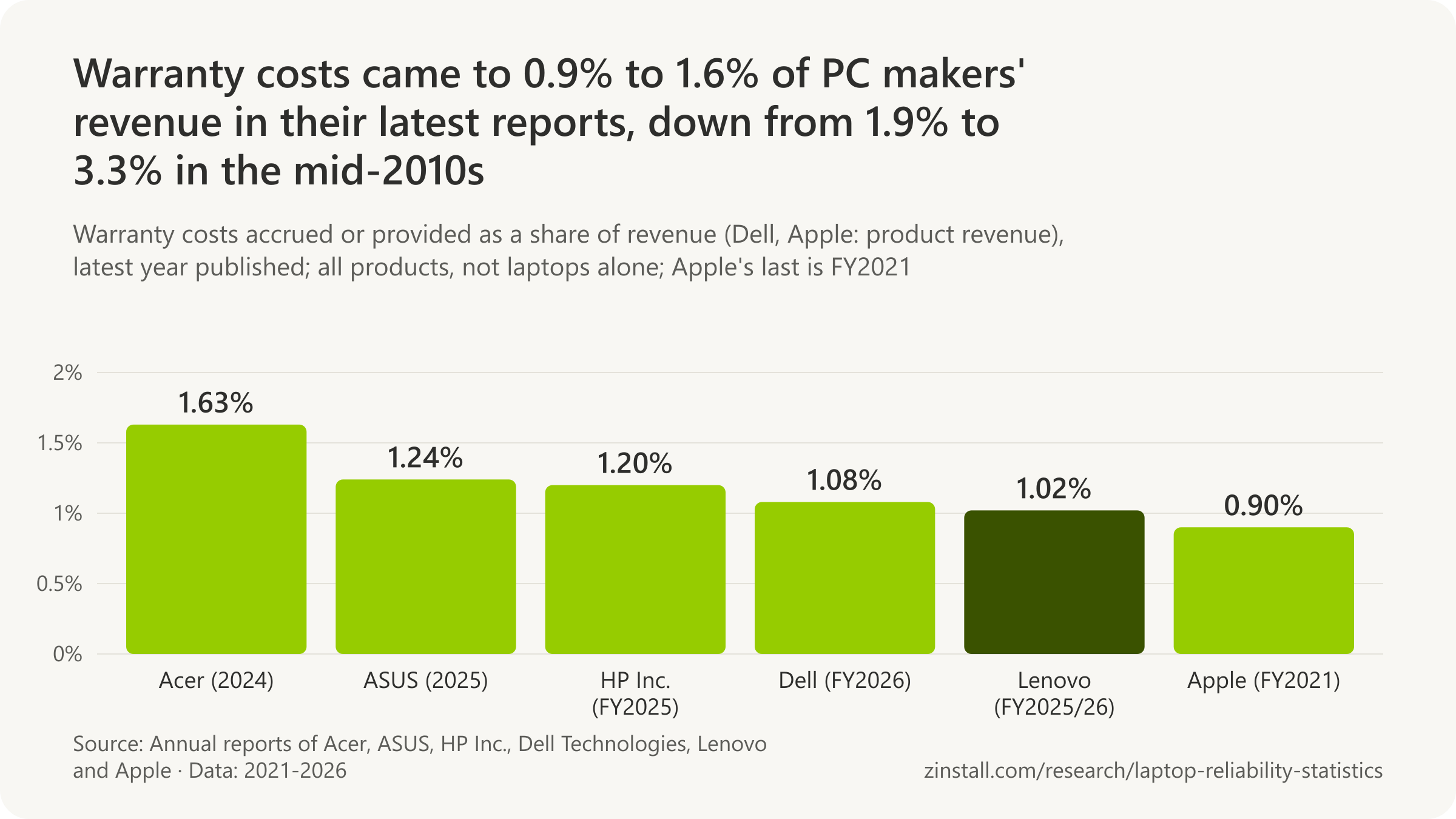
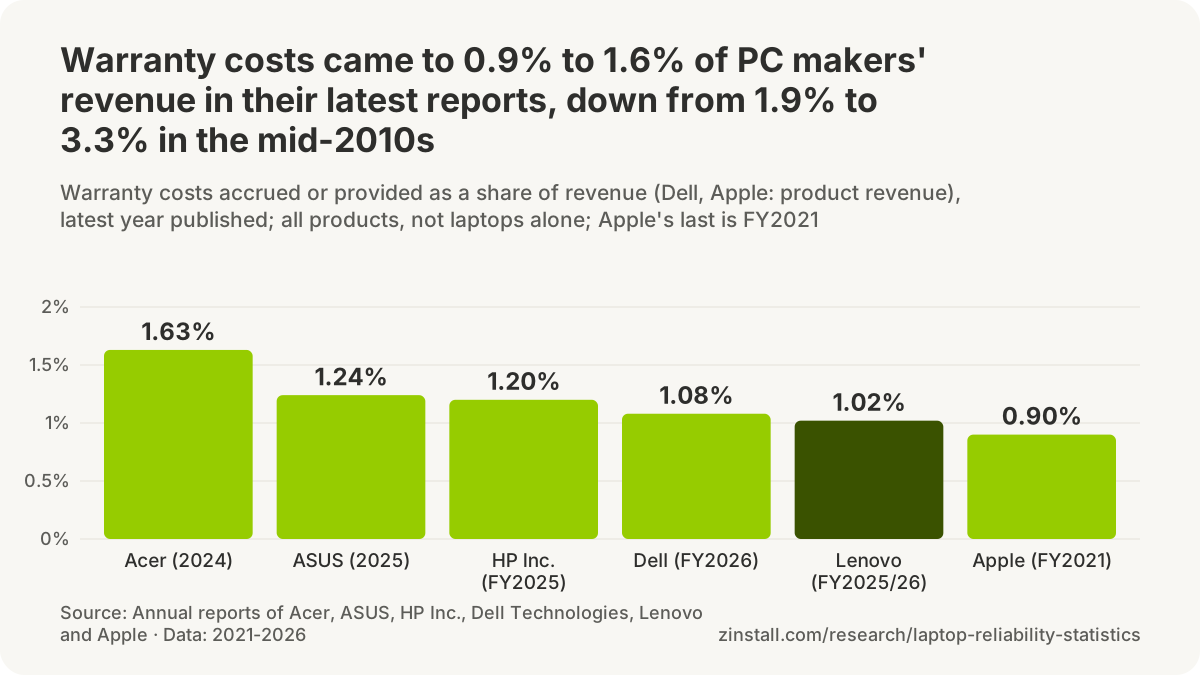
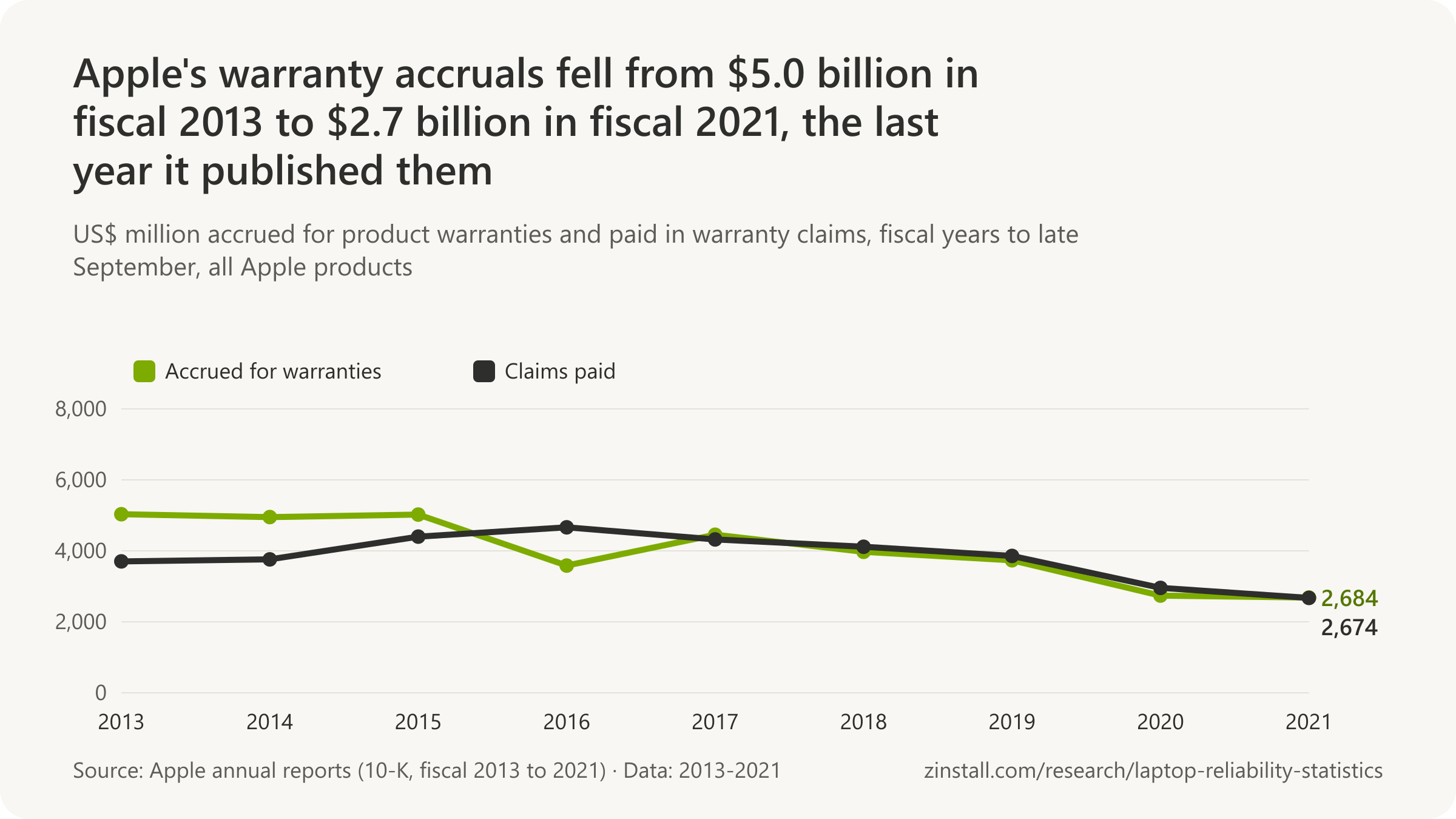
- Apple's annual report last showed its warranty costs for fiscal 2021.
- Microsoft last published warranty figures for fiscal 2011, so Surface warranty costs are not public.
- ASUS held NT$26.4 billion of warranty provisions at the end of 2025, more than three times its claims that year.
| Maker, measure and year | Figure |
|---|---|
| Dell: warranty costs, share of product revenue, FY2015 to FY2026 | 1.86% to 1.08% |
| Acer: warranty costs, share of revenue, 2014 to 2024 | 2.48% to 1.63% |
| Dell: average standard warranty left on its installed base, FY2026 | 15 months |
| Apple: accrued for warranties, FY2013 | $5.0 billion |
| Apple: accrued for warranties, FY2021 | $2.7 billion |
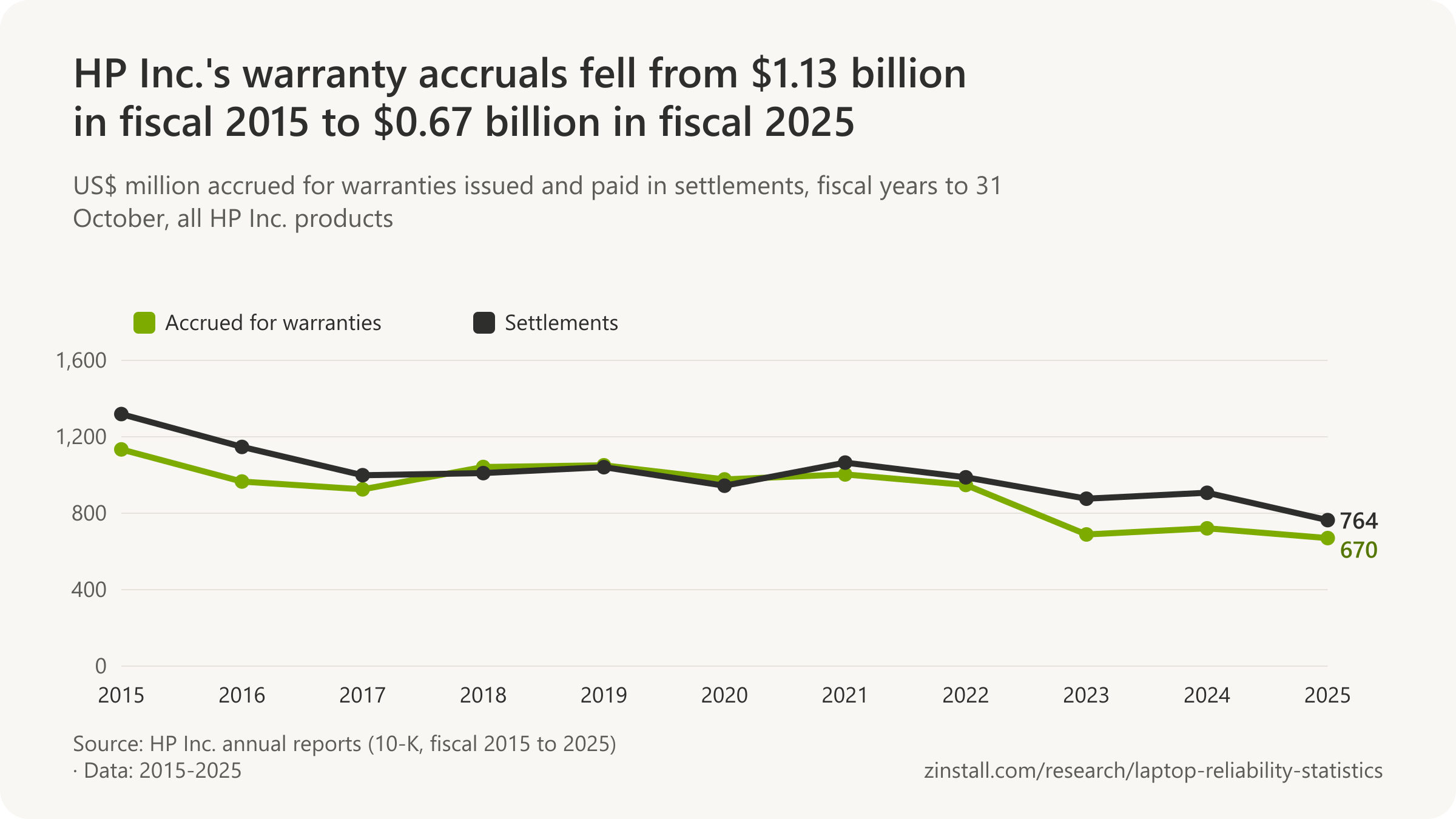
| HP Inc.: accrued for warranties, FY2025 | $670 million |
| Dell: warranty costs accrued, FY2026 | $978 million |
| Lenovo: warranty provisions made, FY2025/26 | $851 million |
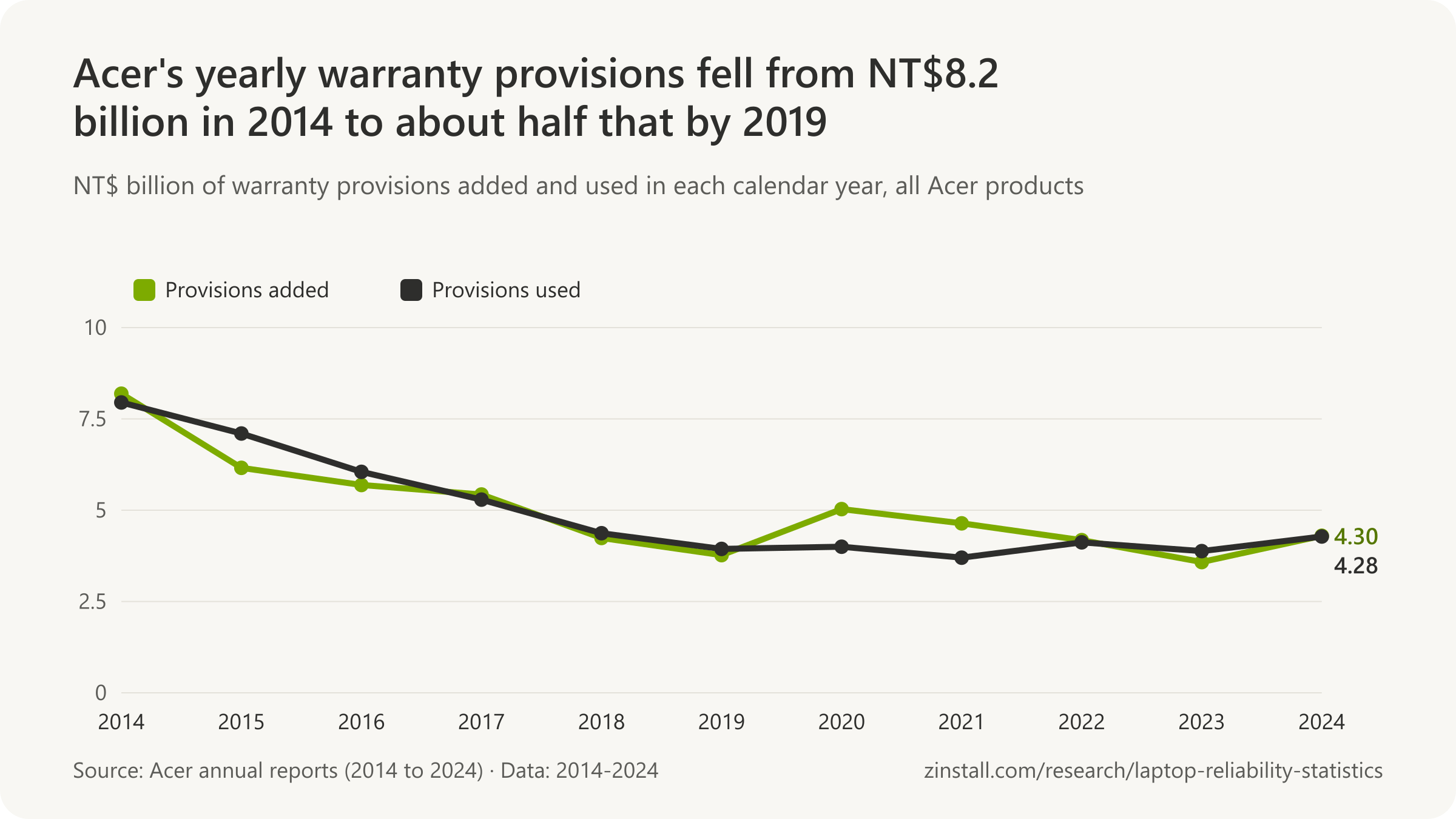
| Acer: warranty provisions added, 2024 | NT$4.30 billion |
| ASUS: warranty provisions recognized, 2025 | NT$9.13 billion |
Sources: Lenovo; HP Inc.; Apple; Apple Inc. (2022, 2021, 2015); Microsoft Corporation; ASUSTeK Computer Inc.; Dell Technologies; Acer; Dell Technologies Inc.; Lenovo Group Limited; Acer Incorporated
Related guides: A new HP laptop or desktop · Lenovo Migration Assistant and alternatives
More statistics (14)
PC makers set money aside for the warranty repairs they expect, and their annual reports show how much. Measured against revenue, those warranty costs fell at Apple, HP, Dell, Lenovo and Acer from the mid-twenty-tens, a sign that fewer products came back or that repairs got cheaper. The figures cover all of each maker's products, not laptops alone; Apple has stopped publishing its warranty table, and Microsoft gives no warranty figures at all.
Warranty costs as a share of revenue

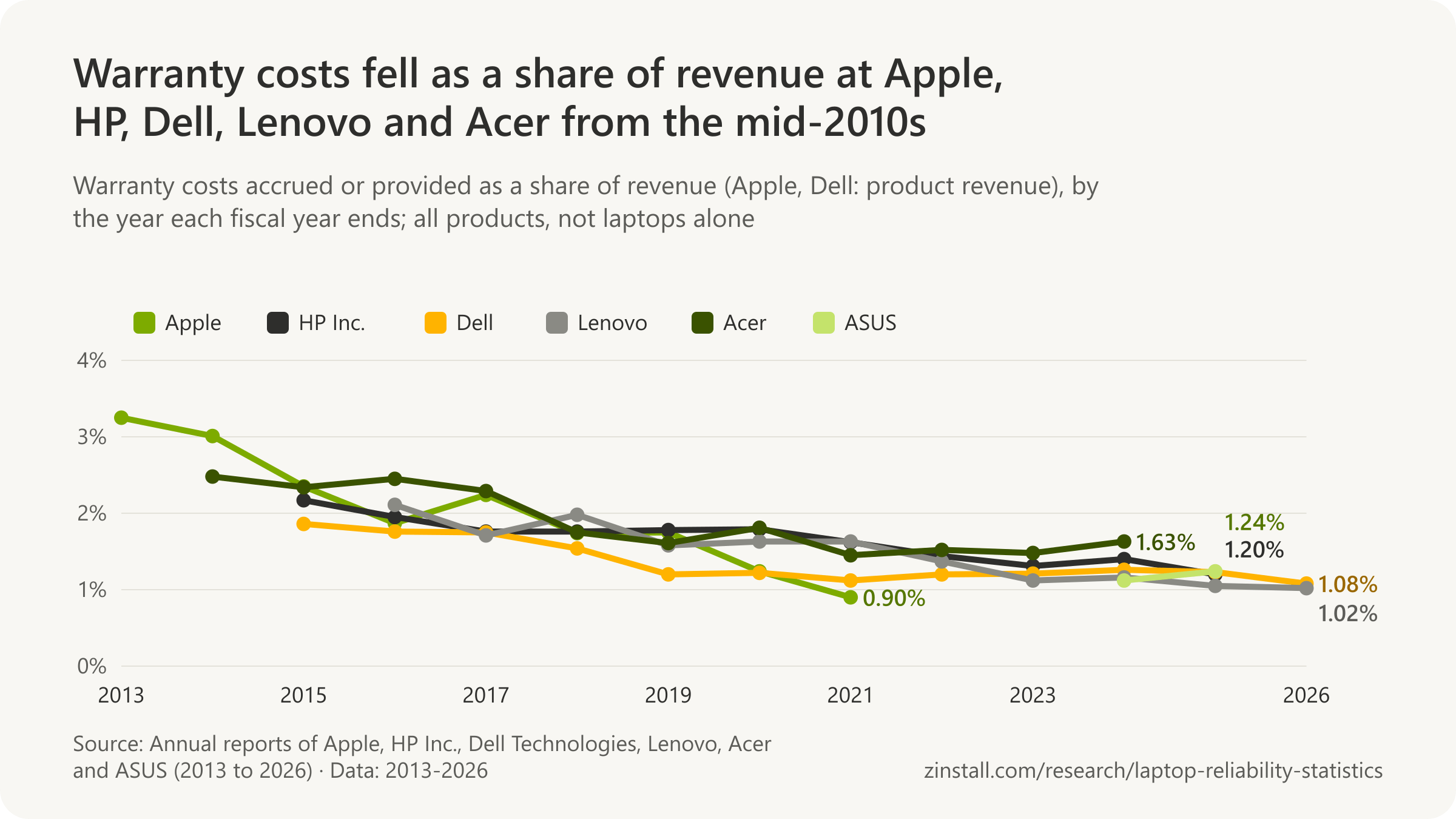
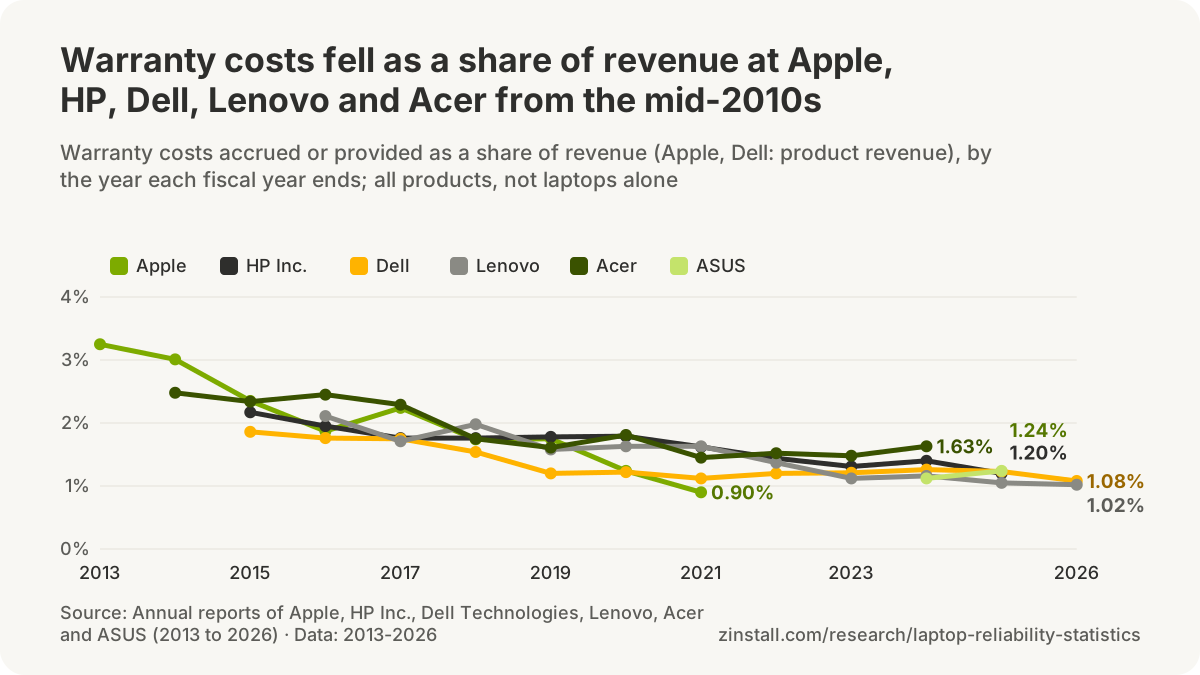
- FY2021 was the last year Apple's annual report showed its warranty accruals and claims; from the fiscal 2022 Form 10-K onward the table is gone (Apple, 2022).
- FY2011 was the last year Microsoft's annual report showed a product warranty liability ($172 million, from the Xbox era); its 10-Ks since, including fiscal 2026's, give no warranty figures, so Surface warranty costs are not public (Microsoft, 2026).
- 2.35 percentage points was the fall in Apple's warranty costs as a share of product net sales between FY2013 and FY2021, from 3.25% to 0.90%, all products included (Apple, 2021).
- 0.97 percentage points was the fall in HP Inc.'s warranty costs as a share of net revenue between FY2015 and FY2025, from 2.17% to 1.20%, all products included (HP Inc., 2025).
- 0.78 percentage points was the fall in Dell's warranty costs as a share of product revenue between FY2015 and FY2026, from 1.86% to 1.08%, all products included (Dell Technologies, 2026).
- 1.09 percentage points was the fall in Lenovo's warranty costs as a share of revenue between FY2015/16 and FY2025/26, from 2.11% to 1.02%, all products included (Lenovo, 2026).
- 0.85 percentage points was the fall in Acer's warranty costs as a share of revenue between 2014 and 2024, from 2.48% to 1.63%, all products included (Acer, 2025).
Accrued and paid, maker by maker



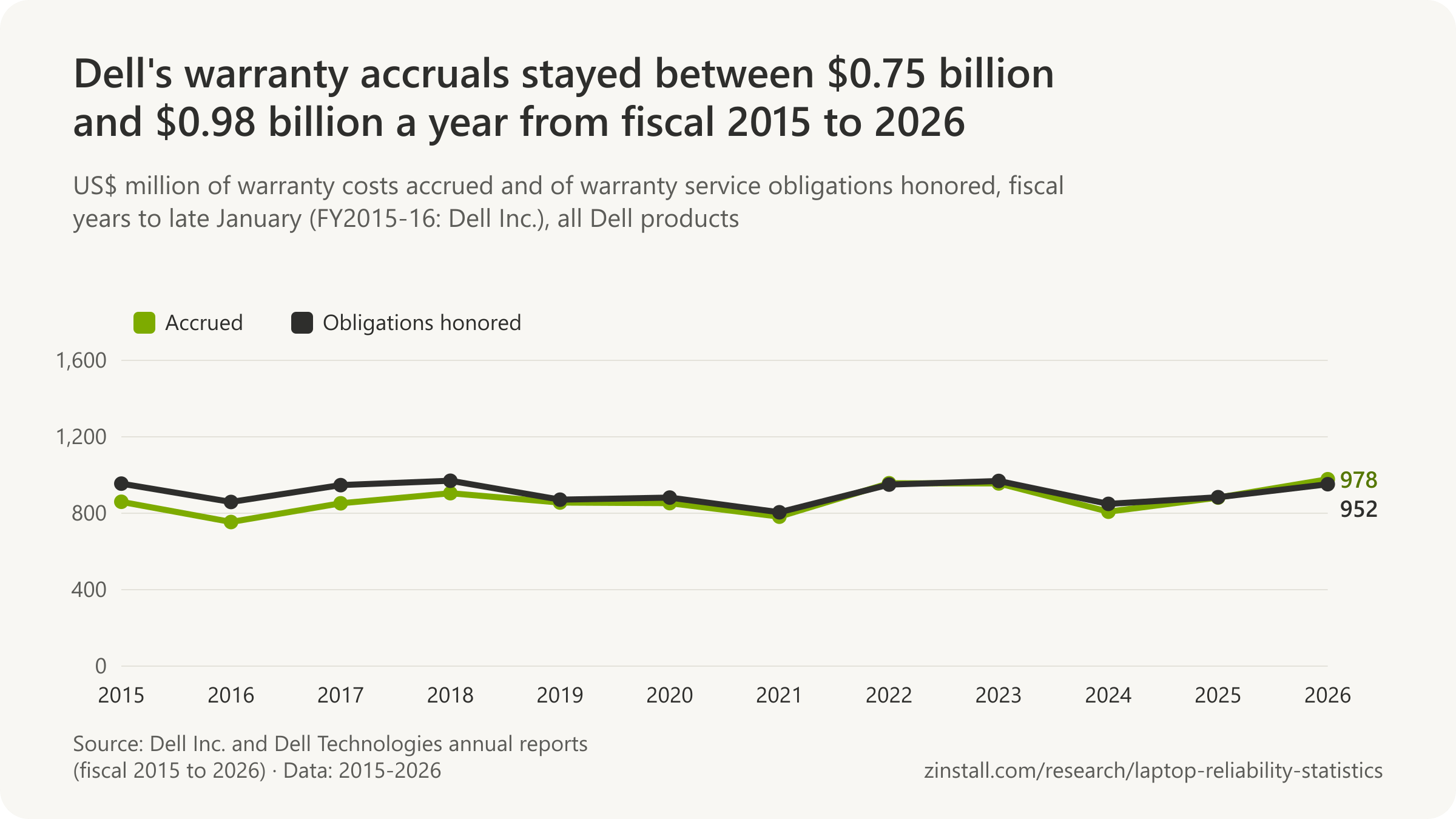
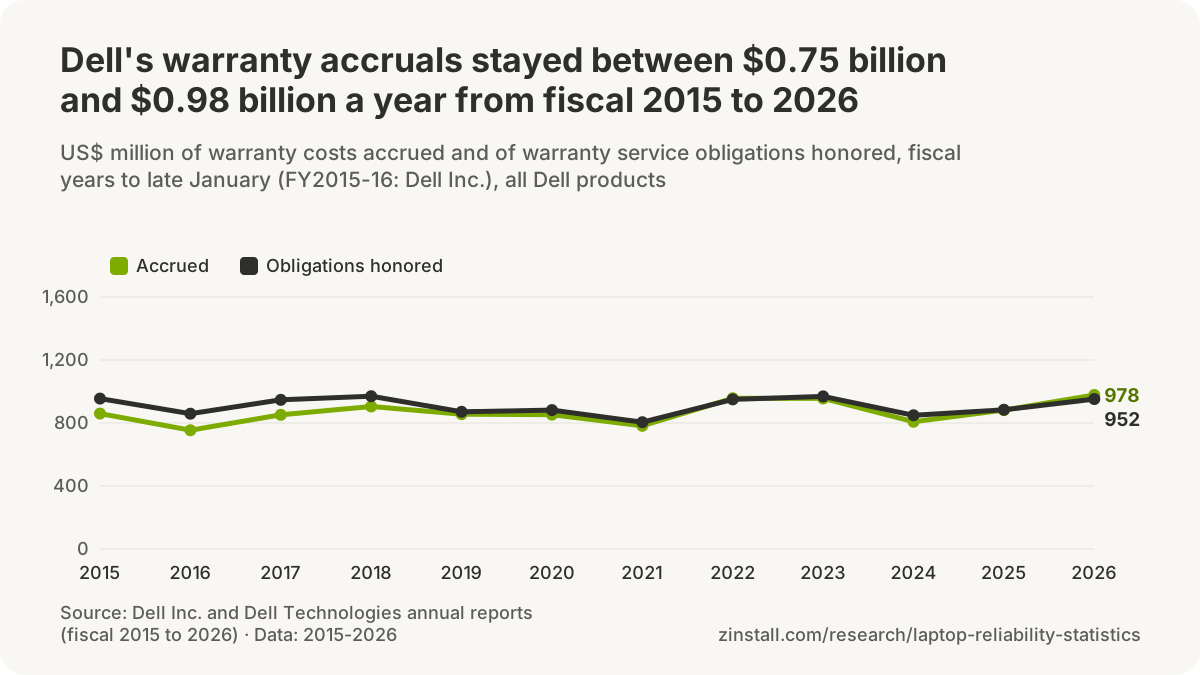

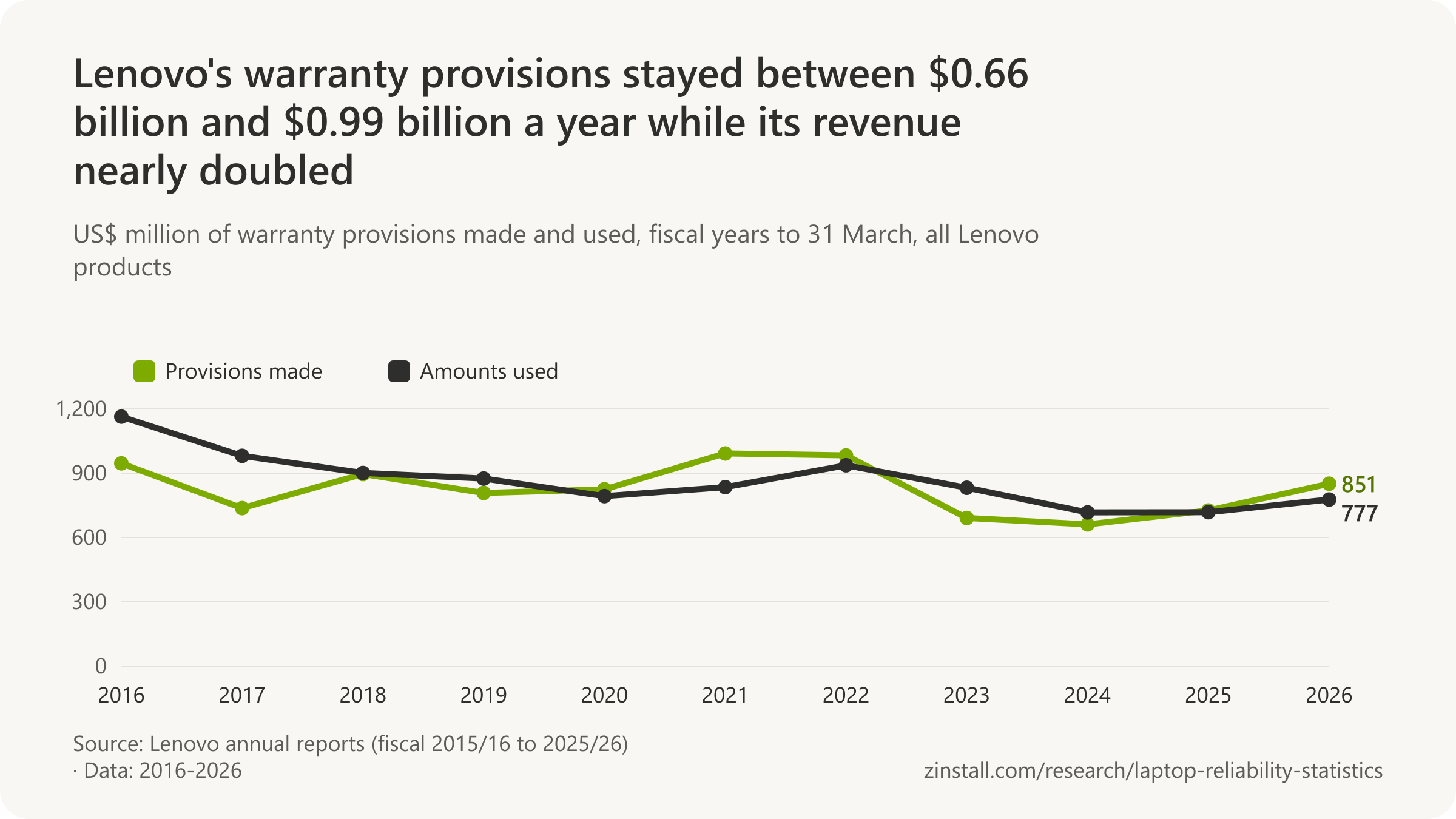
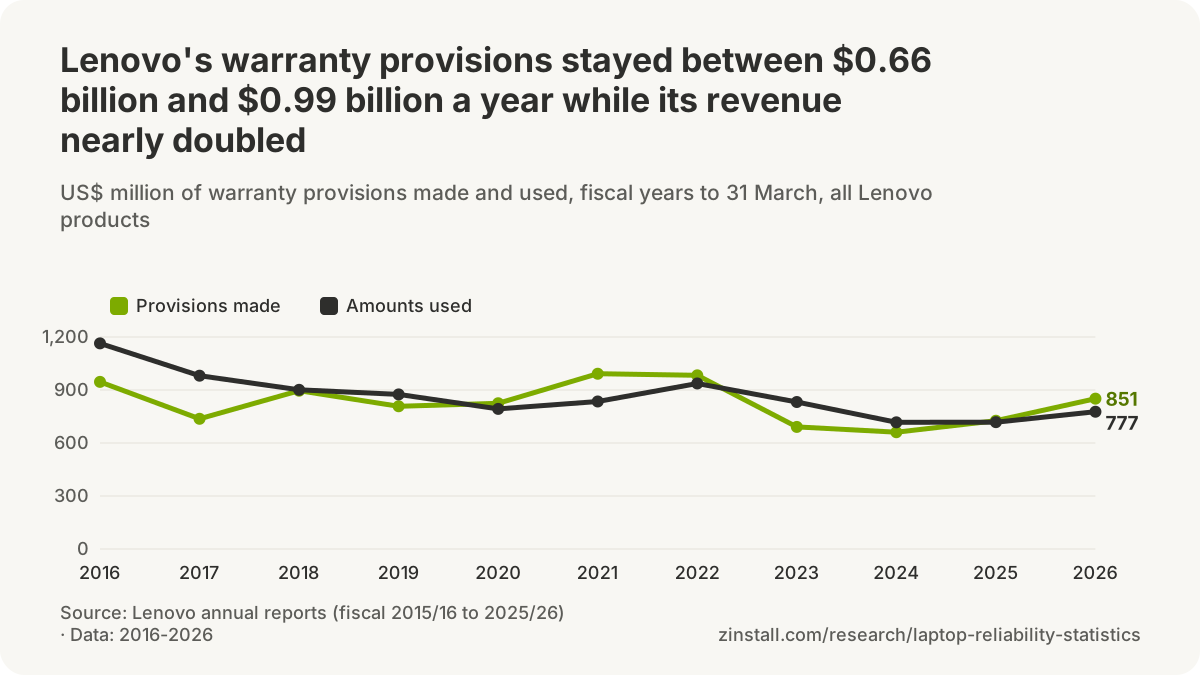

- NT$9.13 billion of warranty provisions was recognized by ASUS in 2025, net of reversals, all products included (ASUS, 2026).
- NT$7.77 billion of warranty provisions was used by ASUS in 2025, what it spent on warranty claims, all products included (ASUS, 2026).
- NT$6.57 billion of warranty provisions was recognized by ASUS in 2024, net of reversals, all products included (ASUS, 2026).
- NT$7.83 billion of warranty provisions was used by ASUS in 2024, what it spent on warranty claims, all products included (ASUS, 2026).
- NT$26.4 billion of warranty provisions stood on ASUS's books at the end of 2025, more than three times what it spent on warranty claims that year (ASUS, 2026).
How makers estimate warranty costs
- 15 months was the average remaining standard warranty on Dell's covered installed base at the end of fiscal 2026, under warranties that run one to three years and whose cost Dell estimates from its historical failure rates (Dell Technologies, 2026).
- Product call rates, average cost per call and ongoing product failure rates are among the inputs HP Inc. says drive its warranty estimate, in its fiscal 2025 annual report (HP Inc., 2025).
Sources: Apple Inc. (2015-2022); Microsoft Corporation; Apple; HP Inc. (2016-2025); Dell Technologies; Lenovo; Acer; ASUSTeK Computer Inc.; Dell Technologies Inc. (2017-2026); Lenovo Group Limited (2017-2026); Acer Incorporated (2016-2025)
Which laptops are easiest to repair?
7 of 63 laptops scored the top 10 out of 10 for repairability at a repair guide site, none of them Apple's (iFixit, 2026).

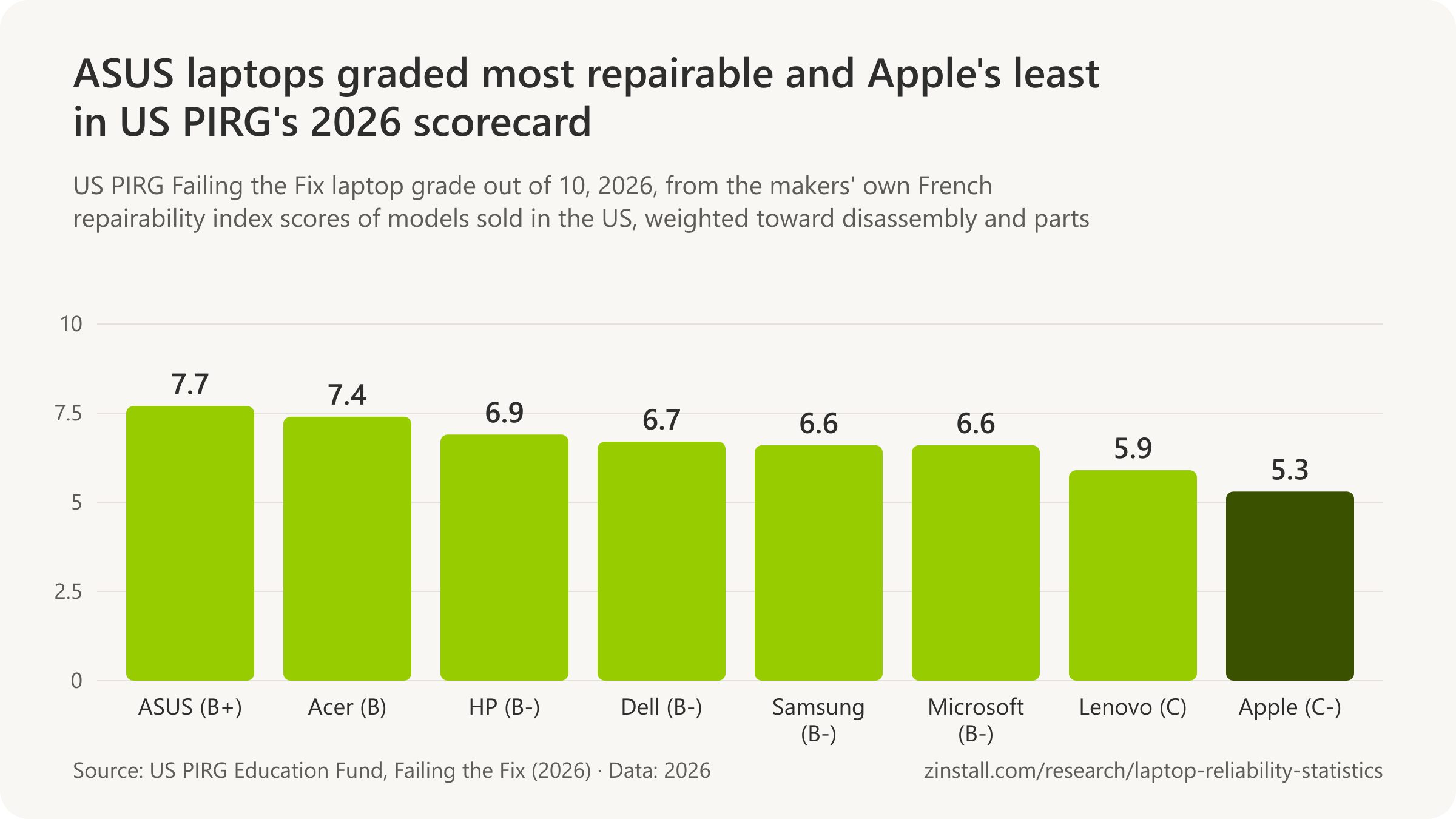
- Apple laptops scored 5.34 out of 10 (C-) in a US consumer group's 2026 repairability grades, the lowest of eight brands.
- Lenovo's ThinkPad T14 Gen 7 and T16 Gen 5 were the first T-series laptops to score 10 out of 10 for repairability.
- Apple's MacBook Neo scored 6 out of 10, the most repairable MacBook in about fourteen years.
- 98% of the 1,964 laptop references in France's repairability open data were ASUS's, all scored 8.7 to 10.
- 62% of the laptops a consumer group checked scored zero for spare-parts availability, yet averaged 6.2 out of 10 overall.
| Law and what it sets | Date or period |
|---|---|
| California: years of parts after a model's last manufacture | 7 years |
| New York: law covers equipment sold from | July 1, 2023 |
| Minnesota: law in force from | July 1, 2024 |
| Oregon: law covers electronics first sold from | July 1, 2015 |
| Colorado: law in force from | January 1, 2026 |
| Washington: law in force from | January 1, 2026 |
| Texas: law in force from | September 1, 2026 |
| US states with active right-to-repair bills, April 2026 | 22 states |
| EU: Right to Repair Directive applies from | 31 July 2026 |
| EU: extra legal guarantee after choosing repair | 1 extra year |
Sources: iFixit (2026a, 2026b, 2026c, 2025); U.S. PIRG Education Fund (2026a, 2026b); data.gouv.fr, producers' declarations; UFC-Que Choisir, Service des études; California Legislature; New York State Senate; Minnesota Office of the Revisor of Statutes; Oregon Legislative Assembly; Colorado General Assembly; Texas Legislature; European Commission
Related guides: Files from an old computer · Transfer with a USB drive
More statistics (61)
Repairability scores rate how easily a laptop can be opened, how long spare parts are offered and what they cost; they say nothing about how often a laptop breaks. France's index is calculated by the makers themselves, iFixit scores the laptops it takes apart, and US PIRG grades brands from the French scores. Framework's laptops and Lenovo's newest ThinkPads score best at iFixit, and Apple's MacBooks have climbed from the bottom of the scale. Several US states now have right-to-repair laws that cover laptops, and the EU has a repair directive.
US PIRG's grades by brand

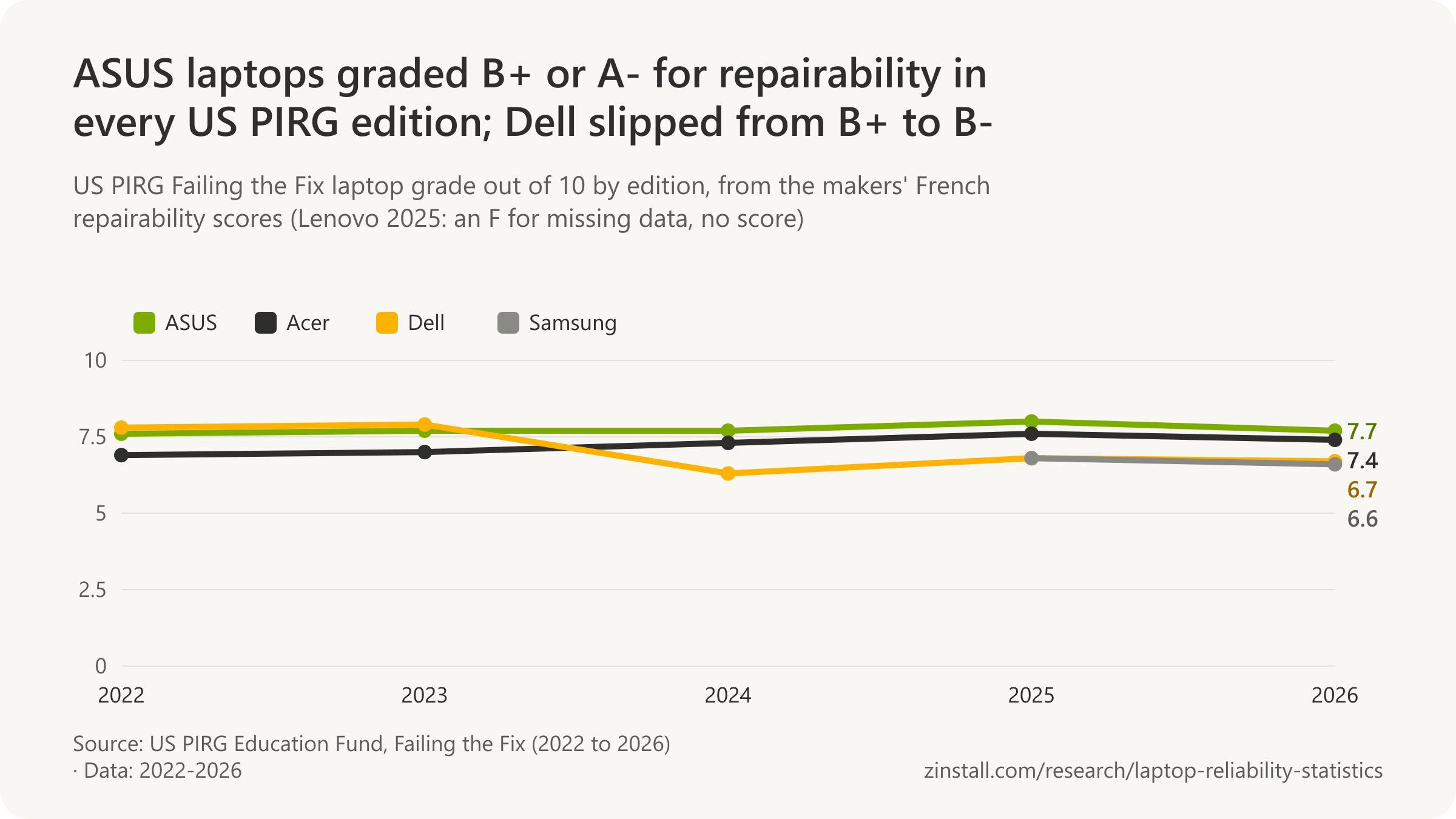

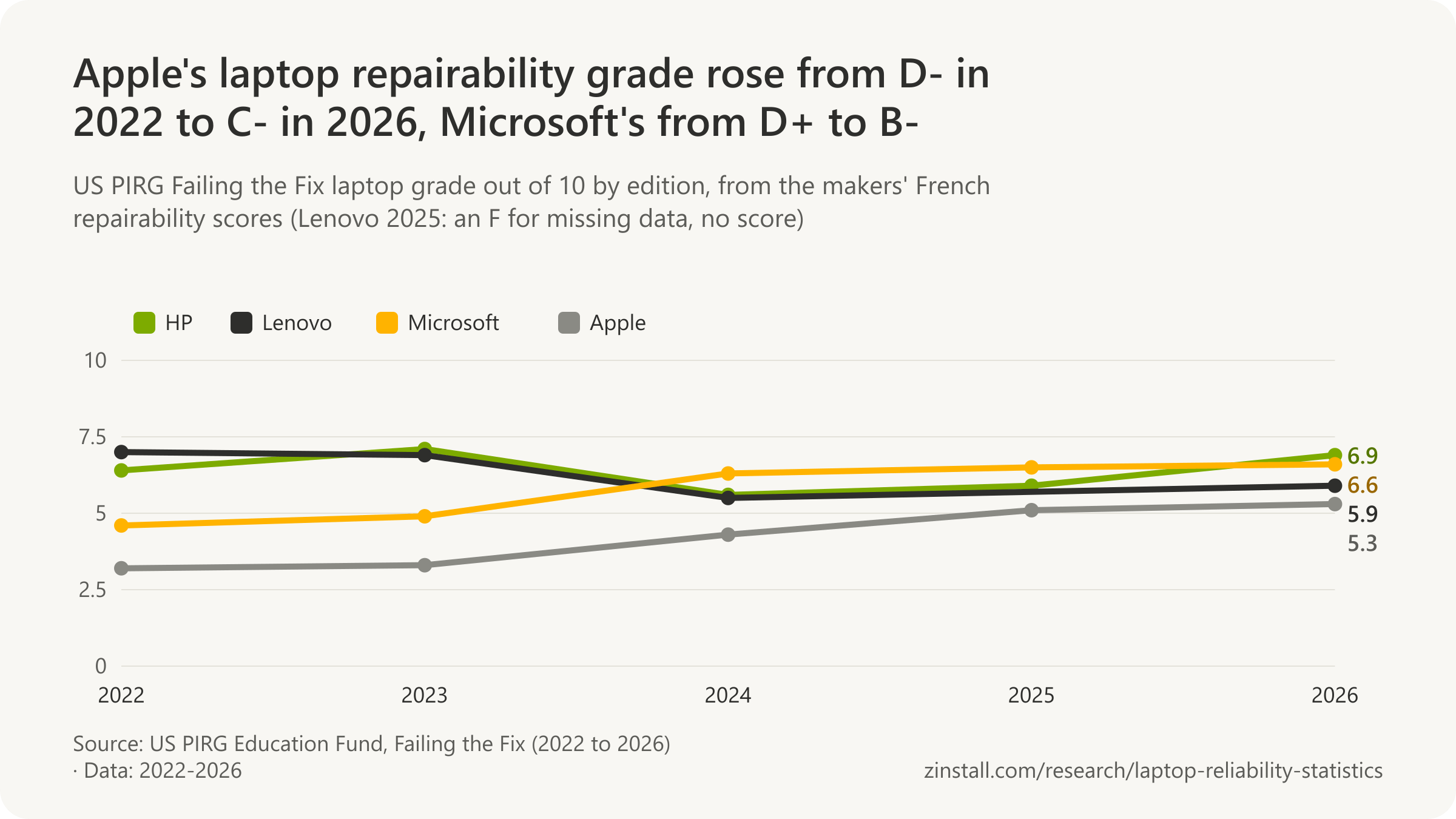
- F was Lenovo's laptop repairability grade in US PIRG's 2025 Failing the Fix scorecard because Lenovo published the full French repairability breakdown for only 1 of its 13 laptop models sold in both the US and France (US PIRG Education Fund, 2025).
- 7.0 out of 10 was the average French repairability score of the 10 Apple laptops US PIRG scored in 2026, against 9.1 for ASUS, 8.5 for Samsung and 6.6 for Microsoft, and PIRG called laptop repairability 'pretty stagnant' (US PIRG Education Fund, 2026).
- 7.2 out of 10 was the average French repairability score across the laptop makers US PIRG graded in 2025, up from 6.9 in 2024, with the disassembly average only moving from 7.3 to 7.4 (US PIRG Education Fund, 2025).
- 12 of 13 Lenovo laptop models (92%) sold in both the US and France had no full French repairability breakdown available when US PIRG graded laptops in January 2025 (US PIRG Education Fund, 2025).
- 6.3 out of 10 was the average French repairability score of Chromebooks in US PIRG's 2024 scorecard, against 7.0 for all other laptops (US PIRG Education Fund, 2024).
- 3.5 out of 10 was the average disassembly score of Apple's MacBooks in US PIRG's 2023 scorecard, against 9.6 for Dell laptops, which PIRG summarised as MacBooks being twice as difficult to open up and repair (US PIRG Education Fund, 2023).
iFixit's scores
- 10 out of 10, iFixit's top repairability score and a first for Lenovo's T-series, went to the ThinkPad T14 Gen 7 and T16 Gen 5 in March 2026, provisionally until official parts and guides are online (iFixit, 2026).
- 9 out of 10 was iFixit's repairability score for the Lenovo ThinkPad P16s Gen 5 (Intel), the newest laptop on its scores list in November 2026 (iFixit, 2026).
- 5 out of 10 was iFixit's repairability score for the 14-inch MacBook Pro with PROLED XDR in November 2026, one point above the M5 MacBook Pro (iFixit, 2026).
- 4 out of 10 was iFixit's repairability score for the 14-inch MacBook Pro with M5 (2025): storage is not removable and the keyboard is riveted down (iFixit, 2025).
- 6 out of 10 was iFixit's repairability score for Apple's MacBook Neo in March 2026, which made it the most repairable MacBook iFixit had seen in about fourteen years (iFixit, 2026).
- 5 out of 10 was iFixit's provisional repairability score for the 13-inch MacBook Air with M4 (2025), the same score as the M2 models of 2022 and 2023 (iFixit, 2025).
- 8 out of 10 was iFixit's repairability score for Microsoft's Surface Laptop 7 (2024), against 5 for the Surface Laptop 3 of 2019 (iFixit, 2024).
- 10 out of 10 was iFixit's repairability score for both Framework laptops it scored, the Laptop 13 (2021) and the Laptop 16 (2023), whose major components including the graphics module are modular (iFixit, 2023).
- 9 out of 10 was iFixit's repairability score for HP's EliteBook 840 Aero G8 (2021), the newest HP laptop on its list; 10 of the 11 HP laptops it scored from 2017 to 2021 got 9 or 10 (iFixit, 2021).
- 10 out of 10 for the Dell Latitude E5270 and 7 for the Dell XPS 13 were iFixit's repairability scores for the newest Dell laptops on its list, both scored in 2017 (iFixit, 2017).
- 7 of the 63 laptops on iFixit's repairability list (2010 to 2026) earned its top score of 10: two Framework models, three HP EliteBooks, a Dell Latitude and Lenovo's 2026 ThinkPad T14 Gen 7 and T16 Gen 5 (iFixit, 2026).
- 14 of the 32 MacBooks on iFixit's list scored 1 out of 10, all models from 2012 to 2019, and no MacBook scored above 7; the 2020s models score 4 to 6 (iFixit, 2026).
- 80% of an iFixit repairability score is the product's design for repair, 10% the maker's service manual and 10% the availability of replacement parts, so a device without a free service manual can score at most 9.0 (iFixit, 2023).
- 2017 is the latest year iFixit scored a laptop from Acer (Predator 17.3-inch, 8 out of 10) or Samsung (Series 9 15-inch, 9), and 2016 for ASUS (Chromebook C202, 9), so iFixit has no current scores for these brands (iFixit, 2026).
France's repairability index

- 5 criteria of equal weight (documentation; disassembly, tools and fasteners; spare-parts availability; spare-parts price; criteria specific to the product) make up France's repairability index, each scored out of 20 and the 100-point total brought to a score out of 10, under the rules in force since 1 January 2021 (French government, 2020).
- 5 parts are named by France's laptop repairability rules as the list of parts whose breakage or failure is most frequent: the storage drive (HDD or SSD), the display, the battery, the power connectors and the charger (French government, 2020).
- 7 years or more of spare-parts availability earns full points in France's laptop repairability index, while a commitment of 4 years or less earns none (French government, 2020).
- 30% of the new laptop's price is the spare-parts cost above which France's repairability index gives zero points for parts price, with full points only below 10% (French government, 2020).
- 5 product categories still carried France's repairability index in July 2025, laptops among them, after the durability index replaced it for televisions and washing machines (French Ministry of Ecological Transition, 2025).
- 2025 is the year France's durability index, which adds reliability criteria, replaced the repairability index for televisions (from 8 January) and washing machines (from 8 April); laptops were not moved and keep the repairability index (French Ministry of Ecological Transition, 2025).
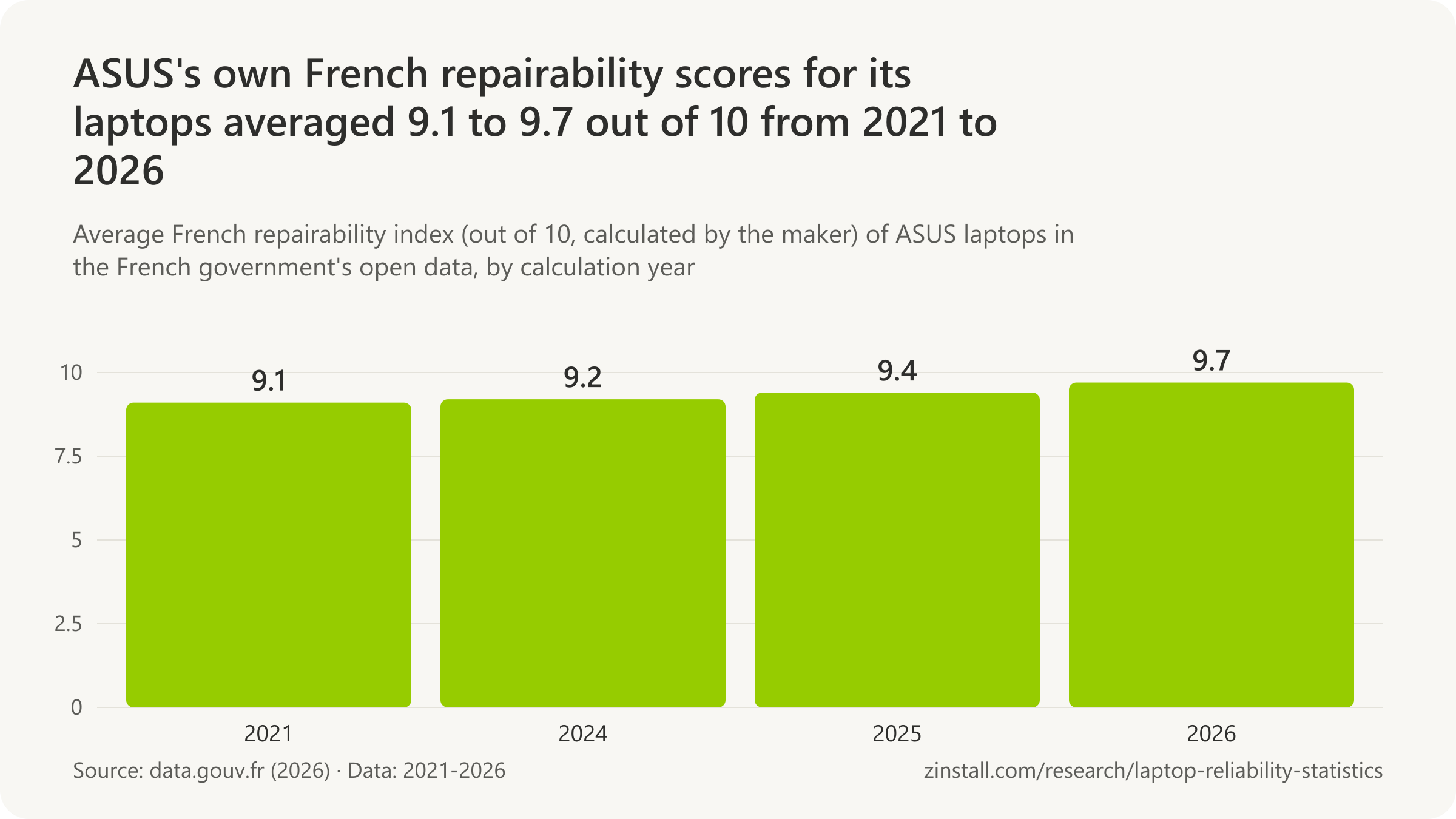
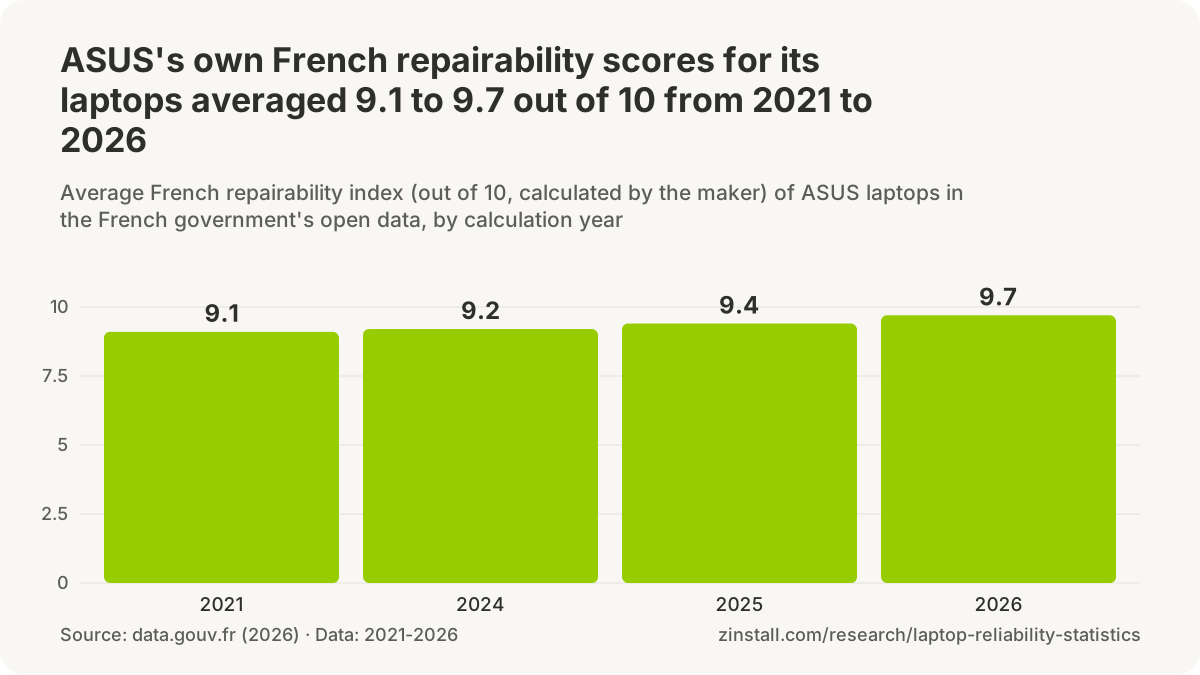
- 9.4 out of 10 was the average French repairability index of 1,933 ASUS laptop references in the government's consolidated open data (lowest 8.7, highest 10), scores the maker calculates itself, as of November 2026 (data.gouv.fr, 2026).
- 9.0 out of 10 was the average French repairability index of 15 Dell laptop models in the government's consolidated open data (lowest 8.8, highest 9.3 for the Dell Pro 14 PC14255), scores Dell calculated itself between 2022 and 2025 (data.gouv.fr, 2026).
- 8.8 out of 10 was the French repairability index of each of the 16 HP EliteBook 8 G1 and ZBook 8 G1 laptop references HP published in the government's consolidated open data, calculated in March to May 2025 (data.gouv.fr, 2026).
- 1,964 laptop references in the French government's consolidated repairability open data all scored between 8.7 and 10 out of 10 (average 9.4), and 98% of them were ASUS, as of November 2026 (data.gouv.fr, 2026).
- 6.3 out of 10 was the average French repairability index of the 15 MacBook models Apple lists on its French support page (lowest 5.5, highest 7.0), scores Apple calculated itself between 2021 and December 2022 (Apple, 2022).
- 6.7 out of 10 was the French repairability index Apple calculated for the 2023 16-inch MacBook Pro (model A2780), the newest Mac on its French list, in December 2022 (Apple, 2022).
- 6.6 out of 10 was the French repairability index Apple calculated for the M2 MacBook Air (model A2681) in May 2022, with 7.0 of 20 points for the price of spare parts (Apple, 2022).
- 7.0 out of 10, the highest score on Apple's French list of Macs, was the repairability index Apple calculated for the M1 MacBook Air (model A2337) in August 2021 (Apple, 2021).
- 5.5 out of 10, the lowest score on Apple's French list of Macs, was the repairability index Apple calculated for the 2019 13-inch MacBook Pro with two Thunderbolt ports, model A2159 (Apple, 2021).
- 6.6 out of 10 was the French repairability index Microsoft calculated for the 15-inch Surface Laptop 6 for Business in February 2024, its newest laptop in the April 2024 edition of its French index document (Microsoft, 2024).
- 5.9 out of 10 was the average French repairability index of the 12 Surface laptop entries in Microsoft's April 2024 French index document, from 4.1 for the Surface Book 2 and 3 to 6.8 for the Surface Laptop Studio 2 (Microsoft, 2024).
- More than 7 years of spare-parts availability for 9 of 10 listed laptop parts, but 5 years for the battery, is what Dell declared in the French repairability index for all 16 of its laptop references in the government's open data (data.gouv.fr, 2026).
- 16 of 16 HP laptop references in the French government's repairability open data list the external ports as not available as a spare part, and 12 list the power connector as unavailable, while battery, display, storage and motherboard are declared available for more than 7 years (data.gouv.fr, 2026).
- 2020 is the year of the French anti-waste law (loi AGEC n° 2020-105 of 10 February 2020) whose article 16 made a repairability score from 0 to 10 mandatory for electrical and electronic products, laptops first among them from January 2021 (French Ministry of Ecological Transition, 2025).
- 62% of the laptops UFC-Que Choisir checked in 2021 scored zero for spare-parts availability in the French repairability index, yet those laptops still averaged 6.2 out of 10 (UFC-Que Choisir, 2021).
- 6.6 out of 10 was the average French repairability index of the laptops UFC-Que Choisir checked in 2021, while their scores for spare-parts availability and delivery topped out at 3.1 out of 10 (UFC-Que Choisir, 2021).
- All laptops and smartphones in UFC-Que Choisir's 2021 sample got full marks for 'information on the nature of updates', and 97% for software reset, two sub-criteria worth 1.5 points of the 10-point French repairability index (UFC-Que Choisir, 2021).
- 62% of French people knew the repairability index in a 2024 ADEME survey, as quoted by UFC-Que Choisir in April 2026 in an investigation that questions a score 'the makers award themselves' (UFC-Que Choisir, 2026).
- 4.7 out of 10 was the average repairability score of more than 60 laptops tested by the Labo Fnac, with scores from 2 to 6.9, a year after it launched its own laptop repairability index (Fnac Darty, 2019).
Self-repair programmes
- November 17, 2021 is when Apple announced Self Service Repair, giving owners genuine parts and tools for the iPhone 12 and 13 first and Macs with M1 chips next, alongside more than 5,000 authorised service providers and 2,800 independent repair providers (Apple, 2021).
- More than 200 individual parts and tools were offered when Apple's Self Service Repair Store opened in the US on April 27, 2022, for the iPhone 12, iPhone 13 and iPhone SE (3rd generation), at the same prices Apple charges its authorised repairers (Apple, 2022).
- More than a dozen repair types per model, including the display, the top case with battery and the trackpad, became available to owners of M1 MacBook Air and MacBook Pro laptops through Apple's Self Service Repair from August 23, 2022 (Apple, 2022).
- 7 genuine components (front and rear case, display, battery, touchpad, power key with fingerprint reader, rubber foot) became available to owners of Samsung's Galaxy Book Pro 15-inch and Pro 360 15-inch laptops when Samsung added PCs to its US self-repair programme in January 2023 (Samsung, 2023).
Right-to-repair laws
- 8 of the 10 laptop and phone brands US PIRG graded in 2026 belonged to a trade association that lobbies against right-to-repair laws (US PIRG Education Fund, 2026).
- July 1, 2023 is the date from which New York's Digital Fair Repair Act covers electronic equipment first made and sold in the state, requiring makers to offer owners and independent repairers documentation, parts and tools on fair and reasonable terms (New York State, 2023).
- July 1, 2024 is when Minnesota's digital fair repair law took effect, covering electronic equipment sold on or after July 1, 2021, including laptops (State of Minnesota, 2023).
- 7 years after a model was last manufactured is how long California's Right to Repair Act requires makers of electronics with a wholesale price of 100 dollars or more to supply documentation, parts and tools, for products first sold from July 1, 2021, in force since July 1, 2024 (State of California, 2023).
- 2015 is how far back Oregon's 2024 right-to-repair law reaches: it applies to consumer electronics other than phones first sold in the state from July 1, 2015, and bans parts pairing on equipment first sold after January 1, 2025 (State of Oregon, 2024).
- January 1, 2026 is when Colorado's right-to-repair law for digital electronic equipment took effect, covering equipment first sold in the state from July 1, 2021 and banning parts pairing on equipment first sold after January 1, 2026 (State of Colorado, 2024).
- January 1, 2026 is when Washington's right-to-repair law for consumer electronics and appliances (HB 1483, signed May 19, 2025) took effect, covering phones, laptops and tablets sold after July 1, 2021 (iFixit, 2025).
- September 1, 2026 is when Texas's right-to-repair law for digital electronic equipment took effect, covering equipment with a wholesale price of at least 50 dollars first offered for sale in Texas from that date (State of Texas, 2025).
- 22 US states had active right-to-repair legislation in April 2026, with laws already on the books in New York, Oregon, Colorado, Minnesota and Washington among others, according to US PIRG (US PIRG Education Fund, 2026).
- 31 July 2026 is the date from which EU member states had to apply the Right to Repair Directive (EU) 2024/1799, adopted on 13 June 2024, which obliges makers to repair products listed in its Annex II at a reasonable price (European Commission, 2024).
- One extra year of legal guarantee goes to EU consumers who choose repair over replacement under the legal guarantee, under the 2024 Right to Repair Directive's amendment of the Sale of Goods Directive (European Commission, 2024).
- 2013 is the year of the EU ecodesign rule for computers still in force in November 2026 (Regulation 617/2013, energy only), which the Commission was reviewing, so no EU repairability or spare-parts requirement applied to laptops (European Commission, 2026).
Sources: U.S. PIRG Education Fund (2022-2026); iFixit (2023, 2025, 2026); French government (2020); Ministère de la Transition écologique; data.gouv.fr, producers' declarations; data.gouv.fr, Dell SAS declarations; data.gouv.fr, HP France SAS declarations; Apple (2021, 2022); Microsoft; UFC-Que Choisir, Service des études; UFC-Que Choisir; Fnac Darty; Samsung Electronics America; New York State Senate; Minnesota Office of the Revisor of Statutes; California Legislature; Oregon Legislative Assembly; Colorado General Assembly; Texas Legislature; European Commission (2024, 2026)
Which laptop recalls and defects were the biggest?

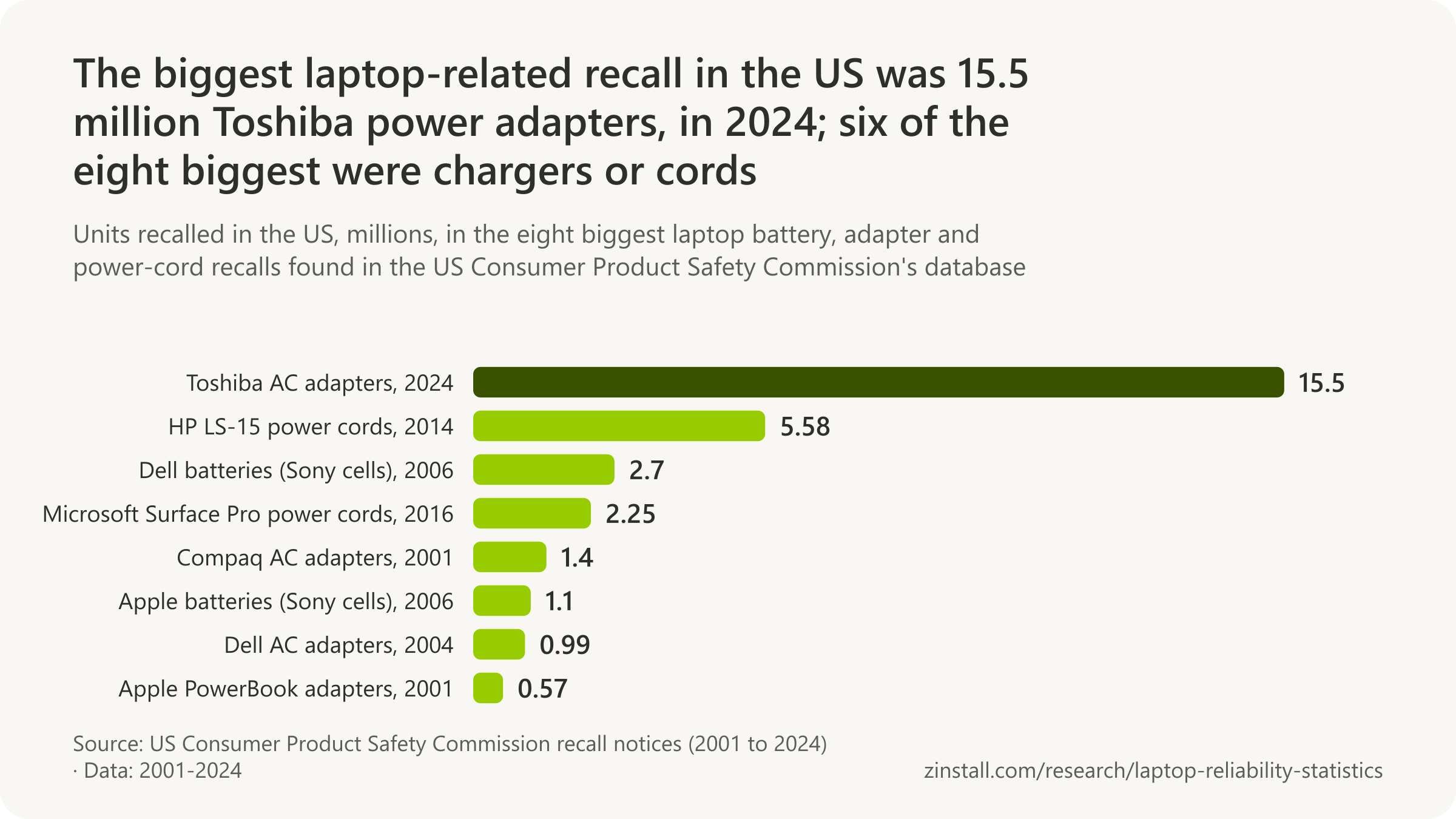
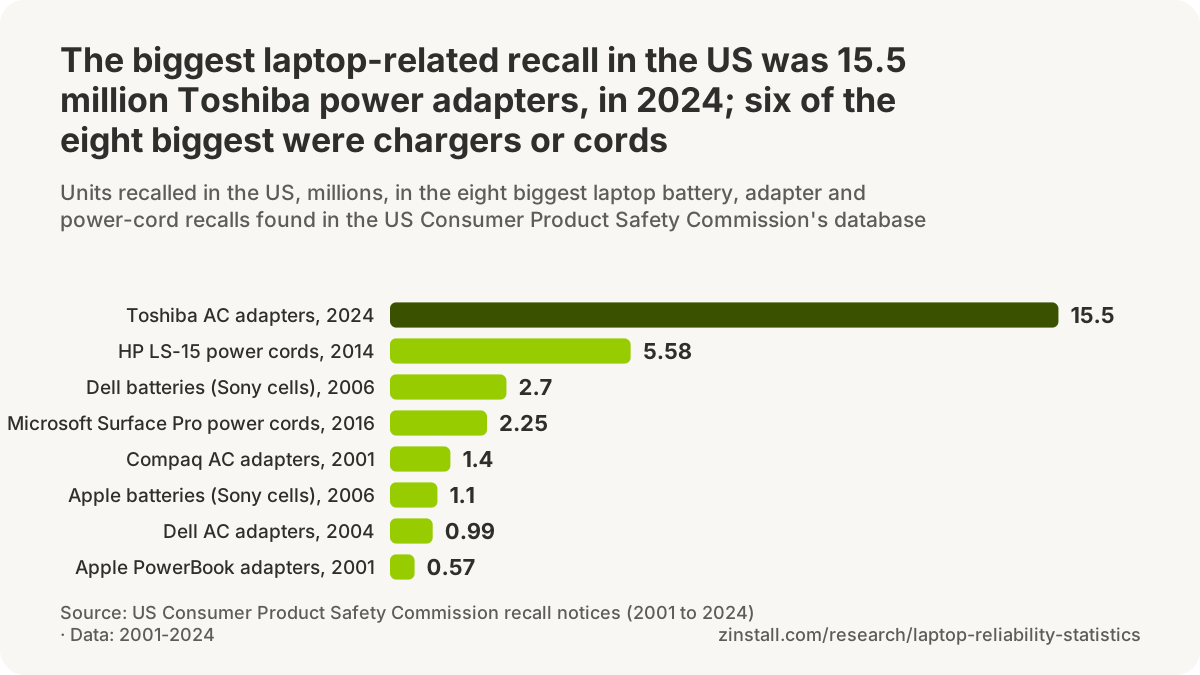
- About 27.9 million laptop power adapters, chargers and cords were recalled in the US, four times as many as laptop batteries (derived from CPSC, 2026).
- 15.5 million Toshiba laptop power adapters made from 2008 to 2012 were recalled in the US in 2024, the biggest laptop-related recall.
- No laptop battery recall has been announced in the US since Apple's 15-inch MacBook Pro recall of June 2019.
- Failing notebook graphics chips cost their maker $475.9 million in net warranty charges over three fiscal years.
| Recall or defect, measure and date | Figure |
|---|---|
| Sony-cell battery packs covered worldwide, 2006 | Up to 9.6 million |
| Dell notebook batteries recalled in the US, 2006 | About 2.7 million (US) |
| Apple notebook batteries recalled in the US, 2006 | About 1.1 million (US) |
| Apple 15-inch MacBook Pro recalled for its battery, 2019 | About 432,000 |
| HP notebooks in its 2018-2019 recall that had an affected battery | About 3% |
| Japan: laptop battery accidents involving recalled products, 2012-2016 | 47 of 110 |
| US flights: lithium battery incidents involving laptops, 2006-2022 | 41 of 354 |
| MacBook keyboard settlement: claims filed, 2023 | 86,117 claims |
| Intel 6 Series chipset defect: final cost estimate, 2011 | $733 million |
| Dell OptiPlex desktops' faulty part: product charge, 2006 | $338 million |
Sources: U.S. Consumer Product Safety Commission (2001-2026); NVIDIA Corporation; United States District Court, Northern District of California; Sony Corporation; HP Inc.; National Institute of Technology and Evaluation, Japan; Federal Aviation Administration; Intel Corporation; Dell Inc.
Related guides: Programs and files to a Microsoft Surface · Back up your entire computer
More statistics (94)
Laptop recalls peaked with the Sony battery-cell recalls, when Dell, Apple, Lenovo and others recalled millions of battery packs that could overheat. The largest recalls since have been power adapters and cords, and no laptop battery recall has reached the US safety regulator's database in recent years; makers now run their own service programmes instead. Defects in chips and keyboards, never recalled as safety risks, cost makers hundreds of millions in repairs and settlements.
Battery recalls in the US

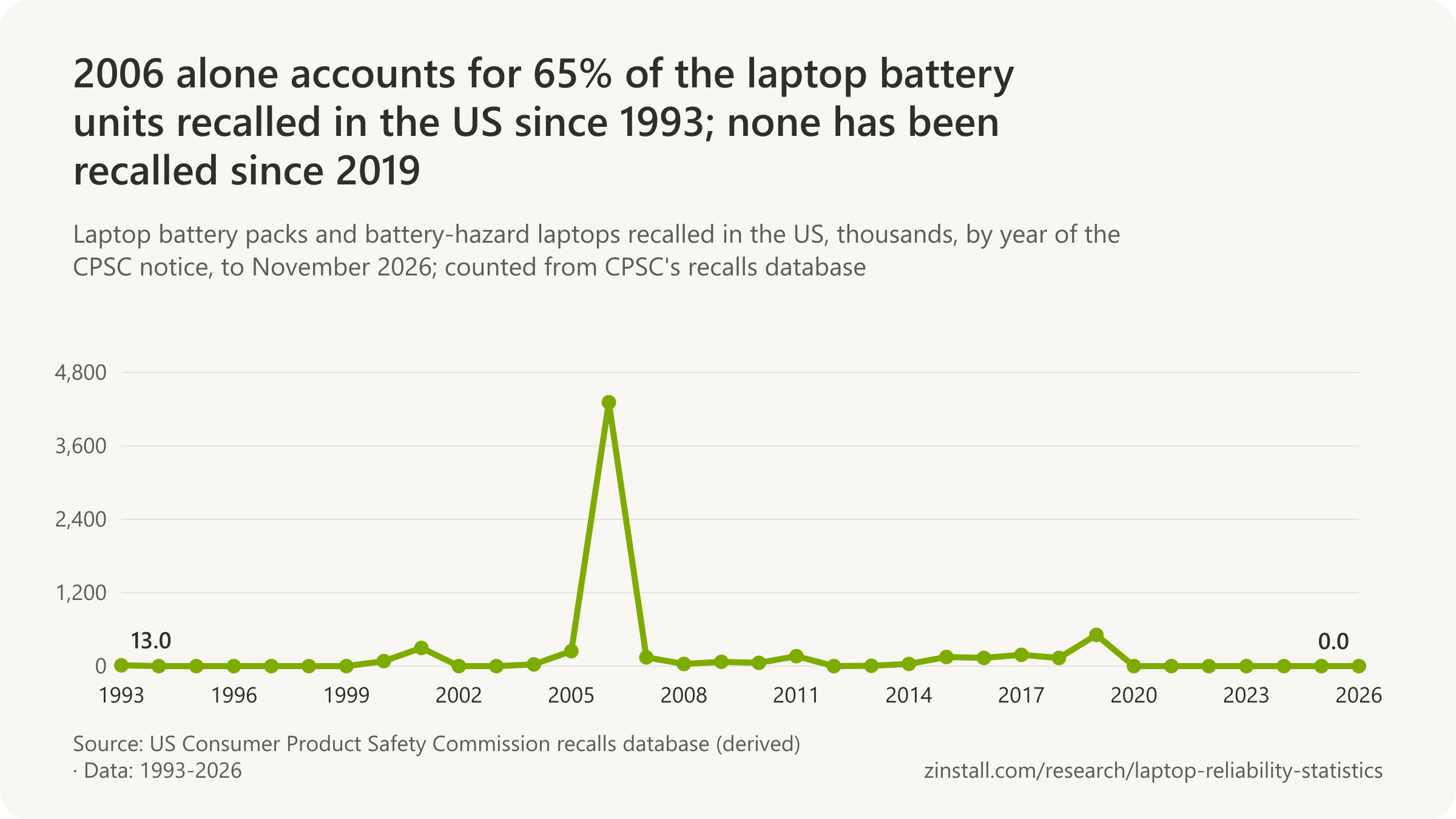
- 65% of all the laptop battery units recalled in the US from 1993 to 2019 were recalled in 2006 alone, the year of the Sony cell recalls by Dell, Apple, Lenovo and Sony (derived from CPSC, 2026).
- No laptop battery recall has been announced in CPSC's database since Apple's 15-inch MacBook Pro recall of June 2019, as of November 2026 (CPSC, 2026).
- Up to 9.6 million notebook battery packs with Sony cells were covered by Sony's 2006 global replacement programme and the Dell, Apple and Lenovo recalls before it, at an expected cost to Sony of about 51 billion yen (Sony, 2006).
- About 3.5 million notebook battery packs with Sony cells were covered by Sony's October 2006 replacement programme on top of the packs already recalled by Dell, Apple and Lenovo (Sony, 2006).
- No laptop battery recall appears in Health Canada's recalls database after the 15-inch MacBook Pro recall of June 2019, as of November 2026, matching CPSC's US record (Health Canada, 2026).
- About 13,000 NEC PC-17-01 and PC-17-02 laptop computers sold in the US and Canada from 1988 to 1990 had their batteries recalled in 1993 because the batteries could explode and catch fire, after seven smoke or fire incidents during recharging (CPSC, 1993).
- About 27,000 batteries for Dell notebook computers were recalled in the US in October 2000 because they could short circuit, overheat and catch fire, even when not in use (CPSC, 2000).
- About 55,000 battery packs for Compaq Armada notebook computers were recalled in the US in October 2000 because they could short circuit, overheat and catch fire (CPSC, 2000).
- About 284,000 Dell Inspiron 5000 battery modules were recalled in the US in May 2001 because they could overcharge, overheat and catch fire (CPSC, 2001).
- About 13,000 batteries for notebook computers sold under brands such as ChemBook, Sceptre and Systemax were recalled in the US in November 2001 because they could overcharge, overheat and catch fire (CPSC, 2001).
- About 28,000 batteries for Apple's 15-inch PowerBook G4 were recalled in the US in August 2004 because an internal short could make the cells overheat, a fire hazard (CPSC, 2004).
- About 128,000 batteries for Apple iBook G4 and PowerBook G4 computers were recalled in the US in May 2005 because an internal short could make the cells overheat (CPSC, 2005).
- About 10,000 Hi-Capacity replacement notebook batteries made by Battery-Biz were recalled in the US in June 2005 because an internal short could make the cells overheat (CPSC, 2005).
- About 135,000 HP and Compaq notebook battery packs were recalled worldwide in October 2005, about 85,000 of them in the US, because an internal short could make the cells overheat and melt or char the case (CPSC, 2005).
- About 22,000 Dell notebook batteries were recalled in the US in December 2005 because they could overheat, a fire risk (CPSC, 2005).
- About 4,100 HP Pavilion and Compaq notebook batteries were recalled in the US in April 2006 (about 15,700 worldwide) because an internal failure could make them overheat and melt or char the case (CPSC, 2006).
- About 2.7 million Dell notebook battery packs made with Sony cells were recalled in the US in August 2006 because they could overheat, a fire hazard, with about 1.5 million more sold outside the US (CPSC, 2006).
- About 1.1 million Apple iBook G4 and PowerBook G4 battery packs with Sony cells were recalled in the US in August 2006 because they could overheat, with about 700,000 more sold outside the US (CPSC, 2006).
- About 168,500 ThinkPad battery packs with Sony cells were recalled in the US in September 2006 by Lenovo and IBM, with about 357,500 more sold worldwide, because they could overheat (CPSC, 2006).
- About 340,000 notebook batteries with Sony cells used in Fujitsu, Gateway, Sony and Toshiba laptops were recalled in the US in October 2006, with about 3,080,000 more sold worldwide (CPSC, 2006).
- About 100,000 ThinkPad 9-cell extended-life battery packs were recalled in the US in March 2007, with about 105,000 more sold worldwide, because a hard knock on a corner could make them overheat (CPSC, 2007).
- About 27,800 Acer notebook batteries with Sony cells were recalled in the US in April 2007 because they could overheat, a fire hazard (CPSC, 2007).
- About 14,000 Gateway notebook battery packs were recalled in the US in June 2007 because they could overheat, a fire hazard (CPSC, 2007).
- About 1,400 Toshiba notebook batteries with Sony cells were recalled in the US in August 2007 because they could overheat, a fire hazard (CPSC, 2007).
- About 35,000 notebook batteries with Sony cells used in HP, Toshiba and Dell laptops were recalled in the US in October 2008, with about 65,000 more sold worldwide, after 19 reports of overheating including 17 of flames (CPSC, 2008).
- About 70,000 lithium-ion batteries used in HP and Compaq notebook computers were recalled in the US in May 2009 because they could overheat and rupture, a fire and burn hazard (CPSC, 2009).
- About 54,000 more HP and Compaq notebook batteries were recalled in the US in May 2010, expanding HP's May 2009 recall after 38 more reports of batteries overheating and rupturing, with 11 minor injuries (CPSC, 2010).
- About 162,600 more HP and Compaq notebook batteries were recalled in the US in May 2011, the second expansion of HP's 2009 recall, after 40 more reports of batteries overheating and rupturing, with seven burns (CPSC, 2011).
- About 5,100 ATG replacement batteries for the MacBook Pro sold by Best Buy were recalled in the US in June 2013 after 13 reports that the battery caught fire, including one serious burn (CPSC, 2013).
- About 34,500 ThinkPad battery packs were recalled in the US in March 2014 (plus 2,900 in Canada) because they could overheat, a fire hazard (CPSC, 2014).
- About 680 Sony VAIO Flip laptops were recalled in the US in July 2014 because their Panasonic-made lithium-ion batteries could overheat, after four incidents in Asia of units smoking, catching fire and melting (CPSC, 2014).
- About 148,800 more ThinkPad battery packs were recalled in the US in April 2015 (plus 17,700 in Canada), expanding Lenovo's March 2014 recall (CPSC, 2015).
- About 300 Fujitsu notebook battery packs were recalled in the US in September 2015 after three battery fires in Japan and China (CPSC, 2015).
- About 387 Panasonic CF-S10 laptop battery packs were recalled in the US in March 2016 because conductive foreign material had been mixed into the cells during manufacturing (CPSC, 2016).
- About 91,000 Panasonic battery packs in 39 Toshiba Portege, Satellite and Tecra laptop models were recalled in the US in March 2016 because they could overheat (CPSC, 2016).
- About 1,700 Panasonic battery packs in 18 Sony VAIO laptop models were recalled in the US in June 2016 because they could overheat (CPSC, 2016).
- About 41,000 HP notebook batteries with Panasonic cells were recalled in the US in June 2016 because they could overheat, a fire and burn hazard (CPSC, 2016).
- About 83,000 more Panasonic battery packs in Toshiba Satellite laptops were recalled in the US in January 2017, expanding Toshiba's March 2016 recall (CPSC, 2017).
- About 101,000 more HP notebook batteries with Panasonic cells were recalled in the US in January 2017, expanding HP's June 2016 recall (CPSC, 2017).
- About 700 more Panasonic battery packs in Sony VAIO laptops were recalled in the US in February 2017, expanding Sony's June 2016 recall (CPSC, 2017).
- About 50,000 lithium-ion batteries for HP ProBook, ZBook, Envy, Pavilion x360 and other notebooks were recalled in the US in January 2018 because they could overheat (CPSC, 2018).
- About 5,800 Panasonic battery packs for Fujitsu LIFEBOOK and Celsius notebooks were recalled in the US in February 2018 because they could overheat (CPSC, 2018).
- About 78,500 more batteries for HP commercial notebooks and mobile workstations were recalled in the US in March 2019, expanding HP's January 2018 recall (CPSC, 2019).
- About 432,000 Apple 15-inch MacBook Pro laptops sold from September 2015 to February 2017 were recalled in the US in June 2019 because their batteries could overheat, with 26,000 more in Canada (CPSC, 2019).
Adapters, chargers and cords
- About 220,000 AC adapters for IBM ThinkPad 310 and i Series notebooks and WorkPad z50 devices were recalled in the US in May 2000 because they could overheat, a fire hazard (CPSC, 2000).
- About 225,000 AC power adapters for IBM notebook computers were recalled in the US in September 2004 because they could overheat and melt through the housing (CPSC, 2004).
- About 507,000 Targus universal wall power adapters for laptops, made by Comarco, were recalled in the US in April 2010 after 518 reports of the connector tips heating, eight of them with finger or hand burns (CPSC, 2010).
- About 145,000 chargers sold with the HP Chromebook 11 were recalled in the US in December 2013 because they could overheat and melt, after nine reports of overheating (CPSC, 2013).
- About 500,000 Lenovo LS-15 AC power cords sold with IdeaPad and Lenovo laptops were recalled in the US in December 2014 (44,000 more in Canada) because they could overheat (CPSC, 2014).
- About 8,900 Dell hybrid power adapters sold with power banks for laptops were recalled in the US in February 2019 because of a shock hazard (CPSC, 2019).
- About 2,850 Lenovo USB-C laptop power banks were recalled in the US in November 2023 because loose internal screws could short-circuit and overheat the lithium-ion battery, the newest recall of an external laptop battery in CPSC's database as of November 2026, after the last recall of laptops' own batteries in June 2019 (CPSC, 2023).
- About 27.9 million laptop AC adapters, chargers and power cords were recalled in the US in eleven of CPSC's largest such notices from 2000 to 2024, four times the units of all laptop battery recalls (derived from CPSC, 2026).
- 89 lithium battery incidents involving smoke, fire or extreme heat on passenger and cargo aircraft were verified by the FAA in 2024, a record, with 38 more in the first half of 2025 (FAA, 2025).
- About 501,597 Toshiba notebook computers sold in Canada from 2010 to 2012 came with an LS-15 AC power cord that Toshiba recalled in November 2014 because it could overheat, the same cord type HP and Lenovo recalled that year (Health Canada, 2014).
Other laptop recalls
- About 78,000 Lenovo ThinkPad X1 Carbon (5th generation) laptops were recalled in the US in February 2018 because an unfastened screw could damage the battery, a fire hazard (CPSC, 2018).
- About 73,000 Sony VAIO TZ-series notebooks were recalled in the US in September 2008 because wires near the hinge or a dislodged screw could short circuit and overheat (CPSC, 2008).
- About 22,000 Acer Aspire-series notebooks were recalled in the US in January 2010 because a microphone wire under the palm rest could short circuit and overheat (CPSC, 2010).
- About 233,000 Sony VAIO laptops were recalled in the US in June 2010 because they could overheat, after 30 reports of units overheating and deforming keyboards and casings (CPSC, 2010).
- About 41,000 Toshiba Satellite T135, T135D and Satellite Pro T130 notebooks were recalled worldwide in September 2010 after 129 reports of overheating at the AC adapter plug-in (CPSC, 2010).
- About 50,500 Lenovo ThinkCentre M70z and M90z all-in-one desktop computers were recalled in the US in March 2012 because a defective power-supply component could overheat, a fire hazard (CPSC, 2012).
- About 13,000 more Lenovo ThinkCentre M70z and M90z all-in-one desktops were recalled in the US in April 2012, expanding the March 2012 recall of 50,500 over a power-supply component that could overheat (CPSC, 2012).
- About 5,600 Sony VAIO notebook computers were recalled in the US in September 2003 because users could get a mild electric shock when the computer was connected to a phone line and the phone rang (CPSC, 2003).
Makers' own service programmes
- Apple said in October 2008 that some MacBook Pro computers with the Nvidia GeForce 8600M GT graphics processor, made from about May 2007 to September 2008, may be affected by Nvidia's packaging defect, and repaired failures free for two years from purchase, later four (Apple, 2008).
- Apple said in February 2015 that a small percentage of MacBook Pro computers sold from February 2011 to December 2013 (15-inch and 17-inch 2011 models and 15-inch Retina models of mid 2012 and early 2013) may show distorted video, no video or unexpected restarts, and repaired them free (Apple, 2015).
- 16 MacBook, MacBook Air and MacBook Pro models from 2015 to 2019 were covered by Apple's free Keyboard Service Program for butterfly keyboards whose keys repeat, fail to appear or stick, each for four years after first retail sale (Apple, 2019).
- Apple said in May 2019 that a very small percentage of 13-inch MacBook Pro (2016) displays may show bright vertical areas along the bottom or lose the backlight, and serviced units sold from October 2016 to February 2018 free for four years from first sale (Apple, 2019).
- Apple said in April 2018 that a component could fail and make the built-in battery expand in a limited number of 13-inch MacBook Pro (non Touch Bar) laptops made from October 2016 to October 2017, and replaced the batteries free, saying it was not a safety issue (Apple, 2018).
- Apple said in June 2019 that in a limited number of older 15-inch MacBook Pro units, sold mainly from September 2015 to February 2017, the battery may overheat and pose a fire safety risk, and replaced the batteries free (Apple, 2019).
- Apple's keyboard, 13-inch display backlight and 15-inch MacBook Pro battery programme pages all showed 'The Apple Service Program you are looking for has ended' in November 2026 (Apple, 2026).
- About 3% of the HP notebooks and mobile workstations potentially affected by HP's 2018 battery recall and its 2019 expansion actually had an affected battery, HP said, and the expansion alone covered less than 0.4% of those products (HP, 2019).
- HP expanded its 2018 notebook and mobile workstation battery recall a second time in August 2019, to batteries in models including the HP ZBook 17 G3, 17 G4 and Studio G3 and G4 sold worldwide from December 2015 to October 2018, a step that has no CPSC notice (HP, 2019).
- HP's list of its own replacement programmes and product recalls showed no notebook safety recall newer than the August 2019 battery expansion as of November 2026, after battery recalls in 2016, 2017, 2018 and 2019 and a power cord recall in 2014 (HP, 2026).
- Microsoft said in 2018 that a small percentage of Surface Pro 4 devices showed a screen 'scramble' that no firmware or driver update could fix, and replaced affected units free for three years from purchase (Microsoft, 2018).
- Dell added 12 months of coverage for Nvidia's notebook graphics chip defect to the warranties of 15 Latitude, Inspiron, Vostro, XPS and Precision laptop models worldwide in August 2008, up to 60 months from purchase (Dell, 2008).
Chip defects

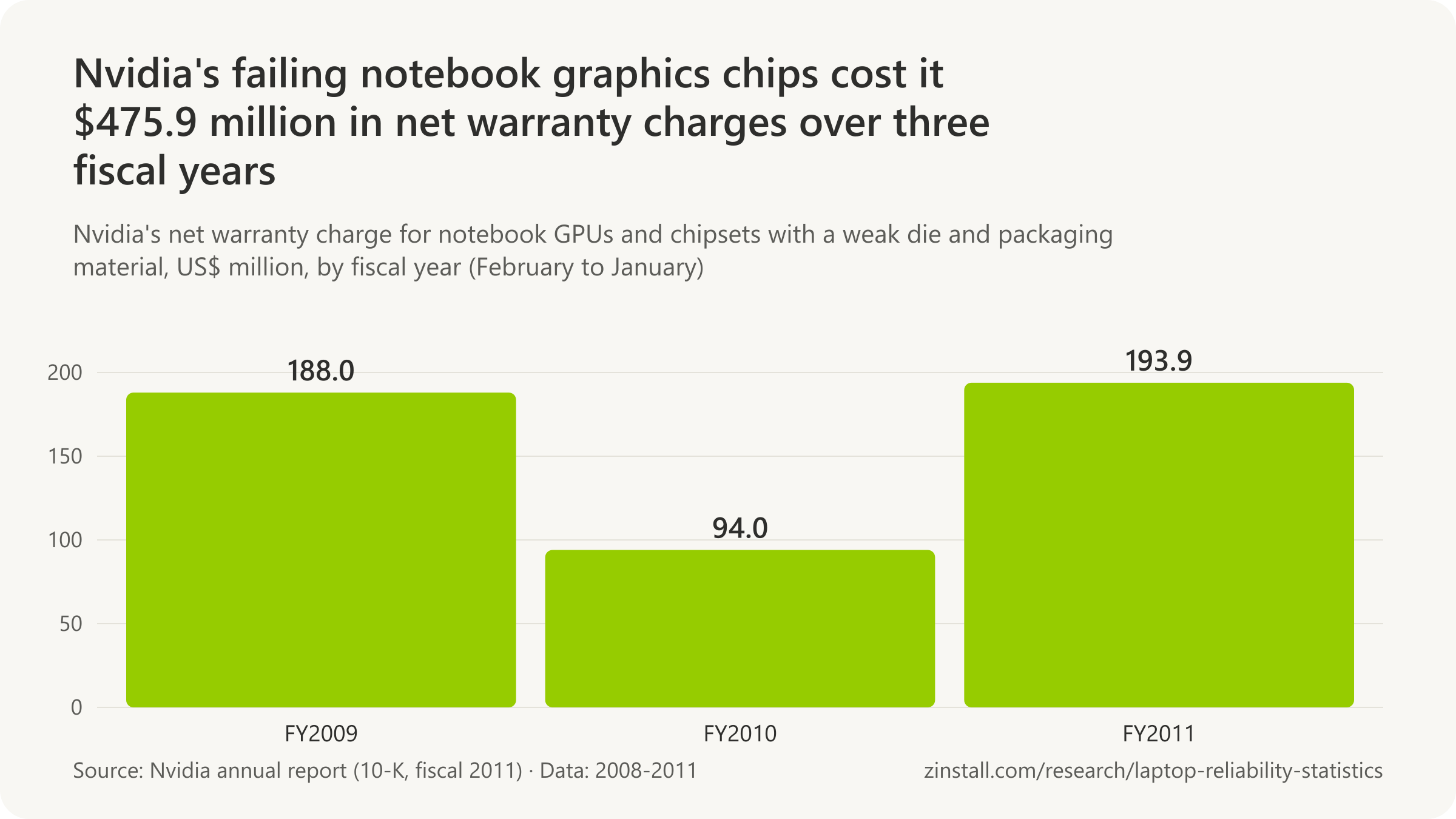
- $150 million to $200 million was the charge Nvidia said on 2 July 2008 it would take to cover warranty, repair and replacement costs for notebook graphics and chipset parts failing in the field at higher than normal rates (Nvidia, 2008).
- $196.0 million was the charge Nvidia recorded in July 2008 against cost of revenue for the warranty, repair and replacement costs of notebook GPUs and chipsets with a weak die and packaging material (Nvidia, 2009).
- $475.9 million in cumulative net warranty charges was what Nvidia recorded over fiscal 2009 to 2011 for notebook GPUs and chipsets with a weak die and packaging material, $466.4 million of it against cost of revenue (Nvidia, 2011).
- The number of notebook chips affected by Nvidia's weak die and packaging defect stayed in line with its July 2008 estimate, but repair costs ran higher than expected, Nvidia said in March 2010 without disclosing the unit count (Nvidia, 2010).
- $2 million was the fund Nvidia agreed to provide in the 2010 US class action settlement to reimburse owners who had paid to repair Dell, HP or Apple notebooks with its failing chips, on top of chip or whole-computer replacements (N.D. Cal. settlement, 2010).
- $13 million in class counsel fees and expenses was approved in the 2010 settlement of the US class action over Nvidia's failing notebook graphics chips, paid by Nvidia, against a $2 million fund for owners' repair reimbursements (N.D. Cal. settlement, 2010).
- $700 million was Intel's January 2011 estimate of the total cost to repair and replace PCs and parts with its Intel 6 Series (Cougar Point) chipset, whose SATA ports could degrade over time, a defect found weeks after Sandy Bridge PCs went on sale (Intel, 2011).
- $733 million was Intel's final estimate of the cost to repair and replace PCs and parts affected by the 2011 design issue in its Intel 6 Series Express chipset, charged across the fourth quarter of 2010 and the first half of 2011 (Intel, 2012).
- $338 million was the product charge Dell took in fiscal 2006 for the estimated warranty cost of servicing or replacing certain OptiPlex business desktops with a vendor part that failed to perform to its specifications (Dell, 2006).
The butterfly keyboard settlement
- $50 million was the non-reversionary fund Apple agreed to pay to settle the US class action over butterfly keyboards in MacBook, MacBook Air and MacBook Pro laptops sold from 2015 to 2019, approved in May 2023 (N.D. Cal., 2023).
- 86,117 claims were filed by March 2023 out of 718,651 eligible members of the MacBook butterfly keyboard settlement's single-repair groups, a claims rate the court gave as approximately 11%, against 1,733 opt-outs and 6 objections (N.D. Cal., 2023).
- 14,359,253 butterfly-keyboard MacBooks in the US class had email notice of the settlement sent to their owners by January 2023, and 401,579 more had no valid email address on file, a class of about 14.8 million computers (N.D. Cal., 2023).
- 63,069 owners whose butterfly-keyboard MacBook had needed two or more full keyboard (topcase) replacements were each paid the $395 maximum under the US settlement, $24.9 million in all (N.D. Cal., 2024).
- 64,686 owners whose butterfly-keyboard MacBook had one full keyboard replacement that did not fix the problem were each paid the $125 maximum under the US settlement, and 4,773 with keycap replacements $50 (N.D. Cal., 2024).
- About 5% of the roughly 14.8 million butterfly-keyboard MacBooks in the US class had a qualifying keyboard repair on Apple's records within four years of purchase (one or more topcase or keycap replacements), by our count from the settlement filings (N.D. Cal., derived, 2024).
Battery accidents in Japan and on planes

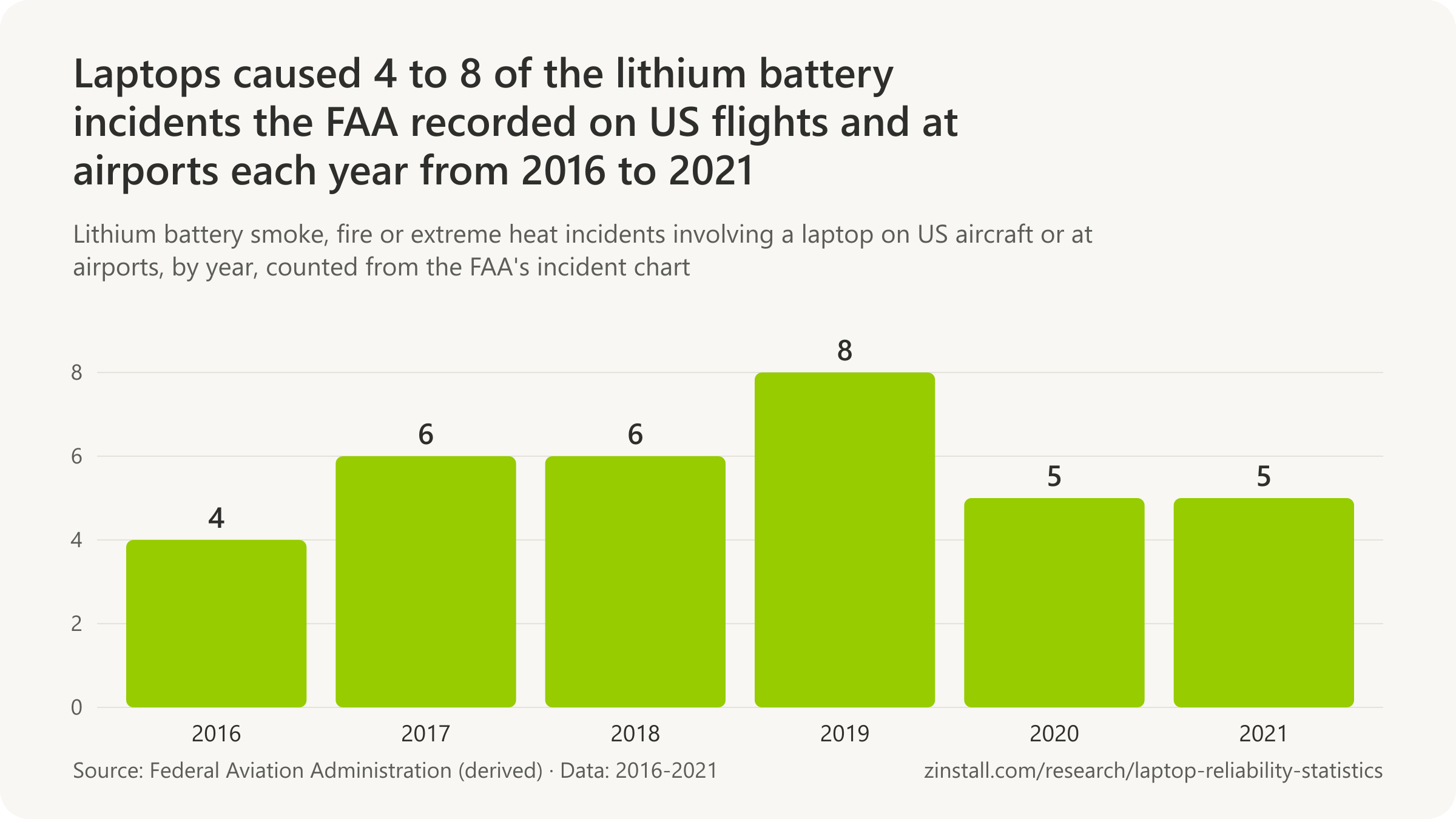
- 41 of the 354 lithium battery smoke, fire or extreme heat incidents the FAA recorded on US aircraft and at airports from January 2006 to February 2022 involved laptops, about 12%, by our count of the FAA's incident chart (FAA, derived, 2022).
- 110 accidents involving laptop lithium-ion batteries were reported to Japan's product safety agency NITE in the five fiscal years to March 2017, more than the 108 for mobile batteries or the 56 for smartphones (NITE, 2017).
- 47 of the 110 laptop battery accidents reported to Japan's NITE from fiscal 2012 to 2016 involved laptops or battery packs already under recall, accidents NITE said a completed recall could have prevented (NITE, 2017).
- 134 laptop accidents were among the 1,860 accidents involving lithium-ion battery products reported to Japan's NITE from 2020 to 2024, and 103 of them spread damage beyond the laptop, such as fires (NITE, 2025).
- 12 laptop accidents involving non-genuine (third-party) batteries were reported to Japan's NITE from 2014 to 2023, 9 of them fires, out of 235 accidents with non-genuine batteries across all products (NITE, 2024).
Sources: U.S. Consumer Product Safety Commission (1993-2026); Sony Corporation; Health Canada (2014, 2026); Federal Aviation Administration (2022, 2025); Apple (2008-2019); HP Inc. (2019, 2026); Microsoft; Dell Inc. (2006, 2008); NVIDIA Corporation (2008-2011); The NVIDIA GPU Litigation settlement administrator; Intel Corporation (2011, 2012); United States District Court, Northern District of California (2023, 2024); National Institute of Technology and Evaluation, Japan (2017, 2024, 2025)
Are business and rugged laptops more durable?
Consumer-class notebooks fail 50% to 100% more often in business use than enterprise models, by a consultant's estimate (J.Gold Associates, 2009).

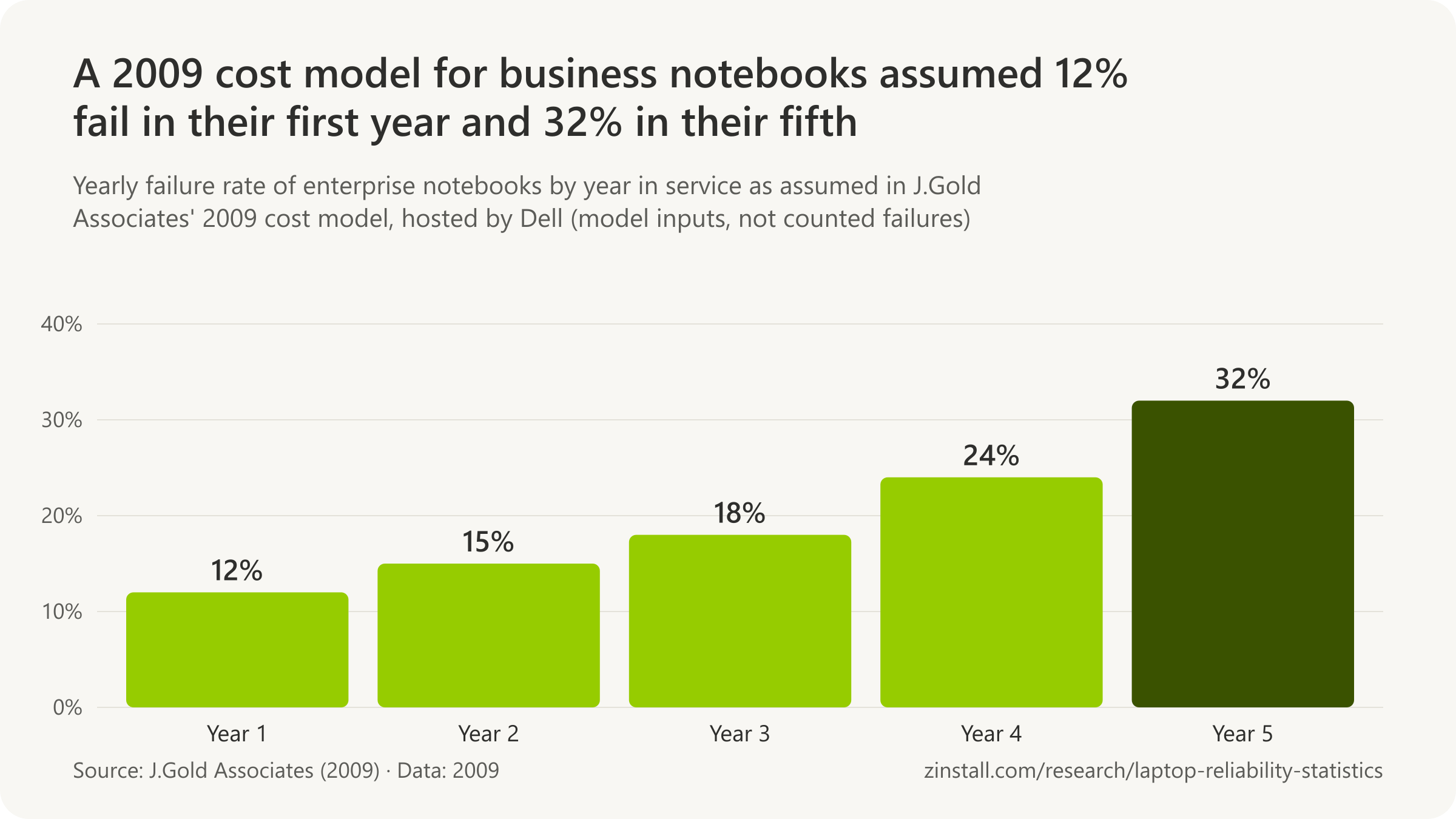
- 18% of a company's notebooks needed a repair of some kind each year, mostly after accidents, in a survey for a rugged-PC maker.
- A rugged-laptop maker reports a 0.61% yearly failure rate for its own models, from its own service data.
- One passed test out of dozens can be enough to claim 'MIL-STD-810H certified', a rugged-laptop maker warns.
- Every current ThinkPad is tested against 12 MIL-STD-810G test methods and 20 procedures, by the maker's own claim.
- First-year failure rates of business notebook models ranged from below 10% to near 20%, even within one maker's range.
| Source, measure and date | Figure |
|---|---|
| HP EliteBook: MIL-STD-810 tests passed, maker's claim | 19 tests |
| HP business PCs: hours of testing per model, maker's claim | more than 120,000 hours |
| Dell Latitude: drop-test heights, maker's claim | 18 to 48 inches |
| Rugged against ordinary notebook: price per unit, 2016 | $2,818 vs $1,875 |
| Cost of one notebook failure out of and under warranty, 2009 | $1,425 vs $970 |
| Hard drives' share of business notebook failures, 2009 model | 35% |
| Apple work laptops: users' reliability rating, 2025 | 9.3/10 |
| IT buyers for whom reliability decides brand loyalty, 2014 | 79.4% |
| Dell enterprise notebook customers who would buy Dell again, 2014 | 81.4% |
| Dell enterprise notebook customers who would recommend Dell, 2014 | 80.1% |
Sources: J.Gold Associates; IDC; Panasonic Connect North America (2026a, 2026b); Lenovo; HP Japan (2026a, 2026b); Dell; PCMag; Technology Business Research
Related guides: A new PC on a new domain · A Windows on Arm laptop
More statistics (17)
Business laptops are sold on durability and rugged models on military-standard tests, but those tests are the makers' own claims and the independent evidence is old. A consultant's cost model and an analyst survey found consumer-grade notebooks failing more often in business use, and rugged makers publish their own failure rates. People who use laptops at work rate their reliability much as consumers do.
Business notebooks' failure rates
- Below 10% to near 20% was the spread of first-year failure rates J.Gold Associates observed across business notebook models in 2009, with large gaps even between models from the same maker (J.Gold Associates, 2009).
- 50% to 100% higher yearly failure rates are what consumer-class notebooks show in business use compared with enterprise-class machines, J.Gold Associates said in 2009 (J.Gold Associates, 2009).
- 35% of business notebook failures were assumed to be hard-drive failures and 65% other faults in J.Gold Associates' 2009 cost model (J.Gold Associates, 2009).
- $1,425 was the full cost to a business of one notebook failure out of warranty, against $970 under warranty, counting help-desk time, technicians, parts and lost user time, in J.Gold Associates' 2009 model (J.Gold Associates, 2009).
- 18% of a company's notebooks needed repair of some kind each year, mostly from accidental damage, rising from 11.5% in a device's first year to 21.3% by year five, in IDC's survey of 800 organisations sponsored by rugged-PC maker Panasonic (IDC, 2016).
- 2,818 dollars per rugged notebook against 1,875 dollars per non-rugged notebook was what organisations reported paying in IDC's 2016 survey for Panasonic, which put the payback of the rugged premium in the second year (IDC, 2016).
- The screen, then the keyboard, then the storage drive were the notebook components IT decision makers most often reported as damaged, in IDC's 2016 survey of 800 organisations for Panasonic (IDC, 2016).
Military-standard tests and makers' claims
- 12 MIL-STD-810G test methods and 20 procedures are what Lenovo says every current ThinkPad is tested against, a maker's claim that Lenovo itself says is not a guarantee of future performance, as stated in November 2026 (Lenovo, 2026).
- 19 MIL-STD-810 tests are what HP says its EliteBook laptops pass, including a drop from 121 cm onto plywood in 26 orientations under the 810H version, a maker's claim HP says does not guarantee future performance (HP Japan, 2026).
- More than 120,000 hours of testing per model is what HP says its business PCs go through in its own Total Test Process (drops, temperature, vibration, transport shock and more), including a keyboard test of more than 10 million keystrokes, a maker's claim (HP Japan, 2026).
- 18 to 48 inches is the range of transit-drop heights in Dell's MIL-STD-810H test summary for Latitude laptops (18 inches for the 3000 series, 30 for the 5000, 36 for the 7000 and 9000, 48 for Education models), and the 26 required drops may be spread over up to five units (Dell, 2023).
- 0.61% was the overall annualised failure rate Panasonic reports for its TOUGHBOOK 40, 33, G2 and 55 rugged models from five years of its own service data, against a 3% rate it uses for a competitor in an illustrative example (Panasonic Connect, 2026).
- One passed test out of dozens can be enough for a device to claim it is 'MIL-STD-810H certified', the rugged-laptop maker Panasonic warns buyers, advising them to check which test methods were run (Panasonic Connect, 2026).
Ratings from people at work

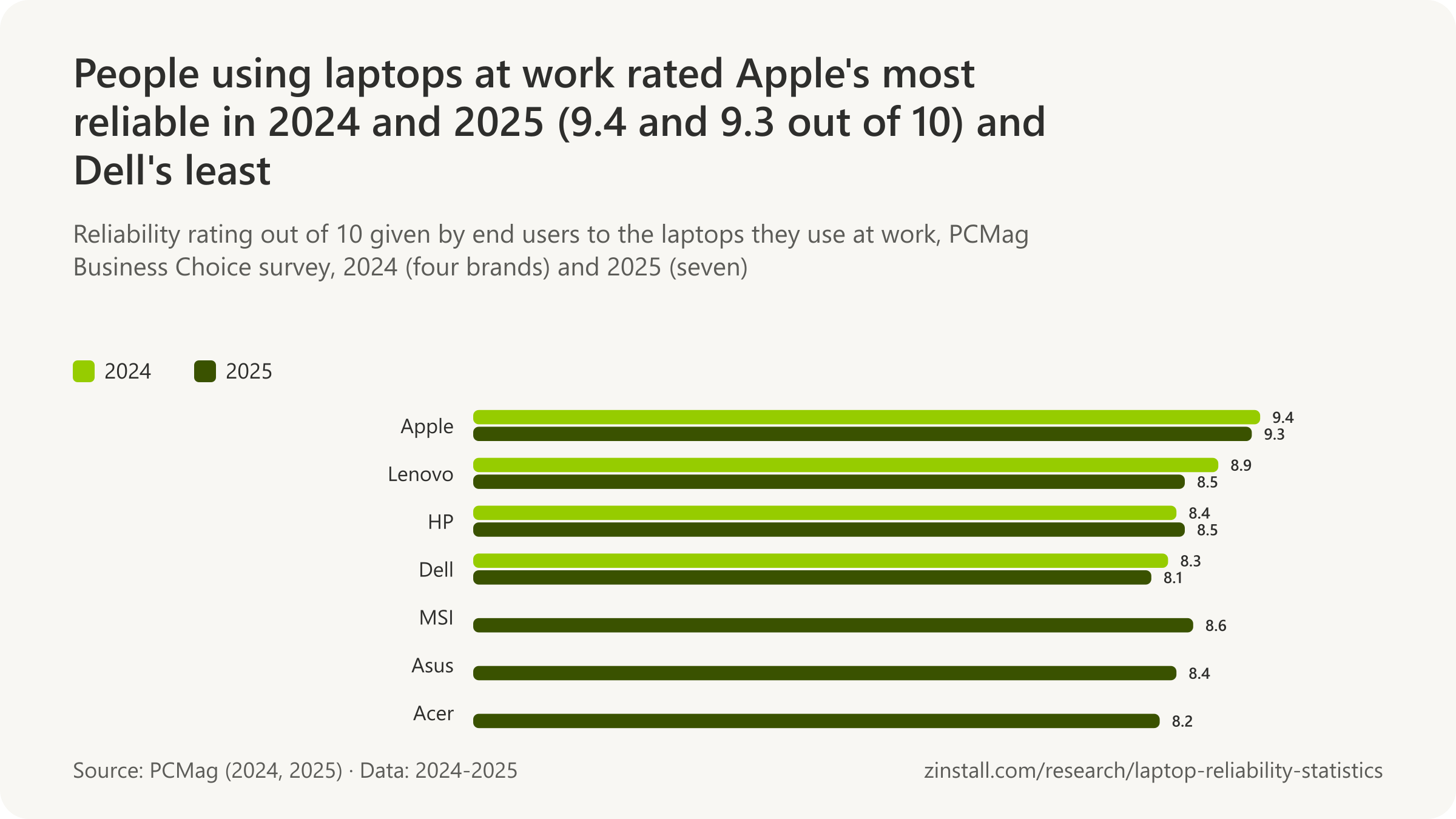

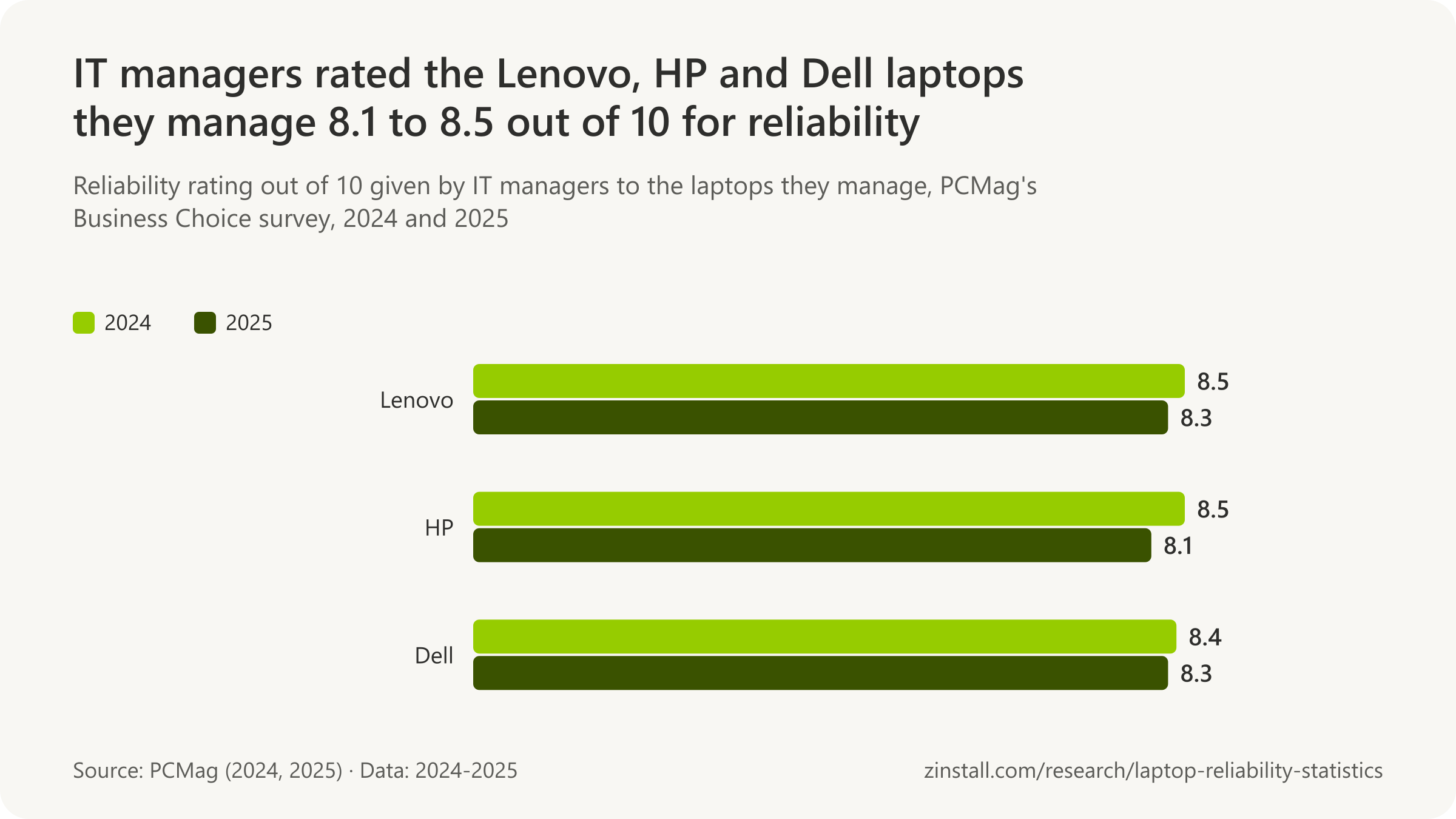
- 81.4% of Dell's enterprise notebook customers said they would buy Dell notebooks again, the highest loyalty score of the vendors profiled in Technology Business Research's 3Q14 satisfaction study, in a white paper distributed by Dell (TBR, 2015).
- 80.1% of Dell's enterprise notebook customers said they would recommend Dell notebooks for enterprise deployment, in Technology Business Research's 3Q14 satisfaction study, in a white paper distributed by Dell (TBR, 2015).
- 79.4% of enterprise IT buyers said hardware reliability was critical to staying loyal to a notebook brand, in Technology Business Research's 3Q14 notebook satisfaction study, in a white paper distributed by Dell (TBR, 2015).
- 22 of 22 satisfaction attributes went to Dell (first or tied first) in Technology Business Research's 3Q14 enterprise notebook study, its third straight quarter ahead, according to a white paper distributed by Dell (TBR, 2015).
Sources: J.Gold Associates; IDC; Lenovo; HP Japan (2026); Dell; Panasonic Connect North America (2026); Technology Business Research; PCMag (2024, 2025)
Mac or Windows laptop: which has fewer problems?
Enterprise Windows devices had 3.1 times as many forced shutdowns as Macs in 2025, in a device-management vendor's telemetry (Omnissa, 2026).

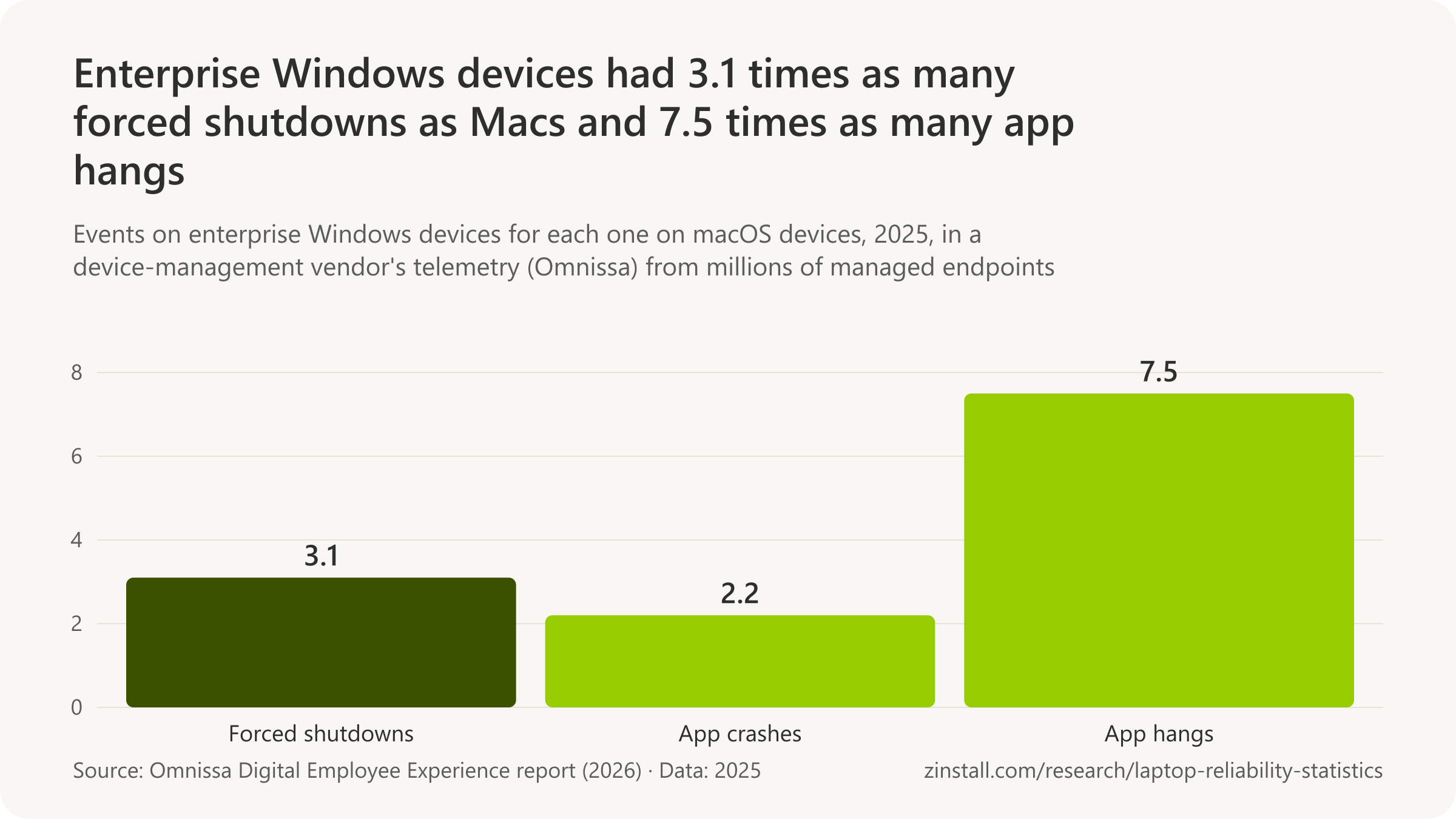
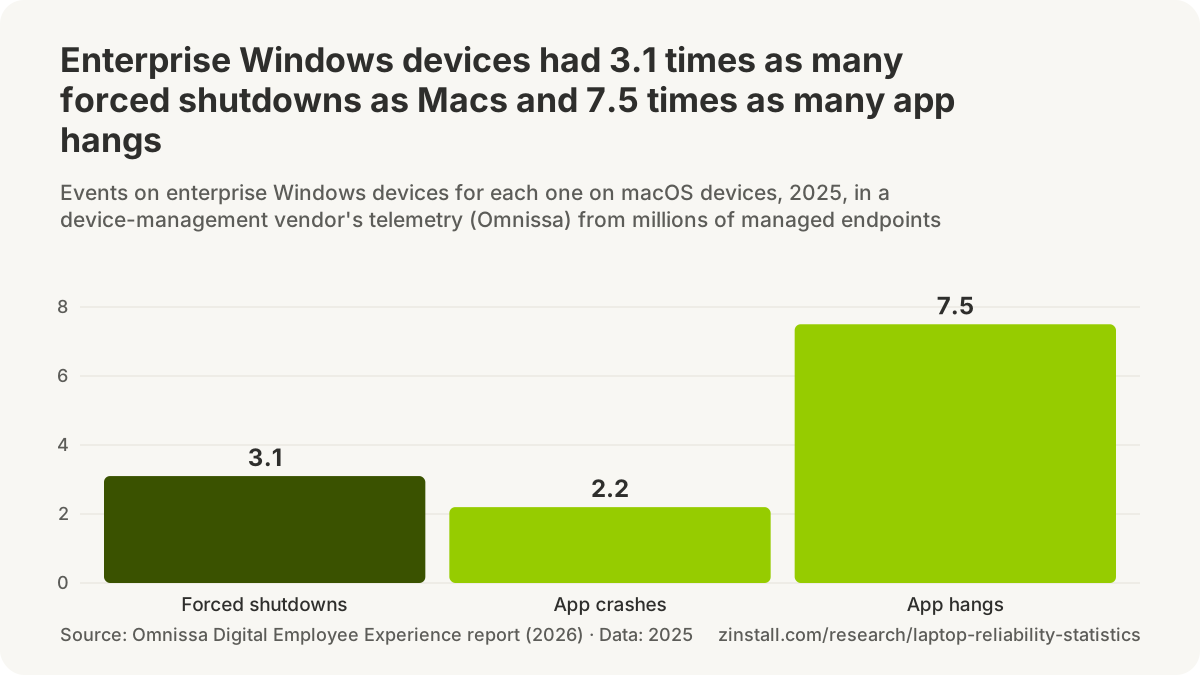
- 10% of Apple laptops were estimated to fail by their third year, against 16% to 19% for Windows brands, in a 2015 owner survey.
- 3.5% of IBM's Mac users called the help desk in 2016, against 25% of its PC users.
- Nearly 98% of IBM's Mac users found moving to a new Mac simple, against 86% of those moving from Windows 7 to 10.
- IT buyers reported 24% fewer help-desk tickets after moving staff to Macs, in a survey Apple commissioned.
- Apple reported 78% fewer in-warranty repairs from 2015 to 2022 across its devices, from its own data.
| Source, measure and date | Figure |
|---|---|
| IBM: Mac against PC users calling the help desk, 2015 | 5% vs 40% |
| IBM: help desk staff for its Macs and iOS devices, 2015 | 24 staff for 130,000 devices |
| IBM: support engineers per 200,000 Macs against Windows, 2019 | 7 vs 20 engineers |
| IBM: Windows users' likelihood of needing on-site support, 2019 | 5 times |
| IBM: saving per Mac against a PC over four years, 2016 | $273 to $543 per Mac |
| US owners completely satisfied with reliability, Apple against others, 2015 | 71% vs 38% |
| Failed laptops that broke more than once, Apple against others, 2015 | 42% vs 55% |
| Apple owners' paid repairs costing $300 or more, 2015 | almost 1 in 3 |
| Owners buying an extended warranty, Windows against Apple, 2015 | 16% vs 36% |
| Windows devices with a blue screen crash on an average day, 2024 | 1 in 200 a day |
Sources: Omnissa; Consumer Reports, Inc.; IBM (2019, 2016a, 2016b, 2015); Forrester Consulting; Apple Inc.; Nexthink
Related guides: Windows 10 to Windows 11 · From a desktop to a laptop
More statistics (17)
The comparisons come from three places: owner surveys, which have long found Apple laptops breaking least; companies that moved staff to Macs and reported fewer help-desk calls; and device-management vendors, whose telemetry counts crashes and hangs on the machines they manage. The company figures were presented at a Mac-management vendor's events and the telemetry comes from vendors that sell device management, as each figure says.
Owner surveys
- 10% of Apple laptops were estimated to fail by the third year of ownership, the lowest of any brand in Consumer Reports' 2015 survey of more than 58,000 laptop owners (Consumer Reports, 2015).
- 16% to 19% of Windows laptops were estimated to fail by the third year of ownership, depending on the brand, in Consumer Reports' 2015 survey of more than 58,000 laptop owners (Consumer Reports, 2015).
- 42% of Apple laptops that failed broke down more than once, against 55% of other brands' laptops that failed, in Consumer Reports' 2015 owner survey (Consumer Reports, 2015).
- Almost a third of the out-of-pocket repairs Apple laptop owners paid for cost $300 or more, which Consumer Reports called more than three times the expense for Windows laptops, in Consumer Reports' 2015 owner survey (Consumer Reports, 2015).
- 23 hours a week was the average use of Apple laptops, against 20 hours for all laptops, in Consumer Reports' 2015 owner survey, in which heavier use otherwise meant more problems (Consumer Reports, 2015).
- 16% of Windows laptop owners bought a service contract or extended warranty, against 36% of Apple laptop owners, in Consumer Reports' 2015 owner survey (Consumer Reports, 2015).
- 71% of Apple laptop owners were completely satisfied with their computer's reliability, against 38% of other laptop owners, in Consumer Reports' 2015 survey, a satisfaction measure and not a failure rate (Consumer Reports, 2015).
IBM's move to Macs

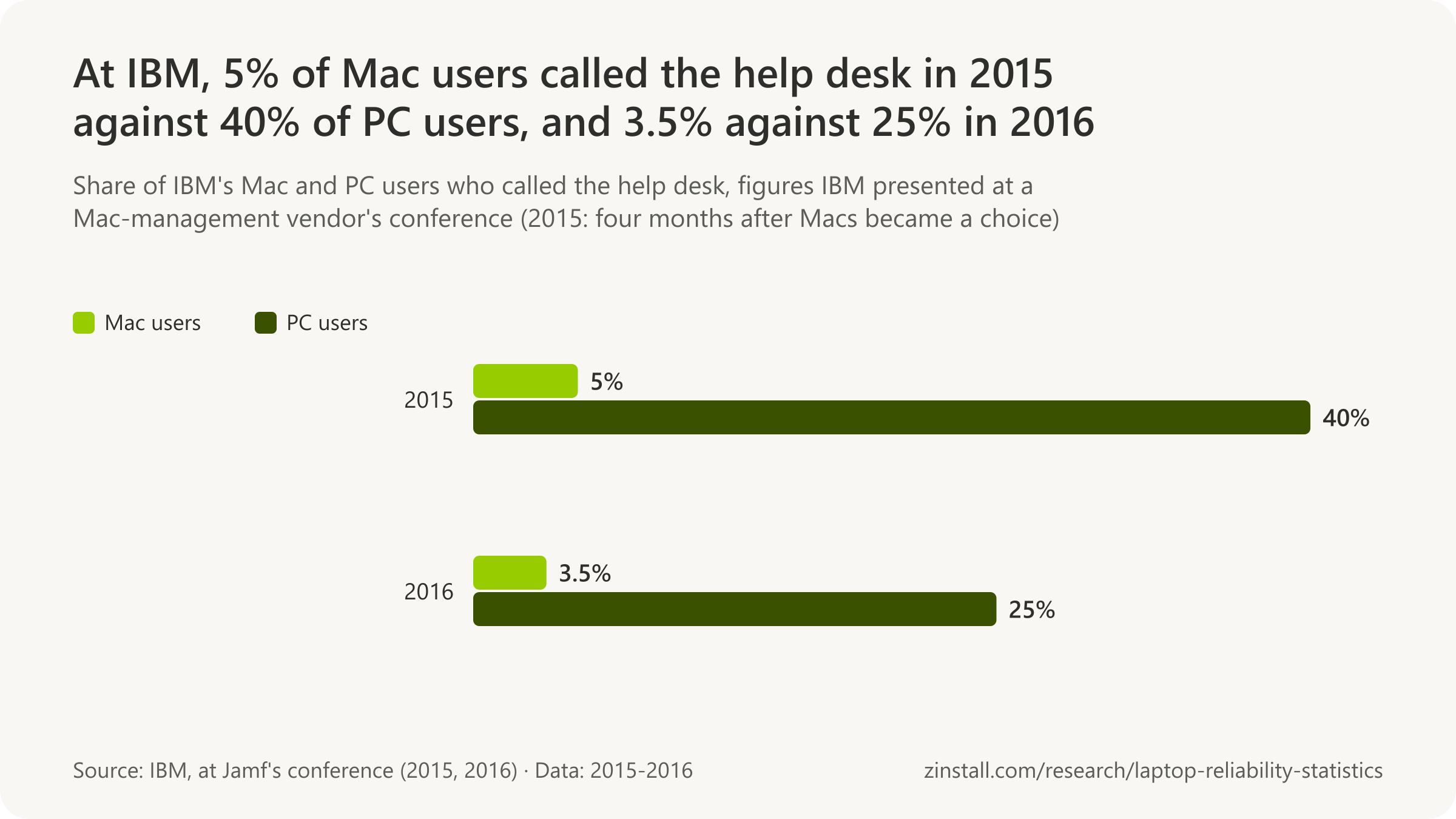
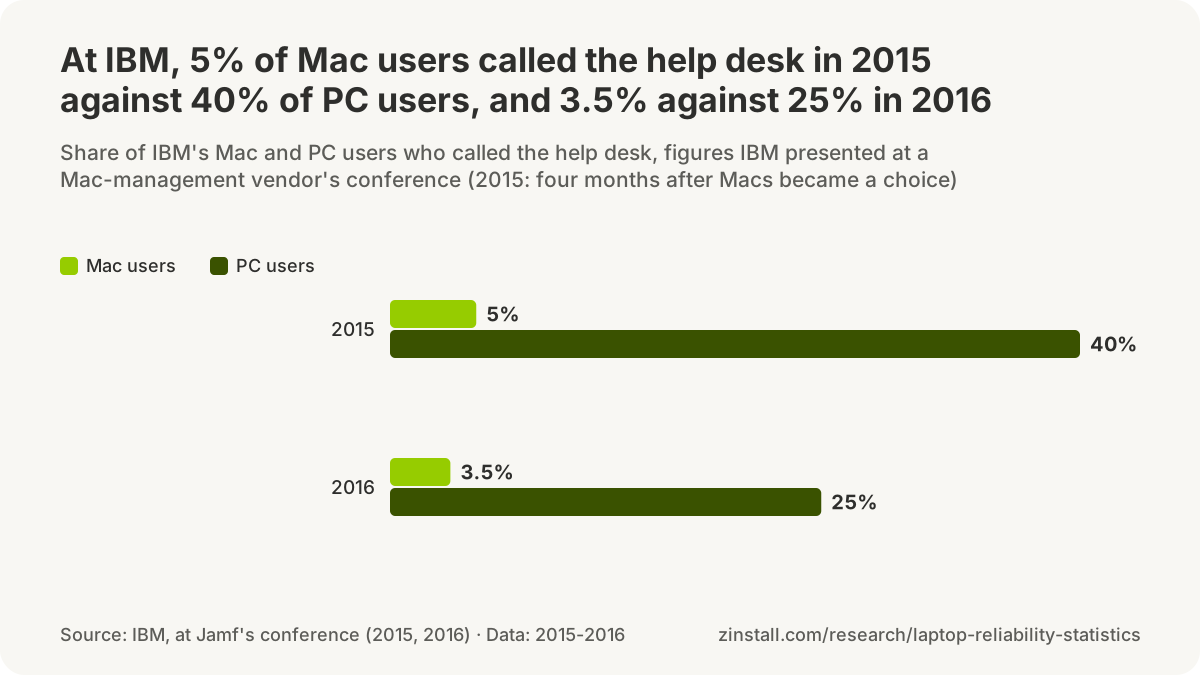
- 24 help desk staff supported IBM's 130,000 Macs and iOS devices in October 2015, about one per 5,400 users, against an industry average of one per 242 that IBM's Previn quoted (IBM, 2015).
- $273 to $543 less per Mac than per PC over a four-year life was IBM's total-cost finding in October 2016, depending on the model, counting device, software, support, resale and deployment (IBM, 2016).
- 7 support engineers served 200,000 Macs at IBM, against 20 for the same number of Windows devices, IBM said in November 2019, when it had over 290,000 Apple devices (IBM, 2019).
- 5 times as likely as Mac users to need on-site help desk support were IBM's Windows users, IBM said in November 2019 (IBM, 2019).
- Nearly 98% of IBM's macOS users said moving to a new Mac was simple, against 86% of those migrating from Windows 7 to Windows 10, IBM said in November 2019 (IBM, 2019).
Fleet telemetry
- 1 in 200 Windows devices hit a blue screen crash on an average day, even under normal conditions, Nexthink found from 10.5 million devices it monitors, rising to 1 in 10 after the July 2024 CrowdStrike outage (Nexthink, 2024).
- 15.2% of technology-sector devices had a blue screen crash each month, the highest of any industry, against 8% in financial services, in Nexthink's 2024 analysis (Nexthink, 2024).
- 24% fewer help desk tickets after moving staff to Macs was what IT decision-makers reported in a Forrester survey commissioned by Apple in 2026; Forrester's model then assumes 55% fewer tickets than PCs' six a year (Forrester for Apple, 2026).
Apple's own repair figures
- 78% fewer in-warranty and 38% fewer out-of-warranty repairs from 2015 to 2022 is what Apple reported in its June 2024 "Longevity, by Design" paper, from its own data on customers with AppleCare+ across its devices, not broken out for Macs (Apple, 2024).
Numbers in circulation
- 242 PC users per support staff member is how Jamf's 2019 press release restated IBM's 2015 figures, although the 2015 account gives 1:242 as the industry average Previn cited, not IBM's PC ratio (Jamf, 2019).
Sources: Consumer Reports, Inc.; IBM (2015, 2016, 2019); Nexthink; Forrester Consulting; Apple Inc.; Jamf
How often do school laptops and Chromebooks break?
17.8% of North Carolina's student laptops needed a repair in the 2025-26 school year, against 5.0% of student desktops (NC Department of Public Instruction, 2026).

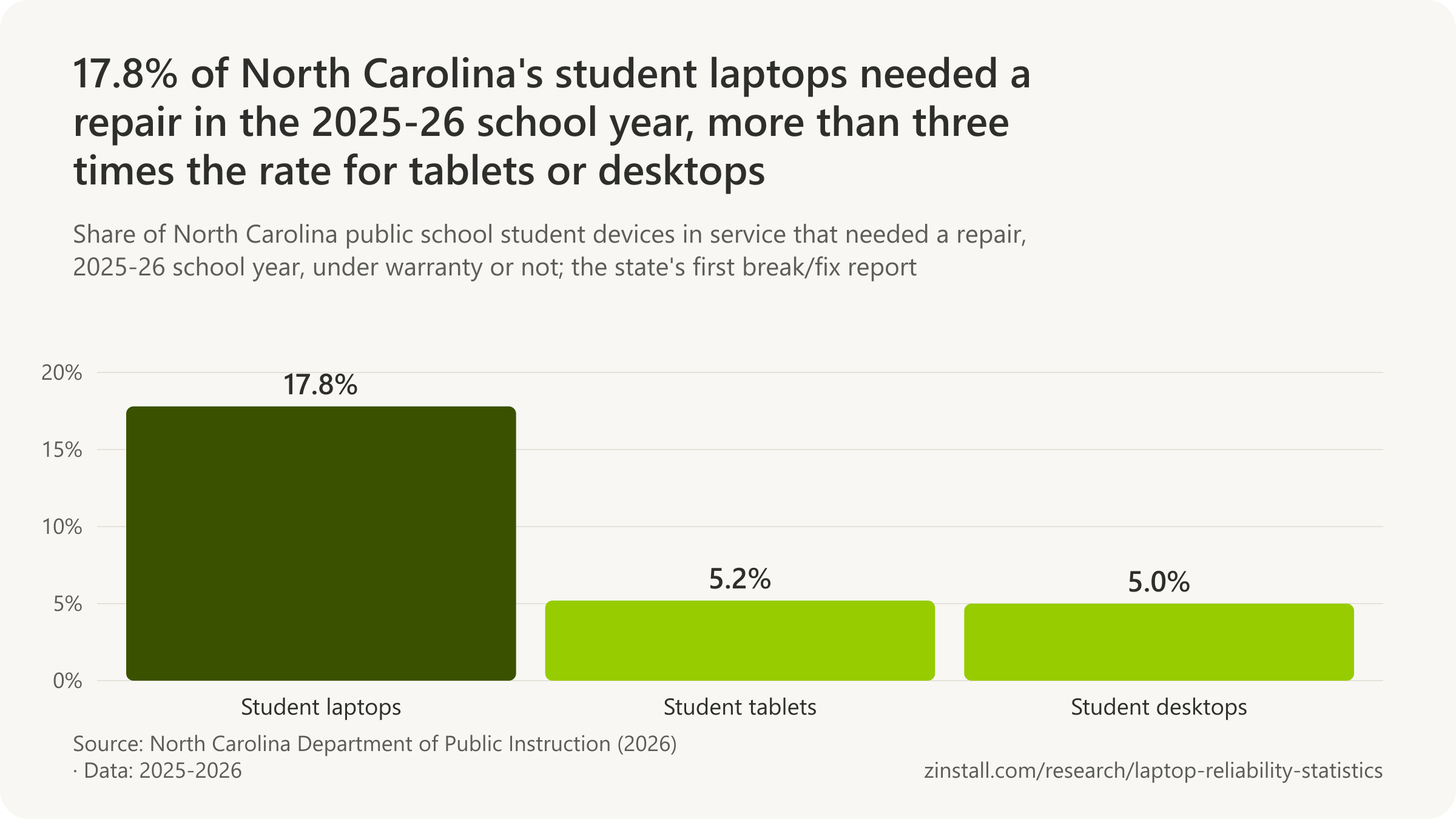
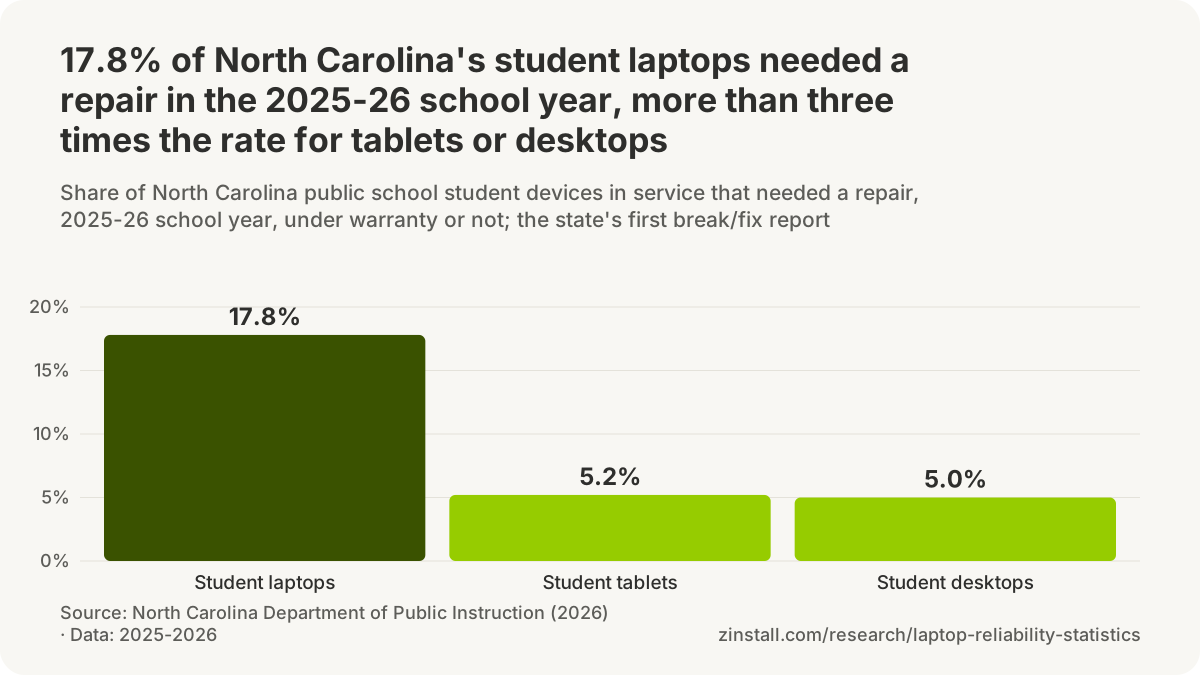
- About 60% of North Carolina's school computer repairs in 2025-26 were not covered by warranty.
- 10.6% of North Carolina's student laptops needed a repair that warranty did not cover, its break/fix rate.
- 90.3% of North Carolina's 1.19 million student devices were Chrome devices in 2024-25.
- 9 of 13 school IT staff surveyed had retired a working Chromebook because its software support had expired.
- North Carolina's schools spent $441 per device on average once repairs over its life were counted.
| Source, measure and date | Figure |
|---|---|
| North Carolina: schools' spending on computer repairs, 2025-26 | $6.6 million |
| North Carolina: student tablets needing a repair, 2025-26 | 5.2% |
| North Carolina: student desktops needing a repair, 2025-26 | 5.0% |
| A school repair programme: Chromebooks replaced against computers fixed | 4,156 replaced vs 590 repaired |
| Los Angeles schools: spending on Chromebooks and fees, 2021-2023 | $130.7 million |
| Oakland: cost of a cracked Chromebook screen repair | about half the price |
| US school devices damaged each year, an insurer's estimate | 8% to 12% a year |
Sources: North Carolina Department of Public Instruction (2026a, 2026b); U.S. PIRG Education Fund; Worth Ave. Group
Related guides: Programs and files to Windows 11 · Windows Easy Transfer on Windows 11
More statistics (10)
Schools hand laptops to children who carry them every day, and the first statewide count of their repairs shows laptops breaking far more often than tablets or desktops. Most student devices in North Carolina are Chromebooks, and most of its school repairs were not covered by warranty. A consumer group found schools retiring working Chromebooks when their software support ended, and screen repairs costing a large share of a new device.
North Carolina's break/fix report
- 10.6% of North Carolina public school student laptops in service needed a repair that warranty did not cover in the 2025-26 school year, the state's break/fix rate, against 7.2% repaired under warranty (NC Department of Public Instruction, 2026).
- About 60% of North Carolina public schools' computer repairs in the 2025-26 school year were not covered by warranty, and student laptops were the most likely to need repair (NC Department of Public Instruction, 2026).
- More than $6.6 million was spent by North Carolina public schools to repair broken computers in the 2025-26 school year, and nearly 75% of districts reported no sustainable funding to maintain their fleets (NC Department of Public Instruction, 2026).
- $441 per device was North Carolina public schools' average spend on student and staff computers once repairs over a device's life cycle were counted, the state's 2026 break/fix report found (NC Department of Public Instruction, 2026).
- 90.3% of the 1.19 million devices North Carolina public schools had for students in 2024-25 were Chrome devices, 8.7% Windows and 1% Apple, the state's Statewide Trends in Student Digital Learning Access report found (NC Department of Public Instruction, 2026).
Chromebooks and repair
- 8% to 12% of US school-issued devices are damaged each year on average, ranging from 2% to 25% by school, according to device insurer Worth Ave. Group in 2023 (Worth Ave. Group, 2023).
- 9 of 13 US school IT administrators and technicians surveyed by PIRG had stopped using a working Chromebook because its software support expired, in 2023 (U.S. PIRG Education Fund, 2023).
- 4,156 Chromebooks had to be replaced, most of them still working, by a school repair internship that fixed 590 computers over two summers, PIRG reported in 2023 (U.S. PIRG Education Fund, 2023).
- About half the price of a new device is what fixing a cracked Chromebook screen can cost, an Oakland, California school district official told PIRG in 2023 (U.S. PIRG Education Fund, 2023).
- $130.7 million was spent by the Los Angeles Unified School District on Chromebooks and related fees, including warranty replacements, between July 2021 and February 2023, about $229 per student, PIRG found (U.S. PIRG Education Fund, 2023).
Sources: North Carolina Department of Public Instruction (2026); Worth Ave. Group; U.S. PIRG Education Fund
Do 1 in 3 laptops really fail within 3 years?
'One-third of all laptops will fail within 3 years', a warranty seller's own undated page still says of its 2009 study (SquareTrade, 2009).
- 'One in three newly bought laptops fail within three years', a warranty seller wrote in 2026, citing the 2009 study without its year.
- '22 percent will break within four years' was a 2006 news report's misreading of Gartner's yearly failure rates.
- Notebook failure rates 'as high as 20% in the first year' were an analyst's 2005 remark, the likely root of a line still repeated.
- A laptop 'MTBF' of about 25 months came from a reader poll, which cannot measure time between failures.
- Five laptop brands 'worth avoiding' on a 2026 list came from reliability scores that only paying members can see.
| Page and claim | Figure claimed |
|---|---|
| evertiq, 2009: 'one in three' over three years | 1 in 3 (31%) |
| Laptop Mag, 2009: notebooks failing over three years | 20% to 30% |
| ECOS, 2020: laptops failing within three years, undated | 1 in 3 |
| ECOS, 2020: commercial computers' 'annual failure rate' | 18% a year |
| SureBright, 2026: failure rate by year three, undated | 18% by year 3 |
| A reseller, 2025: Dynabook's monthly failure rate | under 1% a month |
| A fan site, 2026: Chromebook failure rates after five years | 6.3% (Lenovo) to 9.7% (Samsung) |
| A leasing firm, 2025: failure rates in year four | 20% to 30% (year 4); +40% to 50% support costs |
| A leasing firm, 2025: business laptops' useful life | 3 to 4 years (Windows); 4 to 5 years (MacBooks) |
| A case maker, 2021: brand lifespans from two blogs | Apple 5; Dell 3 to 5; HP up to 6 (years) |
Sources: SquareTrade; SureBright; CIO; Computerworld; TechYorker; BGR; evertiq; Laptop Mag; ECOS, with Coolproducts and Right to Repair Europe; ECOS; Enterprise Technology International; About Chromebooks; inki.tech; Higher Ground
More statistics (31)
The most repeated laptop failure figure, one in three within three years, comes from a single warranty study of the late two-thousands that counted accidents as failures, and it is still quoted without its date. Other lines trace back to an analyst's quote, a misread of Gartner's yearly rates, rankings built on members-only scores, or no source at all. Each claim below says where it came from.
SquareTrade's 'one in three'
- One in three laptops failing over three years, 31% including accidents, is how electronics-industry site evertiq reported SquareTrade's study in November 2009; the 2009 page still ranks for "laptop failure rate" and feeds Google's AI answer (evertiq, 2009).
- 20% to 30% of notebooks failing over three years, with HPs failing most, was Laptop Mag's November 2009 headline on SquareTrade's study; its text also names Acer among both the most and the least reliable brands, where SquareTrade had Asus and Toshiba on top (Laptop Mag, 2009).
- Asus and Toshiba making the most reliable laptops, with nearly one in three laptops failing in three years, was Tom's Hardware's November 2009 report of SquareTrade's study, the origin of the "Asus is most reliable (SquareTrade)" line still repeated (Tom's Hardware, 2009).
- "One in three newly bought laptops fail within three years. Not 'might fail.' Fail." is how warranty provider SureBright opened a February 2026 post, citing SquareTrade's 2009 study of 30,000 laptops without its year (SureBright, 2026).
- Failure rates of roughly 18% by year three, from a Consumer Reports survey of more than 58,000 laptop owners, were restated without the survey's 2015 date by warranty provider SureBright in February 2026 (SureBright, 2026).
- A chart of the share of laptops failing within three years, "as of 2009", is how Statista packages SquareTrade's study; last updated in 2011, it sits behind a paywall and still ranks for laptop failure searches (Statista, 2011).
- One third of all laptops failing within three years, two thirds of them from hardware malfunction, is how ECOS used SquareTrade's 2009 study in its 2020 ecodesign report, without the study's year in the text (ECOS, 2020).
- Commercial computers having an annual failure rate of 18% is how ECOS cited IDC's 2016 study for rugged-laptop maker Panasonic, via an EU JRC report, in 2020; IDC's 18% was the share of business notebooks needing repair of any kind each year, mostly after accidents (ECOS, 2020).
- "Latest 8 Most Reliable Laptop Brands" is the October 2025 title of a GeckoandFly roundup whose newest data is RESCUECOM's 2020 report, which it says was the last, with SquareTrade's 2009 study below it (GeckoandFly, 2025).
- "One third of laptops break after three years" is how Atos's 2024 workplace sustainability paper summed up SquareTrade's 2009 study, dated and sized correctly, before presenting its own fleet data; SquareTrade's third included accidental damage (Atos, 2024).
- "One-third of all laptops will fail within 3 years" is how SquareTrade's own landing page for its November 2009 study puts it, with no year on the page; the page now carries Allstate Protection Plans branding and ranks for "laptop failure rate" (SquareTrade, 2009).
Gartner's yearly rates read as totals
- Notebook failure rates "as high as 20% in the first year" were what Gartner analyst Leslie Fiering told Computerworld in November 2005, the likely root of the "20% of laptops fail in the first year" line still repeated (Computerworld, 2005).
- "15 percent of laptops will break within a year, and 22 percent will break within four years" is how IDG News Service (CIO, InfoWorld) reported Gartner in June 2006; Gartner's figures were annual failure rates by year of ownership, so 22% was the fourth year's rate, not a four-year total (CIO, 2006).
Rankings built on members-only or blended scores
- Apple being the most reliable laptop brand "based on estimated problem rates derived from over 75,000 Consumer Reports surveys" is how BGR reported Consumer Reports in August 2026; CR's brand order itself is for members only (BGR, 2026).
- Consumer Reports ranking Apple the most reliable laptop brand after more than 75,000 survey responses is what SlashGear wrote in September 2026, adding that Apple's score is "well beyond" LG, HP, Samsung and Lenovo; the scores are members-only (SlashGear, 2026).
- BGR's January 2026 ranking of the 10 most reliable laptop brands (Apple first, Dell last) averages Consumer Reports' members-only reliability scores with PCMag Readers' Choice 2025 scores multiplied by 10, mixing a problem-rate survey with a reader poll (BGR, 2026).
- SlashGear's October 2024 ranking of the 11 most reliable laptop brands (Apple first, Dell last) rests on Consumer Reports' 2023 predicted-reliability scores from over 64,000 member responses, "supported" by PCMag, Statista popularity data and SquareTrade's 2009 study (SlashGear, 2024).
- Asus scoring 88 out of 100 as the best laptop brand, with Microsoft last at 70 and Apple second last at 73, was Laptop Mag's 2020 brand rating, an editorial score of reviews, design, support, innovation and value rather than a reliability measure, and the last edition published (Laptop Mag, 2020).
- RTINGS' "7 best laptop brands" page, which Google's AI answer cites for brand questions, is a guide built from its lab tests of laptops it buys, not a reliability or failure ranking (RTINGS, 2026).
- "Apple, Razer, and Lenovo stand out as among the best" is the Laptop Mag line Google shows first for "most reliable laptop brands", but the November 2025 sentence ranks tech support and warranty coverage from its Tech Support Showdown, not reliability (Laptop Mag, 2025).
- Five laptop brands "worth avoiding" (Alienware, Dell, MSI, Acer and Asus) is BGR's March 2026 list, built from the lowest Consumer Reports reliability scores for 75,923 laptops, scores CR shows only to members (BGR, 2026).
- Education and government Chromebooks being "often built to military-grade standards" is how BGR explained their longer claimed lifespans in January 2026; military-grade (MIL-STD-810) labels are makers' claims that a device can make after passing a single test (BGR, 2026).
- ThinkPads possibly lasting 10 years or more is what BGR concluded in July 2026 from "a lengthy Reddit thread", one of a series of brand-lifespan articles built on owners' forum posts rather than any count of failures (BGR, 2026).
- Apple and Samsung topping "Rescuecom's latest laptop reliability report" was Laptop Mag's December 2015 headline; the article itself notes the scores compare market share with calls to one repair firm, and the page still ranks for brand questions (Laptop Mag, 2015).
- Alienware and Gateway being the two least reliable laptop brands "according to Consumer Reports" is what Money Digest wrote in March 2026 from CR's survey of nearly 76,000 owners, whose brand scores are members-only; AOL syndicates it (Money Digest, 2026).
Lifespans and failure rates with no source
- Laptop failure rates reaching 20% to 30% in year four, and IT support costs rising 40% to 50% a year after year three, are claims a laptop-leasing firm's blog made in November 2025 without any source (inki.tech, 2025).
- A business Windows laptop's useful life of around 3 to 4 years, against 4 to 5 for MacBooks, is how laptop-leasing firm inki.tech summed it up in November 2025, without a source (inki.tech, 2025).
- Dynabook laptops delivering "under 1% average monthly field failure rates based on warranty claims" is how IT reseller Enterprise Technology International promoted the maker's brief in 2025; it is Dynabook's own warranty data, and a monthly rate, not an annual one (Enterprise Technology International, 2025).
- Laptop "MTBF" of about 25 months for Dell's XPS and 24 months for Asus's ZenBook, from a "reader survey" of 4,200 respondents, is what content site TechYorker published as its 2026 Readers' Choice; MTBF is not something a reader poll can measure (TechYorker, 2026).
- Chromebook hardware failure rates after five years of 6.3% for Lenovo and 9.7% for Samsung are figures a Chromebook fan site published in 2026 with "About Chromebooks, BGR" as the source; no data or method stands behind them (About Chromebooks, 2026).
- MacBooks lasting five years on average, Dell laptops three to five and HP computers up to six is how laptop-case maker Higher Ground listed brand lifespans in 2021, linking two other blogs as its sources; the page still ranks for "average laptop lifespan" (Higher Ground, 2021).
Sources: evertiq; Laptop Mag (2009-2025); Tom's Hardware; SureBright; Statista; ECOS, with Coolproducts and Right to Repair Europe; ECOS; GeckoandFly; Atos; SquareTrade; Computerworld; CIO; BGR (2026); SlashGear (2024, 2026); RTINGS.com; Money Digest; inki.tech; Enterprise Technology International; TechYorker; About Chromebooks; Higher Ground
Data. All 1,449 statistics on this page, each with its source, verbatim quote and locator: CSV · JSON. Charts and figures on this page may be reused with a link to https://www.zinstall.com/research/laptop-reliability-statistics as the source. Original publishers retain attribution.
Data behind each chart (CSV, 63 files)
- At one European retailer, 0.6% of Apple notebooks came back as warranty cases within two years; 7.9% of Captiva's
- US owners rate every PC brand between 72 and 81 out of 100 for satisfaction, and Apple and Samsung share the top
- Measured, 16% to 37% of laptops developed a fault, depending on the years and the faults each source counted
- Australian owners rated HP laptops joint second for reliability and Dell's last of eight brands
- Gaming PCs scored 67 for reliability in a French retailer's repair data, against 113 for laptops and 128 for desktops
- A laptop that would not switch on was 30% of the five most common faults a French retailer's technicians saw
- Two thirds of the laptops a French retailer's after-sales service handled were repaired without a spare part
- Warranty costs came to 0.9% to 1.6% of PC makers' revenue in their latest reports, down from 1.9% to 3.3% in the mid-2010s
- ASUS laptops graded most repairable and Apple's least in US PIRG's 2026 scorecard
- The biggest laptop-related recall in the US was 15.5 million Toshiba power adapters, in 2024; six of the eight biggest were chargers or cords
- A 2009 cost model for business notebooks assumed 12% fail in their first year and 32% in their fifth
- Enterprise Windows devices had 3.1 times as many forced shutdowns as Macs and 7.5 times as many app hangs
- 17.8% of North Carolina's student laptops needed a repair in the 2025-26 school year, more than three times the rate for tablets or desktops
- Apple notebooks became warranty cases least often of 15 brands at Digitec Galaxus, Captiva, Gigabyte and MSI notebooks most often
- Customers returned 3.2% of Lenovo notebooks and 10.2% of Captiva's at Digitec Galaxus; returns are not failures
- Dell's and Lenovo's notebook warranty-case rates at Digitec Galaxus fell by more than a third from 2023 to 2026; Apple's stayed lowest
- ASUS notebooks' warranty-case rate at Digitec Galaxus fell from 4.1% in 2023 to 3.4% in 2026
- Fewer than 1 in 100 products of any kind became a warranty case at Digitec Galaxus; IT products a little more often
- Apple laptops scored highest for reliability and durability in a French retailer's repair data, Microsoft's lowest
- In 2009's warranty claims, 15.6% of Asus laptops were projected to malfunction within three years, and 25.6% of HP's
- Owners' failure estimates in 2015 ran from 7% for the MacBook Air to 23% for Lenovo's Y Series
- Apple has led US PC satisfaction most years since 2004; the industry average ranged from 70 (1997) to 81 (2024 and 2025) and was 78 in 2026
- Samsung has scored 78 to 83 for US PC satisfaction since 2015; Asus fell to 74 in 2026
- Amazon scored 74 to 82 in ACSI's US PC satisfaction table from 2015; Microsoft entered it in 2024 and LG in 2026
- Compaq, Gateway, IBM and Packard Bell scored 66 to 78 for US PC satisfaction before leaving ACSI's table
- US owners rated their laptops 83 out of 100 for keeping crashes to a minimum in 2026, up from 80 in 2022
- PCMag readers rated Apple laptops 9.3 to 9.5 out of 10 for reliability in every edition, HP's 8.3 to 8.6
- MSI owners rated their laptops 9.1 to 9.6 for reliability in PCMag's surveys; Samsung went from 7.7 to 9.0
- Apple led PCMag readers' overall laptop satisfaction among the big brands in every edition; HP fell to 7.8
- Alienware topped PCMag readers' overall laptop satisfaction in 2026 at 9.2; MSI led in 2022 and 2023
- Owners of laptops used four years or more were most satisfied with Apple's (9.2 out of 10) and least with HP's (8.0)
- RESCUECOM's scores swung from report to report: Apple's ran from 76 to 849, Lenovo's from 79 to 524
- Asus scored up to 1,791 in RESCUECOM's August 2010 report; Microsoft led the last report, in October 2020, at 235
- Tablet brands with few support calls scored in the thousands once RESCUECOM counted tablets: Amazon up to 11,560
- A magazine's 2020 editorial brand ratings put Asus first at 88 and Apple tenth of 11 at 73
- Apple scored 95 out of 100 for laptop tech support in a magazine's 2023 undercover test; MSI scored 44
- Apple led CHOICE members' laptop satisfaction (91%) and its Best Brand score (78%) in 2024; Acer was lowest for satisfaction
- 31% of laptops failed within three years in 2009's warranty claims, two thirds of them from malfunctions
- Netbooks were projected to malfunction more often than pricier laptops: 25.1% within three years against 18.1% for premium models
- Gartner put notebooks' yearly failure rate at 15% in their first year, three times desktops' 5%, and 22% in their fourth
- 0.5% of Apple desktops and 0.6% of Dell's became warranty cases at Digitec Galaxus, against 8.0% of Erazer's
- Apple desktops scored 164 for reliability in a French retailer's repair data, Acer's 99
- MSI and Medion notebooks became warranty cases at 5% to 8% at Digitec Galaxus in every year since 2023, Captiva's since 2024; Gigabyte's rate doubled
- HP's gaming PCs scored 118 for reliability in a French retailer's repair data, Lenovo's 55
- Software faults were the most common computer fault New Zealand owners reported, then storage and the battery
- Slow or crashing laptops were the most common fault brought to community repair events, ahead of power and battery faults
- Accidental damage grew from 49% of an insurer's PC loss claims in 1999 to 72% in 2002
- About two thirds of laptop repairs at a French retailer needed no spare part, more than for products overall
- Warranty costs fell as a share of revenue at Apple, HP, Dell, Lenovo and Acer from the mid-2010s
- Apple's warranty accruals fell from $5.0 billion in fiscal 2013 to $2.7 billion in fiscal 2021, the last year it published them
- HP Inc.'s warranty accruals fell from $1.13 billion in fiscal 2015 to $0.67 billion in fiscal 2025
- Dell's warranty accruals stayed between $0.75 billion and $0.98 billion a year from fiscal 2015 to 2026
- Lenovo's warranty provisions stayed between $0.66 billion and $0.99 billion a year while its revenue nearly doubled
- Acer's yearly warranty provisions fell from NT$8.2 billion in 2014 to about half that by 2019
- ASUS laptops graded B+ or A- for repairability in every US PIRG edition; Dell slipped from B+ to B-
- Apple's laptop repairability grade rose from D- in 2022 to C- in 2026, Microsoft's from D+ to B-
- ASUS's own French repairability scores for its laptops averaged 9.1 to 9.7 out of 10 from 2021 to 2026
- 2006 alone accounts for 65% of the laptop battery units recalled in the US since 1993; none has been recalled since 2019
- Laptops caused 4 to 8 of the lithium battery incidents the FAA recorded on US flights and at airports each year from 2016 to 2021
- Nvidia's failing notebook graphics chips cost it $475.9 million in net warranty charges over three fiscal years
- People using laptops at work rated Apple's most reliable in 2024 and 2025 (9.4 and 9.3 out of 10) and Dell's least
- IT managers rated the Lenovo, HP and Dell laptops they manage 8.1 to 8.5 out of 10 for reliability
- At IBM, 5% of Mac users called the help desk in 2015 against 40% of PC users, and 3.5% against 25% in 2016
Methodology
What we included. Retailers' own after-sales data (Digitec Galaxus's warranty-case and return rates by brand, read from its product pages and archived copies; Fnac Darty's after-sales barometer); consumer organisations' owner surveys in what they publish openly (Consumer Reports, Which?, CHOICE, Consumer NZ, Testaankoop, OCU, Que Choisir); satisfaction indexes and magazine ratings (ACSI, PCMag, Laptop Mag), labelled as satisfaction; warranty-claims and insurance data (SquareTrade, Safeware); analyst and consultant studies (Gartner, J.Gold Associates, IDC), with who paid for them; makers' annual reports for warranty costs; government recall databases (US CPSC, Health Canada, Japan's NITE) and court filings; repairability indexes (France's index and open data, iFixit, US PIRG) and right-to-repair laws; device-management vendors' telemetry, labelled as vendor data; and the pages that rank for laptop reliability searches, traced to their origin. A few figures are this page's own arithmetic on published numbers (warranty costs as a share of revenue, recall units by year, the share of a settlement class with a repair), labelled derived with the method in each record. Official statistics, the trackers' own publications, company filings and transcripts, and peer-reviewed or analyst reports are preferred; vendor surveys and news reports are included only where no better source exists and are labelled as such in the dataset.
How each figure was verified. Every record carries the exact sentence or table cell from the source (the quote) and where it sits (the locator). A researcher confirmed each one against the source document; a script then re-fetched every source on November 11, 2026 and checked for the quote. Records the script could not confirm are kept only if the researcher's check was complete, and are marked for human review in the dataset. Restatements (a later outlet quoting an earlier figure) are recorded as restatements, with the primary figure alongside.
What we excluded. Brand orders from members-only scores (Consumer Reports, Which?), which the page does not reconstruct from press copies; laptop MTBF figures and failure rates with no measurement behind them (they appear only as restatement records, traced); figures whose only source is a roundup, a forum post or a content farm; a copy of a study when the original could be read; and any first-party Zinstall data. Where a source gives a figure only in a form we could not confirm (for example, a chart with no data table), the record is marked unverified and is not exported.
Rounding and derivation. Numbers are reproduced as published. Where a tracker publishes two decimals, statements and table cells give one decimal, rounded half up, and the dataset keeps the published value. In the short sentences at the top of the page and of each section, large counts and money amounts may be rounded to two or three significant figures; the exact figure follows in the section's full statements and in the dataset. Derived figures (a change between two months, a share computed from two counts) say so and name their inputs. The bold figure in each statement is a reading aid, not an edit.
Updates. Sources are re-checked and new figures added quarterly, with the monthly tracker series topped up as they are published; the next scheduled refresh is January 2027 (Consumer Reports' laptop survey results), then each new Digitec Galaxus capture, Fnac Darty's autumn barometer and Which?'s spring survey. Corrections are welcome through the contact page.
Measures. Each figure is given in its publisher's measure. A retailer's warranty-case rate counts the repairs its own service handled for the units it sold; a return rate counts returns for any reason; an owner survey counts reported faults; a satisfaction score or a reader rating measures opinion; a yearly failure rate and a share failed within several years are different things; a recall count measures a defect's size, not how often laptops fail; a repairability score measures how easily a laptop can be fixed, not how often it breaks. Warranty costs in annual reports cover each maker's whole product range.
Cite this page
Zinstall. "Most Reliable Laptop Brands: Laptop Failure Rates and Reliability Statistics." https://www.zinstall.com/research/laptop-reliability-statistics. Updated 2026-11-11.
Frequently asked questions
What is the most reliable laptop brand?
Apple, in nearly every recent source that measures it. 0.6% of Apple notebooks sold by the Swiss retailer Digitec Galaxus became warranty cases within two years in its October 2026 data, the lowest of 15 brands, and Apple laptops scored highest for reliability in Fnac Darty's 2024 repair data and among CHOICE's Australian members. The order of the other brands changes from source to source.
What percentage of laptops fail?
16% of the laptops owned by Consumer Reports members broke or stopped working as well as they should within three years, from 75,923 laptops bought from 2019 to 2025. In New Zealand, 19% of laptops bought in the previous five years had developed a fault. The much-quoted 31% within three years is SquareTrade's 2009 warranty data, accidents included.
Is Dell or HP more reliable?
It depends on the source. At Digitec Galaxus, 1.1% of Dell notebooks became warranty cases against 1.8% of HP's in October 2026, while CHOICE members rated HP laptops more reliable (75%, against 68% for Dell, the lowest of eight brands, in 2024). In SquareTrade's 2009 warranty claims, HP had the highest projected malfunction rate of nine brands.
Do gaming laptops break more often?
In retailers' data, yes. Captiva, Gigabyte and MSI notebooks had the highest warranty-case rates of 15 brands at Digitec Galaxus (7.9%, 5.9% and 5.7%), and Fnac Darty's 2025 reliability score for gaming PCs was 67, against 113 for laptops. PCMag's readers, though, rate MSI laptops among the most reliable.
What is the most common laptop problem?
Batteries, in owner surveys: a quarter of the laptop problems Which?'s UK owners reported in 2024 were battery life getting worse quickly, and 16% of Testaankoop's respondents had had a battery problem. At Fnac Darty's repair service, a laptop that would not switch on was 30% of the five most common symptoms in 2025.
Is it worth repairing a laptop?
Often. 66% of Fnac Darty's after-sales interventions on laptops in 2025 were repairs without a spare part, and the average spare part cost 6% of the laptop's price. Nearly 6 in 10 broken laptops of Consumer Reports members were taken in for repair rather than replaced.
Which laptops are easiest to repair?
At iFixit, 7 of the 63 laptops on its list scored 10 out of 10, among them two Framework models and Lenovo's 2026 ThinkPad T14 Gen 7 and T16 Gen 5; none of them is an Apple laptop. In US PIRG's 2026 grades, built from the makers' French repairability scores, ASUS laptops graded highest (B+) and Apple's lowest (C-).
Which sources should I cite for laptop reliability statistics?
For failure rates by brand, Digitec Galaxus's warranty-case rates and Fnac Darty's after-sales barometer, each with its date and market; for overall failure rates, Consumer Reports' and Which?'s open survey findings and Consumer NZ; for repairability, iFixit and US PIRG; for recalls, the US Consumer Product Safety Commission. Cite SquareTrade's study with its year, 2009. Each figure in the dataset links its source.
Sources: Digitec Galaxus AG (2026); Fnac Darty (2024, 2025); CHOICE; Consumer Reports, Inc.; Consumer NZ; SquareTrade, Inc.; PCMag; Which?; Testaankoop / Test Achats; iFixit; U.S. PIRG Education Fund; U.S. Consumer Product Safety Commission
Ready to transfer your programs and files?
Sources
Every source document behind the figures on this page, listed by publisher. The sources line under each section links each publisher to its document, and the dataset carries the verbatim quote and locator for every statistic.
Show all 343 sources
Loading the list of sources. It is also published as a file: JSON.
guaranteeAny PC, any Windows Buy now